The Ultimate Git vs. GitHub Analogy
Why is this VersionControl meme funny?
Level 1: Books vs Library
Imagine you wrote a really cool story in a notebook at home. Git is kind of like that notebook – it keeps all the versions of your story safe with you, so you can go back if you changed something and didn’t like it. Now, let’s say you want to let your friends read your story or even help you write it. You might put your notebook on a shelf in the local library so everyone can find it. GitHub is like that library – it’s a place where lots of people keep their coding work (stories) so others can see them and work together.
In the funny meme, someone basically said: “Git is like a book, and GitHub is like a library full of books.” That comparison made everyone laugh because it suddenly made the answer obvious. It’s silly to confuse a single book with an entire library, right? One is the thing you create, and the other is where you gather many of those things to share. The question asker probably had an “aha!” moment and a good chuckle. The joke works because it uses a simple idea (content vs. place-to-share) to explain a tricky question. Even if you didn’t know anything about coding, you can feel why that answer is funny – it surprises you, but it makes perfect sense. The big idea: one is the stuff you make, and the other is the place where a whole lot of that stuff is kept for everyone to use.
Level 2: Git It Right (Tool vs Platform)
If you’re a new developer (or just Git-curious), let’s clarify the difference between Git and GitHub in plain terms. They might sound similar, and yes, they’re closely related to version control, but they are definitely not the same thing. Here’s the lowdown:
Git is a version control system (VCS). That means it’s a piece of software developers install on their computer to track changes in their code over time. Imagine you’re writing a coding project – Git lets you save “snapshots” of your work (called commits) as you go. You can revisit those snapshots later, compare changes, or undo mistakes if something breaks. Git works mostly in your own environment: you use it through command-line commands like
git commitorgit branch. It’s distributed, which is a fancy way of saying every developer’s computer holds the whole history of the project (so you don’t rely on one central server while working). You don’t even need an internet connection to use Git on your local machine; everything can be done offline and locally. In short, Git is the tool that manages and records your code history.GitHub is a web-based platform that hosts Git repositories online. Think of GitHub as a special website or cloud service built around Git. When you’re ready to share your code or collaborate with others, you can push (upload) your Git commits to a GitHub repository on the internet. GitHub stores your code and all its version history on their servers, so your teammates (or anyone in the world, if it’s public) can access it, review it, and contribute. But GitHub is more than just remote storage: it provides a nice visual interface to browse code, track issues/bugs, discuss changes, and even show off your projects. You can think of it as a social network for code – developers follow each other, star interesting projects, and work together. Importantly, GitHub uses Git under the hood to handle the version control, but wraps it with user-friendly features. It’s an example of a hosting service (others include GitLab or Bitbucket), whereas Git (the software) could be used with any server or none at all. In short, GitHub is a service or hub where Git-powered projects live and breathe on the web.
A Reddit user explained this difference using a humorous analogy involving adult content: essentially saying Git is like porn, and GitHub is like PornHub. 😳 Porn (the content) exists on its own, created and stored in various places – just as you can have code managed by Git on your computer. PornHub (the website) is a famous place people go to find and share a lot of that content – just as GitHub is a popular site to find and share a lot of Git-tracked code. The analogy might be a bit risqué, but it instantly communicates that one is a standalone thing and the other is a centralized library or hub for those things. The community loved this explanation because it’s unexpectedly clear. (Don’t worry if the adult reference is weird – the key idea is content vs. platform. If it helps, think of a cleaner parallel: Git is like making a home video, and GitHub is like YouTube where you upload that video for others to watch. 📹 One is the creation tool, the other is the sharing service.)
For a newcomer, it’s easy to mix these up. Many beginners say “I need to learn GitHub” when they really mean “I need to learn Git.” This confusion happens because learning Git often goes hand-in-hand with using GitHub (you’ll likely create a GitHub account to publish your code). Also, the names are similar – GitHub literally contains the word “Git.” (Fun fact: the “Hub” in GitHub is there because it’s meant to be a hub for Git repositories. Similarly, PornHub is a hub for, well, you get it. The analogy even lines up in naming!). But now you know: Git is the software that tracks changes, and GitHub is a popular website that hosts Git repositories and makes it easy to collaborate.
To cement this understanding, let’s compare them side by side:
| Git (the tool) 🛠️ | GitHub (the service) 🌐 | |
|---|---|---|
| What is it? | A version control system for tracking changes in code on your computer. It’s software you run locally (usually via the command line). | An online platform for hosting Git repositories. It’s a website where you push your code and collaborate with others. |
| Key Function | Manage code history: commit changes, create branches (parallel versions), merge updates, revert to old snapshots, etc., all without needing internet. | Share and centralize code: view code in browser, manage issues, pull requests (proposed code changes), and have multiple people work together on a project. |
| Where it runs | On your local machine. You install Git and use it in a terminal or GUI client. Works offline; you have the entire repo (history) on your disk. | On remote servers (the cloud). You access it via a web browser or by connecting via Git from your computer. Requires internet to sync changes (push/pull). |
| Data it handles | Files and their change history (all stored as snapshots and diffs in hidden .git folders). Example: your project folder becomes a Git repository with commits. |
Repositories (which are collections of files tracked by Git) uploaded by users. Plus extra meta-data like pull requests, issues, wiki pages for projects, and activity feeds. |
| Ownership | Open-source tool originally created by Linus Torvalds in 2005. It’s not owned by any one company; anyone can install Git freely. | A company-owned platform launched in 2008 (bought by Microsoft in 2018). Your code on GitHub is stored on GitHub’s servers. Public repos are free; private ones and extra features come with plans. |
| Analogy | Like the engine in a car that makes version control possible for your code. You can use the engine in any car (any project) you want. | Like the garage or showroom where you park and show off the car. It’s a central place others can see it and you can get services (maintenance, collaboration) for it. |
In summary, Git is the tool you use to snapshot and manage your code history, while GitHub is a place on the internet where those snapshots (repositories) are stored and shared with others. The Reddit meme used a provocative analogy (comparing to an adult content site) to drive the point home in a funny, unforgettable way. The next time someone asks “Git vs GitHub?”, you’ll remember: one is like the content, the other is the hub. 💡
Level 3: Hub of the Matter
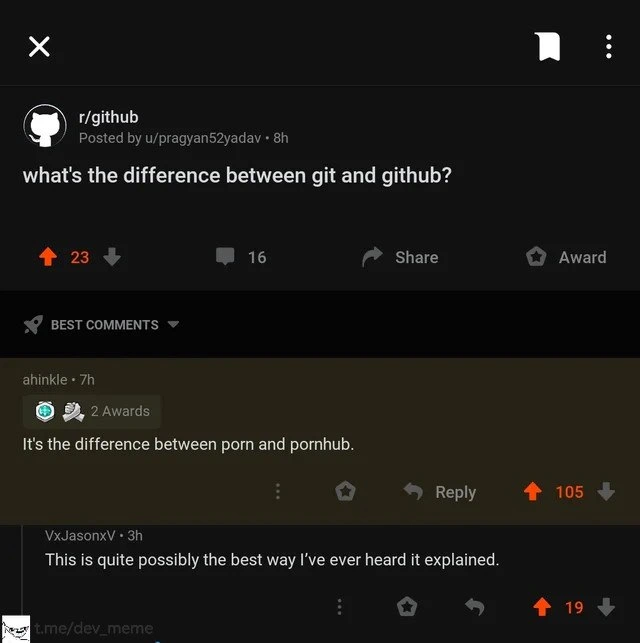
In a dark-themed Reddit thread on r/github, a wide-eyed newcomer asks the age-old question: “what’s the difference between git and github?” Seasoned developers have seen this git_vs_github_confusion countless times – it’s practically an inside joke in dev circles. But this time, Reddit delivered a gem. The top answer didn’t rattle off a dry definition; it dropped a hilariously NSFW analogy that cut straight to the point:
Best comment: “It’s the difference between porn and PornHub.”
That one-liner landed with 105 upvotes and a shower of awards, meaning the community found it both uproariously accurate and immensely relatable. Why is this analogy so spot-on? Let’s break it down for those in on the joke:
Git is a version control tool – a distributed system that lives on your machine, tracking every change you make to your code. It’s the content, the raw material, the “porn” in this cheeky comparison. You create commits (snapshots of your code) locally; you can branch, merge, revert – all on your own computer, even offline. Git doesn’t need an internet connection or a central server to do its job. In fact, Git was built to be decentralized – every developer’s computer is like a complete mini-repository of the project.
GitHub, on the other hand, is an online hosting service – essentially a cloud-based hub where Git repositories live so that people can easily share and collaborate. It’s the platform, the distribution channel, the “PornHub” of the analogy. GitHub takes all those Git-managed codebases and puts them in one place on the internet, complete with a friendly web UI and social features (stars, forks, pull requests, issue tracking – you name it). It’s a centralized space for a decentralized tool, a DevCommunity epicenter where developers showcase and swap code.
By equating Git to porn (the content) and GitHub to PornHub (the popular site hosting tons of that content), the commenter conveyed an immediate understanding: one is the thing itself, the other is a hub for many of those things. It’s a bold adult-content reference, sure, but it’s also hilariously clear. Everyone instinctively knows porn exists independently of any single website – you don’t “need” PornHub to have porn, it’s just a very popular place to find it. In the same way, you don’t need GitHub to use Git – GitHub is just the most popular place to host Git repositories. The analogy is a bit spicy, yet it lands perfectly because it contrasts a tool vs. a platform in terms anyone (not just coders) can grasp. No wonder another user replied, “This is quite possibly the best way I’ve ever heard it explained.” – the analogy smashed the confusion with a dash of shock value and a lot of truth.
This kind of VersionControlHumor resonates with experienced devs because we’ve all met someone who conflates Git with GitHub. It’s a common newbie mix-up: after all, many beginners first encounter Git through GitHub (perhaps installing Git because a tutorial said “push your code to GitHub”). The names are similar, which only adds to the muddle. Seasoned devs might chuckle (or facepalm) at the question “What’s the difference?” because to them it’s like asking the difference between software and a website – a category error. But instead of rolling eyes, the Redditor “ahinkle” answered with a perfect blend of education and humor. It’s a lesson wrapped in a laugh. The answer doesn’t just tell you the difference, it shows you in a memorable way. RelatableHumor like this has a way of sticking: once you’ve heard the “porn vs PornHub” analogy, you’re unlikely to ever mix up Git and GitHub again (you might also suppress a smirk every time you explain GitHub to a newcomer).
From an experienced perspective, this meme highlights how dev communities often handle fundamental questions. Sure, we could reply with textbook precision: “Git is a distributed version control system for tracking changes in source code, while GitHub is a web-based hosting service for Git repositories.” – accurate, but snooze-worthy. Instead, someone went for a punchline that nails it in one go. It’s the kind of candid, slightly irreverent answer you only get in forums like Reddit, where DevCommunity culture values clever analogies. Veteran developers love this stuff because it transforms a banal FAQ into an inside joke we can all share. We laugh not at the newbie, but at how perfectly the confusion was cleared up. In one stroke, the analogy teaches the concept and bonds the community – even if it’s with a wink and a nod to some adult content. After all, the fastest way to explain a tech concept might just be comparing it to something outrageously non-tech. And if that means venturing into Rated-R territory for the sake of clarity, the upvotes show that the community is here for it. Whatever helps the newbies finally git it, right? 😄
Description
A screenshot of a Reddit post from the r/github subreddit. The post, submitted by u/pragyan52yadav, asks the fundamental question, 'what's the difference between git and github?'. The top comment, by user ahinkle, provides a succinct and widely praised analogy: 'It's the difference between porn and pornhub.' Another user, VxJasonxV, replies, 'This is quite possibly the best way I've ever heard it explained.' The humor lies in the analogy's shocking accuracy: Git is the underlying technology/content (like porn), while GitHub is a platform for hosting and sharing that content (like Pornhub). It's a perfect, if NSFW, explanation that instantly clicks with developers

Comments
7Comment deleted
Git is a distributed version control system for tracking changes in source code. GitHub is where you go to watch other people's... merges
Git is the dirty secret you can still erase with `git rebase -i`; GitHub is the moment 400 forks prove you really should’ve run BFG before hitting “push.”
After 20 years in tech, I've finally found the perfect analogy to explain to executives why we can't just "move everything to GitHub" when the Jenkins server goes down
The analogy is technically sound: Git is the distributed version control system (the content/protocol), while GitHub is merely one of many hosting platforms (the delivery mechanism). Just as the underlying technology exists independently of any particular platform, Git predates GitHub by three years and works perfectly fine with GitLab, Bitbucket, or even a bare repository on your own server. The real joke here is that after 15+ years, we're still explaining this distinction - perhaps because GitHub's marketing has been so effective that junior developers think 'git push' is somehow sending code directly to Microsoft's servers rather than using Git's protocol to sync with a remote repository that happens to be hosted there
Git lets you rewrite history; GitHub turns it into governance with PRs, branch protections, and CI bots so your new timeline is audited
Git is the distributed Merkle DAG; GitHub is the human coordination layer that quietly re-centralizes it with branch protection and emojis
Git: your private DVCS stash. GitHub: the public hub where forks steal the show like viral clips