The Git Branch Massacre and Subsequent Rewind
Why is this VersionControl meme funny?
Level 1: Magic Undo Button
Imagine you’re drawing a big colorful picture, and suddenly you accidentally spill ink all over it. Oh no! The picture is ruined! 😢 But wait – you have a special remote control that can rewind time to just before you knocked over the ink. You press the rewind button, and zip! ⏪ everything goes back to the way it was, as if the mistake never happened. Your picture is perfect again, and no one can tell you made a mess. You feel relieved and maybe a little surprised that you got away with it.
That’s exactly the feeling this meme jokes about for computer programmers. In the meme, a programmer did something really bad to their project (imagine they broke a game or a website so it stopped working – like breaking a favorite toy). They’re using a silly, dramatic way to say “Yeah, I totally wrecked it.” They say, “I have massacred my boy,” which is like saying “I completely destroyed something I care about.” It sounds like a line from a movie where a character is super sad about something precious being ruined. It’s over-the-top on purpose, to make it funny how upset they are.
But then comes the happy part: “It’s rewind time.” 🎉 That means the programmer is going to undo the mistake using their special tools. Programmers have a tool (called Git) that’s kind of like an undo button for code. When they say “rewind time,” they mean they’re going to make the code go back to an earlier state, from before it was broken. It’s like time-travel for the project! So the meme is basically someone saying: “Yes, I messed up a lot… but guess what? I can rewind and fix it!”
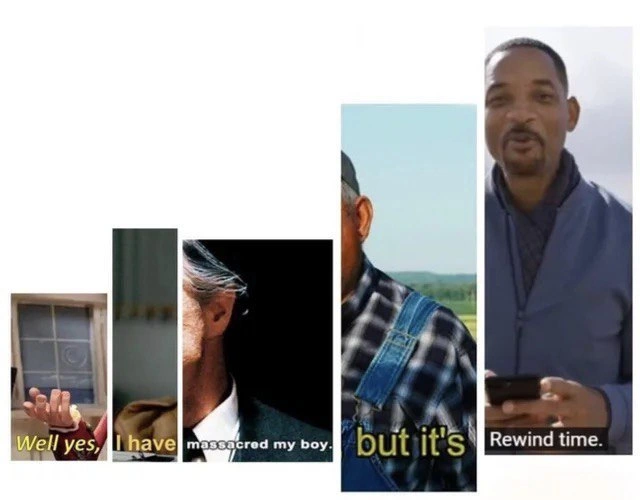
The pictures in the meme show this story like a comic: first a little “Well yes,” (admitting the mistake), then “I have… massacred my boy” (saying the tragedy), then “but it’s rewind time” (announcing the fix). The last picture is a man happily saying it’s rewind time – he represents the ability to undo the error and go back to normal. The bars getting taller each time make it feel like the story is building up to that big rewind moment.
So, in super simple terms: the meme is funny because it’s about making a huge oopsie 😳 and then using a magic time machine to fix the oopsie. It’s as if a kid broke their mom’s favorite vase and then used a time machine to go back a minute before it broke. The kid would be like, “Well yes, I did break it... but watch this – rewind time!” and poof, the vase is unbroken and mom never knew. For a programmer, breaking “prod” (the live website or app) is like breaking something super important. But with their “magic undo button” (version control software), they can fix it before anyone (hopefully) notices. The meme makes us laugh because we all wish we had a rewind button in real life for our big mistakes!
Level 2: Ctrl-Z for Code
This meme is joking about how developers fix big mistakes by effectively hitting an “undo” button in their code repository. Let’s break down the pieces and technical terms in a beginner-friendly way:
Git – Git is a popular version control tool. Think of it as a system that keeps snapshots of your code at different points in time. Every time you commit (save a snapshot in Git), you create a record in the project’s timeline. If something goes wrong later, you can go back to an earlier snapshot. It’s like a time machine or a magic undo (Ctrl+Z) feature for your entire codebase. This is incredibly useful when debugging or fixing bugs, because you can compare what changed or even roll back changes.
Prod – Short for “production,” this means the live environment where the application or website is running for real users. “Breaking prod” means a change you made has caused a failure or serious problem in the live system. It’s every developer’s nightmare because real customers or critical processes are affected. Imagine updating a recipe in a cookbook that’s already printed and on people’s shelves – if there’s a mistake, they’re going to notice! Breaking prod is like that: you deployed a bad change that everyone can see or feel.
“When you screw up the branch you’re working on so you pull from dev and start all over again.” – This caption is describing a very common scenario: You messed up your current work so badly that the easiest fix is to scrap it and start fresh from a known good state. Let’s decode it:
- A branch in Git is like a separate line of development, a series of commits. For example,
master(often now calledmain) is usually the primary branch that eventually goes to production.devmight be a development branch where new code is integrated and tested before going to master. You might also have your own feature branch while coding. - “screw up the branch” means the commits on that branch introduced problems or got so tangled that continuing would be painful.
- “pull from dev” means you fetch the latest code from the
devbranch (essentially getting a clean, working version of the project). - “start all over again” means you abandon your messed-up work and continue from that clean version, re-applying your changes more carefully this time. This often happens if merging or rebasing went wrong, or if your code changes were too messed up to salvage. It’s a fresh start.
Now, about the vertical bar-chart composed of five columns: each column is a slice of a different meme image with text. They are arranged left-to-right, each a bit taller than the previous, like steps or an increasing bar graph. This looks like a commit timeline – an initial commit, then another, then a bigger one, culminating in the tallest bar. In Git, you might visualize a series of commits as points on a timeline. Here, the timeline is shown as bars growing taller, which could imply the significance or impact is growing. The final (tallest) bar has the punchline text “Rewind time,” suggesting the biggest action is the last one: the undo or fix.
Let’s identify the images and captions in each bar, as they each carry meaning:
- “Well yes,” – This is likely from a meme template (the specific origin isn’t super important to understanding the joke, but it sets a tone). It shows someone with a hand raised, saying “Well yes,” as if admitting to something. This is the developer admitting, “Yes, I did break something.” Often memes with “Well yes” are used to agree reluctantly. It’s the set up.
- “I have” – Another piece from a meme or movie, showing just a part of a hooded man. The text “I have” continues the sentence. Not much technical here – it’s just stitching the sentence together. We can guess the phrase is heading towards a confession.
- “massacred my boy.” – This is a dramatic line. It comes from The Godfather film, where a character is mourning his son: “Look how they massacred my boy.” People on the internet use this line jokingly to mean “something I love has been ruined.” Here, “my boy” could stand for the code or the project. The developer is basically saying, “I’ve completely ruined my precious project.” The image behind this text is Marlon Brando as Don Vito Corleone, a famous scene of despair. So this part of the meme conveys a huge, tragic mess-up – the code is dead on the floor, so to speak.
- “but it’s” – This snippet is from a wholesome meme of a farmer in overalls in his field. The original meme’s text is “It ain’t much, but it’s honest work.” Here we only see “but it’s”. This bridges the dramatic confession to the solution. It’s like saying “Yes, I messed up, but it’s…” hinting that there’s a justification or next step. The farmer image adds a bit of humor because it’s an image associated with humble, earnest effort – and here our developer is humbly trying to fix things.
- “Rewind time.” – The final and tallest bar shows actor Will Smith smiling at his phone, from a famous internet meme (the YouTube Rewind 2018 video where he says “Ah, that’s hot, it’s rewind time!”). In our context, “Rewind time” is exactly what the developer is about to do with Git. It means using version control to go back to a previous good state of the code. It’s the solution punchline. The tall height of this bar implies this is the big finale – the move that fixes the problem.
So if you read all the captions together in order: “Well yes, I have massacred my boy, but it’s Rewind time.” It’s a humorous way to say: “Yes, I totally broke my project, but don’t worry, I can roll it back to how it was before.” The phrasing is intentionally absurd, mixing a serious lament with a casual fix. That’s the joke – treating a catastrophic bug as something you can nonchalantly undo.
Technically, how does one “rewind” in Git? A newcomer might not know the exact commands, but some methods include:
- Fetching an earlier commit or branch (like the caption says, pulling from the
devbranch, which presumably doesn’t have the bad changes). - Using
git resetto move the branch pointer back to before the bad commit (in other words, throw away the latest commits). - Or doing a fresh clone/checkout of the stable branch and copying your changes carefully.
The caption suggests the person messed up their current branch so bad that the simplest path is to discard it and start over from dev (which presumably is a stable integration branch). This is actually a common rookie experience: you tangle your code or merge incorrectly, and a senior dev might advise, “Save whatever you need, then just pull the latest clean code and apply your changes again cleanly.” It’s a bit like if you’re editing a document and you make a total mess of the formatting – sometimes it’s easier to grab the last good version and re-do the recent edits rather than untangle the mess.
VersionControlHumor comes from recognizing these situations. Everyone learns Git’s power usually right after their first disaster. For example, a junior dev might commit and push something embarrassing (like a bug, or even secret keys by accident), panic, and then learn about git revert or git reset. That moment feels like discovering a superpower: “You mean I can just undo that commit as if it never happened? Amazing!” But they also learn there are right and wrong ways to do it. For instance, if the bad commit was already pushed to a shared repository, rewriting history (git push --force) can confuse others who pulled it. Teams often prefer a revert commit in that case, because it fixes the issue without rewriting history that others already have.
The meme exaggerates it to make us laugh. We have massacred (a strong word for “broke badly”) and then calmly, rewind time. It resonates with any developer who has accidentally taken down a site or crashed an app—your heart sinks (“I massacred my boy!” 😭), then you remember version control can save you (“It’s okay, rewind time!” 😁). It’s essentially gallows humor about DeveloperMistakes: poking fun at ourselves for messing up, and celebrating the tools that help us recover.
For a junior developer or someone new to Git, the key takeaways and definitions here are:
- Branch: a series of commits. You can have multiple branches for different work. If one branch gets messed up, you can switch to another or recreate it from a stable point.
- Pull from dev: update your local code to match the remote
devbranch. “dev” is likely a branch where the latest development code lives. Pulling means grabbing the latest commits from that branch. - Start all over again: throw away the broken work and restart from the good code you just pulled. This might involve deleting the messed up branch or resetting it to
dev’s state. - Rewind time (in Git terms): using Git commands to go back to an earlier version of the code. This could be through a reset, revert, or just checking out an older commit.
The visual joke with the bar chart is also interesting to explain: It’s styled like a meme bar chart, which is a trend where meme creators line up images of increasing size or intensity to tell a story or make a comparison. Each bar’s height can signify importance or level. Here, as the bars get taller, the situation escalates. By the final bar (Will Smith saying “Rewind time”), the bar is tallest – meaning the most extreme action (time reversal) is being taken. It’s a fun way to use a chart-like format to communicate a sequence: minor admission, confession of big screw-up, then dramatic fix.
This meme falls under VersionControl humor because only people who use tools like Git get the “rewind” reference fully. But even without deep Git knowledge, one can understand: He messed up (“massacred my boy”), but he’s going to rewind time to undo it. It’s like watching someone break something expensive and then use a time machine to go back a few minutes. The absurdity makes it funny. And as developers, we chuckle because version control is the closest thing we have to an actual time machine for our work – and boy, do we rely on it!
Level 3: Commit Crime, Rewind Time
This meme mashes up pop culture quotes to dramatize a Git disaster and its miraculous undo. The five ascending image columns look like a commit history graph climbing toward the inevitable “undo” moment. Each fragment is from a different meme or movie scene, stitched together into a darkly funny confession: “Well yes, I have massacred my boy, but it’s rewind time.” In a developer context, “massacred my boy” is an over-the-top way to say “I completely ruined my code” – like deploying a bug that breaks production. Every senior engineer has felt that gut punch: one moment your app is running, the next moment “look how they massacred my boy branch.” 😅
The humor hits home because Git truly is a time machine for code. The phrase “it’s rewind time” (famous from a Will Smith internet meme) captures the almost sci-fi power Git gives us: we can rewind the project’s timeline to before the mistake. In Git, commits form a timeline (a directed acyclic graph of snapshots). When we screw up badly – say we merge a bad commit into master (the main branch holding production code) – we have a few “time-travel” options:
- We might create a new commit that reverts the bad changes, effectively undoing the massacre while keeping a record of it. This is like acknowledging “Yes, that happened, but here’s the fix.”
- Or we might rewrite history using
git resetorgit rebase -i(interactive rebase) to pretend the bad commit never happened at all. This is the full “Rewind time” approach – erasing the crime from the timeline. It often involves agit push --force(force-push) to replace the remote history with our edited local history.
Experienced devs know that rewriting a shared history is risky. It’s the “Well yes, I broke everything...” moment followed by “...but I’ll fix it and hope nobody pulls the broken commit in the meantime.” The meme’s escalating bar chart visual cleverly suggests an increasing severity (each bar taller than the last) leading up to the tallest bar: the grand fix. It’s like each bar is a commit, getting worse and worse, until the final tallest bar where the developer uses Git’s history rewrite to save the day.
This scenario is painfully familiar in VersionControl and Debugging_Troubleshooting lore. We joke about “time travel debugging” because with tools like Git, you can jump to an old good state, or examine historical code to find when things went wrong (e.g., using git bisect to pinpoint the commit that introduced a bug). Here, though, our developer knows exactly what went wrong – they introduced the bug – so the remedy is straightforward: roll back or reset to a safe point. The meme’s dialogue is basically the dev admitting guilt (“I have indeed murdered my codebase, oops”) and then proclaiming a fix (“but behold, Git shall restore it!”). It’s a savvy mix of dramatic remorse and confident solution, which is exactly the rollercoaster of emotions you get when you blow up production and then realize you can recover.
Why is this so relatable? In real life, deploying a bad commit can feel like you “massacred” something dear – maybe you crashed the site or wiped some data. That line with Don Corleone from The Godfather (“Look how they massacred my boy”) is a meme for heart-wrenching loss. Developers use it ironically to lament broken code or a beloved feature that got axed. Pairing that with “It’s rewind time” (a lighthearted meme from YouTube Rewind 2018) creates a jarring but funny contrast – extreme regret meets whimsical optimism. It’s the classic dev coping mechanism: dark humor. Yes, we destroyed things (massacred my boy = killed my app), but with git pull or git rebase we can start fresh as if it never happened – time to rewind!
The bar-chart style layout itself is an inside joke. It visually implies a commit log or timeline. In Git GUI tools, you often see a graph of commits over time, though not literally bars like this. By using ascending bars, the meme artist suggests progress toward the catastrophic commit, with the tallest bar being the big “rewind” commit. In other words, each bar could represent successive commits: things were OK (small bar), then maybe a warning sign commit (next bar taller), then the disastrous commit (middle bar with “massacred my boy”), and finally the heroic fix (tallest bar, “Rewind time”). It’s a clever visual metaphor for a sequence of changes, ending in an emergency fix.
Let’s talk Git specifics for a moment. Git is a distributed version control system, meaning every developer’s copy of the repo has the full history. When you commit, you create a new snapshot of your files, identified by a hash (like abc1234). The branch (e.g., master or dev) just points to the latest commit in that line. If you make a terrible commit that breaks everything (imagine committing rm -rf / by mistake in your code 😨), that commit is now part of history. To “rewind time,” you have a few approaches:
Soft rewind (undo changes but keep history): e.g. using
git revert <bad_commit_hash>. This makes a new commit that does the inverse of the bad commit. Production is fixed, but the history will still show that the bad commit happened (followed by a “Revert” commit). It’s like saying, “Well yes, I did massacre it, but I’ve bandaged it up now.” Everyone can see both the mistake and the fix.Hard rewrite (alter history as if it never happened): e.g.
git reset --hard HEAD~1(move HEAD pointer one step back, deleting the latest commit from current branch) followed by agit push --force. This actually removes the bad commit from the branch history. It’s like going back in time and stopping yourself before you made the mistake. Only you and Git’s reflog remember that commit now (reflog is Git’s private diary of moves). To the rest of the team, it’s as if you never screwed up – unless, of course, someone already pulled the bad commit or you logged it somewhere. This is “rewind time” in the purest sense, but it comes with the danger of messing up collaborators’ copies if not everyone is on board. It’s generally only safe on a private branch or very carefully on a shared branch (with coordination).
The meme specifically says “When you break prod but Git says, ‘Well yes… it’s rewind time’.” “Break prod” means you deployed something to production that caused a failure. That’s the nightmare of any on-call engineer. But Git is portrayed as a helpful genie here, saying “It’s rewind time!” like it’s ready to magically fix it. In reality, senior engineers have a healthy respect for Git’s power: it can save your bacon, but you must use it correctly. For instance, force-pushing a rewind to the dev or master branch will fix production only if you also redeploy that old code state – and you better communicate with your team so nobody accidentally reintroduces the bad commit. It’s a mix of Bugs and VersionControlHumor: the bug (massacre) is devastating, but the version control trick (rewind) is the punchline.
The pop culture mashup amplifies the humor because each piece is a meme on its own:
- “Well yes,” likely references the meme “Well yes, but actually no”, implying an awkward admission. Perfect start for “Did you just break everything?” – “Well yes…” 🙄
- “I have massacred my boy,” is a twist on “Look how they massacred my boy” from The Godfather, used here to mean “I utterly destroyed something I cherish (my code or my server)”. The formal, dramatic tone makes the coding screw-up sound like an epic tragedy.
- “but it’s” comes from the wholesome farmer meme (“It ain’t much, but it’s honest work.”). Here it’s just a connector, but using a farmer image saying “but it’s” adds a bit of irony – as if to say, no excuses, but it’s fix time.
- “Rewind time.” is Will Smith’s enthusiastic line from the infamous YouTube Rewind 2018 video. In meme culture, this line is used to humorously propose turning back the clock. Having Will Smith smiling with a phone saying this as the final panel is like Git cheerfully offering the ultimate solution.
All together, the absurd sentence encapsulates the scenario: Yes, I did something terrible… but I can undo it. Seasoned developers laugh (and wince) because we’ve all been there. We joke that Git is so powerful it’s like “programmer’s CTRL+Z” or a “get out of jail free card”. Of course, in practice, not every production problem is solved by a simple rewind – databases, user data, and side effects can’t always be undone so easily. But for code and configuration, having version control means we can recover from many self-inflicted wounds. This meme exaggerates that dynamic. It’s basically a modern dev’s “confession and redemption” story compressed into one bizarre bar-chart quote.
So, from a senior perspective, the meme humorously acknowledges a hard truth: we all break things, and when we do, we rely on our tools (like Git) to bail us out. The combination of dramatic regret and casual solution is funny because it’s true – no matter how experienced you are, mistakes happen. But if you’ve been smart enough to use version control (you did commit your work, right? 😉), then you’ve got a time machine at your fingertips. Well yes, I messed up prod; but with Git’s help, I can rewind this whole fiasco. History will (hopefully) never know what truly happened – except maybe in the commit logs that we force-pushed away, now hidden like skeletons in Git’s closet.
Description
A composite meme made of five vertically sliced panels from different popular culture sources, which together form a single, humorous sentence. The panels read, from left to right: 'Well yes,' (from Aardman Animations), 'I have' (unclear source), 'massacred my boy.' (from the film 'There Will Be Blood'), 'but it's' (from the 'It Ain't Much, but It's Honest Work' meme), and 'Rewind time.' (from Will Smith in YouTube Rewind). The full sentence is 'Well yes, I have massacred my boy. but it's Rewind time.' This meme perfectly captures a deeply relatable scenario for software developers using version control. 'Massacring my boy' refers to hopelessly messing up a local feature branch with bad commits, broken logic, or unsolvable merge conflicts. Instead of trying to salvage the mess, the developer pragmatically decides to invoke 'Rewind time' - deleting the broken branch and starting fresh from the main development branch. It’s a humorous admission of defeat and the ultimate 'turn it off and on again' solution for version control woes
Comments
8Comment deleted
Some developers use git rebase to create a clean, linear history. I use 'git branch -D' followed by a thousand-yard stare. It's called 'eventual consistency' with the main branch
Nothing like seeing Grafana draw a staircase of 500s to remind you that the real killer feature of Git is reflog - a one-command witness-protection program for every commit you just massacred
The only time 'It's rewind time' hits harder than YouTube's dislike ratio is when you realize your force push to main just overwrote three weeks of the team's work and the backup strategy was 'someone probably has it locally'
Every senior engineer knows this cycle intimately: you architect a beautiful solution, convince yourself you've achieved code nirvana, then production teaches you humility at 3 AM. The 'rewind time' moment usually comes right after you've confidently merged to main, dismissed that nagging feeling about edge cases, and realized your 'elegant abstraction' just created a distributed monolith. It's not imposter syndrome if you actually need to revert the last six commits
When your KPI bars start forming full sentences, you didn’t build a dashboard - you shipped a CROSS JOIN with schema drift and a very persuasive narrative
Nuked six months of commits with git clean -fdx? Reflog to the rescue - rewind time for architects who code
Refactor torched prod, so we hit rewind - until the migration with DROP COLUMN reminds us the only rollback left is a 2 a.m. roll-forward fix
This is pretty good😂 Comment deleted