A Modest Proposal for Spicing Up Git Commit History
Why is this VersionControl meme funny?
Level 1: Silly Signature Surprise
Imagine you’re writing a very important note or doing a homework assignment, and at the end you randomly add a line like, “Sent from my phone.” It doesn’t really belong there, right? It would make your teacher or friends pause and maybe giggle, because normally you’d only see “Sent from my phone” in a casual text or email to explain you’re on the go. This meme is just like that, but for computer programmers. When programmers save their work, they leave a short message about what they did. The joke here is telling them to always add “Sent from my iPhone” at the end of those save-notes. It’s a silly signature that would definitely surprise people who read it later. The reason it’s funny is because it’s mixing something very casual (a message you’d send from your phone) into something that’s usually a bit formal (notes about code changes). It’s like drawing a little smiley face on a serious document – it makes people laugh because it’s unexpected and playful.
Level 2: Commit Message Mischief
Git is a tool that developers use every day to keep track of changes in their code. When using Git, you save snapshots of your work called commits. Each commit comes with a commit message – basically a short text explaining what you changed or fixed in that batch of work. It’s like leaving a note in a project journal: “I did X, Y, and Z in this update.” Usually, commit messages are somewhat serious and to the point, because they help you and others understand the project history later on. For example, a normal commit message might say something like “Fix login button not responding on mobile” or “Add unit tests for user model”. This helps the team know what that commit was about without digging into the code diff immediately.
Now, this meme suggests a bit of mischief: it says you should start signing all your commit messages with the phrase “Sent from my iPhone.” That phrase might sound familiar even if you’re new to coding. It’s the default email signature many iPhone users have, appearing at the bottom of emails sent from the Apple Mail app on an iPhone. So if someone emails you from their phone, you might see “Sent from my iPhone” at the bottom, which casually lets you know “hey, I typed this on my phone, pardon any typos.” It became a well-known snippet of text – so much that it’s almost a cultural reference. Some people leave it on proudly or humorously, while others replace or remove it to appear more professional.
In the world of coding and Git commits, though, you never see “Sent from my iPhone” in a commit message… or at least you’re not supposed to! Commit messages are about code changes, not about what device you used to write them. That’s why this idea immediately comes off as a joke. It’s like pasting a casual text message signature into a formal change record. The meme is basically saying: wouldn’t it be funny (and a bit absurd) if every time you saved your code changes, you ended the message with this totally irrelevant line? It’s poking fun at developer habits and how sometimes we inject humor into our work. This is a form of commit_message_trolling – intentionally adding something to the commit that will surprise or amuse anyone reading it later.
Let’s break down how that would look. Suppose you just fixed a bug in the app and you’re making a commit. Normally you might do:
git commit -m "Fix null pointer exception in UserService"
The -m flag lets you write the commit message in quotes right in the command. The result is that your commit message (visible in history) is “Fix null pointer exception in UserService.” Simple and clear. If you followed the meme’s advice, you’d do something like:
git commit -m "Fix null pointer exception in UserService\n\nSent from my iPhone"
Here, the \n\n is indicating a new line (imagine pressing Enter twice). So the commit message that gets recorded would be:
Fix null pointer exception in UserService
Sent from my iPhone
Now any developer on your team, or even yourself in a few weeks, might run git log or look at the repository history and see that commit. It will show the author, date, and message. And that message will have an extra little surprise line: “Sent from my iPhone.”
At first, someone might think, “Wait, did this commit come from a phone or something?” There are apps and ways to interact with Git on a phone, but it’s pretty rare for serious development. The phrase is really there as a prank – a little signature that doesn’t belong. It’s similar to how some people sign off letters or forum posts with a funny quote or how they might use an email signature to convey personality. In a professional version control setting, though, adding a personal signature line is unusual. It’s not harmful at all (it won’t break the code or Git), but it stands out like a joke in the meeting notes.
Newer developers might wonder, “Is this a thing? Are we supposed to sign commits like emails?” The answer is generally no! In fact, the word “sign” in Git usually has a totally different meaning: it means digitally sign using a cryptographic key to verify you are who you claim (for security). That’s a pretty advanced topic, and it’s done with commands like git commit -S and some GPG key setup. But importantly, that kind of signing doesn’t involve typing a phrase; it’s all math under the hood, and it adds a signature block (a blob of text) to the commit’s metadata, not to the human-readable message. What this meme suggests is purely for laughs: manually tacking on “Sent from my iPhone” as part of the commit’s text, almost like an inside joke every time you commit code.
In terms of DeveloperExperience_DX, it’s highlighting that being a developer isn’t just dry technical work – there’s a culture and humor shared among programmers. On platforms like Twitter, developers often post relatable jokes about things like unnecessary meetings, forgetful coding moments, or version control mishaps. A tweet_screenshot like this one captures a quick, punchy gag that many coders will get instantly. If you’ve ever been in a team where someone pushed a silly commit (maybe with a message like “oops fix typo” or “temp commit, please ignore”), you know the mix of annoyance and amusement it can cause. This tweet is encouraging a flavor of that behavior, purely to “spice up” life – meaning to make the day-to-day routine a bit more interesting.
For a junior dev, it’s also a peek into the lighter side of dev communities (DevCommunities). We take our work seriously, but we also bond over these nerdy jokes. In many open-source projects or team settings, you’ll find Easter eggs: maybe a test file named after a Star Wars planet or a variable with a funny name. Those are akin to this idea of a mail_signature_prank in commit messages – it’s not functional, it’s cultural. It tells other devs, “hey, I have a sense of humor.” Of course, moderation is key. If every commit message is a joke and never says what changed, that can become a problem for collaboration. But a well-placed humorous commit among many serious ones is usually appreciated as a moment of levity.
One could actually set this up if they were determined. Git has features like commit templates and hooks that could automatically append a standard line to each commit message. For instance, a commit template is a text file whose content is pre-loaded into your commit message editor every time you make a commit. A mischievous developer might configure their repo with a template that contains “Sent from my iPhone” at the bottom, so they don’t even have to type it each time. It would just appear by default (and they’d fill in the top part with the actual change description). That’s how you could practically “start signing all git commits” with a given phrase. It’s not a common use of the feature – normally templates are used for things like reminding authors to fill out a detailed message or include issue numbers – but it shows the flexibility of Git. This is a perfect example of commit_metadata_fun: playing with the metadata (in this case, the commit message text) to inject a little fun into an otherwise rigid workflow.
To sum up this level: The meme is telling us that something very informal from mobile/email culture (the “Sent from my iPhone” signature) can be humorously transplanted into developer culture (Git commit messages) to lighten the mood. It’s funny because it doesn’t belong there, yet it’s harmless. If you did this on your next project, you’d probably get a mix of eye-rolls and laughs from your teammates. It’s a reminder that even with serious tools like Git, developers love to share a laugh and not take everything too seriously all the time.
Level 3: Sign-Off Shenanigans
At first glance, this meme is a witty mash-up of version control etiquette and the classic mobile email signature. In Git – the de facto distributed version control system – developers "sign" their work with commit messages detailing what changed. Typically, signing a commit refers to cryptographically signing it (using GPG keys for authenticity) or adding an official Signed-off-by line to certify contributions. But here, the tweet jokes about a completely different kind of signature: appending the tongue-in-cheek phrase "Sent from my iPhone" to every commit message. It’s as if each code change were a casual email shot off from your phone. This idea is equal parts absurd and relatable in a developer humor sense.
Why is this funny to seasoned devs? For one, it satirizes our reverence for clean commit history. Teams often enforce strict commit message guidelines (think Conventional Commits or detailed Changelog entries) – yet we’ve all seen quirky or downright useless commit messages slip in. By suggesting everyone literally sign their commits with a mobile email tagline, it highlights the contrast between ideal practices and what sometimes actually happens. It's a gentle jab at the sanctity of commit logs: imagine browsing git log to debug an issue and encountering dozens of commits ending with "Sent from my iPhone." You’d probably do a double-take and chuckle, questioning if the author was literally coding on an iPhone or just trolling. This is commit_message_trolling at its finest – injecting a bit of harmless chaos into an otherwise serious history of code changes.
There’s also a playful technical pun here. In Git, "signing" a commit usually means using git commit -S to attach a cryptographic signature verifying the author’s identity. Those signatures appear as a block of ASCII armor text in the commit metadata. But the tweet twists that notion: the only “signature” is the jokey sent_from_my_iphone_signature line in the commit message itself. No actual cryptography, just pure comedic payload. It conflates a formal security practice with a trivial email quirk. This contrast tickles developers who know both worlds. It’s like someone suggesting to use RSA encryption and then handing you a papyrus scroll sealed with a smiley-face sticker – a silly mismatch of seriousness.
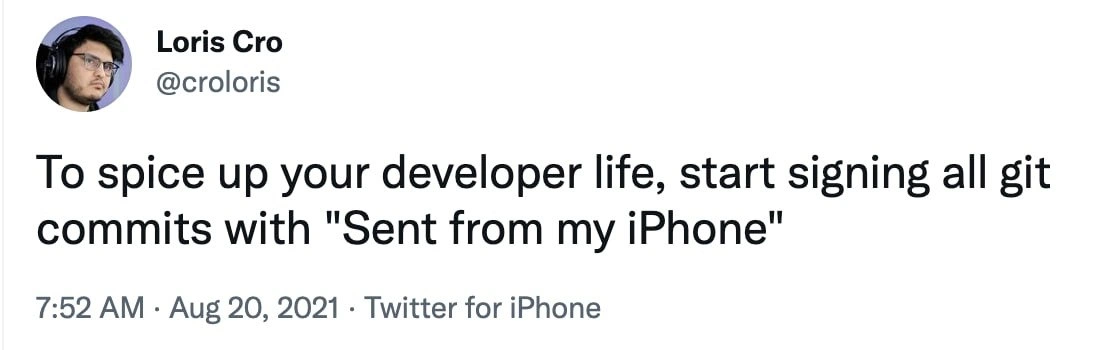
The context of the meme being a tweet_screenshot adds another layer. The tweet by Loris Cro reads: “To spice up your developer life, start signing all git commits with 'Sent from my iPhone'”. Notably, the Twitter UI shows it was posted via Twitter for iPhone (the meta line says so). That detail is comedic gold for observant devs: the author literally sent the suggestion from an iPhone. It’s a meta wink – he’s doing on Twitter what he recommends for Git commits. The developer community on Twitter often shares these inside jokes, and seeing Twitter for iPhone right under the tweet text is like a punchline reinforcement. It blurs the line between the joke and reality, prompting senior engineers to smirk, “Well played, sir.”
From an experienced developer perspective, this meme also touches on DeveloperExperience_DX and team culture. By “spicing up your developer life,” it implies that routine coding work and commit writing can get dull or overly formal. Many of us have horror stories of nitpicky code reviews where even commit messages get scrutinized to death. Dropping a casual “Sent from my iPhone” is a cheeky catharsis – a way to not take ourselves too seriously. It’s comparable to those humorous comments we sometimes bury in code or the funny Git blame easter eggs (like naming your functions after song lyrics just so blame annotations form a poem). Everyone who’s endured corporate commit policies or painstakingly formatted every message might secretly relish the thought of this low-stakes rebellion. After all, it's a prank that doesn’t break anything technically – the code remains the same, but the commit_metadata_fun factor goes up dramatically.
Let’s visualize how such a commit might look in practice. Normally, a well-formed Git commit message might be:
Add user authentication feature
- Implement OAuth2 login flow
- Store tokens securely in session
Signed-off-by: Alice Dev <[email protected]>
But following the pranky advice, you might end up with:
Add user authentication feature
- Implement OAuth2 login flow
- Store tokens securely in session
Sent from my iPhone
The second example replaces the serious certification line with a mail_signature_prank. The content of the change is presumably the same, but any dev reading this in the project history will likely crack a smile. It’s so out-of-place that it humanizes the commit – reminding us there’s a person behind the code, possibly with a goofy sense of humor. On a big open-source project, a maintainer encountering that line might tweet it out for laughs or add it to the hall of fame of funny commit messages (yes, those are a thing). It’s the kind of harmless dev community mischief that becomes lore.
In essence, this meme tickles the DeveloperHumor nerve by subverting expectations. Version control workflows are almost sacred in engineering – we treat commit messages like historical records, and some teams even automate changelogs and releases directly from them. So the suggestion to adorn each commit with a frivolous phrase is absurdly humorous. It’s relatable developer experience too: everyone from a scrappy startup coder to a battle-scarred enterprise developer has felt the grind of committing code daily. Why not have a bit of fun with it? We all recognize the phrase “Sent from my iPhone” – it’s practically a running joke about brief, typo-ridden emails fired off on the go. Seeing it in Git history is funny because it implies the coder might have been half-distracted or on the move, as if committing code was as casual as replying to a text. The truth is, very few developers commit from actual phones (though with cloud IDEs and GitHub mobile apps, it’s not impossible), but that literal scenario isn’t even needed for the joke to land. It’s the idea of inserting a mundane, non-sequitur phone signature into a technical process that makes the scenario irresistibly silly.
DevCommunities love this kind of inside joke because it’s a form of shared rebellion. It doesn’t harm productivity (unless you count slightly confused colleagues), and it bonds developers through humor. If one person on the team started doing this, others might join in or respond with their own witty commit footers (“Sent from my Android”, “Sent from my TI-84 calculator”). Before you know it, your team’s Git history could turn into a mini comedy thread. Of course, there’s an underlying truth: commit messages are important, and filling them with jokes could backfire when someone genuinely needs to understand why a change was made. But as a one-off prank or a spirit-lifter during a dull sprint, this idea is harmless fun. It’s a gentle reminder that even in the serious world of software versioning, there’s room for personality and laughter. After all, if we can have project names like Kubernetes (Greek for “helmsman”) or binary release names like “Disco Dingo”, why not a commit signed from an iPhone? Embracing a bit of silliness can make the slog of debugging and feature-building more enjoyable. And who knows – the next time you git blame and see a line authored by someone apparently on an iPhone, it might just lighten your mood during a stressful bug hunt.
Description
This image is a screenshot of a tweet from user Loris Cro (@croloris). The tweet offers a humorous suggestion for developers: 'To spice up your developer life, start signing all git commits with "Sent from my iPhone"'. The timestamp reveals the tweet itself was sent via 'Twitter for iPhone,' adding a layer of subtle irony. The humor originates from the stark contrast between the professional, often serious, context of a git commit message - a permanent record of code changes - and the casual, unprofessional, and automated signature from a mobile email client. For experienced developers, the joke is multi-layered: it conjures the absurd image of a developer making critical code changes from their phone, it mocks the boilerplate text we see in emails, and it serves as a lighthearted prank to confuse colleagues during code reviews. It's a commentary on developer culture and the small ways to find amusement in the daily routine of software engineering

Comments
15Comment deleted
GPG signing your commits verifies you're a trusted developer. Appending 'Sent from my iPhone' verifies you're a chaotic neutral who merges to main from the grocery store
Add “Sent from my iPhone” to every Signed-off-by line and watch DevSecOps invent a whole mobile-supply-chain threat model while your risky refactor sails straight to prod
Nothing says 'I take code reviews seriously' quite like explaining to your tech lead why your critical production hotfix at 3 AM was apparently authored on a 6-inch touchscreen while presumably holding the device with one hand on public transit
The real power move is configuring your git signature as 'Sent from my iPhone' while actually committing from a ThinkPad running Arch with a tiling window manager - because nothing says 'I'm casually shipping production code from the beach' quite like a 3AM hotfix that clearly required your entire IDE, multiple terminal panes, and at least 32GB of RAM to debug
Git blame just got personal: now every regression traces back to 'iPhone autocorrect' for plausible deniability
Append 'Sent from my iPhone' in prepare-commit-msg and you'll instantly test whether anyone reads history - commitlint panics, DCO shrugs, and Legal opens a ticket about misleading signatures
Added 'Sent from my iPhone' to a commit and our 'require signed commits' gate passed - compliance theater powered by grep
Explain please Comment deleted
twitter moment Comment deleted
Imagine that all your work is done from a smartphone. As an additional bonus — one known for auto correcting everything it doesn’t like. Comment deleted
Use Bluetooth keyboard and mice (not sure if mice is supported on iOS, not tested yet). Some people already abuse VIM for coding.. so they need only terminal emulator, which is ok too. Comment deleted
It autocorrects with external keyboards as well! Comment deleted
Turn it off then Comment deleted
You asked for a joke explanation and got it :P Comment deleted
Imagine its to be ios with no proper file explorer just a cloud bs explorer Comment deleted