When the git history replies with a universal shoulder-shrug commit message
Why is this VersionControl meme funny?
Level 1: Just a Shrug
Imagine you ask your friend why they moved all the furniture in your room, and they just shrug 🤷. They don’t say a word, just “I dunno.” That’s funny in a silly way, but also not very helpful, right? You’re left thinking, “Okay… but why did you do it?”
This meme is the coding equivalent of that. In a coding project, whenever someone makes changes, they’re supposed to leave a little note (a commit message) to say what they did. It’s like leaving a label on a changed puzzle piece. But here, the person just left a shrug emoji instead of a note. They basically said “I have no idea!” about their own change. Everyone who sees it later will chuckle because it’s like the code itself is shrugging its shoulders. It’s funny because it’s so absurd – we expect a helpful explanation, and we get a playful “¯\(ツ)/¯” instead. It captures that feeling when someone doesn’t explain something and just goes, “Oh well!” This little shrug in the code’s history makes us laugh, because we all know the frustration of getting no answer except a shrug.
Level 2: The Shrug Commit
Let’s break down the joke for those newer to Git and coding. In Git (a popular version control system), you save changes to your code with a commit. Each commit has an identifier and a commit message that describes what you changed. Developers use commands like git commit -m "Some message" to add a message. Ideally, that message should be clear and helpful — for example, “Add login functionality with OAuth” or “Fix null pointer exception in UserService”. These messages help you and others understand the history of the project.
Now, the meme shows someone using a commit message that is just ¯\_(ツ)_/¯. This is a text emoji of a person shrugging, commonly used to mean “I don’t know” or “I don’t care”. It’s like the developer is saying, “Changes made… who knows why? shrug.” They literally put a shrug emoticon where an explanation should be! 😅
Why is that funny to developers? Because it’s relatableDevExperience: almost every programmer has seen (or unfortunately written) a commit message that doesn’t explain anything. Examples might be “update”, “stuff”, “bug fixes” or even the dreaded “.” (just a single dot). These give no clue about what the code change was for. It’s considered sloppy because later on, when you use git log to review changes or git blame to find out who changed a specific line of code, such messages are useless. Git blame is a command that shows which commit last modified each line of a file. Developers use it when debugging, to see why a change was made or what commit might have introduced a bug. If git blame points you to a commit with message “¯_(ツ)_/¯”, you learn nothing except that the person at that time didn’t document it. It’s like hitting a dead end.
This meme pokes fun at poor CodeQuality practices. Writing a good commit message is like leaving notes for your future self or teammates: “Here’s what I did and why.” When someone just writes a shrug, it means no useful notes were left. Every junior developer is taught to write clear commit messages, but in the real world, people get lazy or rushed. Maybe the change was complicated or the dev was frustrated, and they couldn’t summarize it — so they just shrugged in text form. It’s funny because we recognize it as a bad habit we sometimes fall into, even though we know better.
The context mentions ambiguous_commit_log and future_git_blame_nightmare. That’s exactly the point: a commit log (history) full of ambiguous messages like this is a nightmare later when you’re trying to figure out changes. It’s “future you” who suffers. Picture coming back to your code a month later, finding a bug, and seeing that the last change to that section has the message “¯\(ツ)/¯”. You’d probably laugh, then groan, and wish Past You had written something more useful! This is why the meme resonates — it’s a little cautionary tale wrapped in humor. Git is super powerful for tracking changes, but it relies on humans to write meaningful messages. When we don’t, we end up with a history that just shrugs at us.
Level 3: 404 Message Not Found
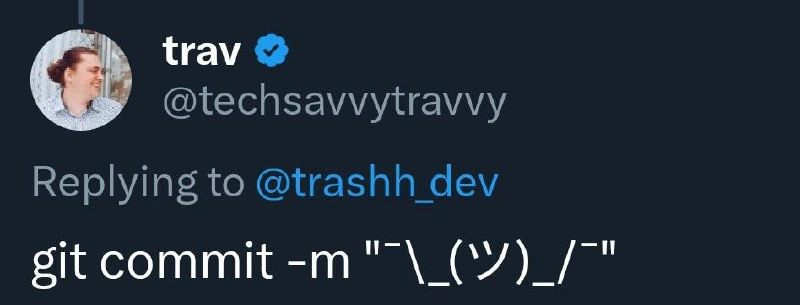
Imagine cracking open your project’s Git history and discovering a commit message that’s basically a digital shoulder shrug. In the meme, a developer literally runs the command:
git commit -m "¯\_(ツ)_/¯"
This ¯\_(ツ)_/¯ text emoticon is the universal sign of “I have no clue” or “whatever, I give up.” For seasoned developers, seeing this in a commit log is equal parts hilarious and horrifying. It’s funny because we’ve all encountered commits with messages so vague or nihilistic that they might as well be empty. But it’s also painfully real: a version control history littered with messages like this is a nightmare for anyone trying to understand code changes later on.
In professional practice, a commit message should explain why a change was made or what it does. It’s part of CodeQuality and good hygiene in VersionControl. But here we have a commit that basically says “¯\(ツ)/¯” – an ASCII shrug. This is the ultimate ambiguous commit log, implying the author either didn’t know what they were doing or couldn’t be bothered to write a real description. It’s the kind of commit that triggers veteran engineers to roll their eyes and mutter “future git blame archaeology is gonna be fun with this one.” 😒
Why is this so relatable? Because under pressure or fatigue, even good developers sometimes push commits with messages like:
git commit -m "fix stuff"git commit -m "temp changes"git commit -m "final final FINAL"git commit -m "yolo commit"
Those are real-world anti-patterns in commit messaging. The meme exaggerates it to pure absurdity with a literal shrug as the message. It satirizes the shared experience of checking git blame on a buggy line only to find the commit message provides zero insight – maybe just this shrug emoji or its moral equivalent (“???” or “no idea”). A senior developer will chuckle because they’ve done those blame archaeology sessions where the commit history is supposed to explain code, but instead it just shrugs back at you. It’s like the code itself is telling you: “Beats me, I was just born this way.”
Technically speaking, a commit is an atomic snapshot of changes in your repository, identified by a hash (like 7ac3d9f). That hash is useless to humans by itself, so we rely on commit messages to carry the meaning. A commit message like ¯\_(ツ)_/¯ carries virtually zero information – it’s a semantic void. In terms of information theory, it’s the lowest entropy message possible: it doesn’t differentiate this change from any other. The code diff might reveal what changed, but without context or reasoning, we’re left guessing why. This often indicates rushed development, lack of process, or a culture that doesn’t value documentation. A cynical veteran immediately recognizes this scenario: technical debt not in the code, but in the commit history. It’s a sign that tracking down bugs in this project will be extra painful.
From an organizational perspective, commit messages like this hint at deeper issues. Perhaps the team has no code review, or no guidelines for commit messages. Maybe it was a Friday deploy (it’s always on Fridays, isn’t it?), and the developer was exhausted and decided a joking shrug was all the effort they could spare. Everyone laughs when seeing it on Twitter, but when it’s your production service and you’re grepping the repo at 3 AM to find why something broke, a “¯\(ツ)/¯” commit will make you want to throw your pager out the window. It’s humor built on collective developer trauma: we laugh to keep from crying about our past VersionControlHumor moments.
In summary, the meme gets a knowing groan from senior devs because it nails a core truth: too often our Git commit history (which should be a carefully written chronicle of the codebase) devolves into an abyss of ambiguous one-liners and resigned shrugs. Today’s quick “whatever” commit is tomorrow’s future_git_blame_nightmare.
Description
Screenshot of a Twitter reply in dark-mode UI. The profile shows a small circular avatar, username “trav” with a blue verification badge, and handle “@techsavvytravvy.” Beneath it, the line “Replying to @trashh_dev” appears in lighter grey. The tweet’s body reads exactly: “git commit -m "¯\_(ツ)_/¯"”. The image humorously captures a developer treating source-control history like a place to record existential resignation instead of meaningful change logs, poking fun at sloppy commit practices that later haunt code reviewers and blame archaeology sessions
Comments
18Comment deleted
Nothing says “I fully understand our branching strategy” like shipping production with a Unicode shrug for traceability
After 15 years in the industry, you realize the real version control isn't managing code history - it's managing the urge to push 'fix: stuff' to production at 4:59 PM on a Friday while your git blame already looks like a crime scene investigation report
When your commit message is a shrug emoji, you're not just documenting code changes - you're creating a time capsule of existential dread for the poor soul who runs `git blame` six months later. It's the developer equivalent of leaving a note that says 'good luck' before going on vacation, except this vacation is permanent and the codebase is now someone else's problem. Future archaeologists will study these commits to understand the exact moment when we collectively gave up on meaningful documentation
Every time someone runs git commit -m '¯\_(ツ)_/¯', your future git bisect gains another iteration and your changelog loses another clue
Every ¯\_(ツ)_/¯ commit converts your audit trail into a philosophy textbook - at scale, git blame just returns existential dread
The regex for ideal commit messages: ^$ - matches this perfectly, bisects never
¯\_(ツ)_/¯ Comment deleted
more like ¯_(ツ)_/¯ Comment deleted
(the backslash gets lost) Comment deleted
also eats up the following character Comment deleted
i'd say SYNTAX ERROR: INVALID ESCAPE CHARACTER: _ Comment deleted
I don't think bash really cares about that Comment deleted
yeah true you're right Comment deleted
(╯°□°)╯︵ ┻━┻ Comment deleted
just tried to make a joke Comment deleted
lol F Comment deleted
meanwhile my code Comment deleted
Unicode not supported error /s Comment deleted