Copilot Writes the Code, You Take the Blame
Why is this AI ML meme funny?
Level 1: No Robot to Blame
Imagine you have a helpful robot friend who whispers answers to you while you do your homework. You write down all the answers it gives and hand in the assignment with your name on it. If some answers are wrong, the teacher is going to talk to you about it, not the robot. Why? Because it’s your homework and only your name is on the paper. It’s the same idea here: a programmer gets help from an AI to write some code, but when someone checks who “wrote” that code, they only see the programmer’s name. In the end, the person who turned in the work (or pressed the save button) is the one who gets the credit or the blame — not the secret helper.
Level 2: The Git Blame Game
Let’s break down what’s happening for a newer developer. Git is a version control system that keeps track of code and who changes what. One of Git’s handy commands is git blame. Despite the dramatic name, git blame simply shows you, line by line, who last modified each part of a file and when. It’s like a detective tool for code history: you run git blame on a file, and it will display the author’s name, the commit identifier, and the content of each line (often with a timestamp). Developers use it to find out who to ask about a piece of code or to track down where a bug might have been introduced.
Now, GitHub Copilot is an AI-powered coding assistant. Think of it as a smart autocomplete on steroids: as you write code in your editor, Copilot suggests the next line or even whole functions based on the context. Under the hood, it uses a large machine learning model trained on tons of open-source code, so it often comes up with common solutions or patterns. For example, if you’re writing a function to sort a list, Copilot might pop up with the code to do it for you. It feels almost like pair programming with a robot teammate who’s read every Stack Overflow post out there (pretty cool for a developer, right?).
Here’s the catch: when you accept Copilot’s suggestion and include it in your code, you are the one actually adding it to the project. When you save and run git commit (or let your IDE commit the changes), Git records your name as the author of that change. Every commit in Git has metadata including the author’s name and email (which you set up, for example, “Alice Dev [email protected]”). Copilot doesn’t have its own Git identity or account in your repo. It’s not committing the code for you; it’s offering you the text, and you’re the one hitting the Enter key and sealing it into the repository history.
So later, when someone runs git blame on that file to see where a particular line came from, they will see your name attached to those lines. For instance, let’s say Copilot helped Alice write a function in login.js. After Alice commits, if her teammate Bob types:
$ git blame login.js -L 10,10
1f4c3e2d (Alice 2025-06-17 11:35:20 -0400 10) authenticateUser(username, password);
This output means that line 10 of login.js was last changed by Alice in a certain commit (with ID 1f4c3e2d) on that date. There’s no mention of Copilot in that info at all — just Alice. Git is essentially saying, “Alice was the one who wrote this line (as far as I know).”
This leads to the humorous point of the meme: if that line turns out to be buggy or problematic, the record points to Alice. In a code review or a debugging session, Bob might turn to Alice and ask, “Hey, what’s going on with this code?” Alice can’t just reply, “Oh, that was Copilot, not me,” because Bob sees clearly that Alice committed it. It’s Alice’s commit in the eyes of the system.
To put it simply: Copilot helps you write code, but it doesn’t change how Git tracks authorship. “When your commit hits production” means when your code is deployed and running in the real world. If any problems arise there, people will trace back through the commit history to find who wrote the offending code. And that trail will lead to you, not to the AI. Everyone checking the history will see a human developer’s name in the blame results, not "Copilot".
So, the developer (you) still carries the responsibility for that code. Copilot can greatly boost your productivity and even improve your developer experience (DX) by handling the boilerplate or suggesting solutions, but it won’t show up to take credit or blame in your version control records. The takeaway for a junior dev is: no matter how much an AI helped generate a piece of code, your name is on the commit. You should understand and stand behind anything you merge, because if something goes wrong, git blame will point fingers at the person who pushed the code — and that’s you!
Level 3: Ghost in the Commit
In the Wild West of modern coding, AI assistants like GitHub Copilot are writing more of our code, but Git — our trusty version control oracle — hasn’t updated its justice system. When something goes wrong in production and a senior engineer runs git blame, it’s going to highlight a familiar name: yours. There's no special entry in the commit history that says "Copilot wrote this line"; the commit papertrail stubbornly points to the developer who accepted and committed the code. This stark reality is the punchline: even if an AI guided your hand on the keyboard, Git blame will cheerfully finger you as the author.
This scenario resonates with every battle-scarred engineer who’s navigated a chaotic post-mortem or a tense code review. Imagine a subtle bug sneaking through to production via a snippet that “seemed fine when Copilot suggested it.” At 3 AM, the on-call developer pores over logs and then uses git blame on the suspicious file. The output doesn’t list an all-seeing AI or "GitHub Copilot" at that line — it lists Jane Developer (or whatever poor soul merged the code). The ai_authorship_dilemma here is as clear as day: the large-language model may have done 90% of the thinking, but you, the developer, own 100% of the accountability. Version control forensics like blame or audit trails treat the AI-assisted code no differently than if you copied it from Stack Overflow or wrote it from scratch. The repository’s history shows a single source of truth (the human committer), creating a kind of phantom author problem — Copilot is the ghostwriter, but it’s your name on the cover.
From an industry perspective, this meme pokes fun at a real tension. We have powerful AI/ML tools boosting our productivity, yet our processes for code accountability are built around human authorship. Teams rely on blame to identify who to loop in for a fix or clarification. If a line triggers an audit or security flag (say the code handles personal data insecurely), the question isn’t "Did Copilot do this?" It’s "Which engineer merged this?". In security reviews or developer liability debates, there’s no sympathy for "the AI made me do it" — the logs only recognize human actions. The humor hides a genuine caution: your AI pair programmer won’t show up to defend that line of code when the Git history accountability comes knocking.
Seasoned developers find this both amusing and sobering. It’s a reminder that no matter how futuristic our tools get, some parts of the development process remain almost old-fashioned. Git’s concept of authorship is straightforward and immutable: every commit has an author name and email, typically tied to your credentials. Copilot doesn’t have a Git identity; it’s not listed in your repository’s contributor graph. (Unless you manually credit it, which is rare.) And since nobody is giving commit rights to an AI (yet!), the commit log is essentially an immutable ledger of which human did what. This "Copilot-blame mismatch" – where the coding brain was an AI but the blame falls to a human – highlights a gap between our shiny new AI-assisted development practices and the time-tested accountability tools like blame and code review logs.
In short, the meme humorously underscores a truth every senior dev knows: you can use all the fancy AI coding assistance you want, but when it’s time to trace who introduced that funky line of code, Git will only point to real people. It’s a lighthearted push to remember that with great AI power comes great responsibility for the developer hitting the commit button.
Description
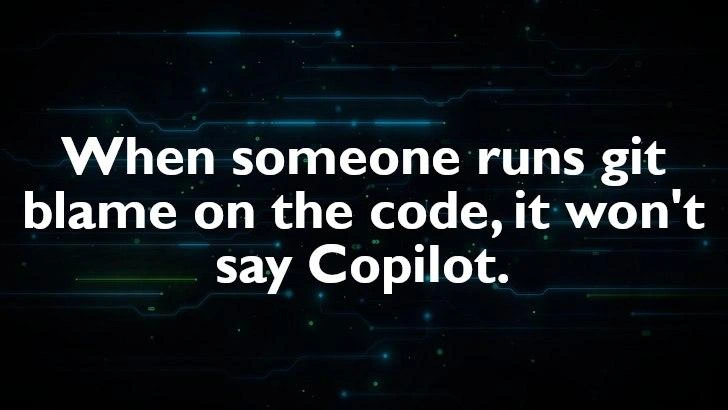
The image features a dark, abstract background with faint, glowing blue lines resembling a circuit board or network diagram, giving it a high-tech aesthetic. Overlaid in a clean, white, sans-serif font is the text: 'When someone runs git blame on the code, it won't say Copilot.' This is a direct, punchy statement that serves as the entire meme. The humor is rooted in the modern developer experience of using AI-assisted coding tools like GitHub Copilot. The 'git blame' command is used in version control to identify which developer last modified a specific line of code, often to assign responsibility for bugs or technical debt. The joke is that while an AI might have generated the faulty code, the developer who committed it is the one who will be held accountable. It's a wry commentary on code ownership and responsibility in the age of AI-powered development
Comments
15Comment deleted
Copilot is the ultimate intern: it writes half your code, you take all the credit, and when it breaks production, you're the one on the 3 AM incident call
Copilot may autocomplete the function, but when legal needs a signature for that 3-AM patch, git still fingers the meat-space author
The real horror isn't finding your name in git blame anymore - it's explaining to the CTO why the AI-generated regex that passed all tests is now processing customer emails as valid credit card numbers in production
The modern developer's perfect alibi: 'git blame' shows your name, but the code quality suggests you were merely the conduit for an AI's fever dream. It's like having a ghostwriter for your commits, except the ghost has read every Stack Overflow answer ever posted and occasionally hallucinates deprecated APIs from 2015
Copilot can autocomplete your tech debt, but git blame still resolves to the only identity with a GPG key and a DCO: you
Copilot can autocomplete, but in the postmortem your GPG key does the talking
Copilot autocompletes your code, but git blame autocompletes your name - AI helps, humans own the fallout
That's where you're wrong, kiddo https://github.com/dotnet/runtime/pull/116416 Comment deleted
😄 Comment deleted
I don't envy the devs over there. That was a PR that was actually merged, there are worse examples https://github.com/dotnet/runtime/pull/115733 Comment deleted
damn that's depressing 💀 Comment deleted
Much commit. And I'm half convinced this wasn't actually done by copilot Comment deleted
because they say compile it nah copilot Comment deleted
Deep... Comment deleted
Same with lawsuits and doctor's decisions... Man.... Comment deleted