Skip to content
DevMeme
197 of 7435
The Art of Over-Documenting Code
Documentation Post #238, on Mar 17, 2019 in TG

The Art of Over-Documenting Code

Why is this Documentation meme funny?

Level 1: Leaving Notes for the Next Person

Imagine you build an amazing LEGO castle, and someone else will have to fix it or add a tower after you've gone home. A nice person leaves a few sticky notes: "this wall is glued," "don't touch the drawbridge, it's fragile." That's the first panel — being kind to whoever comes next. The second panel imagines someone so extremely polite that they record themselves describing every single brick out loud, one by one, into a tape recorder. It's funny because it takes a genuinely nice idea and pushes it so far that it becomes ridiculous — like writing a thank-you card for every grape in a fruit basket — while reminding everyone that most people don't even leave the sticky notes.

Level 2: Why Comments Are an Achievement

Code comments are notes written inside source files that the computer ignores — they exist purely for humans. In most languages they start with // or #:

// Retry 3 times because the payment gateway randomly
// drops the first request on cold starts (ticket #4521)
const MAX_RETRIES = 3;

Without that comment, a future developer sees a magic number 3 and has no idea whether it's sacred or arbitrary. With it, they know the why — which is the entire point of documentation. Early in your career you'll discover the gap firsthand: your first encounter with legacy code is usually a thousand-line file, zero comments, original author gone, and a bug due Friday. That experience converts more people to commenting than any style guide ever has.

The second panel exaggerates this into knowledge transfer — the broader practice of getting what's in one developer's head into other heads: onboarding docs, recorded walkthroughs, pairing sessions. Voice-recording every line is satire, but the underlying need is real; teams genuinely do record screen-share explanations when someone who owns a critical system leaves. The "achievement card" framing — a small badge for the normal act, a golden one for the heroic act — mirrors how teams actually treat documentation: as optional flair rather than part of the job.

Level 3: Documentation Theater, Director's Cut

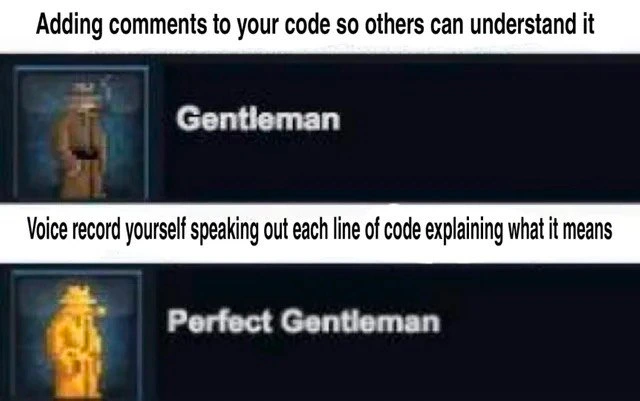
The format here is borrowed from video game achievement cards — the trench-coated pixel figure and "Gentleman" / "Perfect Gentleman" tiers are styled after unlockable badges, where the golden glowing version signals the rare, prestige-tier accomplishment. The meme maps that escalation onto documentation culture:

Adding comments to your code so others can understand it — Gentleman

Voice record yourself speaking out each line of code explaining what it means — Perfect Gentleman

The first panel is already a joke at the industry's expense. Writing comments so others can understand is framed as an achievement — something noteworthy enough to earn a badge — because in practice it is. The default state of most production codebases is a fog of uncommented intent: functions named processData2_final, a // TODO: fix this properly from 2017, and one load-bearing comment that just says // don't remove, breaks prod. The industry has spent two decades arguing about this. The Clean Code camp insists good code is self-documenting and comments are a failure of naming; the pragmatist camp points out that no identifier, however well-named, can explain why the retry count is 3 and not 5, or why this date parser deliberately ignores timezones because the upstream vendor's API lies. Comments encode the why; code can only ever show the what. The meme's first panel quietly sides with the pragmatists: explaining yourself to future readers is gentlemanly conduct precisely because it's voluntary, unrewarded by any sprint metric, and invisible until the author is long gone.

The second panel escalates into absurdity — and lands because it's only slightly absurd. Voice-recording a line-by-line walkthrough is a parody of knowledge transfer rituals that real organizations actually perform: the departing engineer's frantic final-week brain-dump sessions, the hour-long "architecture walkthrough" recording that nobody can search, skim, or diff. The original post text ("We all hate voice messages, right?") sharpens the irony: voice is the worst documentation medium — unsearchable, unversionable, impossible to code-review, instantly stale after the next refactor — yet it's also the most human. Every senior engineer has wished, at least once at 2 AM, that the author of some inscrutable legacy module had left behind literally any recording of their reasoning, even a muttered apology. The joke's escalation structure works because both panels describe the same underlying virtue — caring about the next reader — taken to a polite extreme and then a deranged one, and the gap between them is smaller than our code quality dashboards would like to admit.

Description

This is a two-panel meme that escalates the concept of code documentation. The format appears to be taken from a video game's achievement or ranking system. The top panel shows a pixelated character in a brown trench coat next to the word 'Gentleman'. Above this panel, the text reads: 'Adding comments to your code so others can understand it'. The bottom panel displays the same character, but now glowing a brilliant gold, next to the text 'Perfect Gentleman'. The caption for this panel is: 'Voice record yourself speaking out each line of code explaining what it means'. The meme humorously contrasts a reasonable, good practice (writing comments) with a completely absurd and impractical one (voice recordings), ironically presenting the latter as the pinnacle of consideration. For developers, this satirizes the endless debate on documentation standards and the occasional desire for hyper-detailed explanations when faced with obtuse code. The post's caption, 'We all hate voice messages, right?', adds a layer of irony, acknowledging that this 'perfect' solution would be incredibly annoying to consume
Comments

8
Anonymous ★ Top Pick I tried submitting my code documentation as a podcast. The code reviewer left a comment: 'This is great, but can you also provide a transcript? I listen at 2x speed and I think I missed the part where you explain the memory leak.'
  1. Anonymous ★ Top Pick

    I tried submitting my code documentation as a podcast. The code reviewer left a comment: 'This is great, but can you also provide a transcript? I listen at 2x speed and I think I missed the part where you explain the memory leak.'

  2. Anonymous

    “Inline comments are polite, but when your 300-line microservice ships with a 45-minute Dolby Atmos ‘director’s commentary’ committed to git, ‘git blame’ turns into an actual listening party.”

  3. Anonymous

    The same architect who insists on self-documenting code just submitted a PR with seventeen minutes of voice memos explaining their "elegant" use of triple-nested ternaries

  4. Anonymous

    Honestly, an audio log of the original author muttering 'this shouldn't work but it does, don't touch it' would be more accurate documentation than most Confluence pages

  5. Anonymous

    Ah yes, the logical evolution of documentation: from inline comments to voice recordings. Next up: hiring a professional narrator to read your git commits in Morgan Freeman's voice, followed by interpretive dance performances to explain your architectural decisions. Because nothing says 'maintainable codebase' quite like a 47-hour audiobook explaining why you chose that particular sorting algorithm. At least when the code breaks in production at 3 AM, you can listen to your soothing voice explaining the bug you're about to fix - it's like ASMR for incident response

  6. Anonymous

    Comments are polite; the perfect gentleman ships a per‑line voiceover - so git blame becomes git listen, and the docs are obsolete before the merge finishes

  7. Anonymous

    Voice narration per line: the only way to embed the exact tone of 'this seemed like a good idea at 3 AM' that comments eternally betray

  8. Anonymous

    We tried narrating diffs; turns out code reviews don’t accept .wav, grep can’t index your tone, and the bus factor just became a bitrate

Use J and K for navigation