Skip to content
DevMeme
3798 of 7435
Functional Programming Romance Hits a Comprehension Error
FunctionalProgramming Post #4140, on Jan 31, 2022 in TG

Functional Programming Romance Hits a Comprehension Error

Why is this FunctionalProgramming meme funny?

Level 1: Awkward Silence

Imagine two people on a date. One of them is a computer programmer who tries to impress the other by using a super special computer term as a cute pickup line. He basically says, "Let me be the magic piece in your special system," but in actual computer language. He hopes it sounds clever and loving to him, because in his world that phrase means something cool about connecting things together.

Now, the other person hears this and just looks completely puzzled. It’s like if someone suddenly spoke in a foreign language or said a big science word you’ve never heard before. She pauses and asks, "What does that even mean?" In the meme, she literally says, "What’s a monad?" — which is the exact confusing word he used. At that moment, all the romance just grinds to a halt. There’s a big awkward silence. You can almost hear crickets chirping. The guy was trying to be sweet and smart, but it backfired because the girl has no idea what he’s talking about.

This is funny because we’ve all seen situations where a joke or comment doesn’t land. One person thought they said something really witty or charming, but the other person just goes, "Huh?". It’s like telling a joke that no one laughs at — you feel a bit embarrassed afterwards. In this case, the joke was ultra-nerdy. The term “monad” is something even many programmers scratch their heads about, so it’s no surprise the girl is confused. The last part of the meme has no words, just her looking upset or crying a little, which exaggerates the feeling of “Well, that was awkward...” as if this misunderstanding was heartbreaking in a silly way.

Think of it like this: the guy essentially said, "I want to be very close to you" but he said it in a secret code that only he understands. The girl didn’t know the code, so she was just confused instead of flattered. The awkward silence is both of them realizing that his fancy line totally failed. It’s humorous and a bit cute because it shows how being overly complicated or nerdy when trying to be romantic can just lead to confusion. Next time, maybe he’ll stick with a simple "You mean a lot to me" instead of trying to turn computer talk into a pick-up line! In the end, the meme is poking fun at how sometimes smart people use big words or ideas at the wrong moment, and it reminds us in a lighthearted way that if your audience doesn’t speak your language (be it Klingon or programmer), you might just get a blank stare and an uncomfortable quiet moment in return.

Level 2: What’s a Monad?

Let’s break down the technical bits of this joke in simpler terms. The meme revolves around Haskell, which is a programming language known for its use of functional programming principles. In functional programming, you structure programs using functions and avoid side-effects (changes in state, I/O, etc.) as much as possible. This often means using abstract concepts to handle things that other languages do with mutable state or exceptions. A monad is one of those abstract concepts. The word sounds fancy (and it is a bit fancy!), but you can think of a monad as a kind of wrapper or context for values that also provides a way to chain operations on those values. It’s like a pattern that many different features (like handling missing values, dealing with computations that can fail, doing input/output operations, etc.) can use in a uniform way.

In programming terms, a monad is defined by two main things: an operation often called return or pure that puts a value into the monad (basically wraps a normal value into that context), and an operation called bind (written as >>= in Haskell) that takes the value out and passes it along to the next piece of code, while keeping everything wrapped in the context. The >>= operator is thus the workhorse for chaining operations. Its type signature in Haskell, m a -> (a -> m b) -> m b, looks intimidating, but conceptually it means: “Give me a box (m a) and a function that knows how to take a normal thing from that box and produce a new box (a -> m b), and I’ll give you the new box (m b). I’ll handle the unwrapping and re-wrapping for you.”

To make that concrete, consider a couple of common Haskell monads:

  • Maybe monad: Imagine an operation that might fail or not return anything meaningful. Instead of, say, returning a special error code or null, Haskell uses the type Maybe a to represent “maybe there’s a value of type a, or maybe there isn’t.” It’s like a box that can either hold one value (Just something) or be empty (Nothing). The bind operator >>= for Maybe knows how to pass a value along if it’s there, or stop the chain if it’s Nothing. So if you do Just 5 >>= f (where f is some function that returns a Maybe), the bind will feed 5 into f. But if you had Nothing >>= f, the bind just gives you Nothing without calling f at all (because there’s nothing to feed in). This allows you to chain a series of computations that might fail, and if any one of them returns Nothing, the whole result is Nothing — no special error-checking needed at each step.

  • IO monad: This one is how Haskell deals with input/output and other side effects. An IO a can be thought of as “a recipe to produce a value of type a by doing some interaction with the outside world.” You can’t just take an IO a and get an a out (that would break the purity of the language), but you can bind IO actions together. If you have an IO a and a function that takes a normal a and returns an IO b, the bind (>>=) will run the first action, take its result, feed it into the function, and then run the second action. The result is an IO b – another “recipe” that now represents doing the first action and then the second. This ensures that effects happen in the sequence you specify. Under the hood, Haskell is guaranteeing the order and passing the data along, so you as the programmer can think of it as one long sequence of actions.

So, simplified: a monad is a way to structure a sequence of operations, especially when those operations have some extra context or complexity (like "might not produce a value", or "involves doing I/O", etc.). The >>= operator is literally the glue that binds these operations together, taking care of the messy parts (like checking for Nothing or carrying out I/O in order) for you. Many programming newcomers find monads confusing because it’s an abstraction that’s not immediately tangible – it’s like an on-call formula or protocol for how functions should be chained, rather than something you can see directly. But once you see a few examples, it starts to make sense: it’s a lot about “do this, then do that, but keep it all in this particular context.”

Now back to the meme: The guy’s line “Let me be the >>= in your monad” is a nerdy pickup line. Knowing what we just discussed, he’s basically saying “I want to be the thing that helps connect you with everything, the one who carries you through from one step to the next.” In a normal romantic way, one might say “I want to be there for you” or “I want to be the one who supports you through life’s ups and downs.” But being a programmer, he’s phrased it in terms of code: >>= supports or connects values inside a monad, so he’s metaphorically implying “Let me support you or be close to you like bind supports a monad’s values.” It’s an ultra-geeky way to express affection. This falls under classic DeveloperHumor where we turn programming terminology into puns or cute sayings. There’s a whole subgenre of these functional_pickup_line jokes; for instance, a jokey flirt in the developer world might say “You’ve stolen my heart like an unmanaged memory leak” or “Are you a binary tree? Because you’re perfect (balanced) for me.” These are intentionally silly and only land if the other person also knows the lingo.

The humor takes full effect when the woman responds with “What’s a monad?” That right there is the record-scratch moment. To a lot of programmers (even ones not super familiar with Haskell), “What’s a monad?” is known to be a somewhat dreaded or at least very deep question. It’s notorious because finding a simple answer is hard — countless forum threads and tutorials exist solely to answer this! In the context of the meme, this question popping up is funny because it’s so predictable and so incongruous with the romantic intent. Instead of the flirty back-and-forth he hoped for, he’s basically prompted a technical Q&A session. If she genuinely doesn’t know what a monad is, he now has two options and both are hilariously bad for a romantic mood: either (a) attempt to explain monads (good luck keeping that short and sweet!) or (b) admit he said something meaningless to her and retreat in embarrassment. The third panel with no text implies that he chose option (b) — stunned silence, maybe a facepalm. It’s the comedic equivalent of telling a joke that no one laughs at, and you just stand there feeling awkward.

For a junior developer or someone new to these terms, the takeaway is: monads = tricky concept, and >>= is a piece of Haskell syntax related to that concept. The meme leans on the fact that monad memes are a thing — yes, believe it or not, there are tons of jokes and references about “monads” in programming communities, precisely because so many people struggle to understand them and yet they’re talked about with almost reverence by functional programming enthusiasts. It’s an inside joke: as soon as monads are mentioned, someone might quip “Ah yes, monads… can you explain that to me? 😉” knowing it’s a challenge.

In simpler language, when the girl asks “What’s a monad?”, it’s funny to us because we imagine the guy’s confident bravado deflating immediately. Picture a scenario outside of coding: it’s as if someone used a really niche Star Wars reference to flirt with a person who’s never seen Star Wars. For example: Guy says: “You’re the BB-8 to my Poe Dameron” and Girl replies: “Who’s BB-8?” The guy now realizes his cute line requires a whole movie’s worth of explanation — totally not sexy anymore. Same energy here, just with programming. The meme captures that universal communication gap in a nerdy context: one person speaks in jargon, the other person is left completely in the dark. And as a developer (especially if you’ve dabbled in Haskell or heard myths about monads), you can’t help but grin at how perfectly this nails that experience.

Level 3: Functional Flirting

For seasoned developers, this meme hits on a classic inside joke of the programming world. It combines a FunctionalProgramming concept that has reached almost mythical status (the monad, specifically in Haskell) with the utterly non-technical setting of a romantic one-liner. The clash of domains is what sparks the laughter. We have all seen enthusiastic programmers try to impress or connect with others by dropping a bit of niche tech jargon, sometimes with cringe-worthy results. Here, the suitor deploys a Haskell gem:

Guy: Let me be the >>= in your monad.
Girl: What’s a monad?

This exchange encapsulates a well-known scenario. The first line is nerd romance at its peak — a flirty pun that only makes sense if you’re versed in Haskell or category theory. The >>= symbol, pronounced "bind", is Haskell’s way to chain monadic operations. It carries a cheeky double meaning: in plain English “bind” suggests bonding or uniting (a romantic connotation), while in code it’s the operator that binds computations together within a monad. So essentially, he’s saying “Let me bond with you” in a tongue-in-cheek, big-brained way. Experienced devs recognize the humor because it’s simultaneously clever and ridiculously impractical. It’s clever in that the pun technically works — >>= does connect things in a monad — but it’s impractical (and comical) because who on Earth expects a normal person to find that swoon-worthy?

The real punch comes with her response: “What’s a monad?” This is the ultimate buzzkill question in functional programming circles. The moment someone asks "what is a monad?" you know you’re headed down a rabbit hole. In the developer community, monads have a notorious reputation: they’re powerful and ubiquitous in Haskell, yet explaining them concisely often leaves both speaker and listener more confused. It’s a running joke that whenever monads come up, someone will invariably ask for an explanation, prompting a flurry of metaphors (burritos, containers, spacesuits, you name it) and still not quite nailing it. So here, the poor guy on the left is essentially hoisted by his own petard — he tossed out a fancy reference assuming it would impress, but now he’s confronted with the dreaded question even senior devs hesitate to answer on the spot. We can almost see his face fall as he realizes he’s either going to have to launch into a 30-minute technical explanation or just admit defeat. The third panel with no caption — just an awkward emotional close-up — hilariously captures that exact moment of “oh no, what have I done?”

From a veteran coder perspective, this meme is relatable on multiple levels. First, it satirizes programmer romance memes and functional_pickup_line attempts. We chuckle because mixing love and code is often delightfully clumsy. (Who among us hasn’t at least thought of a terrible “You complete me” coding joke like “You auto-(complete) me” or “Be the semicolon to my statements”?) This particular line digs into a very specific in-joke: monads are like the final boss of Haskell concepts. The community has a folklore about them—there are endless blog posts titled “Monads explained for X” (for beginners, for the layman, for my wife, for a five-year-old, etc.), yet people still quip that the easiest way to spot a Haskell newbie is if they ask what a monad is. By choosing monads as the flirtation vessel, the meme shouts out to all functional programmers: Remember that confusing thing you struggled with? Imagine using that as a chat-up line! It’s wonderfully ludicrous.

Secondly, the setting of the meme uses what appears to be a dramatic movie scene (indeed, the image is from an emotional moment between Peter Parker and Mary Jane in a Spider-Man film). By placing stoic meme text over a teary, heartfelt scene, it exaggerates the emotional stakes of this nerdy misfire. It’s as if the misunderstanding over a piece of code jargon is as tragic as a superhero breakup. This contrast is classic DeveloperHumor – we take something trivial in real life (explaining a tech term) and blow it up as if it’s life-and-death. The woman’s confused and pained expression in panel 3 humorously mirrors the frustration many of us have felt either asking or answering “what’s a monad?” – it’s the facial expression version of a facepalm combined with “I give up.”

There’s also an element of schadenfreude for the experienced dev: we cringe-smile because we know the trap he fell into. Over-eager to show his functional programming prowess (perhaps trying to demonstrate “Hey, I know hard stuff like Haskell!”), he forgot that if your audience isn’t already in on the joke, you’ll get blank stares. The situation parodies the communication gap developers often face. If he now earnestly attempts to explain a monad, it’s going to sound like: “Well, darling, a monad is sort of like a design pattern. See, it’s a type class with certain laws that allow function composition within a context…” — by which time any semblance of romance has withered. Even among programmers, giving a clear answer to “what’s a monad?” can be challenging. So we have an almost meta-joke here: the meme itself is explaining that explaining a monad is tough! It’s a humorous nod to the fact that monads are so conceptually tangled that they can ruin even a pick-up attempt.

In essence, the meme is a perfect storm of LanguageQuirks and social awkwardness. Haskell’s quirky operator symbols (>>= looking like some kind of sideways emoticon with an equals) and its advanced type system give rise to a lot of DeveloperInJokes. This one leans on the community’s collective memory of struggling with monads. It lovingly pokes fun at the Haskell aficionado (the kind who might unironically wear a “Free
monad” T-shirt and wax poetic about lambda calculus) trying to navigate normal human interaction. The humor says: we know monads are awesome and profound, but c’mon, they’re also the last thing you’d bring up when trying to be smooth. When you drop an ultra-nerdy one-liner and your crush responds with genuine confusion, you’ve basically compiled error in real life. The silent panel at the end? That’s the program crashing with no error message — just a deadpan freeze. Experienced devs read this and think, “Yup, there’s always that one person who hasn’t heard of monads... and of course it’s the person you were trying to impress.” It’s a gentle roast of both the complexity of monads and the overconfidence of those who think referencing them will make them look cool. And it works because it’s true: even the smartest among us have stumbled over explaining a monad, so it’s comedic karma that a monad reference here leads to an awkward silence.

Level 4: Category Theory Courtship

At the most theoretical level, this meme is invoking concepts from category theory under the guise of a flirtatious one-liner. In Haskell (a pure functional programming language deeply rooted in math), >>= is the monadic bind operator. And a monad, in the mathematical sense, is famously described as a monoid in the category of endofunctors. This dense definition unpacks to mean that a monad is formed by an endofunctor (a mapping from a category to itself) equipped with two natural transformations that behave like an identity and an associative binary operation (analogous to how a monoid has an identity element and an associative binary combine). Translating that to Haskell terms: a monad is defined by two operations, traditionally return (also known as pure in modern Haskell) and >>= (bind), which must satisfy identity and associativity laws. Formally, we see a type class like:

class Monad m where
  (>>=) :: m a -> (a -> m b) -> m b   -- bind
  return :: a -> m a                 -- wrap pure value

These operations obey the monad laws (left identity, right identity, and associativity) ensuring that chaining computations yields consistent results regardless of how you parenthesize or sequence them. In category theory language, return is the unit (identity) and >>= (bind) composes two actions within the context m, much like function composition but for computations wrapped in a context (this is sometimes called Kleisli composition in the Kleisli category of the monad). The power of this abstraction is profound: it provides a principled way to sequence computations without breaking functional purity.

Originally, the concept of monads was introduced to programming language theory by mathematician Eugenio Moggi and later popularized in the Haskell community by Philip Wadler. This abstraction allowed Haskell to handle side effects (like I/O, state, or exceptions) by encapsulating them in a monadic type, rather than mixing impure operations into the language semantics. For example, the IO monad wraps actions that interact with the outside world, and the >>= operator ensures those actions execute in a specific order while keeping the functional core pure. Similarly, the Maybe monad (built on the Maybe functor) provides a way to chain computations that might fail, carrying a "nothingness" through the chain without explicit checks. In all these cases, >>= is the mechanism that binds one computation’s output to the next computation’s input, all within the monad’s contextual rules.

So, when someone says “Let me be the >>= in your monad,” on a purely technical level they’re referencing this bind operator that connects or sequences operations inside a monadic context. It’s as if they’re proposing, in grandiose abstract terms, “Let me be the mathematical glue that composes your functions; let our two contexts become one continuous computation.” This is a hilariously highbrow way to express togetherness — leveraging the algebra of functional programming as a romantic metaphor. The absurdity lies in applying a concept as arcane as monadic binding to the realm of pickup lines. Unless both parties have a strong background in functional programming theory (and find it alluring), speaking in terms of monoids, endofunctors, and bind operators is more likely to generate confusion than chemistry. The meme’s humor at this level comes from this stark mismatch: it’s like quoting a research paper on lambda calculus in the middle of an intimate conversation. For those who recognize the theory, there’s an extra layer of comic irony: monads are a beautifully elegant abstraction in theory, but notoriously mystifying to explain in practice — making them possibly the worst choice for a casual flirtatious reference.

Description

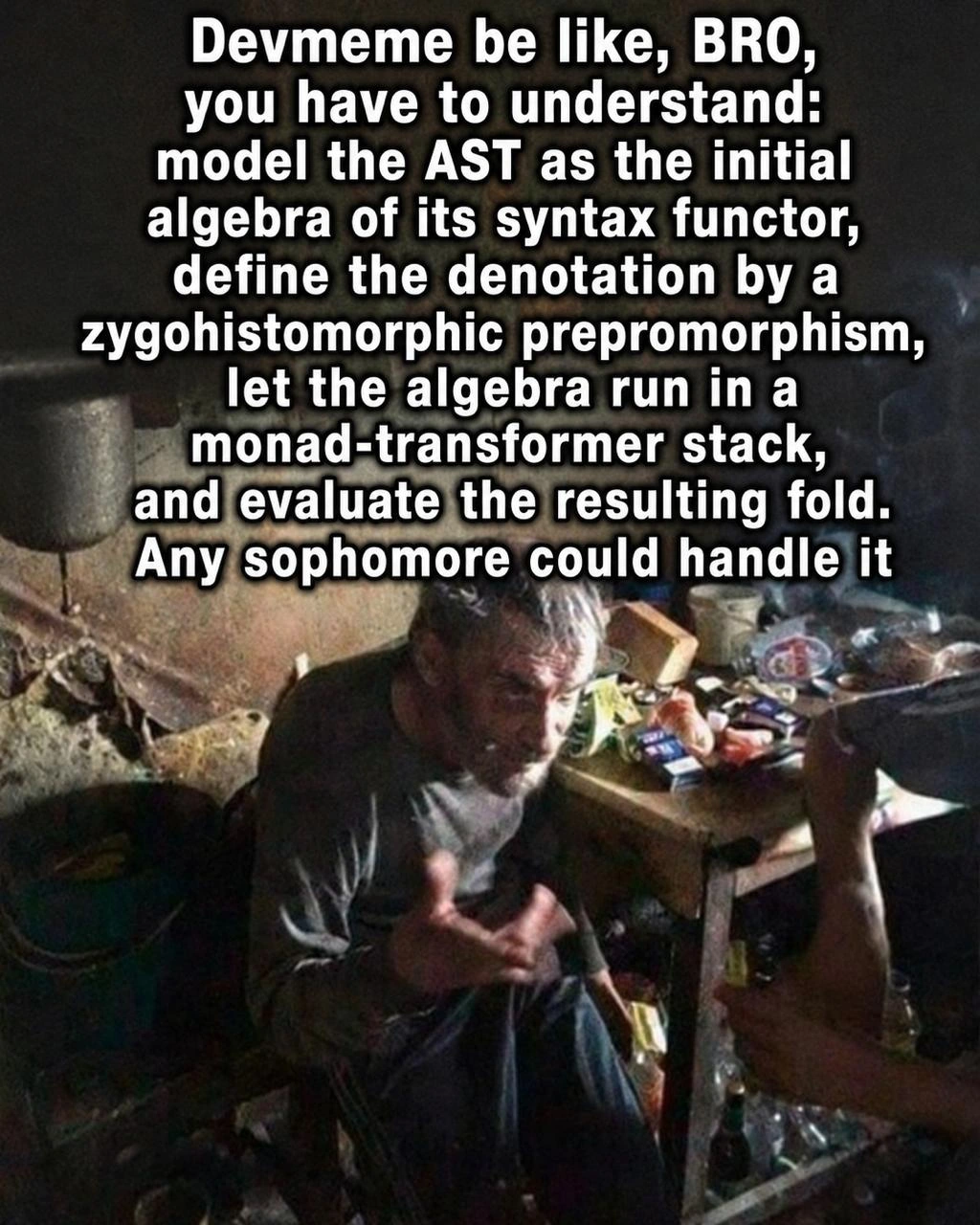
This three-panel meme uses a dramatic scene from the Spider-Man movie. In the first panel, a tearful Mary Jane Watson says to Peter Parker, 'LET ME BE THE >>= IN YOUR MONAD.' The '>>=' is the bind operator in languages like Haskell, central to the concept of monads. In the second panel, a concerned Peter Parker replies, 'WHAT'S A MONAD?' In the final panel, Mary Jane is shown crying with her eyes closed, signifying her disappointment and the communication breakdown. The meme humorously captures the niche and often esoteric nature of advanced functional programming concepts. It highlights the communication gap that can exist between programmers with different specializations and the frustration of trying to share a deep technical passion with someone who doesn't understand the terminology, equating it to a failed romantic gesture
Comments

18
Anonymous ★ Top Pick Explaining monads on a first date is the emotional equivalent of a cold boot with no cached dependencies
  1. Anonymous ★ Top Pick

    Explaining monads on a first date is the emotional equivalent of a cold boot with no cached dependencies

  2. Anonymous

    Tried that line once - by the time I’d finished drawing Kleisli arrows to explain “what’s a monad,” the waiter had already garbage-collected our table

  3. Anonymous

    After 20 years in the industry, you finally understand monads just well enough to realize you've been implementing them wrong in production for the last decade

  4. Anonymous

    Offering to be the >> in someone's monad is bold - you're literally volunteering to have your result discarded

  5. Anonymous

    This perfectly captures the monad paradox: anyone who truly understands monads loses the ability to explain them to others, while those who can explain them clearly probably don't understand them deeply enough. It's the functional programming equivalent of quantum mechanics - the moment you try to observe and explain it, the understanding collapses into a confused analogy about burritos or space suits

  6. Anonymous

    She offered to bind with my monad; he couldn't even fmap the question - classic FP interview fail

  7. Anonymous

    Pro tip: leading with >> on a date just sequences you in and discards your value - use >>= if you’re hoping for a relationship

  8. Anonymous

    "Let me be the >>= in your monad." "What's a monad?" "Then let's keep this a Functor - no Kleisli commitments."

  9. @feskow 4y

    It's like Result in rust?

    1. @Tomato_Bomb_Tom 4y

      A monad is simply a monoid in the category of endofunctors

    2. @Vo_6V 4y

      Result + Ok + and_then forms monadic structure, you are right.

      1. @feskow 4y

        Thanks for feedback) (although I still don't get any of these haskelly terms)

        1. @Vo_6V 4y

          Just learn about and_then and how to use it. Simplifying, monads allow to control side effects, like returning multiple results, or possibly returning no result, changing state, exceptions, IO, transactions in pure functional code. Also this abstraction provides clean way to compose multiple effectful computations in one. In other languages and_then called flatMap, bind, >>= and so on

  10. @Vo_6V 4y

    >> combines effects of it's operands but ignores first value, unlike full bind operator >>=. Is it part of the joke?🤓

  11. @MagnusEdvardsson 4y

    It's not from Haskell, it's something from functional programming theory in general

  12. @yistarostin 4y

    Let me be the overloaded bitwise shift operator in your c++ object

  13. @eclypze 4y

    sry but i am web programmer

  14. @callofvoid0 4y

    da hell ur talking 'bout?

Use J and K for navigation