The Calm Before the Weekend On-Call Storm
Why is this Deployment meme funny?
Level 1: Don’t Deploy on Friday
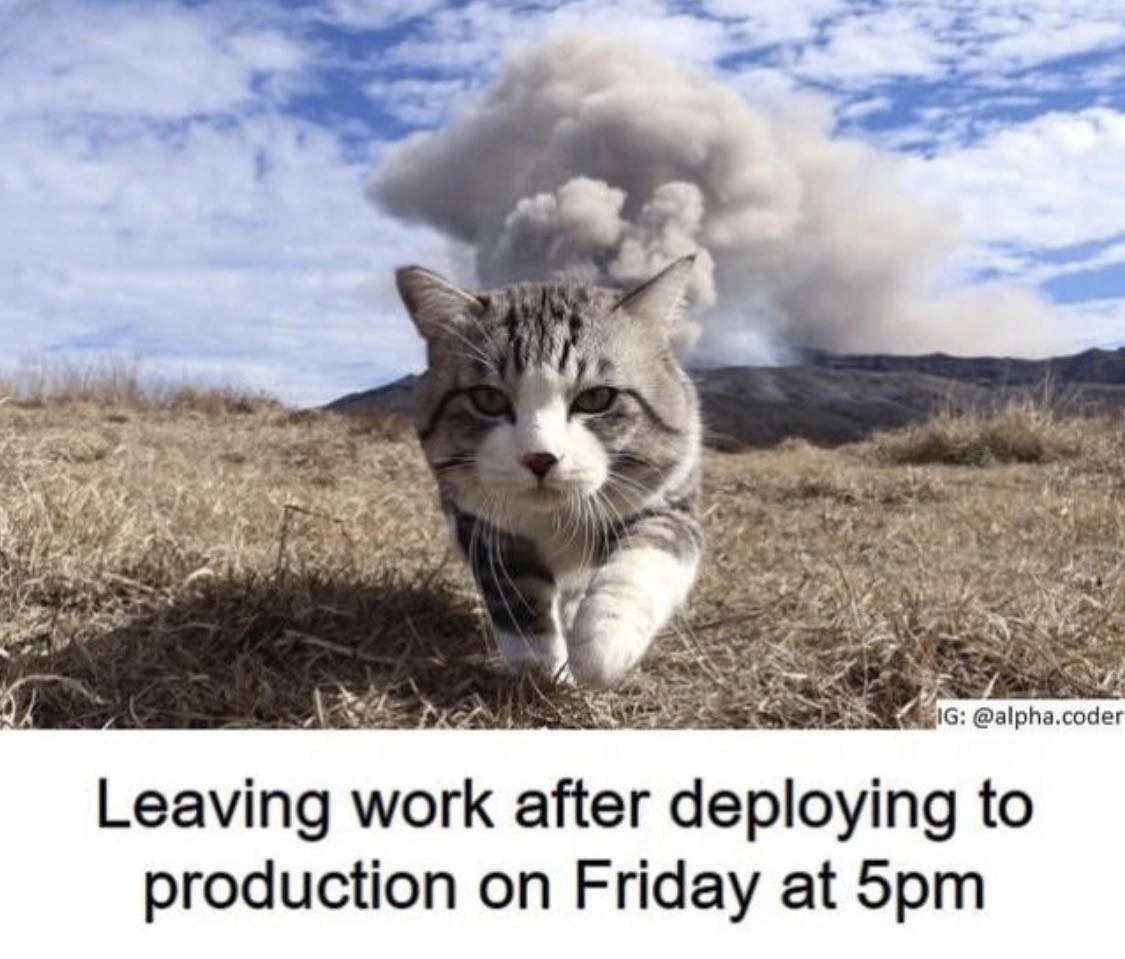
Imagine you shake up a big bottle of soda really hard, then calmly set it on the table and walk out of the room as if nothing will happen. You know that once you leave, the soda is going to fizz up and explode everywhere, making a huge sticky mess. But you act super cool, strutting away like you didn’t just cause that trouble. That’s what’s happening in this meme. The cat is like the person who did something risky (shook up the soda) and is confidently walking away. The volcano exploding behind the cat is the giant mess that’s about to happen because of what they did. It’s funny because the person (or cat) pretends everything is fine – like they didn’t just set off a disaster – even though everyone can see something big and bad is erupting right behind them. In other words, the meme jokes about someone doing something obviously dangerous and then walking away as if it’s “no big deal,” which is a silly thing to do.
Level 2: Deployment Danger Zone
Let’s break down the scenario in the meme in simpler terms. The caption says “Leaving work after deploying to production on Friday at 5pm.” In developer-speak, deploying to production means you’ve just released new code or updates to the real, live system (the one actual customers or users are using). Production is that live environment, as opposed to a test or development environment. So, in this scenario, a person (the cat represents them) pushed out a code change at 5:00 PM on a Friday — literally right at the end of the work week — and then immediately headed out the door to start their weekend.
Why is that funny (or cringey) to developers? Because it’s generally considered a bad idea to deploy late on a Friday. When you do a deployment, there’s always some chance something could go wrong: maybe a bug that wasn’t caught in testing, or a configuration mistake, or something unexpected that only shows up when real users start interacting with the new code. If you deploy earlier in the day (say, Wednesday morning), you and your team are around for hours afterward to watch the system, spot any problems, and respond quickly. But at 5pm on Friday, most people are logging off and leaving work. If your update causes an issue, nobody might notice until it becomes a big problem, possibly not until much later that evening or even the next day. And by then, the people who can fix it aren’t sitting in front of their computers. In short, releasing a change right before the weekend is riskier because you have a much smaller safety net. You’re basically hoping nothing bad happens at a time when it’s hardest to react if something does.
That’s where on-call comes in. Many DevOps/SRE teams have an on-call rotation – a designated person (or team) who will get notified if something breaks in production during off-hours. Think of it like an emergency responder for software: if the website or app crashes in the middle of the night, the on-call engineer’s phone will ring (or their pager will buzz) to alert them. So in our Friday 5pm deployment scenario, if the new release causes the site to start crashing at 8pm Friday, the on-call engineer will be the one getting that “something’s wrong!” alert. Now imagine being that person: you thought you were done for the week and could relax, but suddenly you’ve got to jump back on the computer to fix a surprise problem. If the developer who deployed the code already left work (like the cat walking away in the meme), the on-call engineer might be scrambling to handle the issue alone, or they’ll be urgently calling that developer to come help. Either way, it’s not how you want to spend your Friday night.
The meme uses a very dramatic image to highlight this scenario. The cat is walking toward us very calmly, which represents the developer acting super casual after doing the deploy. The cat even looks a bit smug, like “Yeah, I pressed the button, and it’s fine.” Meanwhile, the volcano erupting in the background represents a huge problem happening in the system because of that deploy. Volcanic smoke and an explosion = the servers or website catching fire, metaphorically. The joke comes from that contrast: the person (the cat) appears totally unconcerned and is leaving work as if everything is great, while behind them things are literally blowing up. It’s like they set off a bomb (the risky deployment) and just walked away with a swagger.
There’s even a common saying among developers: “Don’t deploy on Fridays.” It’s basically a rule of thumb born from experience. A late Friday deploy often means if something goes wrong, you’ll be dealing with it during your time off (or coming in to a mess on Monday). A lot of us learn this the hard way at least once. For example, maybe as a new developer you were eager to push out a bug fix or a new feature before the weekend, only to find out later that night that it caused something else to break. Instead of enjoying your Friday evening, you end up logging back in, scrambling to patch things up. After that, you remember not to tempt fate like that again.
DevOps culture (the blend of “Development” and “Operations” responsibilities) encourages developers to take responsibility for their code running in production. That’s why many teams are cautious about when they deploy changes. It’s considered a best practice to release updates when you and your team will be around to monitor the outcome and respond if needed. Doing it when no one is watching the store (like late Friday) goes against those best practices. In fact, some companies have explicit policies or deployment freezes – for instance, no code releases on Friday evenings or over the weekend – specifically to avoid scenarios like the one in this meme. These rules exist because people have been burned by exactly this kind of situation before.
In summary, this meme is an inside joke and a gentle warning about a well-known deployment pitfall. The cat represents the overly optimistic (or inexperienced) developer who deploys code and immediately checks out, and the volcano represents the obvious trouble that’s about to erupt as a result. The vibe of “like nothing exploded” comes from the cat’s attitude – acting like everything’s fine even though a disaster is looming right behind. The takeaway for a newcomer is: be careful about when and how you deploy code to production. If you do it at a risky time (like right before everyone leaves for the weekend), you might end up with a giant mess when nobody is around to help fix it. This meme humorously says, “Don’t be that person who pushes code on Friday at 5 and walks away – because you might come back to find everything on fire!”
Level 3: Release Roulette
This meme perfectly captures a well-known DevOps rule of thumb (some call it a superstition) by showing exactly what you shouldn’t do: deploy code to production on a Friday at 5pm and then casually stroll away. The grey-striped cat’s calm swagger in the foreground, with a volcano belching smoke behind it, embodies a mix of reckless confidence and impending doom. It’s portraying a developer walking out of the office after a last-minute deploy, acting as if nothing could possibly go wrong. Sure, go ahead – deploy on Friday. What’s the worst that could happen? Seasoned engineers know the answer: pretty much everything.
The humor here is dark and deeply relatable. The cat striding confidently toward the camera is like the dev who just merged to main and hit “deploy” at 4:59 PM. The massive smoke plume from the volcano symbolizes the production environment blowing up in their wake – albeit on a slight delay. It’s the classic “cool guys don’t look at explosions” trope, except in tech form: the developer doesn’t even glance back at the problems erupting behind them. Experienced developers and SREs can practically feel their blood pressure rise just looking at this image.
We’ve all either witnessed or personally committed a Friday deployment that seemed fine… until we were halfway home and some latent bug came alive like a volcano exploding. The meme nails that DeploymentAnxiety: releasing something risky at the worst time and then trying to walk away like everything’s under control, even though deep down you suspect you might have just lit a fuse.
In real-world DevOps terms, pushing to production at 5pm on a Friday is playing release roulette with your weekend. Why? Because if anything goes wrong, your team is largely offline and unprepared. The on-call engineer might be the only line of defense, and they’re probably praying nothing breaks so they can enjoy their Friday night. Deploying so late means if a serious bug or performance regression was introduced, it might not be caught immediately – there’s less real-time monitoring by humans, fewer eyes on the graphs. Small problems can smolder and escalate. On-call production issues often follow this pattern: a tiny misconfiguration or undetected edge-case starts as a subtle warning and, without anyone around to respond, snowballs into a system outage.
To illustrate, a hypothetical timeline of this kind of deployment failure might look like:
17:00 - Deploy started for version 2.3.4
17:05 - Deploy succeeded. All systems nominal.
17:30 - WARNING: Elevated error rates detected (smoke starting to show)
18:00 - CRITICAL: Major functionality outage (volcano erupting now)
18:01 - PagerDuty Alert: High-severity incident triggered (on-call gets paged)
18:30 - On-call engineer initiated rollback to previous version
It’s a scenario that ops veterans know by heart. At 5:05 PM, our developer-cat is high-fiving themselves for a “smooth” release and shutting their laptop. By 5:30 PM, some production metrics are looking a little off – maybe errors are creeping up – but the office is empty and nobody saw the warnings. By 6:00 PM, that minor glitch has erupted into full-blown site issues (users are seeing errors or a service is down). Now the volcano is truly spewing. The on-call engineer’s phone starts buzzing furiously (hello, 6:01 PM alert!), dragging someone back from dinner to firefight the incident. If the original developer is also on-call, well, they’re about to have a very bad evening. If not, some unsuspecting teammate just inherited a deployment disaster. Either way, somebody’s weekend plans are getting smoked.
The caption “Leaving work after deploying to production on Friday at 5pm” reads like an indictment in every post-mortem report. It’s basically the setup to a horror story in DevOps culture. When we see a scenario like that, we immediately recall how many times a Friday deploy has led to 2 A.M. emergency Slack alerts and monitoring dashboards lit up red with errors. This image exaggerates it hilariously: the cat looks completely unbothered, while behind it an IT Pompeii is unfolding. The contrast is comedic gold because it’s so true – people have actually done this, walking away all confident, and then gotten that dreaded call an hour or two later saying, “Uh, hey… everything’s on fire.” It’s poking fun at that overconfidence. The developer in the meme is basically whistling on their way out, ignoring the deployment risks they just created.
From a senior engineering perspective, the meme highlights exactly why many teams have the unwritten rule: “Don’t deploy on Fridays.” Releasing changes right before two days of thin support coverage is just begging for trouble. If you absolutely must push something heading into a weekend, savvy teams will take precautions: deploy on Friday morning (so you have all day to watch it), or use a canary deployment or feature flag so that only a small percentage of users get the change at first (limiting the blast radius of any problem). They’ll also double-check that monitoring and rollback procedures are ready in case things go south. In other words, if you’re going to gamble, at least have some safety nets. The meme implicitly mocks someone who did none of that – they just threw the code into prod and peaced out. It’s the epitome of deployment hubris.
In the DevOps and SRE world, there’s a concept of being mindful about when you deploy. Pushing an update at 5pm Friday (especially before a holiday weekend) is like parking a fuel truck next to a campfire and then heading out for the weekend. July 2, 2021 – the date on this meme – was right before the Fourth of July holiday in the US, so any American engineer seeing this would cringe extra hard. Having to fight fires in production over a holiday, due to a last-minute change, is every on-call engineer’s nightmare scenario.
Ultimately, this meme resonates as a cautionary tale wrapped in humor. It’s essentially saying, “Look how silly this is – don’t be this person!” The veteran engineers chuckle (perhaps a little bitterly) because they’ve been there or cleaned up after someone who was. The meme perfectly caricatures an over-eager dev who hasn’t learned that painful lesson yet. The rest of us, like that volcano, are just waiting to erupt with “I told you so” when the inevitable happens.
Description
The image displays a popular meme format featuring a grey and white tabby cat walking confidently towards the camera with a calm, unbothered expression. In the background, a massive plume of smoke and ash billows from what appears to be an erupting volcano or a large explosion under a blue, partly cloudy sky. Below the image, a caption reads: 'Leaving work after deploying to production on Friday at 5pm'. There is a small watermark for an Instagram handle, 'IG: @alpha.coder', in the bottom right corner. The meme humorously illustrates the notorious developer practice of deploying new code to the live production environment right before the weekend. This is widely considered a high-risk, reckless act because if any critical bugs or issues arise (the 'explosion'), the person responsible is already gone, leaving the on-call team or SREs to handle the crisis over the weekend. The cat's nonchalant attitude perfectly captures the developer's blissful ignorance or willful disregard for the potential chaos they may have just unleashed
Comments
9Comment deleted
A Friday deploy is the engineering equivalent of texting 'we need to talk' and then immediately turning your phone off for the weekend
Strutting off at 17:00 because the canary stayed green - totally ignoring that the smoke plume is the message queue replaying three years of events against a schema you forgot to migrate
The only thing more predictable than a Friday 5pm deployment causing issues is the senior engineer who approved it already having their phone on airplane mode halfway to the mountains, leaving the on-call junior to discover why the database migration script had a hardcoded dev environment connection string
Ah yes, the classic Friday 5pm production deploy - where 'continuous deployment' meets 'continuous regret.' It's the perfect time to test whether your monitoring alerts can successfully ruin a weekend, your rollback procedures actually work under pressure, and if that 'it works on my machine' confidence translates to 'it works when everyone's gone home.' Bonus points if you've disabled PagerDuty notifications and are already three drinks deep by the time the first Slack message arrives. Remember: the blast radius is directly proportional to how close you are to the weekend, and the mean time to recovery is inversely proportional to how many team members have already boarded flights
Friday 5pm prod deploy: a live test of blast-radius containment - canary flips, feature flags misfire, the error budget evaporates, and your weekend becomes the incident timeline
Shipping a one-way DB migration at 4:59, skipping the canary, and trusting the error budget to answer PagerDuty
Friday 5PM prod deploy: The anti-pattern where your CI/CD turns into a CAP theorem violation over the weekend
Me in ~7 hours Comment deleted
😂 Comment deleted