Skip to content
DevMeme
3851 of 7435
Free thinkers sheepishly follow camelCase instead of PascalCase naming conventions
CodeQuality Post #4194, on Feb 10, 2022 in TG

Free thinkers sheepishly follow camelCase instead of PascalCase naming conventions

Why is this CodeQuality meme funny?

Level 1: The School Uniform

Think of it like a school where every student claims to be unique and different, but the school has a dress code. Let’s say all the kids love to show off their individual style with cool clothes. Then one day, the principal announces that everyone must wear a uniform. Suddenly, even the wildest, most creative kids all show up in the same plain uniform, no questions asked. They might have thought they were free to wear anything, but as soon as there’s a rule, everyone dresses the same to follow it.

In this meme, the “clothes” are the way programmers write their variable names. Some programmers like doing it one way (like having a name start with a big letter), and others like a different way (starting with a small letter). But when the team or the project says “Hey, in our group we all start variable names with a small letter,” every programmer on that project does it that way. Even the ones who normally insist on doing their own thing will change to match the group, just like students putting on the required uniform. The picture of sheep all together is like those programmers — they’re just following along together. It’s funny because the text teases those “free thinkers” for acting just like everyone else when a simple rule is put in place. In everyday terms, it’s saying: you might think you’re different, but when a rule comes, you behave just like a part of the crowd!

Level 2: Case Closed – Camel vs Pascal

Let’s break down the joke for those newer to coding. It’s all about naming conventions – agreed-upon ways to name things like variables, functions, or classes in code. In many programming languages, especially in C#, Java, and JavaScript, there are common patterns for how to capitalize multi-word names. Two popular styles are camelCase and PascalCase. Both are forms of “CamelCase” lettering (where words are mashed togetherWithout spaces and each internal word starts with a capital letter), but there’s a key difference:

  • camelCase (also called lowerCamelCase) means the first letter of the name is lowercase, and each subsequent word starts with a capital. Example: myVariableName starts with m (lowercase) then capital V and N for the new words “Variable” and “Name”. It’s called camelCase because the bumps (capital letters) in the middle are like the humps on a camel’s back.
  • PascalCase (also known as UpperCamelCase) means every word, including the first, starts with a capital letter. Example: MyVariableName would have capital M, V, and N. The name comes from the Pascal programming language, which encouraged this style, and it’s essentially camelCase but with that first letter also capitalized (so it looks a bit more formal, like Pascal the language).

In the meme, the text jokes about developers acting like sheep (following each other without question) when a project’s convention is camelCase instead of PascalCase. If a coding standard (often documented in a codeStyleGuide or enforced by a linter tool like ESLint, Prettier, or StyleCop) tells everyone “we use camelCase for our variables”, then even developers who normally prefer PascalCase will stop and adopt camelCase just because that’s the rule. They might have been “free thinkers” claiming creativity or independence, but as soon as the style guide says “camelCase only!”, they all comply obediently so their code matches. It’s like everyone wearing the same uniform in a codebase.

For example, consider a simple variable name in two styles:

// Using camelCase convention (common in JavaScript for variables and functions)
let userName = "Alice";

// Using PascalCase convention (common in C# for class names or constants)
let UserName = "Bob";  // This would be frowned upon in a camelCase project!

In a project that mandates camelCase, naming a variable UserName with a capital U would likely get flagged in code review. A teammate or an automated style checker would say, “Hey, our convention is camelCase, please rename it to userName.” This might seem like a trivial change – after all, the code will run either way – but teams enforce these conventions to keep the code consistent. Consistency in naming (and codeFormatting in general) is a big part of CodeQuality because it means any developer can read the code without stumbling on unfamiliar styles. It’s easier on the eyes and brain when the style is uniform: you instantly recognize getUserData() instead of having to double-take at GetUserData() or get_user_data mixed together in one codebase.

New developers quickly learn that variableNaming isn’t a free-for-all; most companies or open-source projects have a set of naming conventions you’re expected to follow. This can be surprising at first (“Does it really matter if this starts with a capital letter or not?”), but it’s a rite of passage in professional coding. You might have a personal preference – maybe you came from a C# background and love PascalCase, or you just think capital letters at the start look nice – but when you join a JavaScript project that uses camelCase, you adjust. Why? Because that’s the convention agreed upon by the team, and going against it would make your code stick out (and not in a good way). It could even break things if the language is case-sensitive in certain contexts or if automated tools are checking names.

This meme is a form of developerHumor that exaggerates this scenario: The phrase "so-called free thinkers" implies developers like to think of themselves as innovative and not bound by arbitrary rules. But in practice, when that codeStyleGuide says “all identifiers shall be camelCase,” these same devs fall right in line, just like a flock of sheep all doing the same thing. It’s funny because it’s true – even the most iconoclastic programmer usually agrees to these common-sense rules for the sake of teamwork (and to avoid endless nitpicking in code reviews). We’ve all seen the herd_mentality_meme in action during a project: one minute everyone has their own style, and the next minute the whole team is united using camelCase because a senior dev or style guide said so. The humor also gently ribs the sometimes absurd importance placed on naming. It’s a reminder that in software, naming things can weirdly be one of the hardest parts – and once a decision is made, everyone treats it as gospel. In fact, teams sometimes spend more time arguing about the casing_conventions or where to put commas than working on actual features – this is the classic naming_bikeshedding at play. The meme encapsulates that irony in one image: independent minds becoming a uniform herd over the simplest of rules.

Level 3: Humps and Herds

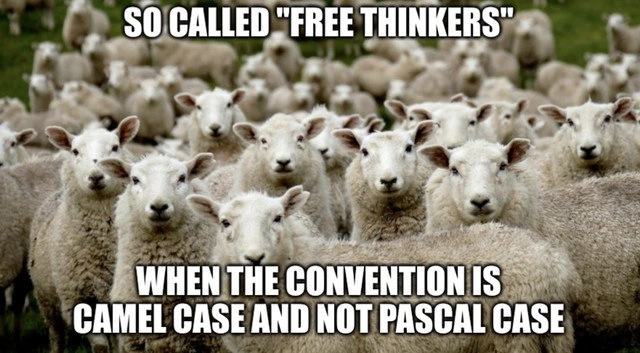
In the realm of CodeQuality and programming language style guides, naming conventions are practically a religion. This meme brutally pokes fun at the herd mentality developers adopt around namingConventions. The top caption mocks "so-called free thinkers"—those devs who pride themselves on independent thought—yet the bottom caption reveals them behaving like a flock of sheep as soon as a project’s style guide mandates camelCase over PascalCase. It’s an inside joke about how even self-proclaimed rebels in software development will sheepishly follow an agreed-upon style for the sake of consistency. The image literally shows a herd of sheep staring blankly, symbolizing developers conforming en masse to a trivial rule: the letter casing of identifiers.

Seasoned engineers will recognize this as satire of bikeshedding—spending disproportionate energy on trivial issues like naming style or bracket placement. It highlights an industry pattern: teams often engage in heated debates over whether variables should be named userName versus UserName, akin to the classic tabs vs spaces holy war. Everyone has opinions on the right way to name things, but once a style is chosen (often documented in a codeStyleGuide or enforced by a linter), every "free thinker" quickly falls in line. The humor here is that naming conventions, a seemingly superficial aspect of code, can inspire nearly religious conformity. This shared experience is painfully familiar from countless code reviews and style guide discussions—senior devs have seen hours lost arguing over a capital letter. The meme exaggerates this collective behavior: the moment the convention is set to camelCase, nobody dares to do PascalCase anymore, individual preference be damned.

Why is this so relatable? Because maintaining consistent variableNaming is actually important for codeQuality—it makes code easier to read and maintain. Veteran programmers know that chaotic naming is a one-way ticket to confusion in a large codebase. So even the most maverick coder will swallow their pride and rename MyCoolFunction to myCoolFunction if that’s what the team agreed on. It’s a pragmatic survival tactic: if you don’t follow the herd on style, your code might not pass code review or automated checks. In languages like JavaScript or Java, for example, the idiomatic convention is lowerCamelCase for variables and functions, whereas C# often uses PascalCase for class names. A so-called rebel coder might secretly prefer a different style, but when working in a team project, they’ll dutifully conform to the project’s standard casing so the build doesn’t fail or the diffs don’t light up with style violations. The meme’s punchline lands because we’ve all seen the hypocrisy: developers who champion creativity and free thought can become the most rigid enforcers of a naming rule once it’s official. In short, this is classic developerHumor about how quickly individualism yields to the almighty codeStyle consensus.

Famous Saying: “There are only two hard things in Computer Science: cache invalidation, naming things, and off-by-one errors.” – (Variations of this joke circulate among developers to emphasize that naming things is surprisingly challenging.)

No matter how brilliant a programmer is, choosing consistent names is a nagging challenge—and once a decision is made, sticking to it is crucial. The meme mirrors that truth with sarcasm: those "free thinkers" aren’t so free when the NamingThings decision (camelCase vs PascalCase) has already been made. They follow the coding herd for the greater good of code readability (and to avoid their PR getting nitpicked to death!). Seasoned devs chuckle at this because it’s both absurd and absolutely true that something as small as a capital letter can inspire cult-like obedience in a codebase.

Description

A photograph of roughly twenty white sheep clustered in a grassy field, all staring directly at the camera. Across the top in bold white Impact font it reads: “SO CALLED "FREE THINKERS"”. A second bold caption at the bottom says: “WHEN THE CONVENTION IS CAMEL CASE AND NOT PASCAL CASE”. The visual gag likens developers who claim independence to a herd of sheep that instantly conform when a project enforces camelCase rather than PascalCase. The meme pokes fun at naming-style bikeshedding, reminding senior engineers that code-style guidelines and identifier casing (common in JavaScript, Java, C#, etc.) still drive collective behavior in the pursuit of code quality and consistency

Comments

21
Anonymous ★ Top Pick We can break prod and rollback silently, but push one PascalCase JSON field and the entire staff-eng guild starts bleating for a company-wide RFC
  1. Anonymous ★ Top Pick

    We can break prod and rollback silently, but push one PascalCase JSON field and the entire staff-eng guild starts bleating for a company-wide RFC

  2. Anonymous

    The real free thinkers are still arguing whether it should be snake_case, kebab-case, or SCREAMING_SNAKE_CASE while their CI/CD pipeline enforces whatever the tech lead decided in 2015

  3. Anonymous

    Real free thinkers use snake_case in a camelCase codebase and let the linter sort out their individuality in pre-commit

  4. Anonymous

    The irony is exquisite: developers who'll spend three hours in a PR thread defending their choice of functional paradigm over OOP will instantly adopt camelCase the moment they join a JavaScript team, despite having written PascalCase in C# for a decade. We're all 'free thinkers' until the linter fails the build - then suddenly we're the most compliant sheep in the flock, bleating 'consistency over personal preference' while secretly mourning our snake_case past

  5. Anonymous

    Funny how “free thinkers” become strict collectivists once the monorepo’s pre-commit hook rejects their PascalCase - CI scales better than individuality

  6. Anonymous

    Nothing turns visionaries into a flock faster than a red CI linter - one failed check and everyone’s happily bulk‑renaming 1,300 identifiers to camelCase like it’s a zero‑downtime migration

  7. Anonymous

    Free thinkers cargo-culting PascalCase into JS: because nothing screams 'original' like a monorepo-wide lint riot

  8. @UQuark 4y

    Well this is camelCase and this is PascalCase

    1. @dsmagikswsa 4y

      camel for var, Pascal for Class.

      1. @UQuark 4y

        agree

      2. @q_rsqrt 4y

        aggreed.

      3. @SamsonovAnton 4y

        Pascal case for ClassNames and FunctionNames, and maybe GlobalVars (PublicAPI_Members in general). Hungarian notation for aiLocalVariables, including avarFunctionParameters.

  9. @UQuark 4y

    Two different conventions bruh

  10. @feskow 4y

    kebab-case

    1. @sylfn 4y

      operator-undefined

  11. @saniel42 4y

    what_about_being_like_yeah_we_have_spaces

    1. @sylfn 4y

      kumir has spaces in var names

  12. @saidov 4y

    What about Incoscase

  13. @saidov 4y

    Inconsistent case, you use whatever you want depending on your mood

  14. @Agent1378 4y

    This_Is_Also_Quite_Readable

    1. @dsmagikswsa 4y

      this_is_enough if you use _

Use J and K for navigation