The Duality of Man: Factorials vs. Not Equals
Why is this Mathematics meme funny?
Level 1: Lost in Translation
Imagine two friends who speak different “languages” of ideas. One friend is speaking math, and exclaims: “Zero factorial equals one!” The other friend only speaks coding, and hears: “Zero is not equal to one!” They start arguing, even though there isn’t actually a disagreement at all — they just misunderstood each other’s language! It’s like one person talking about a bat 🦇 (the animal) and another thinking they meant a bat (the baseball stick). The first friend is yelling, “A bat can fly!” and the second friend is confused, saying “No it can’t, a bat just lies on the ground next to the baseball!” Both are talking about “bats,” but one means the creature and the other means the sports equipment. Silly, right?
That’s exactly what’s happening in this meme. The mathematician is very upset insisting “0! = 1” (which in math means a special rule that gives the number 1), and the programmer (like the cat) is calmly saying “0 != 1” (which in programming means “0 is not the same as 1”). They’re using the same symbols – 0, !, 1 – but in completely different ways, just like two people using the same word for different things. In the end, both friends are actually correct in their own worlds, but they’re too busy yelling to realize it. That’s why it’s funny: it’s a big mix-up! It shows how the very same little symbol or word can mean one thing in math class and something else in computer class. If you don’t know that, you might think someone is claiming “zero equals one” (which would be crazy talk). But really, it’s just a misunderstanding. In simple terms: the joke is about speaking two languages at once without knowing it, and the confusion that follows.
Level 2: One Symbol, Two Meanings
Let’s break down what’s going on in simpler terms. We have two groups: mathematicians and programmers. They’re both looking at something that involves a 0, a !, a =, and a 1, but they interpret those symbols completely differently.
Mathematician’s view: The notation
0! = 1is read as “zero factorial equals one.” The factorial of a number means you multiply that number by every positive whole number below it. For example,5!(read "five factorial") equals5 × 4 × 3 × 2 × 1 = 120. By that pattern,1! = 1(since it’s just 1), and by a special convention,0!is defined to be1(not 0). It might seem a little weird at first, but defining 0! as 1 makes a lot of math formulas work neatly. Think of it like an empty multiplication – when you have no numbers to multiply, the result is 1 by convention (much like how adding no numbers gives 0 as the identity for addition, multiplying no numbers gives 1 as the identity for multiplication). So from the mathematician’s side, 0! = 1 is a perfectly true statement. It’s a cornerstone of CS fundamentals too, since factorials appear in computer science (for example, in algorithms that compute permutations or in complexity like O(n!) time).Programmer’s view: The notation
0 != 1is read as “0 is not equal to 1.” In many programming languages,!=is the operator that checks if two values are different (inequality). It’s written with an exclamation mark and an equals sign, side by side. Soa != breturns true ifaandbhave different values. In this case, 0 and 1 are indeed not equal, so0 != 1evaluates to true (meaning the statement is correct). This is a very common thing in coding: for example,if (password != "secret")means "if the password is not equal to 'secret', then ...". The exclamation mark here means “not” or “no”. It’s a fundamental operation in programming logic.
So why the argument? Because the two sides are reading the same characters in different ways! The mathematician sees 0! as a single entity (factorial of 0), whereas the programmer sees != as a single operator (not-equal). The placement of that exclamation mark changes everything:
| Perspective | What they see | What it means to them | Outcome |
|---|---|---|---|
| Mathematician | 0! = 1 |
0 factorial equals 1 | True (by definition) |
| Programmer | 0 != 1 |
0 is not equal to 1 | True (comparison) |
Both lines above use 0, !, =, 1 – but notice for the mathematician the ! sticks with the 0 (forming “0!”), and for the programmer the ! sticks with the equals (forming “!=”). It’s a subtle difference in spacing and context, but it flips the meaning entirely.
To avoid confusion, keep in mind:
- In math notation,
!after a number means factorial. It’s a math operation, not a punctuation or emotion – it tells you to multiply descending numbers. So0!is a self-contained piece meaning “factorial of 0”. - In many programming languages,
!=means “not equal”. The exclamation isn’t by itself; it works together with=as a two-character symbol. You wouldn’t typically write a number followed by!alone after it in code (that would either be a syntax error or a logical “not” applied to the number, depending on the language). Instead,!is used to negate or to form!=. For example,x != ychecks inequality, and!xmight mean “logical NOT x” (true if x is falsey).
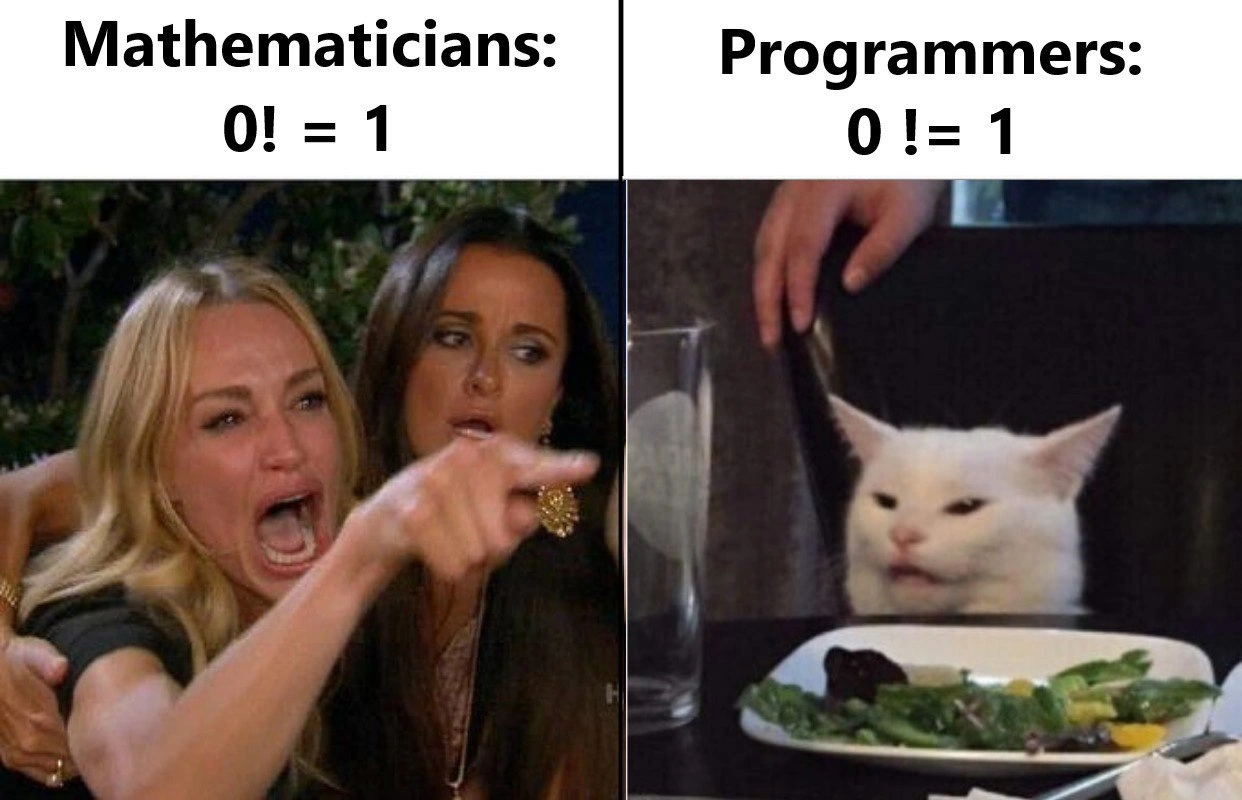
Now, about the meme image: it’s framed as an argument. On the left, the mathematician (represented by the yelling woman) strongly insists on the fact 0! = 1. She’s basically saying, “Zero factorial is one, and that’s that!” On the right, the programmer (the calm cat at the dinner table) is asserting 0 != 1, essentially saying, “Zero is not equal to one, obviously.” The cat looks a bit confused or fed up, which matches a programmer seeing the mathematician’s statement and going, “Well of course 0 isn’t 1, why are you yelling?” Meanwhile, the woman is furious because from her perspective the cat (programmer) just stated something that sounds like “0 is not equal to 1”, which she interprets as if the cat is denying her statement that 0 factorial equals 1. It’s a comedic misunderstanding.
This kind of mix-up is a known language gotcha. It’s like a syntax joke that plays on the fact that the same symbol can mean different things in different arenas. In computer science and programming, we often borrow symbols from math but give them our own twist. Most of the time, it’s fine because context tells you what’s what. But here the context is deliberately removed and mashed together to create humor. If you’re a newcomer to coding, take this meme as a light-hearted warning: always be mindful of context. A ! in a coding exercise likely doesn’t mean factorial, and an exclamation mark in a math formula doesn’t mean “not”.
Think of other examples: in some programming languages ^ means XOR (a bitwise operation), but a math student might think ^ means “to the power of”. Or the word “null” in everyday language means empty/nothing, but "null" in SQL is a tricky beast (not exactly a string "null" or zero, but a special non-value). These little language quirks can surprise you. The factorial vs not-equal is a harmless example because no one is actually writing 0! = 1 in code expecting it to compile. But it perfectly illustrates the general idea: the same notation can’t always be shared across domains without confusion.
So to recap in plain terms: the mathematicians are right that 0 factorial is 1 (that’s a true math fact), and the programmers are right that 0 is not equal to 1 (that’s a true programming/comparison fact). They’re not really arguing about the same question at all, but it looks like they are because of how the notation lined up. The result? A funny ComputerScienceHumor moment that also sneaks in an educational point about understanding your context in both math and programming.
Level 3: Symbol Semantics Showdown
In this meme, two formal languages clash over a tiny symbol, resulting in a nerdy standoff. On the left, a mathematician is essentially screaming “Zero factorial equals one!” while on the right, a programmer (personified by the calm cat) asserts “Zero is not equal to one.” Both statements use the character !, but in radically different contexts:
Mathematicians: 0! = 1
Programmers: 0 != 1
Here’s the twist: both sides are actually correct in their own domain! 🎉 The humor comes from the overloaded exclamation mark — the same symbol means completely different things depending on who’s reading it. This context switch creates a perfect storm of confusion and hilarity, a classic example of language quirks in action.
In mathematics, the notation n! denotes the factorial of n. By definition (or convention), 0! = 1. This might seem counter-intuitive at first (how can multiplying “nothing” give 1?), but it’s a well-established rule that makes many formulas work out neatly. For example, the factorial definition $n! = n \times (n-1)!$ stays consistent at $n=1$ because $1! = 1 \times 0! = 1 \times 1 = 1$. It’s also rooted in combinatorics: there’s exactly one way to arrange zero objects (basically, do nothing). Mathematicians treat the equation 0! = 1 as a fundamental truth, as obvious to them as saying 2+2=4.
In programming, especially in languages influenced by C, != is the not-equal operator. It’s read as “is not equal to.” So 0 != 1 is a boolean expression that evaluates to true because, well, zero is indeed not equal to one (a statement no one in either camp actually disputes!). Programmers see the exclamation mark ! and instinctively think “NOT”. In many languages, ! is the logical negation operator (sometimes pronounced “bang”) that inverts truth. When combined with =, forming !=, it checks inequality. So to a coder, 0 != 1 is just a routine comparison, as mundane as saying the sky != the ocean. The white cat’s deadpan face fits the programmer’s side perfectly: “Why are we even arguing? Of course 0 isn’t 1.”
The comedy gold arises from context collision. The string of characters 0! = 1 means one thing to a mathematician and something completely different to a coder who misreads it as 0 != 1. It’s a syntax overloading issue: identical syntax, divergent semantics. Each side sees the other’s statement and goes “Are you crazy? That makes no sense!” The mathematician thinks the programmer is denying the fact that 0! is 1 (a core math fact), while the programmer thinks the mathematician is somehow claiming 0 == 1 (insanity in basic logic). It’s a big “Wait, what language are you speaking?!” moment. Developers love this kind of joke because it highlights how programming languages and mathematical notation can trip you up if you swap contexts. It’s a reminder that in computer science (and life), context is everything.
This meme also plays on the well-known “Woman Yelling at Cat” image template. The woman on the left (from a reality TV outburst) represents the fiery passion of a mathematician defending a non-negotiable mathematical fact. The cat on the right (internet-famous for looking confused behind a dinner plate) represents the programmer’s calm, slightly smug assertion of a logical truth. It’s an absurd visual of a heated debate where, humorously, both are right. The mathematician’s friend is holding her back like, “Don’t lose your mind over this!”, while the cat’s handler just hovers a hand like, “Easy there, let’s hear the cat out.” In real developer life, this echoes those passionate debates where two teammates argue violently, only to realize they were talking about different things all along.
From a seasoned developer’s perspective, this joke hits on a couple of familiar themes:
Language gotchas: We often encounter symbols that mean one thing in one language and something else in another. (Think of how
^means exponent in math but bitwise XOR in many languages, or how Python uses**for exponent instead.) This factorial vs not-equal mix-up is like a textbook case of an operator context switch – the kind that can cause real confusion in code if you’re not careful. A mathematician writing code might try to use!for factorial and get a rude awakening (most languages won’t understand5!and will throw a syntax error or do something unintended).Historical quirk: Early programming languages couldn’t easily use the elegant mathematical symbol “≠” for not-equal (limited character sets on old keyboards and teletypes). So
!=became the adopted ASCII-friendly syntax for inequality (thanks, C language!). It stuck, and now most programmers instinctively use!=to mean “not equal.” Meanwhile, the exclamation mark for factorial has been in math notation for over a century (originating in the 1800s). Neither side is being willfully obtuse – they’re just fluent in different systems that coincidentally both involve a!character but in totally separate roles.Truth in both worlds: It’s ironically satisfying that
0! = 1(math truth) and0 != 1(programming truth value) are both true statements. They sound the same when spoken (“zero factorial equals one” vs “zero is not equal to one”), but they convey distinct truths. In fact, a cheeky bit of trivia: in C/C++ and similar languages, the expression!0actually evaluates to1. Why? Because!is logical NOT, so!0means “NOT 0,” and in those languages 0 is false, not-false becomes true, and true is represented as 1 😅. It’s a total coincidence, but!0 == 1in C, making the programmer cat and the mathematician both smile for different reasons. This isn’t directly what the meme text says, but it’s a fun convergence of semantics that senior devs might chuckle at – the bang operator in code ends up yielding the same number the factorial does, but for completely different reasons! (Just don’t tell the mathematician why – they might throw their salad.)Cognitive switch: Every developer eventually learns that reading math-heavy code or formulas requires switching mental context. A statement like
f(x)!is a factorial in math, but could be a function call followed by a negation in some pseudo-code. Misplacing a single symbol can lead to bugs or misunderstandings. This meme exaggerates that to an extreme: no one would normally confuse “!=” with “!”, because one has an equals sign and the other doesn’t. But visually,0! = 1and0 != 1look tantalizingly similar at a glance (just move the bang one character to the right). It’s the off-by-one-symbol error of inside jokes.
All in all, the humor resonates with developers and computer science folks because we’ve all been in situations where trivial-seeming syntax differences caused big confusion. It could be as serious as a bug from using = instead of == in a conditional, or as lighthearted as teasing our mathematician friends that their notation means something wildly different in code. This meme encapsulates that Aha! moment and the friendly banter between the math world and the programming world. In summary: 0! = 1 is a math fact, 0 != 1 is a code fact, and the only explosion happening is the poor exclamation mark doing double duty and causing an argument. Context-switching is hard – even for a single character!
Description
This meme uses the popular two-panel 'Woman Yelling at a Cat' format to highlight a syntactic ambiguity between mathematics and programming. The left panel features a distraught woman (Taylor Armstrong) yelling and pointing, with the text above reading 'Mathematicians: 0! = 1'. The right panel shows a confused white cat (Smudge the Cat) sitting at a dinner table, with the text 'Programmers: 0 != 1' above it. The humor derives from the different meanings of the '!' character. For mathematicians, '0!' is the factorial of zero, which is defined as 1. For programmers, '!=' is the 'not equal to' comparison operator, so the expression '0 != 1' evaluates to true, which is often represented by the integer 1. The meme cleverly juxtaposes these two correct, yet conflicting, interpretations, using the classic format of an irrational argument to represent the clash of contexts
Comments
7Comment deleted
This is why code reviews with mathematicians are tough. They see '0!' and start talking about combinatorics, while I'm just trying to prevent a null pointer exception
Nothing highlights symbol overloading like a code review where the math PhD swears 0! == 1, the backend lead argues 0 != 1, and the TypeScript dev just wants the exclamation mark to silence the null checker
After 20 years in the industry, you realize the real debate isn't whether 0! equals 1, but whether your factorial implementation will overflow before the product owner asks why negative factorials throw an exception instead of returning infinity like 'the customer expects'
This perfectly captures why code reviews between mathematicians and programmers devolve into philosophical debates about operator precedence. One side is defending the gamma function's elegant definition at zero, while the other is just trying to prevent a production bug where someone accidentally used assignment instead of comparison. Both are technically correct, which is the most dangerous kind of correct in software engineering
Between empty products and C truthiness, 0!, !0, and 0 != 1 all yield 1 somewhere - proof that overloading punctuation scales worse than our microservices
Math: 0! = 1; C: !0 == 1; JS: 0 !== 1 - amazing how one exclamation point can be a factorial, a negation, and a pager
Mathematicians axiomize 0!=1 via empty product; programmers rediscover it when permute([]) returns [[]] instead of crashing