Skip to content
DevMeme
5807 of 7435
The Ascended Art of Unhelpful README Formats
Documentation Post #6364, on Nov 8, 2024 in TG

The Ascended Art of Unhelpful README Formats

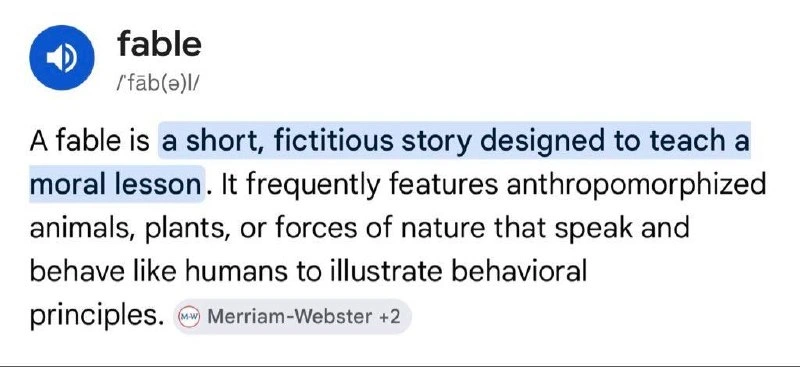
Why is this Documentation meme funny?

Level 1: Keep It Simple

Imagine you want to tell your friend how to find your house for a party. The easiest way is just to tell them plainly: “Take the first left, then the second house on the right.” Now picture instead that you write down the directions on a piece of paper in simple words so they can read it later – that’s already a bit more work, but still clear. Then suppose you decide to get fancy and print out a little map booklet with pictures of each turn – it looks nice, but it was a lot of effort for something simple. Next, you go even further and record a video of yourself walking to the house, talking through each step, and send that to your friend – now they have to watch a few minutes just to get the directions! Finally (for a good laugh), you take those directions and convert them into a secret Morse code message, sending your friend a series of beeps and pauses they’d have to decode to figure out where to go. 🤪 By this point, your poor friend is probably very confused or amused. The whole idea is funny because you took a straightforward task – explaining how to get somewhere – and kept making the way you deliver the message more and more complicated. In the end, the simple approach was the best: just tell them clearly. The meme is joking about the same thing with programming project instructions: sometimes we overcomplicate how we share information, when really everyone just wants clear, easy directions.

Level 2: Decoding the README

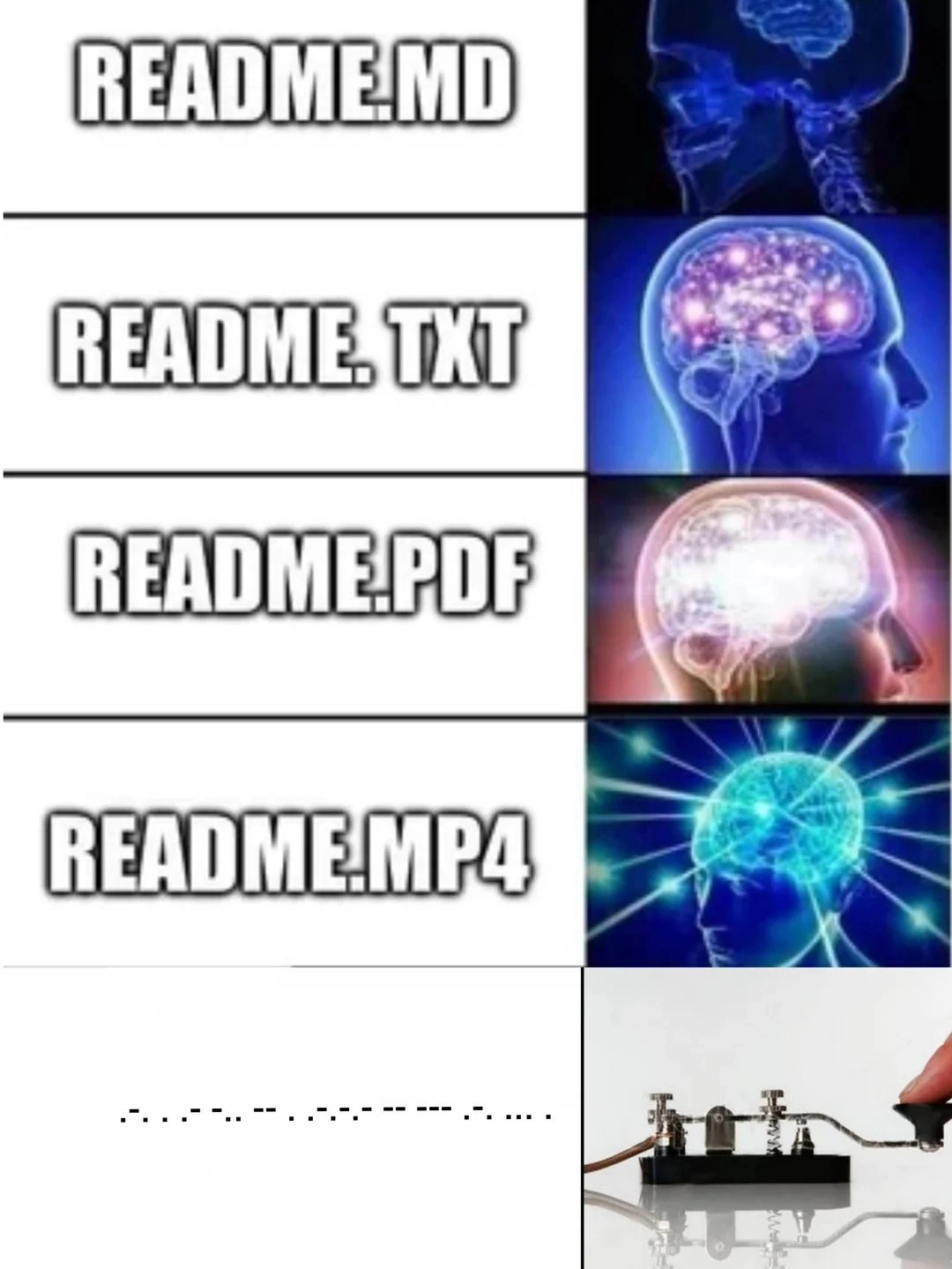
Let’s break down the joke step by step. This meme is using the expanding-brain template, where each row lists a different README file format paired with a brain that’s more illuminated than the previous one. It’s comparing various documentation formats in a tongue-in-cheek way. Here’s what each format means in real life:

  1. README.md (Markdown file) – This is the standard these days for project documentation. A README.md is a text file written in Markdown, which is a simple markup language for formatting text (headers, bold/italic, code snippets, lists, etc.) without needing a fancy editor. On sites like GitHub, the README.md automatically displays as the homepage of the repository with nice formatting. In practice, this file usually contains instructions to install or run the project, a brief overview, and other important notes. For a new developer, finding a clear README.md in a project is a relief – it’s like the project’s “welcome guide.” The meme showing this with a dim brain suggests this is the baseline or ordinary approach (even though it’s a pretty good one!).

  2. README.txt (Plain text file) – This is a README with just raw text and no special formatting. It might look less organized or pretty compared to Markdown, but any computer can open it and it’s very straightforward. This format was common in older projects or simpler setups before Markdown became popular. You’d just see a wall of text instructions. The meme puts README.txt on the next level up with a brighter brain, which is ironic because .txt is actually more bare-bones than .md. The joke hints that someone might think “why bother with Markdown syntax, I’ll just write plain text” as if that’s an epiphany. It’s poking fun but also referencing that ultimately both .md and .txt serve the same purpose: tell you about the project. As a newcomer, you might encounter both .md and .txt READMEs out in the wild – they’re both meant to be read first thing.

  3. README.pdf (PDF document) – PDF stands for Portable Document Format. It’s the kind of file you open in Adobe Reader or a web browser, often used for things like manuals, research papers, or any document where the layout is fixed. A README.pdf in a code project would be a bit unusual, but it does happen especially if the documentation is lengthy or intended to look very professional with images, tables of contents, etc. In this meme, the brain is glowing even more, implying this is a “higher” form of knowledge. In reality, using a PDF for a README can be overkill for developers: you can’t view it directly in a plain code editor, and it’s not as easy to update. But it does convey that the project maintainers put a lot of effort into documentation (perhaps too much effort!). A junior developer might scratch their head if they see a PDF README – you’d have to download it and open it separately just to read the setup instructions. The meme exaggerates this scenario for comedic effect.

  4. README.mp4 (Video file) – An .mp4 is a video format (commonly used for everything from YouTube videos to phone videos). Seeing an README.mp4 suggests the documentation is not written at all, but recorded as a video. Imagine a screen recording or a person talking, explaining how to use the project. That’s very uncommon in a repository (videos are large and not practical to version control), but sometimes project creators include links to YouTube tutorials or demos in their text README. Here, the meme jokingly presents the video file itself as the README. The second brightest brain accompanies this, as if a video tutorial is a super-intelligent way to document a codebase. It’s funny because for developers, having to watch a video for instructions can be impractical – you usually prefer quickly scanning text or code. A junior dev might find a video easier to follow for a complicated setup, but they’ll also realize it’s hard to copy-paste commands from a video or find a specific detail quickly. This part of the meme highlights that turning something as simple as a README into a full audiovisual experience is a bit over-the-top (and that’s why it’s humorous).

  5. Morse code “.-. . .- -.. -- .” – Those dots and dashes are Morse code, an old communication system where letters are encoded as short and long signals (dots and dashes). The string .-. . .- -.. -- . actually spells out “READ ME” in Morse (each letter of “README” converted to Morse). The image next to it shows a hand operating a telegraph key, which is a device that an operator would tap to send Morse code pulses over a wire (from the era before telephones and the internet). This is the final, most “enlightened” stage in the meme’s progression. Of course, no developer really documents their project in Morse code! This is a hyperbolic joke to illustrate a point. It’s basically saying: we’ve gone from normal text to increasingly convoluted formats, ending in something so impractical (and comically archaic) that it highlights how silly this escalation is. For a newcomer, it’s useful to know Morse code was one of the earliest digital codes (just long before computers – humans had to interpret the beeps). But you’ll never be expected to know Morse for reading docs; the meme is using it as a punchline. The humor is that Morse code is about the furthest thing from a user-friendly README – you’d literally have to decode it. It emphasizes, “if we keep complicating documentation, we may as well go back to telegraph-era methods!”

Throughout these stages, the brain images getting brighter imply a tongue-in-cheek “galaxy brain” genius idea with each new format. It’s important to note the sarcasm: usually, we’d consider simpler, well-structured documentation (like Markdown) the best practice. The meme flips this on its head for comedy. It resonates with developers because it’s relatable humor: we’ve all dealt with documentation in various forms, and we know that fancy formats don’t guarantee clarity. If you’re a junior developer, the takeaway is that README files come in different flavors, but the goal is always to help you understand and use the project. And sometimes, engineers joke about these things because, honestly, writing clear docs is hard – so we laugh at the extremes. This meme is a lighthearted reminder not to overthink documentation format: a good old README (in plain text or Markdown) is usually enough. No need to break out the telegraph key just yet!

Level 3: The Medium Is the Message

At first glance, this meme looks like a tongue-in-cheek evolution of project documentation formats, using the classic “expanding brain” (or galaxy brain) template. Each row proposes a new README file format paired with a progressively enlightened brain image. The humor hits experienced developers immediately: it’s satirizing our tendency to continuously reinvent documentation in ever more elaborate ways, even though the basic goal (explaining the project) never changes. The joke is that as the formats get fancier — from a simple Markdown file to a video to even Morse code — the brain images suggest a galaxy-brain level of genius, when in reality these escalating formats are impractical or absurd for a README. It’s poking fun at how we sometimes over-engineer developer documentation under the guise of improving Developer Experience (DX), yet often fail to convey the simple instructions any better than before.

In the software world, a README.md is practically the default for project documentation on platforms like GitHub. It’s straightforward, version-controlled, and rendered nicely in browsers – a sweet spot of simplicity and functionality. The meme starts with README.md as the “lowest” brain tier (a dim blue X-ray brain) implying that this totally normal, sensible choice is somehow the least enlightened idea here. Then it humorously “upgrades” to README.txt (plain text) with a brighter brain. This reversal is intentionally ironic: plain text is actually more old-school than Markdown. By showing a more radiant brain for a .txt, the meme mocks the idea that someone might think dropping formatting is an enlightened move (“who needs Markdown, I’ll use vanilla text!”). It’s a playful jab at contrarian engineers who occasionally insist on ultra-minimalism.

The escalation continues: next is README.pdf with a glowing brain, suggesting an even grander revelation. This targets the enterprise or academic style of documentation – the formal PDF manual. Many senior devs chuckle here because we’ve seen overzealous documentation where instead of a concise README, a project ships a 20-page PDF. Sure, PDF (Portable Document Format) allows polished layout and diagrams, but it’s heavyweight for a quickstart guide. It’s versioned outside the code, not diff-friendly, and often ignored by developers who just want to skim instructions on GitHub. The meme implies that treating a simple README as a published paper or product brochure is an “expansive brain” idea – in other words, overkill masked as wisdom.

The penultimate stage README.mp4 (with a neon starburst brain) parodies the modern trend of video or rich media documentation. This is the “galaxy brain” notion that instead of writing instructions, you’d screen-capture a tutorial or deliver the README as a video file. Experienced devs find this hilarious because a video README is wildly impractical in a repo: it can’t be git diff’d, it bloats the repository, and you can’t quickly search for commands in it. Yet, it’s not unheard of to supplement docs with a demo video or to see projects with animated GIFs and .mp4 walkthroughs on their README page. We grin at this panel because it satirizes how far one might go to engage users—trading easily skimmable text for a time-consuming video. The brain image here is almost transcendent, which underscores the joke: theoretically it’s a “brilliant” new level of documentation (wow, video!), but practically it leaves developers groaning. (Imagine needing to scrub through a 5-minute clip just to find the setup command 😅.)

Finally, the meme’s ultimate enlightenment is pure absurdist humor: a line of dots and dashes “.-. . .- -.. -- .” next to an old telegraph key in use. This is Morse code for “READ ME”. The brightest galaxy brain of all suggests transmitting the project instructions via telegraph signals – effectively turning the README into an encoded cipher from the 19th century. This punchline is intentionally ridiculous. It exaggerates the documentation reinvention to a point of obvious foolishness, implying “we’ve tried text, markup, PDFs, videos… heck, let’s go so far as to require devs to decode Morse code to get their setup info!” It’s a comedic jab at the endless cycle of documentation format fads. Seasoned developers recognize the underlying truth: no matter how clever or flashy the medium, the real challenge is making people actually read the manual. In fact, this meme riffs on the age-old frustration behind RTFM (“Read The Fine Manual” 😇) – the idea that many won’t bother reading instructions in any format. We laugh (perhaps a bit ruefully) because we’ve been on both sides: struggling with sparse docs as newcomers and later grumbling when users ignore the README we painstakingly wrote.

On a deeper level, the meme highlights a kind of format fatigue in developer culture. We’ve gone from plain text files in the UNIX days to Markdown-first workflows, and along the way some have detoured into generating PDFs or building dedicated docs websites, even embedding multimedia. Yet critical information still falls through the cracks. The galaxy-brain escalation is a sarcastic commentary on that phenomenon. It resonates with senior engineers because it’s too real: we’ve seen teammates spend time tweaking documentation generators or pushing a slick format, while the actual content remains incomplete or unclear. We recognize the pattern of over-engineering — focusing on the container over the content. As the meme humorously illustrates, you could deliver instructions by smoke signal or carrier pigeon next, and it wouldn’t matter if the core info is missing or if no one pays attention. The enlightened brain progression here is a send-up of our industry’s occasional tendency to choose novelty or complexity over straightforward solutions. In reality, the simplest approach (a well-written README.md) is usually the most effective, but it’s amusing (and a bit cathartic) to imagine the extremes of documentation madness. This blend of relatability and absurdity makes the meme a hit in developer humor circles: it captures the RelatableDevExperience of README woes and the eternal struggle to communicate clearly, all in one brilliantly exaggerated visual joke.

Description

This image uses the five-panel 'Expanding Brain' (or 'Galaxy Brain') meme format to satirize the different file formats used for README documentation files. The meme progresses from the most standard and sensible choice to the most absurd and impractical. The first panel shows 'README.MD' next to a simple brain scan, representing the common standard. The second panel, 'README.TXT', shows a slightly more illuminated brain. The third panel, 'README.PDF', has a brighter, more active brain, indicating a less practical choice. The fourth panel, 'README.MP4', shows a brain glowing with cosmic energy, a ludicrous option for documentation. The final and most 'enlightened' panel is split into two parts: on the left is the text '...- . .- -.. -- .', which is Morse code for 'README', and on the right is a photograph of a person's hand operating a telegraph key. This represents the ultimate, galaxy-brain level of providing documentation in a deliberately archaic and inaccessible format. The humor derives from the escalating absurdity, mocking the tendency for some to choose overly complex or inappropriate solutions for simple problems, presenting it as a form of intellectual superiority
Comments

25
Anonymous ★ Top Pick The repo with a morse code README probably has a git history rebased into a single commit titled 'init' and uses blockchain for version control
  1. Anonymous ★ Top Pick

    The repo with a morse code README probably has a git history rebased into a single commit titled 'init' and uses blockchain for version control

  2. Anonymous

    Waiting for v2 when the onboarding guide is a gRPC stream - because nothing says “quick start” like needing Wireshark to read the README

  3. Anonymous

    README.MP4? Cute. Enterprise legacy hits peak when it's Morse code - decades of neglect, one dot at a time

  4. Anonymous

    README.mp4 is brilliant - grep can’t find it, diff can’t review it, LFS will invoice you, and next quarter we’ll ship the runbook in Morse to maximize write‑only throughput

  5. Anonymous

    README.mp4 - because if you can’t grep or diff it, you can’t argue with it; final form is the runbook in Morse keyed over a flaky serial console at 3 a.m

  6. @ismailgaleev 1y

    Расширение ложь Билла Гейтса

    1. @sylfn 1y

      please-use-english-in-this-chat

    2. @the_doom_guy 1y

      And Linus Torvalds is based

  7. @Kritcz 1y

    Бинарь?

  8. @the_doom_guy 1y

    Readme.morse, haha classic

  9. @kirisoraa 1y

    hearme.mp3 watchme.mp4

  10. @ZgGPuo8dZef58K6hxxGVj3Z2 1y

    Readme.exe is probably the best

  11. @ZgGPuo8dZef58K6hxxGVj3Z2 1y

    Ewww si= google tracker in the url

    1. @Algoinde 1y

      thanks you killed the embed

  12. @Algoinde 1y

    Yeah, but what about LICENSE.MP3? https://youtu.be/CUleKnUUaGI?si=dn

  13. @jaaaaded 1y

    readme.docx is the worst one i got

    1. @purplesyringa 1y

      how about readme.rtf?

      1. @AmindaEU 1y

        README.cad

      2. @jaaaaded 1y

        isn't rtf just plain text?

        1. @purplesyringa 1y

          Sweet summer child

        2. @SamsonovAnton 1y

          Yeah, the name "Rich Text Format" boldly states just that.

  14. @afdanilkin 1y

    Another one I see sometimes: README.rst. It is supported by GitHub and GitLab

    1. @AmindaEU 1y

      Restructured text should be first class with Python or something and the Sphinx documentation generator (also Python) uses it

  15. @Art3m_1502 1y

    readme.zip

  16. @azizhakberdiev 1y

    readme.torrent

Use J and K for navigation