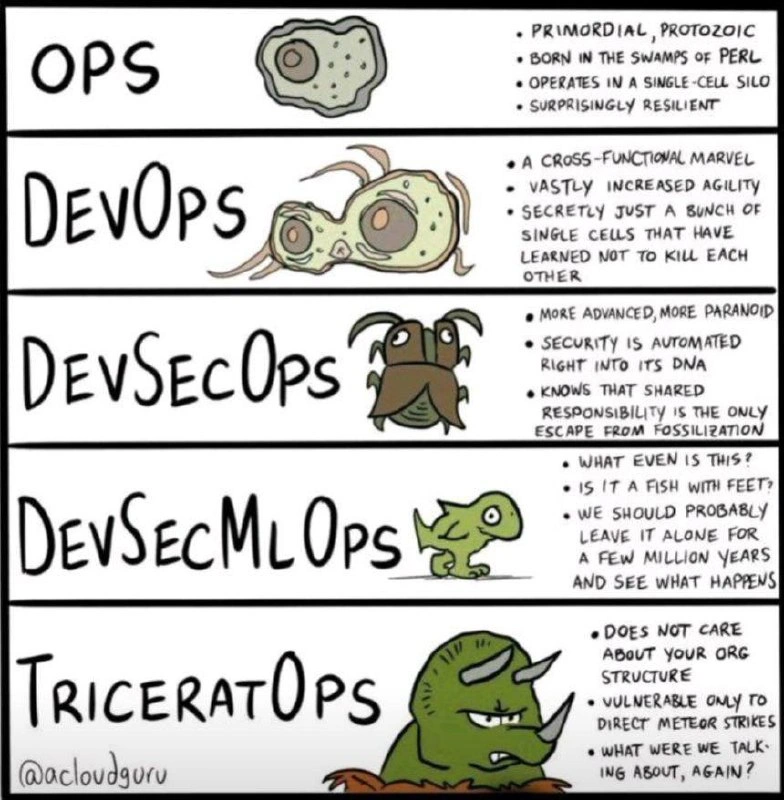
The Evolutionary Ladder of Ops: From Primordial Perl to the Mighty TriceratOps
Why is this DevOps SRE meme funny?
Level 1: When Teams Grow Legs
Imagine you have a one-person band who plays music alone using a drum, a guitar, and a harmonica all at once. They’re like the lone Ops person running around doing everything – it works, but it’s tough and isolated. Now, picture that one-person band turning into a small music group: a guitarist and a drummer start playing together. They have to practice not to step on each other’s beats, but once they sync up, they can play more complex songs – that’s like DevOps, where coding people and operations people cooperate and keep in rhythm. Next, the band decides to add a security guard who checks that the stage is safe and nobody’s sneaking in bad stuff – that’s DevSecOps, building safety checks right into the show. Then things get wild: the band brings in a robot DJ with AI to suggest new tunes on the fly – now we have DevSecMLOps, which is cool but also a bit chaotic because the robot is still learning the ropes (it’s like a fish trying to walk: it might be the future, but it’s a bit clumsy right now!). Through all these changes, there’s also an old music teacher in the corner – he’s seen all the music trends come and go. He doesn’t really change how he plays his trusty grand piano no matter what new gadget or style the band tries. He’s like the TriceratOps: a wise old dinosaur who will keep doing his thing unless something huge forces him to stop (like the power going out – the musical version of a meteor strike!).
In simple terms, the meme is funny because it shows a team getting more and more complicated (and buzzword-filled) over time, kind of like animals evolving weird new features. But at the heart of it, they’re still trying to do the same basic thing they always did: work together to put on a good show (or in tech, to deliver good software). It’s making us laugh at ourselves for always inventing new names for how we work, when maybe we’re not so different from where we started – we just have fancier instruments now.
Level 2: Silos to Synergy
Let’s break down what each of these “-Ops” species means in plainer terms, and why this evolutionary joke makes tech folks laugh. This cartoon is basically using evolution as a metaphor to chart the history of modern software operations practices. Each row in the meme shows a stage in that history with a creature and some traits. Here’s the key idea of each stage:
Ops (Operations) – This is the starting point, the single-celled organism of the tech world. “Ops” refers to IT Operations: the people who manage servers, deploy applications, and keep things running. In the old days (and still in many places), Ops was a separate team from developers. They often worked in isolation – a bit like a tiny amoeba living on its own. The meme calls it “primordial, protozoic” to emphasize it’s the original form. The bullet “Born in the swamps of PERL” is a playful way to say a lot of early Ops work was done with Perl scripts (Perl is a scripting language that was extremely popular for system admin tasks). So picture an ops engineer in the 1990s or early 2000s: working in a silo, writing Perl or shell scripts to deploy code onto physical servers, maybe late at night in a data center. They operate as a single cell, meaning they handle their domain alone and don’t integrate much with others. They’re “surprisingly resilient” because even with primitive tools, they manage to keep systems alive (through sheer dedication and clever hacks). Many companies still have some “protozoan” Ops aspects – like that one script Bob in Ops wrote 10 years ago that still deploys the database every week.
DevOps – Now we have evolution’s first big leap: Developers (Dev) and Operations (Ops) coming together. DevOps is all about breaking the wall between writing code and deploying/maintaining code. Instead of separate silos doing those tasks, DevOps encourages a collaborative team that does both. The meme draws this as a slightly more complex creature (with two eyes, maybe representing the two groups?) and calls it “a cross-functional marvel.” Cross-functional means the team has people with various skills working together (coding, testing, deploying, monitoring – all in one). “Vastly increased agility” refers to the speed: by collaborating, they can deploy updates much faster and more often. In real life, DevOps practices include things like Continuous Integration/Continuous Deployment (CI/CD), where code automatically gets built and rolled out if tests pass. It also involves a cultural shift: devs and ops folks plan together, share responsibilities, and use tools that give everyone visibility (like combined dashboards, alerts, etc.).
The joke “secretly just a bunch of single cells that have learned not to kill each other” means that even in a DevOps team, you still have individuals doing different jobs (you might still have an “ops-focused” person and a “dev-focused” person), but now they communicate and cooperate instead of working at cross purposes. Think of it like a tiny group project team: each person might have their specialty, but they’ve agreed not to sabotage each other and to work towards a common goal. For a junior developer, you might experience DevOps if you’re asked to write not just code, but also maybe a Dockerfile or a deployment config – tasks traditionally done by ops. And conversely, an ops engineer might sit in on design meetings or write some application scripts. Everyone is wearing a bit broader hats.
DevSecOps – This stands for Development + Security + Operations. It’s like taking a DevOps team and adding a security mindset into it from the start. The meme draws it as a more advanced bug-like creature with armor (fitting, because security is like armor). It says “more advanced, more paranoid.” In practice, DevSecOps means when you develop and deploy software, you automate security checks all along the way. For example, as a developer, you might use tools that scan your code for vulnerabilities every time you push to GitHub. Or the build pipeline might fail if you included a library with a known security flaw. Security is not something done in isolation by a separate team at the end; it’s baked into the process (in its DNA), as the meme notes.
The phrase “shared responsibility is the only escape from fossilization” sounds fancy, but it’s basically saying: if we don’t all take responsibility for security, we’ll become outdated (or “fossils”). In other words, modern systems change so fast that if you try to bolt security on at the end like in the old days, you’ll be too slow and insecure. So everyone (devs, ops, etc.) shares the duty of keeping things secure as they go. A simple example: when writing code, a DevSecOps culture encourages you to think “Is this safe against SQL injection or XSS?” (classic security issues) as you code, rather than waiting for a security reviewer weeks later. For someone new to the field, you might encounter DevSecOps when your team uses things like linting or scanning tools in your CI pipeline, or when you have to fix a “security bug” that the automated scan caught before merging your code.
DevSecMLOps – Alright, this one is a bit of a playful stretch. You won’t see too many job postings explicitly for “DevSecMLOps” (yet), but it’s combining MLOps with DevSecOps. Let’s unpack that: MLOps is a term for applying DevOps principles to Machine Learning projects. If you’ve dabbled in data science or machine learning, you know that training models and deploying them is a whole process in itself – you have data preparation, model training, validation, etc. MLOps tries to formalize that so it’s not a wild west. This includes versioning your datasets, automating model training runs, deploying models via APIs or services, and monitoring them (because models can “drift” over time as data changes). Now, DevSecMLOps implies doing all of that, plus ensuring security throughout.
The meme shows this stage as a weird little green amphibian – like a fish that grew legs. It literally asks, “What even is this? Is it a fish with feet?” That reflects the confusion many feel: the industry is piling so many things together (Dev + Sec + ML + Ops) that it’s not even clear what to call it or how it works in practice. The bullet “We should probably leave it alone for a few million years and see what happens” is saying this concept is so new (and perhaps half-baked) that we need to give it more time to mature. For a junior developer, you likely haven’t encountered a fully-fledged DevSecMLOps pipeline because very few places have all these pieces perfectly integrated. You might, however, encounter parts of it: for example, you create a machine learning model and then work with an ops person to deploy it using CI/CD (that’s MLOps). And you might also consider security, like anonymizing personal data, or ensuring your ML model can’t be easily hacked or misused (security in ML is a nascent field). So DevSecMLOps is basically the ultimate combo: build software fast (DevOps), build it securely (DevSecOps), and handle ML workflows too (MLOps). No wonder the meme is drawing it as a strange creature – it’s a lot to take in! This part of the meme pokes fun at our tendency in tech to keep gluing new buzzwords on as we incorporate more fields.
TriceratOps – This is not an official term; it’s a pun combining Triceratops (the dinosaur) with Ops. This final stage in the comic is both a joke and a commentary. The creature is a big dinosaur with three horns (like a Triceratops) and it seems grumpy or unimpressed. The text says things like “Does not care about your org structure” and “Vulnerable only to direct meteor strikes.” What’s this telling us? Essentially, TriceratOps represents the old-school, established way of operations that’s huge and not easily disturbed. It could be seen as the final form – or possibly a dead end (“dinosaur” often implies something outdated, but the twist here is that it’s incredibly tough and enduring until a massive event happens).
For context, a real Triceratops was a large, solid herbivore that lived at the end of the age of dinosaurs – it would pretty much ignore small threats but got wiped out when a giant meteor hit Earth. In tech terms, think of a legacy system or an old methodology that refuses to die. For example, a big enterprise might still be using a mainframe or an ERP system from the 90s to run critical operations. It doesn’t matter how many DevOps or DevSecOps teams you spin up around it; that core system doesn’t change and doesn’t care about your new org chart or trendy methodologies. It will keep chugging along doing its thing. It’s “vulnerable only to direct meteor strikes” meaning only something truly catastrophic – like the company going bankrupt, or the hardware failing with no replacement, or a truly earth-shattering tech change – could force it to retire. The line “What were we talking about, again?” adds humor by showing the dinosaur ops has basically tuned out of this conversation about evolution; it’s implying that these new-fangled terms sometimes go over the head of entrenched practices (or they just don’t bother to pay attention).
For someone early in their career, TriceratOps is a reminder that not every company is on the bleeding edge. You might encounter teams or systems that seem ancient but they stick around because they work. It’s also a bit of a cautionary hint: if a practice or system becomes too static and refuses to adapt at all, it risks a “meteor strike” event. For instance, a business that refused to adopt any DevOps principles might find itself unable to compete and essentially face extinction. But until that happens, that big old dinosaur is going nowhere.
Why is all this funny? Because it exaggerates the progression of trends in a way that’s very relatable to tech folks:
- We often jokingly talk about new methodologies as “evolutionary stages” or “next-gen,” and here it’s literally drawn that way.
- Each added term (DevSecMLOps!) makes the creature name longer and sillier, pointing out how absurd these jargon combos can become.
- Yet, each one has a kernel of truth from real experience (the lone Perl ops, the DevOps team learning to get along, the security paranoia, the confusion with ML, and the stubborn legacy stuff).
If you’re learning these concepts, don’t worry – the meme isn’t mocking the ideas themselves (DevOps and DevSecOps are actually very important improvements in how we build software!). It’s poking fun at how the industry sometimes over-hypes things and stacks buzzwords, and how, in the end, we might just be reinventing what we were already doing in a slightly shinier way. The evolutionary roast reminds us not to take the hype too seriously and to recognize the common thread through it all: deliver working, safe software, and adapt when needed.
Level 3: Adapt or Fossilize
This meme hits home for senior engineers because it satirizes the hype-cycle of “Ops” buzzwords we’ve lived through, while hinting at the unchanging core beneath all that hype. It’s a humorous reflection on how our industry keeps renaming and “evolving” the operations role by piling on new responsibilities – from plain Ops to DevOps, then DevSecOps, now MLOps (or absurdly, all combined into DevSecMLOps). Each step was born from real pain points, but the meme’s cynical undercurrent suggests that despite all these mutations, many fundamentals (and pain points) remain the same.
Let’s walk through these evolutionary stages with an experienced eye:
Ops (Primordial) – In the beginning (think pre-Agile, early 2000s and before), there were siloed Operations teams. They lived in their own world (a “single-cell silo”) maintaining servers, deploying code handed off by developers, and writing quirky scripts to automate ugly but necessary tasks. The meme’s description “Born in the swamps of PERL” is a witty nod to that era. Perl was famously the duct-tape of the Internet – sysadmins wrote inscrutable
*.plscripts to handle nightly builds, cron jobs, and deployment chores. These scripts were often messy, but surprisingly resilient, much like a hardy amoeba that refuses to die. A veteran engineer chuckles at this because it rings true: some of those ancient Perl or Bash scripts from the “primordial soup” of IT are probably still running in corners of production, quietly doing their job. They were monolithic and not pretty, but they evolved in harsh conditions (low resources, no cloud, no fancy pipelines) and thus could take a beating.#!/usr/bin/perl # A snippet of primordial Ops automation in the swamp of Perl use File::Copy; my $build = "/var/builds/latest.tar.gz"; if (-e $build) { copy($build, "/var/www/prod/app.tar.gz") or warn "Deploy failed: $!"; } # It's not pretty, but it deploys the latest build to production (most of the time).(Above: an imagined relic of the Ops Permian era – a simple Perl deployment script. It’s hacky, but like a single-celled organism, it gets the job done without any fancy structure.)
Classic Ops operated as an isolated silo: developers tossed code “over the wall,” and ops caught (or fumbled) it in deployment. This often led to an us-vs-them mentality. If something broke at 3 AM, Ops was on the hook, and they’d sometimes resent devs for deploying finicky code. Developers, in turn, got frustrated by slow ops processes. This separation was primal and inefficient, but it was the status quo for a long time – until environments changed and faster adaptation was needed.
DevOps (Cross-functional) – Fast forward to around 2009–2010: the industry faced new pressures for speed and agility. Startups and tech giants alike needed to ship features continuously to stay competitive. The old “waterfall” approach (long dev cycles, then a handoff to ops) was too slow. The environment rewarded those who could adapt quickly. Enter DevOps, often heralded as a cultural revolution where Dev and Ops would finally work as one organism. The meme calls DevOps “a cross-functional marvel” with “vastly increased agility.” Indeed, DevOps practices introduced things like CI/CD pipelines, infrastructure as code, and the idea that developers and ops engineers share responsibility for the product from development through production.
In practice, DevOps meant tearing down the wall: devs started learning deployment and monitoring, ops folks got involved earlier in the development process, and both started speaking each other’s language (sometimes via the intermediary of a new breed of tools like Jenkins, Docker, Kubernetes, etc.). For a senior who’s been through this shift, the memory is vivid: earlier in their career they might have been the “Ops amoeba” manually deploying, and suddenly they had to become part of a multicellular team, pairing with developers to automate everything. It did feel like gaining superpowers (or at least extra limbs) – deployments that used to take all night became push-button, and issues could be resolved faster because everyone was on the same team.
However, the meme wryly notes “Secretly just a bunch of single cells that have learned not to kill each other.” This hits on a truth: even in a DevOps team, you still have individuals with specialized skills (your database guru, your networking expert, your coding whiz). They haven’t merged into a single amorphous being; rather, they learned to coordinate without conflict – much like cells in a multicellular organism coordinate via signals instead of competing. For seasoned DevOps practitioners, this line resonates as a humorous reminder that cultural change was as important as the tech. The hardest part of DevOps was never the tools — it was convincing humans (cells) to collaborate and trust each other. When it works, a DevOps team is a harmonious unit (no one gets eaten alive in blame games), but it took plenty of failed experiments and cultural coaching to get there. Many of us recall those early DevOps days: post-mortems replacing blunt finger-pointing, chatrooms bridging the dev/ops divide, and maybe an ex-ops person teaching developers how to write a proper deployment script (or vice versa). In other words, what the meme calls a “marvel” was really hard-won peace. We stopped killing each other (figuratively) and started killing the deploy tickets instead.
DevSecOps (Secure from the start) – Once dev and ops learned to play nice, another longtime silo emerged into focus: security. In older models, security was often a separate team that swooped in at the end (or after a breach) to audit or lock things down, sometimes viewed as an obstacle to speedy releases. But high-profile hacks, data breaches, and regulatory demands in the 2010s turned up the pressure – security could no longer be an afterthought. So the industry’s next adaptation was to integrate security deeply into the DevOps pipeline, giving birth to DevSecOps. The meme’s trilobite-like creature reflects an evolutionary step up in complexity (trilobites had exoskeletons – an early “security system” for bugs!). The bullets “More advanced, more paranoid” and “Security is automated right into its DNA” encapsulate how a DevOps pipeline evolved an immune system. To a senior engineer, DevSecOps means things like:
- Every code commit triggers not just builds and tests, but also security checks – e.g., static code analysis for vulnerabilities, dependency scanning for known CVEs, container image scans, etc.
- Infrastructure templates include security by default (no leaving S3 buckets accidentally public or using default passwords).
- Teams adopt a “shift-left” mindset: developers are taught to think about security from day one, not leave it to a separate “security czar” at the end.
In short, security became a shared responsibility across dev and ops roles, rather than a final gate. This is reflected in the meme: “Knows that shared responsibility is the only escape from fossilization.” The term “fossilization” humorously suggests that if we didn’t evolve to integrate security, we’d become antiquated or dead (like a fossil in an era of agile predators). A senior dev might recall painful lessons that led to this change – e.g., that one time a deployment had to be rolled back at the last minute because InfoSec found a critical flaw after release; or a frantic all-hands after a security incident that made it clear the old silo model wasn’t working. DevSecOps was the adaptation to avoid those catastrophes by making security continual and proactive.
From experience, this stage also introduced its own headaches: new tools to learn, pipeline failures due to a flagged vulnerability in a library, developers needing to fix security issues they never even considered before. Essentially, we traded one kind of risk (ignoring security until it’s too late) for another manageable inconvenience (occasional false positives or extra steps in the pipeline). As a battle-scarred engineer, you find humor in the “more paranoid” description – yes, our processes became a tad paranoid, but for good reason. We joke that now everyone on the team has a bit of a tinfoil hat on – scanning logs for intrusion attempts, not trusting any dependency – but that paranoia keeps our systems alive in a threat-filled environment.
DevSecMLOps (Everything plus the kitchen sink) – Now we enter truly chaotic territory. The meme asks “What even is this?” because honestly, many seniors are asking the same. MLOps by itself is a fairly new practice: it’s about applying DevOps principles to Machine Learning workflows. For instance, versioning datasets and models, automating model training, continuous integration of ML code, continuous delivery of model updates, monitoring model performance in production (did our prediction accuracy drop?), etc. Companies realized that throwing a Jupyter notebook over the wall to ops is just as bad (or worse) as throwing raw code – you need a structured process to deploy AI models reliably. MLOps is still evolving; it’s that awkward “fish with feet” trying to venture onto land. Different organizations handle it differently: some have data scientists and engineers working closely (like multi-cell cooperation), others are still pretty siloed (the data science team might feel like an isolated aquatic creature). A senior who’s dabbled in MLOps knows it can involve a whole menagerie of new tools (Kubernetes, Kubeflow, MLFlow, feature stores, etc.) which sometimes feel like building a spaceship just to launch a model update. Now DevSecMLOps – that’s basically saying “do all that, plus everything aforementioned for security, plus everything for standard ops, all together.” It’s the ultimate mutation: a creature with so many appendages and subsystems that it’s hard to classify.
The meme wisely suggests we let it marinate for a few million years. In real terms, that means the industry hasn’t fully settled on best practices here. Should every DevOps engineer also learn the intricacies of machine learning pipelines? Do we infuse security into our ML models’ lifecycle too (ensuring our ML code and data pipelines are secure and ethical)? The likely answer is yes, eventually – but today, it’s something being hashed out through trial and error. As a result, DevSecMLOps in practice might look like a patchwork of roles: a DevOps engineer tries to containerize an ML model one day, a data scientist learns about Docker and CI for model code, a security engineer sets guardrails around data access – and they all try not to step on each other’s toes. There’s definite comedy in this scenario for anyone who’s been involved: imagine a three-legged race with a developer, a security expert, and a data scientist all tied together, running across cloud infrastructure – it’s both funny and a bit of a mess!
Experienced folks laugh at “Is it a fish with feet?” because we’ve seen many “half-evolved” tech initiatives in our careers. (Remember early mobile apps that were basically desktop sites awkwardly crammed on a phone? Or initial cloud migrations where people treated VMs like physical servers? Those felt weird until better patterns emerged.) DevSecMLOps might be weird now, but given time, the kinks will likely work out – or it might flop if it proves too unwieldy. Natural selection is at work: useful practices will survive as standard DevOps+ML, and anything overly convoluted will die off when its cost outweighs benefits.
TriceratOps (Dinosaur Ops) – Finally, we arrive at the punchline: the TriceratOps. This is where the meme’s roast of modern operations comes full circle. After all the fancy evolved forms, we meet a grumpy dinosaur who ostensibly “does not care about your org structure.” To a senior engineer, this immediately conjures images of legacy systems or old-school IT veterans that persist in a company no matter what new methodology is trending. It could be that giant mainframe application in the back room that’s been running since the 90s, tended by one or two old-guard operators who scoff at containerization talk. Or it’s that lead sysadmin who’s been around 20+ years, who has survived every re-org, every new CTO with a pet methodology, by virtue of actually knowing how everything works. That person/system is virtually untouchable – “vulnerable only to direct meteor strikes.” In day-to-day terms, only something like the data center literally catching fire, or perhaps the dinosaur admin finally retiring, would significantly disrupt things. Normal changes (new CFO wants DevFinOps, or someone introduces a fancy platform tool) bounce off this TriceratOps like little meteors off a dino’s hide.
There’s an undercurrent of truth here: many organizations have at least one critical piece of infrastructure or process that is dinosaur-old and rock-solid. It doesn’t adapt much, it doesn’t need to, and it forms the backbone that newer, more experimental projects rely on. For example, that might be a rock-solid transactional database (or even a mainframe) that has reliably processed orders for decades – you modernize around it, but it itself might not ever become “DevOps” or “cloud-native.” It just works, and people leave it alone (often because changing it is riskier than benefiting from it).
The meme’s final jab “What were we talking about, again?” is the perfect capstone. It implies that TriceratOps – symbolic of these steadfast legacy pillars or curmudgeonly ops veterans – isn’t even paying attention to the DevSecMLOps hype we were so excited about. It has outlived buzzwords and perhaps finds them trivial. This line likely makes senior folks smirk because we’ve all seen how today’s hot methodology can become tomorrow’s forgotten fad. One moment everyone’s debating some new DevOps tool or process, and a year later nobody mentions it because the next thing arrived. Meanwhile, the fundamentals (like keeping servers running, responding to incidents) continue unperturbed. TriceratOps reminds us of that continuity and perhaps whispers, “Calm down kids, we’ve been doing a version of this forever.”
In summary, the senior perspective sees the humor in how each Ops evolution is both a real improvement and a rebranding of age-old challenges:
- We solved siloed communication by working together, but we’re still wrangling humans and technology – that hasn’t changed.
- We added security into the pipeline, but we still chase bugs and vulnerabilities like we always did, just earlier now.
- We’re adding ML into the mix, but it’s just another kind of software (with data wrinkles) that we need to deploy reliably.
- And in the end, the ultimate reliability often still lies in simple, time-tested solutions (our dinosaur systems or the Unix philosophy or that one script that never fails).
This meme is funny-accurate for senior devs and SREs because it’s basically our collective tech history portrayed as an absurd nature documentary. We’ve lived through the “evolution of ops,” and we nod knowingly (with a chuckle) at each step. The next time management announces a new “Ops” buzzword initiative, we might just picture a fish sprouting legs or a unimpressed Triceratops, and remember that plus ça change, plus c’est la même chose – the more things change, the more they stay the same (at least in Ops).
Level 4: Ops Phylogeny Parody
At the most abstract level, this meme presents a phylogenetic tree of Ops practices – a tongue-in-cheek Darwinian chart from primordial single-cell Ops to a horned dinosaur “TriceratOps.” It’s drawing an evolutionary analogy to the way tech organizations have adapted over time. Just as life on Earth evolved new organs and defenses under selective pressure, software teams kept bolting on new “-Ops” capabilities in response to shifting IT environments. The result is a lineage of increasingly complex “multicellular” DevOps creatures.
In evolutionary biology, single-celled organisms banded together into multicellular life for greater survival advantage – cells specialized but had to cooperate (and crucially, not destroy each other). In tech, the classic siloed Ops team was like a lone amoeba: self-contained, scrappy, and resilient in its niche (say, a sysadmin in the “swamps of Perl” automating deployments with duct-tape scripts). Dev and Ops were separate species in the IT ecosystem for decades. But when rapid software delivery became the new environment, DevOps emerged as the multi-cellular organism: development and operations fused into one cross-functional organism to survive the demands for speed and continuous deployment. This was a Cambrian explosion in our industry’s culture – suddenly every company needed this new cooperative DNA to thrive, analogous to how the Cambrian period saw a burst of new life forms once cells learned to work in colonies.
Each subsequent “Ops” mutation corresponds to another step up the evolutionary ladder:
DevSecOps added a built-in immune system, if you will. As threats grew and compliance pressures mounted (the “predators” and harsh environment of the tech world), security practices had to be encoded into the organism’s DNA rather than tacked on later. In biology, complex organisms evolved immune cells patrolling for invaders; in DevSecOps, automated security scans and policies are embedded in the pipeline (unit tests, integration tests, SAST/DAST tools watching for vulnerabilities) from the start. The meme’s bullet “Security is automated right into its DNA” nails this parallel. The result is a more paranoid but better-defended creature – an organism less likely to fossilize (become obsolete) because it adapts to its hostile environment continuously. Shared responsibility is highlighted as the escape from fossilization: in evolutionary terms, it’s like each cell or team member carries part of the defense mechanism, preventing the whole from turning into a security fossil stuck in the past.
DevSecMLOps is portrayed as a fish with legs – a direct nod to transitional fossils like Tiktaalik (the famous fish-amphibian hybrid). This is the meme’s way of saying “we’re witnessing an awkward but significant evolutionary step.” Machine Learning efforts have lived somewhat like fish in their own separate water (data science teams doing experiments in isolation). Now organizations attempt to bring ML out onto land, integrating model training and deployment into the DevOps pipeline (thus, MLOps). The addition of “Sec” makes it DevSecMLOps: everything including security and ML all in one organism. It’s an ungainly hybrid right now – an experiment in progress. Just as early amphibians were weird and clunky on land, early attempts to unify data science, engineering, and ops (with security oversight) feel confusing and half-evolved. The meme jokes “What even is this? Is it a fish with feet?” indicating nobody is quite sure how to classify this thing yet. And the caption “leave it alone for a few million years and see what happens” suggests that, given time (and iterative adaptation), this precarious fusion might evolve into a well-adapted new creature in the tech ecosystem. It’s an evolutionary bet: some of these ML-integration practices will survive (becoming standard “best practices” in the future), while others might be evolutionary dead-ends that go extinct.
Finally, TriceratOps enters as a big, cranky dinosaur. In the evolutionary analogy, we’ve jumped to the Late Cretaceous of tech operations. The dinosaur represents something both advanced and old. It’s advanced in the sense of being a large, mature organism with thick armor – perhaps symbolizing the hardened, battle-tested legacy systems or veteran Ops practices that have seen it all and survived. Triceratops in nature had few predators; similarly, the meme quips this beast “is vulnerable only to direct meteor strikes.” In IT terms, a “meteor strike” is an extreme, cataclysmic event – maybe a total paradigm shift or an extinction-level incident (think of a massive cloud outage, a company-wide migration to a new platform, or a critical zero-day exploit). Short of such a disaster, the dinosaur Ops plods along undisturbed by org chart changes or the latest trendy frameworks. This creature “does not care about your org structure” – it’s indifferent to whatever DevSecBizDataMLOps re-org the leadership is currently excited about. It has its way of doing things that has kept systems running since ages past. In evolutionary terms, it’s like a living fossil – highly optimized for a bygone environment yet still kicking around.
There’s a paradox in this Ops phylogeny. We set out thinking each new -Ops development is a revolutionary leap, but the meme slyly implies it’s more of a continuum. Genetically, each new creature still carries the core DNA of the previous. Our modern DevSecMLOps pipeline still runs on scripts and servers set up by Ops fundamentals; it just has new regulatory genes toggled on. Despite all the mutations, the fundamental mission – “keep the software running and deliver value” – has remained constant since the single-cell stage. In other words, we’re dressing up the same reliable single-celled core with fancy new horns and frills. The humor (especially appreciated by seasoned engineers) comes from recognizing this pattern: tech’s buzzwords evolve at breakneck speed, but underlying needs and problems are ancient. Much like how a Triceratops and an amoeba are vastly different yet share some primordial cellular machinery, our cutting-edge DevSecMLOps pipelines ultimately owe their existence to those scrappy one-cell Ops scripts and habits that came first.
Description
This is a five-panel comic from '@acloudguru' illustrating the evolution of 'Ops' roles in the tech industry using prehistoric creatures as metaphors. The first panel shows 'OPS' as a single-celled organism from the 'swamps of PERL'. The second, 'DEVOPS', is a multi-celled organism where cells have 'learned not to kill each other'. The third, 'DEVSECOPS', is an armored insect with security 'automated right into its DNA'. The fourth, 'DEVSECMLOPS', is a strange fish with feet, representing a new, uncertain evolutionary step. The final panel is a pun, 'TRICERATOPS', depicted as a powerful dinosaur that 'does not care about your org structure' and is 'vulnerable only to direct meteor strikes'. The comic satirizes the continuous addition of prefixes and responsibilities to the Operations role in tech, reflecting industry trends and buzzwords. It humorously traces the progression from siloed system administration (Ops) to collaborative development (DevOps), integrated security (DevSecOps), and the emerging complexity of machine learning operations (MLOps). The punchline, 'TriceratOps,' cleverly breaks the pattern to represent a powerful, legacy-style force, perhaps a tenured principal engineer or an unchangeable system, that is immune to modern organizational trends. This resonates with senior engineers who have seen these roles evolve and multiply over their careers
Comments
11Comment deleted
I'm waiting for the next stage of evolution: DevSecMLOpsArchFinLegal-Ops. The creature will just be a sentient pile of Jira tickets that assigns itself story points
Sure, we’ve reached TriceratOps, but the 3 AM pager is still fired by that Jurassic 2001 Perl cronjob buried under six layers of YAML
After 20 years in tech, I've watched us evolve from 'just restart the server' to 'the AI-powered security-aware deployment pipeline needs a therapist' - and honestly, the Triceratops approach of ignoring org charts and only fearing extinction-level events is starting to look like senior architect wisdom
The evolutionary chart perfectly captures how each Ops iteration adds another layer of complexity while claiming to simplify things - DevOps promised to break down silos but really just taught teams 'not to kill each other,' DevSecOps automated paranoia into our DNA, MLOps became so complex we're not even sure if it's a fish or a lizard, and TriceratOps? Well, it's survived every extinction-level event your org has thrown at it, outlasted three reorganizations, and still doesn't care about your new matrix management structure. The real joke is that we're all still running Perl scripts from the Ops era in production, because that single-celled organism turned out to be surprisingly resilient - just like that 15-year-old cron job nobody dares to touch
Conway's Law, visualized: Ops -> DevOps -> DevSecOps -> DevSecMLOps; complexity evolves faster than accountability. By TriceratOps, the only thing with three horns is the triage queue
From swamp to SRE: same mud, different acronyms
DevSecMLOps is what happens when the reorg generator overfits; TriceratOps is the staff SRE who ignores org charts and only escalates for actual meteors
oOps: Deletes database by "accident" Coverage 100%, 90% bugs Force push to main is ok👍 "Turns out the task takes longer" Comment deleted
'oops' Comment deleted
Like TriceraCop but Devops Comment deleted
I saw someone CV said DevSexOps Comment deleted