Skip to content
DevMeme
5111 of 7435
A Timeline of Iconic Trucks: From Christmas Cheer to Dystopian Water Wars
IndustryTrends Hype Post #5595, on Oct 19, 2023 in TG

A Timeline of Iconic Trucks: From Christmas Cheer to Dystopian Water Wars

Why is this IndustryTrends Hype meme funny?

Level 1: Soda, Medicine, Water

Imagine a big holiday truck bringing goodies to your town each Christmas. In the first scene, it’s like a truck full of soda pop with Santa’s smiling face – a fun treat for everyone, making people happy just for joy’s sake. In the next scene, years later, the truck isn’t carrying treats anymore – now it’s bringing medicine (like vaccines) to help everyone stay healthy during a really bad flu season. It’s as if the fun candy truck turned into a helpful doctor truck because people needed shots to be safe. Finally, in the last scene set in the far future, the truck looks old and tough, and all it carries is water. There’s no candy or fancy gifts – just the basic water that everyone needs to live, because things have gotten so hard that even water is a precious gift. It’s funny in a surprise way: each Christmas truck gets more serious than the last. First it gave us something sweet, then something healing, and finally just something we absolutely can’t survive without. The meme makes us grin because it’s like a story where Santa’s deliveries change with the world: from bringing joy, to bringing help, to bringing survival.

Level 2: Soda, Science, Survival

This meme shows three holiday-themed trucks in different eras, each with a different brand and cargo, highlighting how what we celebrate (or market) changes over time:

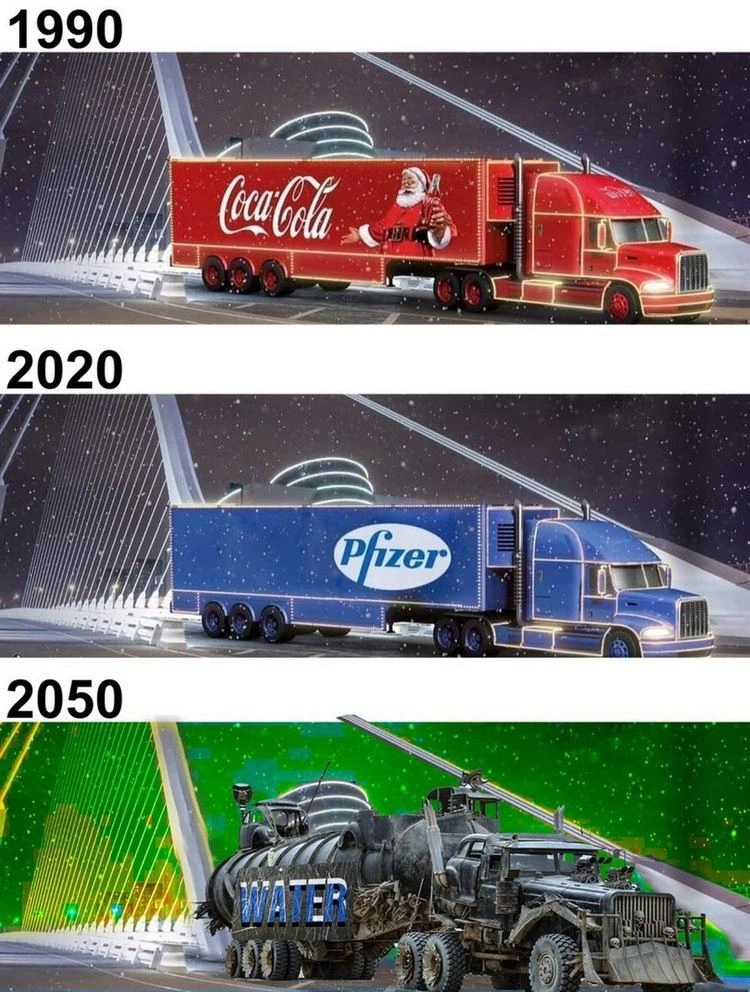
  • 1990 – Coca-Cola Truck: In the top panel, a bright red semi-truck is decked out with the Coca-Cola logo and a waving Santa Claus. Coca-Cola’s Christmas truck ads were (and still are) famous: they play a jolly “Holidays are coming!” jingle and show Santa delivering cola. It represents fun, consumer treats, and classic marketing. In tech terms, think of it like the feel-good projects or trendy gadgets from the ’90s that were all about excitement (the early Internet boom or video games with 8-bit Santa). The meme uses this as a baseline of a happy normal. Everyone knows Coke isn’t essential for survival (it’s sugary soda), but it was marketed as magical during holidays.
  • 2020 – Pfizer Truck: The middle panel swaps in a blue truck with the Pfizer logo, lit up like a holiday decoration. Pfizer is a pharmaceutical company, known in 2020 for its COVID-19 vaccine. The year 2020 was dominated by a global pandemic, so vaccines were literally the big hope. Seeing a Pfizer truck in a Christmas setting is satire – it’s as if the “gift” of 2020’s holiday season was a vaccine shot for your family, instead of a bottle of Coke. This reflects a shift from marketing a fun product to marketing a life-saving service. It’s a nod to MarketingVsReality: companies like Pfizer usually aren’t associated with Christmas cheer, but in reality, 2020’s hero was science and medicine. Many tech workers also felt this shift – for example, tech companies started highlighting how their TechForGood could help people stay connected or help find cures. This panel’s humor comes from the incongruity: a big pharma truck lit up festively on that same snowy bridge, indicating how our priorities flipped. It defines a new IndustryTrend where health-tech and biotech took center stage (the way every developer blog in 2020 suddenly talked about data models for virus spread and remote work tools). The holiday marketing evolution here is dramatic: from cola, a luxury treat, to vaccines, a critical need.
  • 2050 – Water Tanker: The bottom panel leaps into the future with a scary-looking tanker truck labeled “WATER.” The truck is no longer shiny or colorful; it’s armored, rusted black, with spikes or pipes – very post-apocalyptic. The sky is neon green static, giving a glitchy, toxic vibe instead of gentle snow. This draws from Mad Max aesthetics (films about a future where resources like fuel and water are scarce and fought over). In those movies, warlord characters hoard water, and vehicles are makeshift armored beasts – exactly like this truck. By labeling the tanker “WATER,” the meme suggests that by 2050, clean water might be as precious as gold, and corporations could be delivering it with armed convoys. It’s a tongue-in-cheek prediction of a dystopian resource scarcity future. For a developer audience, this also mirrors jokes about how the hype cycle might turn: today we worry about the next JavaScript framework, but in 30 years we might worry about having electricity and water to even run our data centers! It taps into TechSatire by paralleling how tech marketing keeps shifting focus. In 2050, a holiday ad might be a grizzled driver wishing you “Happy Hydration” instead of Merry Christmas. It’s funny in a dark way – the holiday CorporateCulture survives, but the content is basic survival.

Overall, the meme’s timeline from Coke to Pfizer to Water is a satire of corporate rebranding and hype adaptation. CorporateHumor in tech often pokes fun at how companies jump on whatever trend is critical at the moment. Just as Coca-Cola’s bright marketing gave way to Pfizer’s pragmatic messaging and then to a no-nonsense water supply, tech companies have shifted from selling fun consumer tech, to crucial connectivity and health solutions, and are now increasingly concerned with climate tech and sustainability. A junior developer can relate if they think of it this way: imagine early in your career you worked on a cool game app (fun and shiny, like Coca-Cola’s vibe). A few years later, you find yourself working on a healthcare platform during a pandemic (serious and vital, like the Pfizer vibe). In a couple more decades, you might be coding for something like water purification systems or power grid software (fundamental survival stuff). The meme wraps that idea in a visual MemeCulture reference: familiar logos and a timeline format that delivers the message without any words needed. It’s a sarcastic commentary that as times get tougher, what we celebrate (and what we code for) shifts from nice-to-have to need-to-have.

Level 3: Convoy of Hype

At first glance, this meme is a timeline of corporate holiday trucks, but beneath the humor lies a commentary on industry trends and hype-driven priorities. Each panel’s truck represents the zeitgeist of its era, much like dev teams chasing the latest tech hype. In 1990, the classic red Coca-Cola truck with Santa symbolizes a simpler time when marketing sold sweet consumer joy. The tech world then was excited about personal computers and the early web – flashy, fun, and full of promise (the “sugary soda” stage of tech). Fast forward to 2020, and the truck wears a Pfizer logo, reflecting a world focused on vaccines and survival. This stark shift mirrors how developers saw priorities change overnight during crises (think of 2020’s pivot to remote everything and health-tech). The meme exaggerates it: a pharmaceutical company’s logo lit up like a Christmas decoration, as if the COVID vaccine had to save the holidays. By 2050, the humor turns darkly dystopian – the truck is now an armored tanker labeled “WATER.” The once cheerful convoy transforms into a Mad Max aesthetic war rig, complete with rust and spikes. This final panel screams resource scarcity and survival mode. It satirically suggests that in the future, corporations might market basic necessities with the same fanfare as cola in winter – because water could be the most precious commodity.

For seasoned developers, the joke lands with a knowing smirk: it’s reminiscent of the Gartner Hype Cycle on a cultural scale. We’ve gone from feel-good branding fluff to life-or-death essentials. It’s like the evolution of programming fads over decades: one decade’s hot new framework is purely for glitz (like that Coke truck era of joyous bells and whistles), then comes a decade of “mission-critical” tech (the vaccine/truck phase, where tech has to literally save lives or businesses), and eventually we focus on the bare metal basics (the water stage – no more fancy UI, just keep the system alive and the lights on). CorporateCulture and tech culture both have this “pivot or perish” mentality. The meme cleverly ridicules how companies repackage themselves to fit the times. Devs often joke about management chasing buzzwords (“We need blockchain AI now!” – equivalent to swapping the truck’s logo to whatever’s trending). Here, instead of blockchain, it’s swapping Santa’s soda for a syringe, then for a survival kit. The absurdity is that even a holiday tradition like a Christmas truck parade isn’t immune to version upgrades based on societal version 1.0, 2.0, ... 5.0.

This mashup of pop culture reference and tech cynicism also nods to the Zuckerberg-like mantra of “move fast and break things” – except it’s society’s priorities being iteratively refactored. By 2050, the meme imagines a broken world where marketing still rolls on, albeit with armored tanks instead of twinkling trucks. It evokes classic cyberpunk and sci-fi tropes where mega-corporations control essential resources (from Tyrell Corporation’s replicants to Immortan Joe’s water hoarding in Mad Max). Seasoned tech folks see a parallel in how big tech giants increasingly control fundamental services (power, internet, data – perhaps water next?). The humor has a bite: today’s fun feature can become tomorrow’s must-have fix and finally devolve into a struggle for basics. In code, it’s like starting with a cute Easter-egg feature, then writing a critical security patch, and eventually just fighting to keep the server running under extreme load. You chuckle, but also gulp: it’s sarcastic humor about a future that feels all too plausible if trends continue. The meme perfectly captures that “ever-changing industry priority” vibe – from sugary sleigh bells, to life-saving science, to survival mode – a convoy of hype barreling through the decades.

Description

A three-panel vertical meme showing a progression of iconic delivery trucks over time, each representing a different era. The first panel, labeled '1990', features the classic, brightly lit red Coca-Cola Christmas truck with an image of Santa Claus on its side, symbolizing festive consumerism. The second panel, labeled '2020', shows a similar modern truck, but it is blue and bears the Pfizer logo, a clear reference to the global COVID-19 vaccine distribution effort. The final panel, labeled '2050', jumps to a dystopian future, showcasing a heavily armored, ramshackle black tanker truck reminiscent of the vehicles from 'Mad Max: Fury Road'. The word 'WATER' is crudely painted on the side of the tank, suggesting a future where this basic resource is scarce and requires militarized transport. The meme provides a cynical commentary on the evolution of societal priorities, moving from commercial joy to global health crises and finally to a struggle for basic survival

Comments

17
Anonymous ★ Top Pick Logistics-as-a-Service evolution: 1990 delivered high-fructose corn syrup. 2020 delivered mRNA payloads. By 2050, the most valuable container orchestration will manage H2O, not Docker
  1. Anonymous ★ Top Pick

    Logistics-as-a-Service evolution: 1990 delivered high-fructose corn syrup. 2020 delivered mRNA payloads. By 2050, the most valuable container orchestration will manage H2O, not Docker

  2. Anonymous

    1990: ship a monolithic Coke. 2020: roll out an mRNA microservice. 2050: Water-as-a-Service - pay-per-sip API, 3 nines of thirst reduction, void during climate outages

  3. Anonymous

    The only constant in software architecture is change, but at least our microservices won't need armor plating and spike wheels... unless you count the WAF and rate limiters protecting them from the inevitable DDoS attacks during Black Friday

  4. Anonymous

    The real tragedy isn't the dystopian future - it's realizing that by 2050, we'll still be dealing with legacy infrastructure from the 1990s that nobody documented properly, except now the 'technical debt' is literal survival debt and the only thing we're containerizing is potable water

  5. Anonymous

    1990: Festive feature ships. 2020: Pfizer hotfixes. 2050: On-call in Mad Max prod, scavenging H2O for the last hydrated node

  6. Anonymous

    By 2050, our SRE dashboards drop p95 latency and start charting pH - same pipeline, different SLA: potable

  7. Anonymous

    By 2050, “rate limits” won’t be API calls but liters‑per‑minute on the cooling towers - FinOps rebranded to HydroOps

  8. @callofvoid0 2y

    water to wash contamination ?

    1. @SamsonovAnton 2y

      potable water to drink

    2. @marcelopjmuniz 2y

      Madmax reference

  9. @movsbq 2y

    How will they have gas to run those in 2050?

  10. @movsbq 2y

    What's that?

    1. @domokrch 2y

      this shit converts trash into fuel, as far as I remember

    2. @SamsonovAnton 2y

      https://youtu.be/ptlhgFaB89Y

  11. @ZgGPuo8dZef58K6hxxGVj3Z2 2y

    Like this...

  12. @ZgGPuo8dZef58K6hxxGVj3Z2 2y

    ...and this

  13. @pulsar_sp 2y

    woah, THAT's what Factorio devs were inspired by)) fun to know, thx

Use J and K for navigation