Skip to content
DevMeme
2988 of 7435
Eve is always watching
Cryptography Post #3300, on Jun 21, 2021 in TG

Eve is always watching

Why is this Cryptography meme funny?

Level 1: Two’s Company, Three’s a Crowd

Imagine two close friends who just want to share a special secret or moment with each other. It’s Alice and Bob’s big day, and they only care about each other – kind of like when you and your best friend are whispering and giggling about something only you two understand. Now picture someone else, let’s call him Eve, suddenly sneaking up to join in on their private moment without being invited. It’s like when you’re about to take a nice picture with your friend, but a stranger jumps in front of the camera at the last second. 😄 Alice and Bob are the happy couple enjoying their moment (just like two people sharing a secret), and Eve is the nosy person who butts in. In simple terms, two people want to be left alone, and a third person is not respecting that privacy. We find it funny in the meme for the same reason we’d laugh at a photobomb: it’s a silly, unexpected intrusion. It reminds us that when something is meant to be just between two people, having an uninvited guest pop up can totally spoil the moment – and that’s both relatable and humorous to see.

Level 2: The Unexpected Guest

At a more beginner-friendly level, this meme is showing a simple story: two people want to share something private, and a third person is intruding. In the world of security and cryptography, we often give people placeholder names to make examples easy to follow. Alice is the name typically given to the first person (like Person A) who wants to send a message or data. Bob is the second person (Person B) intended to receive that message. Now, in security examples, there’s often an attacker or snooper, and by convention we call that person Eve (because Eve stands for eavesdropper, someone who listens in without permission). These names are used so commonly that it’s almost like Alice, Bob, and Eve are characters in every cybersecurity story.

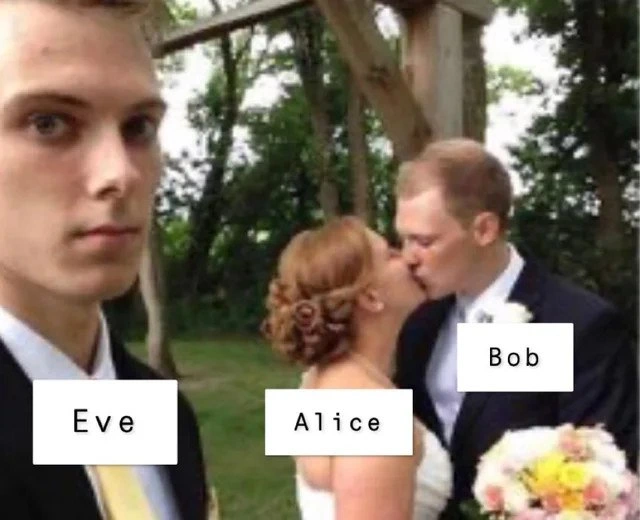
In this picture, the bride is labeled “Alice” and the groom “Bob,” implying they are the two who are communicating or, here, sharing a special moment. The guy on the left with the label “Eve” is essentially the uninvited third party. He represents an attacker or intruder in security terms. The scenario depicted is what tech folks call a man-in-the-middle attack (often abbreviated MITM). In a man-in-the-middle attack, the intruder (Eve) secretly positions themselves between two people communicating (Alice and Bob) so that they can eavesdrop on everything. It’s like if Alice thinks she’s talking directly to Bob, but actually all her messages go through Eve first. Eve can listen or even change the messages before passing them on. Bob, in turn, might think he’s hearing directly from Alice, but he’s really getting relayed messages from Eve. Neither Alice nor Bob realize a “middle-man” is in the loop, if the attack is successful.

Now connect that to the meme: Alice and Bob are having their wedding kiss – a very personal, private exchange (like a confidential message between two parties). Eve, the intruding guy popping into the frame, is akin to someone snooping or intercepting that private moment. In a literal sense, he’s photobombing their wedding photo. In the computer security sense, he’s intercepting their “communication.” It’s a funny dramatization because normally network eavesdropping is invisible, but here we see it as a bold physical act – Eve standing right there in their picture.

For a newcomer, it helps to know why these specific names: This naming convention (Alice, Bob, Eve) is a long-standing tradition in crypto and developer circles. By using the same names consistently, it becomes easier to talk about complex processes. For example, you might read, “Alice encrypts a message and sends it to Bob. Eve tries to decrypt it.” Using names feels more natural than saying “Person A sends to Person B while Person C tries to intercept.” So over time, Alice and Bob became the go-to names in any explanation about encryption or protocols. And because every story needs a villain, Eve (the eavesdropper) became the go-to name for the attacker. It’s like a cast of characters in many cybersecurity teaching examples.

The meme is essentially a visual inside joke using those names. It’s filed under Cryptography/Security because it’s illustrating a security concept (eavesdropping/MITM attack) in a humorous way. If you’ve just started learning about encryption or maybe took an intro to computer security course, you probably encountered Alice and Bob exchanging secret messages protected by some algorithm, while a villain like Eve lurked in the background. Here, that abstract lesson is brought to life: instead of a network diagram, it’s a wedding scene. The reason it works as a joke is because it’s so unexpected to see these textbook characters in a real photo – especially at a wedding of all places! But once you recognize the names, the meaning clicks: Alice and Bob = intended private pair, Eve = sneaky third party. Even the word “Eve” clues you in – it literally starts the same way as “eavesdrop.” So an eavesdropping Eve at a wedding gives you the gist: someone is listening in or intruding where they shouldn’t.

In summary, for a junior developer or anyone new to these terms, the meme is saying: imagine two people sharing something special (or secret) and then imagine an unwanted guest showing up to spy on it. That’s exactly what a man-in-the-middle attack is, and that’s why this image is both informative and funny. It ties a technical idea to an everyday life scenario, making it easier to understand. After seeing this, you might just forever remember that Alice and Bob want privacy, and poor Eve is the meddler trying to peek in – whether it’s at a wedding or in a Wi-Fi network!

Level 3: Man-in-the-Middle Matrimony

For seasoned developers and security enthusiasts, this meme elicits a knowing grin. It takes the classic Alice-and-Bob narrative – something we’ve all seen in countless security tutorials and conference slides – and plays it out in a real-life scene. Alice and Bob finally tying the knot after years of exchanging secret messages? Of course Eve shows up to crash the party! The photo is essentially a wedding photobomb doubling as a cybersecurity meme. The bride and groom labeled “Alice” and “Bob” immediately evoke the well-worn mental image of two parties communicating. In crypto lore, these two have been sharing encrypted love letters since the 1970s, so why not imagine them getting married? The humor is that anyone in on the joke instantly recognizes the third wheel: “Eve” – the canonical eavesdropper – blatantly inserting himself into the frame, just as an attacker would insert themselves into a data stream. It’s a direct visual pun on a man-in-the-middle attack: here’s literally a man standing in the middle of Alice and Bob’s big moment.

What makes this especially funny to developers is the accuracy of the roles and the absurd yet fitting context. In real-world security, a man-in-the-middle attack is one of those things we’re constantly guarding against, whether it’s by using HTTPS, SSH keys, or certificate pinning. We often describe it in human terms: “Imagine Alice whispers a secret to Bob, but Eve is listening behind the door.” This meme just dials it up a notch: imagine Eve actually walking between Alice and Bob at their wedding! It’s ridiculous in a wedding scenario, which is why it’s comedic, but it perfectly mirrors the severity of eavesdropping in tech – an unauthorized agent intruding on a private channel.

Anyone who’s studied or debugged security issues might recall that uneasy feeling of “Is there an Eve snooping on our network?” For example, a senior dev might think of that time they found a fake Wi-Fi hotspot (Eve’s digital cousin) or when a misconfigured certificate left an opening for sniffing. The meme taps into that shared experience: we all learned about Alice, Bob, and Eve in our intro to security class or the first time we implemented encryption. Seeing them in a wedding scenario is like a crossover episode between dry technical education and everyday life humor. It says, “Hey, remember those abstract characters from your crypto lessons? Here they are in the wild!”

Additionally, the meme resonates because it plays on the phrase “wedding crashers.” In popular culture, a wedding crasher is a rogue guest who sneaks in for fun or free cake; here Eve is the ultimate wedding crasher, but in the digital sense he’s after free data. The look on “Eve’s” face (serious, looking directly at the camera) is meme-perfect: it’s the face of an attacker caught in the act or proudly showing off that he wormed his way into the situation. Meanwhile, Alice and Bob are blissfully unaware – just like two endpoints oblivious that someone is in the middle relaying or monitoring their traffic. This image captures that too real aspect of security: the victims usually don’t notice the man-in-the-middle.

The seasoned perspective also appreciates the meta-joke that Alice and Bob have become such legendary figures in developer culture that we talk about them like real people. We joke about their escapades (there’s an old quip about how after all these years, Alice and Bob deserve a happy ending despite all the cryptographic drama). So a senior dev might chuckle, “Ha, Alice and Bob finally got married and of course Eve had to ruin it.” It’s a playful poke at both the folklore of cryptography and the persistent presence of attackers in every system. The meme underscores why we implement all those rigorous security measures: to keep the Eves of the world out of our confidential exchanges – whether those are secret keys or wedding vows. And it does so in a way that’s far more memorable (and chuckle-worthy) than a textbook diagram. In short, the combination of a developer inside joke and a universally recognizable awkward situation makes this meme pure gold for anyone who has fought the good fight in cybersecurity or learned about it.

Level 4: Ceremonial Key Exchange

At the deepest technical layer, this meme is riffing on cryptographic protocol lore and the fundamental challenges of secure communication. In classical cryptography thought experiments, Alice and Bob are the two parties trying to communicate or exchange keys securely, while Eve (short for eavesdropper) lurks as the adversary. The wedding scene cleverly personifies a man-in-the-middle (MITM) scenario: Alice and Bob are literally at the altar exchanging vows (an analogue to exchanging encryption keys or secret messages), and Eve is the uninvited entity intercepting that intimate exchange.

From a theoretical standpoint, this touches on core security principles. Cryptography textbooks often introduce Alice and Bob when describing algorithms like the Diffie–Hellman key exchange or the RSA protocol. In those scenarios, if an attacker like Eve can slip in between, she can intercept messages or even impersonate one side to the other. Formally, this is often modeled by assuming the attacker has full control of the communication channel (the Dolev-Yao threat model in security theory). It’s a fundamental problem: without some form of authentication or pre-established trust, Alice and Bob have no surefire way to know they’re really talking to each other and not an Eve-in-disguise. Mathematically, encryption alone isn’t enough – you also need to verify identities. This is why real-world protocols use things like digital signatures and certificates (think of the certificate authority as the wedding officiant verifying everyone’s identity) during a handshake. For example, in the TLS/SSL handshake that secures HTTPS, Alice (your browser) will check that Bob (the server) presents a valid certificate before trusting him, preventing an Eve from masquerading as Bob.

Historically, the naming convention itself is an inside joke from the very birth of modern cryptography. The use of the names Alice and Bob to make explanations friendlier dates back to the late 1970s (notably in papers by Rivest, Shamir, & Adleman, and in Diffie–Hellman discussions). They chose simple, memorable names instead of abstract labels, making complex algorithms sound like stories about everyday people. Over time, a whole cast of characters was added: Eve was introduced as the archetypal spy (an eavesdropper on the line), and others like Mallory (a malicious active attacker), Trent (a trusted arbitrator), etc., each with roles in various protocol descriptions. In academic papers you’ll read lines like “Alice communicates with Bob, unaware that Eve is listening.” – exactly the scenario depicted in this image. The meme’s brilliance is how it compresses all that theory into one relatable tableau: a wedding ceremony turned secure key exchange ceremony, hilariously photobombed by the adversary. To a crypto-savvy mind, it evokes everything from the need for public-key infrastructure (to keep Eve out of the loop) to the importance of out-of-band trust (perhaps Alice should have whispered her public key to Bob before the wedding!). It’s the absurdly perfect visual representation of what papers dryly call a “man-in-the-middle attack.” The humor lands because it’s underpinned by decades of cryptography fundamentals – a reminder that even the most elegant mathematical protocols boil down to human-like trust relationships, where an uninvited guest can wreak havoc without proper precautions.

Description

A popular photobomb meme is repurposed to explain a fundamental concept in cryptography. The image depicts a wedding scene where a couple is kissing in the background. A white label identifies the bride as 'Alice' and the groom as 'Bob'. In the foreground, another man stares intently and somewhat menacingly into the camera, photobombing the couple. He is labeled 'Eve'. The joke is a clever personification of the standard placeholder names used in security and cryptography: Alice and Bob are the two parties who wish to communicate securely, while Eve is the 'eavesdropper' who tries to intercept their communication. The meme perfectly captures the intrusive nature of a man-in-the-middle attack or network eavesdropping, where the attacker (Eve) is always watching the supposedly private exchange between two parties (Alice and Bob)
Comments

27
Anonymous ★ Top Pick This is your data transmission on HTTP. Any questions?
  1. Anonymous ★ Top Pick

    This is your data transmission on HTTP. Any questions?

  2. Anonymous

    The moment the officiant said “you may exchange keys,” Alice and Bob went with unauthenticated Diffie-Hellman - now Eve’s in every wedding photo, a timeless reminder to always add authentication to your handshake

  3. Anonymous

    Eve's been trying to break their connection for years, but Alice and Bob's relationship uses perfect forward secrecy - even if she compromises today's session key, she'll never decrypt their past conversations about whose turn it is to refactor the legacy codebase

  4. Anonymous

    After years of exchanging encrypted messages, Alice and Bob finally achieved perfect forward secrecy at their wedding - but Eve still managed to capture the session key in this candid photo. Turns out even TLS 1.3 can't protect against a determined third party with a camera at the ceremony

  5. Anonymous

    Eve sees the handshake but can't derive the shared secret - passive attacks gonna pass

  6. Anonymous

    TLS 1.3 at the altar: Alice and Bob negotiated ECDHE; Eve photobombed the handshake, but without a rogue CA all she captured was cake

  7. Anonymous

    Alice and Bob finally ship mutual TLS; Eve still gets the metadata - PFS protects the kiss, not the guest list

  8. @Grebenkin_Il 5y

    it's difficult

  9. @clockware 5y

    Does he really want to intercept any of this?

  10. @viktorrozenko 5y

    I think it's about the fact that in CS problems they use names like Alice and Bob because they start with the first 2 letters of the alphabet, where Eve is not close enough

    1. Deleted Account 5y

      Eve is the eavesdropper Alice and Bob are generic characters

      1. Deleted Account 5y

        Haha) dude thx

    2. @furqan 5y

      makes sense

    3. @p4vook 5y

      Cryptography terms. Alice usually wants to send a message to Bob, while Eve wants to intercept it.

  11. @viktorrozenko 5y

    But I'm not sure

  12. @wizaral 5y

    Cryptographic problems is described with this names

    1. Deleted Account 5y

      +

  13. Deleted Account 5y

    Imagine Middle man attack

    1. @ZgGPuo8dZef58K6hxxGVj3Z2 5y

      Oh noo😂😂😂😂😂😂😂😂👍👍👍

    2. dev_meme 5y

      😂

  14. @viktorrozenko 5y

    Oh yeag

  15. @viktorrozenko 5y

    Truuue

  16. @viktorrozenko 5y

    Thx ppl

  17. @FunnyGuyU 5y

    He's gonna be 'Man in the middle' )

  18. @annshorn 5y

    😂

  19. @beton_kruglosu_totchno 5y

    I do not want to be archaic but why does left human have male face and is called Eve?

    1. @kitbot256 5y

      Short for Evan?

Use J and K for navigation