The Corporate Anatomy of Enterprise Technology
Why is this DesignPatterns Architecture meme funny?
Level 1: If a Company Was a Person
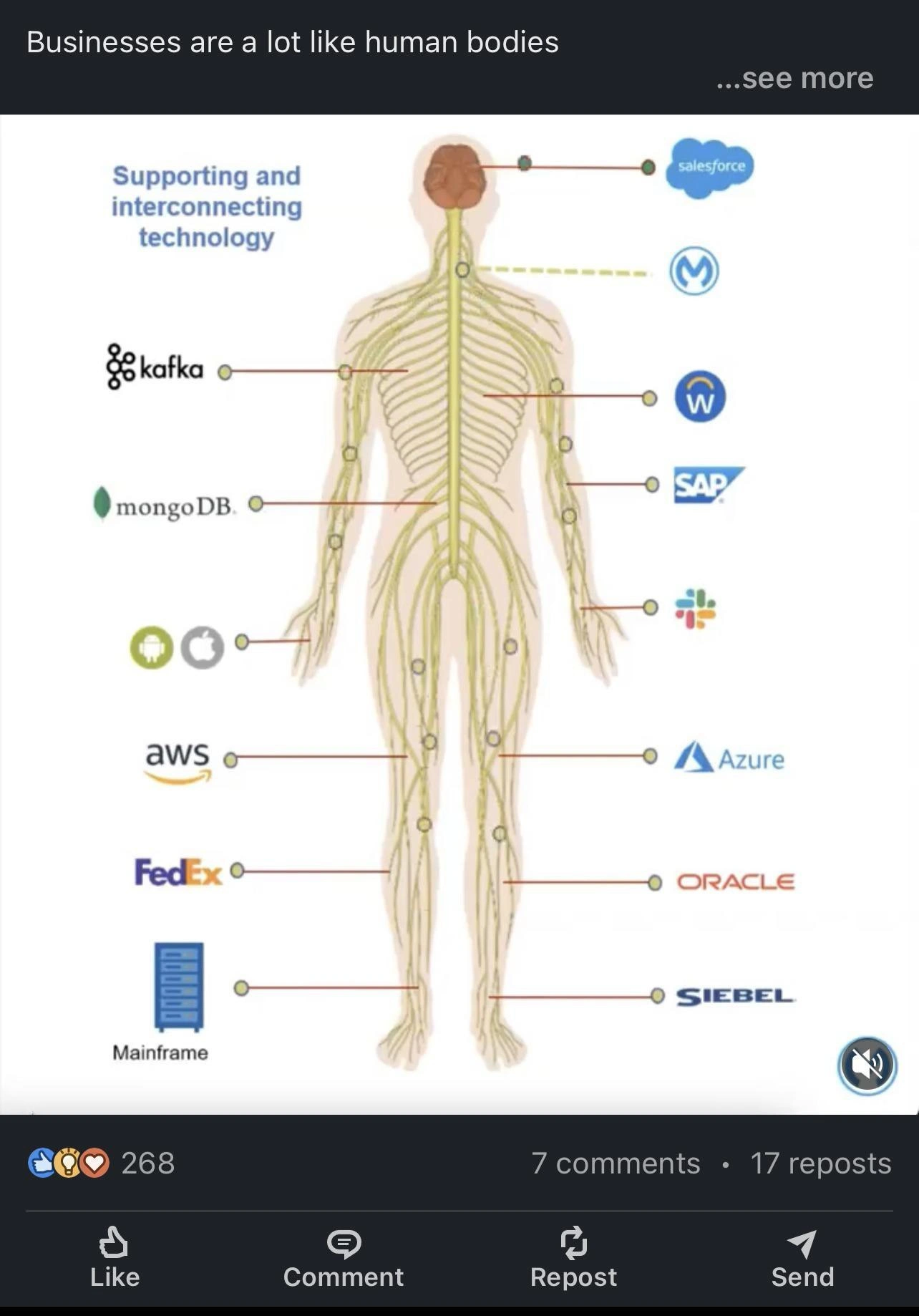
Imagine a big company as if it were one single person. This person has a brain, a body, and lots of parts that need to work together. But here’s the fun twist: each body part is actually a different piece of technology or software! In the picture, the brain is a software where all the customer info is kept (so the company knows who its customers are and what they need, just like a brain remembers things). The heart or torso has the systems that run the company’s important inner workings (like making products and keeping track of money – those are the vital organs). The hands are things the company uses to interact and communicate, like a chat app employees use to talk to each other – that’s shown as a hand because it’s how the company “touches” work every day. The spine in this person is like the internet connections or message system that sends signals from the brain to all the parts (kind of like nerves telling your arms and legs when to move).
Now, the funny part is some of the legs and feet of this person are really old technology – they’re like old bones holding the company up. For example, one foot might be a really old computer system (a mainframe) that the company has used forever, and it still carries a lot of weight (just like your feet carry you). The other foot might be an old customer database from long ago. The knees could be things like shipping services or databases – if those bend or break, the company can’t move forward, just like a person can’t walk with a hurt knee. The hips are big cloud services (basically giant computers in the cloud) that support everything above – like the strong hips carrying the body. This company-person even has a smartphone on one arm, showing that people in the company use phones to do work too (like checking messages or sales info on the go, which is just like the company extending its “hand” through a phone).
So, seeing a human outline filled with logos (Salesforce, Slack, AWS, etc.) is a joke that a company’s technology is organized kind of like a human body. All these different tools have to cooperate as if they were one being. It’s amusing because normally a person’s body parts all grow together naturally, but a company kind of builds its body from many separate pieces. It’s like trying to make a person out of Lego blocks, action figures, and robot parts – a bit crazy and mismatched, but you hope it works smoothly! The meme is saying: “All these separate tech systems are connected, supporting and helping each other, just like your organs and nerves do.”
Why is this funny or interesting? Because it’s a playful way to understand a complicated thing. Instead of saying “our business uses lots of different software that we integrated,” it says “hey, our business is like a human body made of software parts!” That paints a picture anyone can imagine. If one part (say the shipping system represented by the knee) has an issue, it’s like the person gets a sore knee – the whole company-person might stumble. If the brain (the customer info system) is confused or offline, the person can’t think straight so the company doesn’t know what’s happening with customers. By turning it into a human analogy, it becomes easy to see that all parts need to work together for the “business body” to be healthy. And it’s a bit funny to see familiar logos on a drawing of a body – kind of like branding a medical diagram.
In simple terms: the meme jokes that running a company is like keeping a body alive. You have to take care of each part and make sure they are all connected. If you replaced your heart with a battery, your arm with a toy robot arm, and your legs with wheels, you’d look weird but you’d still need everything to connect and communicate to move around — that’s how a modern company feels with old and new technology mixed together. It’s a silly image, but it actually makes you think, “Wow, there’s a lot happening behind the scenes to keep a company running, just like there’s a lot happening in our bodies to keep us alive!”
Level 2: One Body, Many Systems
For a less experienced developer or someone new to enterprise architecture, let’s break down this meme in simpler terms. The image compares a business’s technology to a human body – each major software or system is shown as an important body part. Big companies use a lot of different tools (some cutting-edge, some very old), and they have to connect them all so information flows properly. Here’s what each part of the “enterprise body” represents:
Salesforce (Brain): Salesforce is a popular cloud app for managing customer and sales information (a type of CRM, which stands for Customer Relationship Management software). In this picture, it’s the brain of the company because it holds knowledge about clients and leads. The brain analogy means Salesforce often drives decisions – for instance, when a new sale is recorded, lots of other actions are triggered elsewhere. If you’re new, think of Salesforce as the big central customer database and sales tool that many departments rely on to know what’s going on with clients.
MuleSoft (Neck): MuleSoft is a tool/platform that helps connect different software systems together. It’s like a translator or a pipeline for data between apps – often called an integration platform or enterprise service bus. Positioned at the neck, it connects the “brain” (Salesforce) to the rest of the body. In practical terms, MuleSoft might take data from Salesforce and format it so another system (say SAP or a database) can understand it, and vice versa. As the neck, it suggests that without MuleSoft, the brain and body (business and IT systems) can’t communicate well. For a junior dev, you might encounter MuleSoft or similar tools when your company needs to sync data between a new cloud app and an old legacy system – it’s the plumbing that makes sure, for example, the customer info entered in one place appears in another system too.
Kafka (Spine/Nervous System): Apache Kafka is an open-source message streaming system. That means it lets different applications send messages (like events or data updates) to each other in real-time. In the diagram, Kafka is drawn as the spine, representing the central nervous system of the enterprise. Just like a spine carries signals from your brain to your limbs, Kafka carries data from one service to another. For example, when an order is placed in Salesforce, a Kafka event might be fired so that other parts of the business find out about it immediately (inventory system, shipping system, etc.). If you’re new to Kafka, imagine it as a real-time postal service or a chat channel for software: one app publishes a message, and others subscribe to get it instantly. By being the spine, the meme is saying Kafka supports the whole data flow structure – it keeps everything coordinated. Many modern CloudArchitectureDesign setups use Kafka or similar queues to decouple services. You might have come across terms like “event-driven microservices” – Kafka is a key piece in that, ensuring each microservice (small program) can react to events without being directly tied to the others.
Workday (Right Shoulder): Workday is a cloud-based software for human resources (HR) and sometimes finance. Companies use it to manage employee information, payroll, hiring, etc. It’s placed on the right shoulder, meaning it’s an important support system – it keeps the people aspect of the company strong (like a shoulder supports an arm). If Workday is down or not integrated, employees might not get paid on time or HR processes might stall, which can really hurt the organization. For someone early in their career, think of Workday as the place you go to request time off or where HR stores your info – it’s vital for internal operations, even if it’s not as flashy as customer-facing systems. In an integration sense, Workday might need to share data with other systems too (for example, when a new employee is added in Workday, you might want Salesforce to know about that, or give them access to Slack, etc.). That’s another job for the “neck” (MuleSoft) or the “nerves” (Kafka) – to pass along those changes.
SAP (Right Ribcage): SAP is a big enterprise resource planning system (an ERP). Companies use SAP to handle core business processes like managing inventory, processing orders, running financial accounting, manufacturing planning – essentially the heavy-duty internal work. In the anatomy analogy, SAP is in the ribcage area, suggesting it’s protecting the vital inner workings of the business (like ribs protect your heart and lungs). If you are a new developer, imagine SAP as a giant all-in-one software where a lot of the company’s important internal data lives (orders, invoices, factory data, etc.). It’s often critical and very comprehensive – but also complex. In a modern enterprise, SAP often runs on older principles (sometimes even on the company’s own servers, not cloud), so it’s a big bulky backbone system. It needs to exchange information with newer systems, which can be tricky. For example, when Salesforce (brain) closes a deal for 100 widgets, SAP might need to know so it can reduce stock by 100 and maybe start manufacturing more – that info has to flow through the integration pipeline. The humor here, if you know a bit about SAP, is that it’s considered very monolithic (one large system) and inflexible, yet it’s absolutely essential – much like your chest can be inflexible but you can’t live without what’s inside it.
MongoDB (Left Ribcage): MongoDB is a modern NoSQL database, which stores data in a flexible, document-like format (JSON). It’s often used for newer applications that need speed and flexibility with data models (for example, storing user profiles or event logs where you don’t want the strict tables of a traditional SQL database). In the diagram, MongoDB sits on the left side of the ribcage, opposite SAP. This suggests the company has newer custom or specialized applications using MongoDB, balancing out the older SAP on the other side. Think of SAP as a traditional system (structured, heavy) and MongoDB as a newer approach (flexible, cloud-friendly). They both store important data (hence both in the torso). For a junior dev, you might encounter MongoDB if you’re building a new microservice or web app that doesn’t fit neatly into the existing ERP or Oracle database. It’s easier to start something new with Mongo for certain use cases (like a social feed or a JSON API). However, those new apps still often need to share data with the old ones – for instance, product info might come from SAP but gets duplicated into Mongo for a new web service. The presence of both MongoDB and SAP shows the mix of tech generations: one isn’t fully replacing the other, they’re used side by side, each for what it’s best at.
Slack (Right Hand): Slack is the messaging/chat app that many companies use for internal communication. Here it’s drawn as the right hand, meaning it’s how the company handles day-to-day work and communication. If you imagine the company as a person, the right hand being Slack implies that a lot of action – discussions, quick decisions, alerts – happen through Slack. In practical terms, employees use Slack to coordinate and get things done quickly (“Can you approve this request?” or “Server X is down, please check”). It’s become a central hub where different systems also pipe in notifications (for example, a deployment tool posting a message when code is deployed, or Salesforce sending a win announcement). For someone new in a company, you quickly realize Slack (or Microsoft Teams, etc.) becomes as critical as email, sometimes more so – if Slack is down, people joke that work kinda stops because we’ve come to rely on that instant communication. So Slack being the hand is both humorous and true: it’s how a lot of the company’s collective “muscle movements” are coordinated. You might find yourself one day writing a Slack bot or integration (e.g. a script that sends a message to a channel when something happens in another system). That’s literally making the “hand” respond to signals from the “nervous system.”
Apple (Left Wrist / Devices): At the left wrist, we see the Apple logo (likely representing iPhones, iPads, or Macs) and possibly an Android logo (meaning all mobile devices in general). This stands for the devices and endpoints employees or customers use to connect to the company’s systems. It’s basically the user interface to this whole body. By putting it on the wrist/arm, the diagram is saying these devices are extensions of the company’s reach – like how you use your hand and fingers (through a phone’s touchscreen) to interact with information. In real terms, imagine sales reps using an iPad to show products or managers checking dashboards on their iPhone – those devices need to pull data from systems like Salesforce, and maybe update info back. Ensuring mobile apps work with backend data is a key part of making the “body” function coherently. If you’re a junior dev, you might not directly deal with Apple or Android integration unless you work on the mobile app team, but you’ll certainly consume their output (for example, writing an API that a mobile app calls). The presence of mobile reminds us that a modern enterprise isn’t just backend servers talking to each other; it’s also thousands of users with phones expecting real-time data, effectively putting part of the business in everyone’s pocket.
AWS (Left Hip) and Azure (Right Hip): These are the two major cloud providers. AWS stands for Amazon Web Services and Azure is Microsoft’s cloud platform. Companies rent computing resources from them instead of running all their own servers. Here, each hip has one of the logos, implying our enterprise uses both clouds. The hips are what let a body move and also carry the load of the upper body. In tech terms, cloud platforms carry the computing load – they run the applications, databases, websites, etc., that the company relies on. Using both AWS and Azure means the company likely has some systems on Amazon’s cloud and others on Azure (this could happen because different departments chose different ecosystems, or through acquisitions, or a deliberate multi-cloud strategy). If you’re new to cloud: AWS might host, say, the company’s public website and some microservice APIs, while Azure might host their internal SharePoint and some .NET applications – just as an example. Integrating across clouds can be challenging, but it’s increasingly common. The meme putting one on each hip humorously suggests the company is trying to stand on two platforms at once. A junior dev might not feel the difference initially (an app is an app, regardless of cloud), but as you delve deeper, you notice each cloud has its own tools and quirks. Deploying code to AWS vs Azure involves different services (AWS’s S3, Lambda, etc. vs Azure’s Blob Storage, Functions, etc.). So, it’s like the company has two different leg prosthetics that have to move in unison. If one cloud has an issue (say Azure is having an outage in a region), half the body’s support could falter – meaning some services go down while others are up, causing weird partial outages. Managing multi-cloud is an architectural headache (ensure data consistency, security across both, etc.), which the diagram lightheartedly conveys by splitting the weight on two hips.
FedEx (Left Knee): FedEx’s logo at the knee stands for the shipping and logistics systems. While FedEx itself isn’t software the company owns, companies integrate with FedEx’s shipping APIs or software to handle the movement of physical goods. By labeling the knee as FedEx, the diagram suggests that shipping is a critical joint – it allows the company to actually deliver products, analogous to how knees let you walk and move. If that integration breaks, orders might pile up because labels can’t print or tracking info won’t update. For someone new, think of it like this: if you order a product from a company’s online store, behind the scenes the company’s system will talk to FedEx’s system to schedule a pickup and generate a tracking number. That’s an integration point. If it fails, the business can’t “bend its knee” to take the next step of sending you your package. So, even though FedEx isn’t part of the company’s internal software, it’s connected through tech. This teaches a lesson: enterprises rely on lots of external services (payment gateways, shipping, cloud services, etc.) and each is like a joint in the body – they must work for the whole thing to function.
Oracle (Right Knee): The Oracle logo here likely refers to an Oracle Database (a very common enterprise database system). Oracle databases have been around for ages and store a ton of important structured data (think of all your tables with transactions, customer records, etc., but on a huge scale). At the right knee, Oracle represents another crucial support pillar – the company’s internal data backbone. Many core applications (like maybe the SAP system, or an internal finance system) might run on an Oracle database. It being a knee means the business bends on it – many processes depend on retrieving and storing data in Oracle. If the database has an outage or even runs slow, it’s like a knee injury: the whole company might limp or come to a halt for certain operations. If you’re an up-and-coming developer, you will likely interact with databases a lot – writing queries, designing schemas, etc. Oracle is one of the heavy-duty databases you find in big companies (alongside others like SQL Server, DB2). The meme highlighting Oracle shows that even with new tech like MongoDB in the mix, the old relational databases are still holding up a lot of weight. They’re reliable, but require care (backups, tuning, etc.). This also hints at LegacySoftware aspects: the company probably has decades of data and stored procedures in that Oracle DB. It’s not easy to replace, similar to how a knee replacement surgery is a big deal. So, they keep using it and just integrate it with newer stuff (like maybe they use Kafka connectors or MuleSoft to feed data in/out of Oracle).
Mainframe (Left Ankle): A Mainframe is a large, powerful computer system often used by enterprises for core applications, especially from earlier eras (starting mid-20th century on). They run things like bank transactions, insurance policy processing, etc., very efficiently and reliably, but using older languages and tech (like COBOL). The mainframe at the ankle signifies the old foundational system that the company still stands on. An ankle bears the body’s weight but is a bit vulnerable – similarly the mainframe carries a lot of legacy processes, and if something goes wrong there, everything above is in trouble. If you’re new to IT, you might be surprised that banks, airlines, and big corporations still run code from the 70s or 80s on mainframes – but they do, because it’s stable and rewriting it is risky and costly. So, the mainframe remains, and instead of replacing it, companies connect it to modern systems. For example, they might use MuleSoft or Kafka to pull data out of the mainframe’s databases to share with newer applications. The meme pointing to a mainframe acknowledges that “yes, we have supercomputers and clouds, but somewhere in the basement there’s a blue metal box from the last century doing critical work.” It’s a bit funny and ironic, like seeing a futuristic robot with one foot still wearing an old boot. It also subtly points out how tech careers can span generations: a junior dev might one day be asked to interface with that mainframe data – perhaps learning some COBOL or using a special connector – because it’s not going away yet.
Siebel (Right Ankle): Siebel Systems was a top CRM (customer relationship software) before Salesforce existed. A lot of enterprises used Siebel in the 90s and early 2000s to track customers, sales, and support. By positioning Siebel at the right ankle, the image is saying “here lies an old system that once was critical (a pillar of the company), and still hasn’t been completely phased out.” Even if the company moved to Salesforce (brain) for modern CRM needs, they might still be running a legacy Siebel instance for some old data or processes that weren’t fully migrated. A junior person might compare this to how you sometimes keep old files or an old computer around because it has stuff you need occasionally, even though you have a new one now. Siebel at the ankle shows that a business may carry old tech along as part of its foundation because it’s risky or expensive to eliminate it entirely. If that ankle twists (say the old system fails or data in it becomes inconsistent), it can still cause serious problems up the chain. It’s a reminder of how tech progresses: today’s cutting-edge system (Salesforce now) might become the legacy ankle in 20 years, replaced by something even newer.
So, putting it all together: this meme visualizes a CloudArchitectureDesign where the enterprise is one big “body” made of many different systems (the vendor_stack_body_parts). The enterprise_nervous_system_metaphor is basically saying Kafka and integration tools connect everything so that all these parts can function together as if they were one organism. It’s both informative and tongue-in-cheek.
For someone early in their career, the key takeaways and relatable points might be:
Integration is crucial: Notice how none of these systems alone runs the company – it’s the fact that they’re connected (through APIs, messages, etc.) that makes the business work. A lot of engineering work in enterprises is not just building new features, but also making sure System A’s data flows correctly into System B. The meme shows that with the spine and neck emphasizing integration. You might encounter this when you have to, say, write a script or use a tool to sync customer IDs from the old database to a new service, or when you call an API of one service to push data from another. It’s very common.
Old and new coexist: Enterprises rarely throw away old systems outright; they add new ones on top. So you get this layered mix of tech. If you ever wonder, “Why am I dealing with a 20-year-old system at my cutting-edge developer job?” – this picture explains it. The company is like a body that has grown and aged; some parts are youthful and high-tech, others are like old bones – still there because they’re hard to replace. Many juniors experience a bit of shock when they first encounter a mainframe or a VB6 application or an ancient Oracle form that’s still in use. This scenario is normal in large organizations.
Metaphors in tech: Comparing a company to a human body is a way to simplify complexity. It helps non-technical folks grasp that you need coordination (like a body needs a nervous system). The meme is playing on that metaphor in a humorous way – it’s not often you see logos of AWS or Slack stuck on a drawing of a skeleton! The reason this got attention (268 likes etc.) is because people in tech find it both insightful and a bit funny/cheesy – insightful because it does capture roles of each system pretty well, and cheesy because real systems integration is not as smooth as a human body. (We wish it were – bodies evolved for millions of years to work seamlessly, whereas enterprises just buy stuff and bolt it on).
DesignPatterns_Architecture reference: If you hear terms like “event-driven architecture” (that’s Kafka’s role) or “API-led connectivity” (MuleSoft’s role) or “monolithic vs microservices”, this diagram has examples of each. Monolithic big systems (SAP, Oracle, mainframe, Siebel) = the solid bones. Microservices and new SaaS (maybe things using MongoDB or Slack integrations or small apps on AWS) = the nimble muscles that can move around those bones. The architecture pattern here is to use a central nervous system (Kafka) instead of point-to-point hardcoding every connection. That’s a best practice to reduce direct coupling – like instead of every organ wiring directly to every other (imagine a tangle of wires), you have one bus that routes messages. Knowing these concepts helps you understand why a company might say “we’re introducing an event bus or an API gateway” – it’s to make the whole ecosystem more like a coordinated body rather than isolated islands.
In summary, this meme is giving a crash course in enterprise architecture via a human anatomy analogy. It’s mapping tech terms to something more intuitive. If you’re just starting out, it’s a peek into how complex a big company’s tech really is under the covers. Each logo is a huge system or service in its own right, often requiring specialists to maintain. And you can imagine, just like a body, if any critical part fails, the rest is impacted. The humor is gentle here: it’s amusing to see the usually dry topic of system integration presented as a living, breathing body. It might even help you remember which part does what (e.g., “Kafka is like the spine – carries messages”). And if you eventually work in such an environment, you’ll recall this picture and think, “Oh boy, it really is like that – we’ve got an old leg and a new leg and we’re trying to make them walk in sync!”
Level 3: Postmodern ERP Sprawl
In the world of Enterprise Software architecture, this meme hits on a familiar reality: a company’s tech stack evolving into a patchwork creature of cloud services, SaaS apps, and LegacySystems all wired together. The LinkedIn post’s tagline “Businesses are a lot like human bodies” is a rosy metaphor for what seasoned engineers might dub a Frankenstein’s monster of systems. Let’s dissect this organ chart anatomy illustration (literally an org chart mapped onto anatomy):
Salesforce (Brain) – The meme places the Salesforce CRM at the brain, implying it’s the control center of customer data and business decisions. In many enterprises, SalesforceCRM is indeed treated as the “source of truth” for sales and customer info. It’s the cerebral cortex where strategies (and sales forecasts) live. Of course, a cynic might note that brains can be fickle – if Salesforce goes down or gets misconfigured, the whole body’s decision-making goes blank. (Fun fact: Salesforce even bought Slack, the “hand” in this diagram, so the brain literally owns the right hand now – central nervous corporate synergy at its finest.)
MuleSoft (Neck) – Right below the brain we see MuleSoft (an API integration platform, also owned by Salesforce). It’s acting as the neck, connecting the head to the body. Why? Because MuleSoft’s job is to interconnect technology: it’s an enterprise service bus/iPaaS that lets all the disparate systems talk via APIs and data pipelines. In human terms, it’s the throat through which information (oxygen of data) flows. If the neck gets constricted (say an API gateway goes down or a bad data mapping chokes), the brain can’t tell the body what to do – Salesforce updates wouldn’t reach down to SAP or the Mainframe. The whole organization would feel choked. Seasoned architects recognize this as a single point of integration failure: a stiff neck can paralyze communications between top management systems and the working parts.
Kafka (Spine/Nervous System) – The backbone of the diagram is Kafka, a distributed event streaming platform often used to decouple systems. Kafka is literally drawn along the spinal column, labeled “Supporting and interconnecting technology”. This is a nod to an event-driven CloudArchitectureDesign where Kafka publishes and subscribes messages between services in real-time. It’s the digital spinal cord carrying nerve signals (data events) between all the organs. For example, when an order is closed in Salesforce (brain), a Kafka event might travel down the spine to notify SAP (ribs) to update inventory, kick off a Workday (shoulder) workflow for commission, and maybe alert Slack (hand) to celebrate – all via Kafka’s pub-sub channels. The humor for experienced devs is that Kafka as the nervous system is both apt and a bit ominous: if you’ve managed Kafka clusters, you know a misconfigured broker or a surge in events can pinch a nerve. One glitch in the Kafka spine and suddenly data doesn’t move – parts of the company go numb to each other. In real life, we’ve seen Kafka outages or backpressure issues paralyze critical integrations (like a slipped disk in your spine). The meme elegantly portrays Kafka as crucial connective tissue, and every senior dev knows that when the nervous system misfires (or the message queue backlog spikes), the whole body can convulse.
Workday (Right Shoulder) – Over on the right shoulder is Workday, the cloud HR and finance system. It’s a SaaS application companies use to manage employees (payroll, benefits) and sometimes financials. The shoulder carries the people operations of the company. If Salesforce is who we sell to, Workday is who does the selling (the employees). Placing Workday on the shoulder hints that it supports the company’s arms – the workforce – giving them stability. In a literal sense, if Workday has issues (say the payroll system fails or access to employee records is down), it’s like a dislocated shoulder: the company can’t move that arm smoothly, affecting the whole body’s ability to work. The comedic truth here is that even something as “soft” as HR software is a critical joint – many an engineer has learned the hard way that someone has to integrate HR data with IT systems (onboarding flows, permissions, etc.), and when it breaks, employees feel the pain immediately (“I can’t access the tools because my Workday entry is wrong!”). It’s a less glamorous part of the tech body, but if you’ve been on-call during an HR system outage, you know how quickly shoulder pain can spread through an organization.
SAP (Right Ribcage) – At the right side of the torso we have SAP, a heavyweight ERP system. Think of SAP as the heart or lungs of traditional enterprise operations – it often handles vital functions like finance, supply chain, manufacturing, or procurement. In this anatomy, SAP sits in the ribcage area, suggesting it’s protecting the vital organs of the business process. An ERP like SAP holds together many core transactions (from booking a factory order to running monthly financials). If SAP fails, it’s basically a heart attack for the company’s operations. For old-school enterprises, SAP (or similar ERP) used to be the central brain, but in this modern mapping, notice SAP is just one organ and Salesforce is the brain – sign of the times (front-office SaaS gets the glory, back-office ERP chugs along keeping the blood flowing). Senior folks chuckle at this because they know the business can brag about CRMs and chat apps all day, but if the ERP stops pumping (imagine inventory management or payment processing halts), the flashy front-end tools won’t save you. DesignPatterns_Architecture wise, SAP is typically a giant monolith application (often on-prem or hosted) – one of those monolith bones in our “bones vs muscles” analogy. It’s reliable in doing big heavy tasks, but not very flexible, similar to a ribcage: sturdy structure but not easily changed without breaking something.
MongoDB (Left Ribcage) – Mirroring SAP on the left side is MongoDB, a modern NoSQL database. This suggests the company has some newer applications or microservices that prefer a flexible JSON document store over the rigid schemas of an Oracle or SAP database. MongoDB in the rib area could be a “new lung” helping the organization breathe easier when dealing with unstructured data or agile development needs. Perhaps an in-house built service uses Mongo as its data source for something customer-facing or for analytics. The juxtaposition of MongoDB vs SAP (one modern, schema-less and cloud-friendly; the other classic, strict and often on-prem) captures the two-speed IT many enterprises have: newer microservice components living alongside decade-old ERPs. For a veteran, the humor is in how we’ve literally stuck a Cloud-era technology right next to a 1970s-style ERP inside one body. It’s like giving a cybernetic implant to an old creature – works great, until you need those two systems to sync data. Then you often end up writing custom connectors or batch jobs to dump SAP data into Mongo or vice versa. (Cue the integration engineers pulling late nights to make that data consistent – eventual consistency in human terms might be like one lung breathing a bit out of sync with the other!). This is the postmodern_ERP_sprawl in action: instead of one ERP to rule them all, companies now mix and match specialized systems, and sprawl out the functionality across many tools.
Slack (Right Hand) – The right hand in the diagram is labeled Slack, the popular workplace messaging app. Why the hand? The hand is how humans grasp and interact with the world, and Slack is how a modern company’s people grasp information and interact with each other daily. It’s the collaboration tool where decisions get executed (“hand work”), like coordinating tasks, sharing files, or giving someone a fist-bump emoji. Slack being the hand also implies it’s an extension of the brain’s will – if Salesforce is the brain coming up with a plan, Slack is the hand carrying it out by coordinating the team. Engineers find this funny because Slack often becomes the glue where all alerts and notifications end up. We build Slack bots to report when everything else happens (“New deal closed! High-five” or “Server down! Panic”). In a real enterprise integration scenario, Slack is wired into the nervous system (Kafka or API calls) so every time the business sneezes, a Slack message is posted. It’s both the hand and maybe the ears and mouth too, since it’s how the organization senses issues (monitoring alerts) and voices information. From the cynical perspective, Slack as a hand might also hint that sometimes people end up doing things manually via Slack that integrated systems should do automatically – a bit like a ghost in the machine where human intervention is the actual last-mile integration (“Bob, can you manually update SAP? The Kafka pipeline is down again”). In any event, Slack being a limb underscores how crucial internal communication is in making all these disparate systems function like one being.
Apple (& Android) at the Left Wrist – On the left arm, we see the Apple logo (likely also an Android logo was intended, representing mobile devices). This corresponds to the user devices – smartphones, tablets, maybe the company’s mobile app platform. The left hand’s “wearable” or wrist device being Apple means the organization’s outward reach includes iPhones, iPads or Macbooks used by employees and customers. It’s how the company’s body touches the modern digital world. For instance, salespeople might use an Apple iPad to showcase products pulling live data from Salesforce, or field workers use an iPhone app to update a ticket which goes into Kafka, etc. The presence of Apple (and presumably Android) reminds us that part of the tech ecosystem is literally in everyone’s hands. It’s comedic in an architectural diagram because we normally focus on servers and software, but here even the end-user hardware (or mobile OS) is acknowledged as part of the anatomy. A veteran knows that supporting mobile platforms and keeping apps in sync with backend systems is its own challenge – like ensuring the hand-eye coordination works. If the mobile app (hand) can’t reach the brain (say, the API is down), the body loses dexterity. Many juniors learn this the first time they see that the fancy mobile app is useless during a backend outage – the hand can’t move independently of the nervous system.
AWS & Azure (Hips) – The left and right hips carry the logos of AWS (Amazon Web Services) and Azure (Microsoft’s cloud). Hips are literally the load-bearing joints that connect the torso to the legs, crucial for movement and stability. By putting the two biggest cloud providers at the hips, the meme implies this enterprise runs on a multi-cloud infrastructure. In reality, many large companies do use multiple clouds – sometimes by strategy, often by accident or departmental preference (one team built on AWS, another on Azure). The hips being two different clouds suggests the company’s foundation is split across platforms. This is both ambitious and painful – akin to doing the splits constantly. The experienced dev humor here: multi-cloud sounds great in conference talks, but in practice it doubles your complexity (two sets of services, APIs, security models) and can make the “spine” integration even more complicated (you might be sending Kafka events from an AWS app to an Azure service, crossing the cloud boundary like a sciatic nerve pinch). We imagine this company storing some services or data in AWS (maybe their websites, some microservices) and others in Azure (maybe Office 365 integrations, or .NET based apps), and inevitably those need to talk. The hips have to be well-aligned or the body limps. Plus, cloud outages happen – if AWS is down on the left hip, you better hope Azure on the right can compensate, or else the body can’t stand. Hips also hint at something else: cost. In a human, the torso and legs meet at the hips; in cloud, on-prem meets cloud at these junctions. Sometimes data pipelines from on-prem systems (like that Oracle knee or mainframe ankle) upload into cloud (hip) for processing. Moving data up and down is like flexing a hip muscle – do it wrong and you’ll tear something (or incur painful bandwidth bills!). The CloudArchitectureDesign lesson hidden here: architecture must account for connecting on-prem legacy to cloud services seamlessly, otherwise the body needs crutches (ugly workarounds).
FedEx (Left Knee) – This one stands out as not a software platform but a shipping company’s logo on the left knee. FedEx represents the logistics and supply chain component of the business. Many companies integrate with carriers like FedEx or UPS via APIs to track shipments, manage orders, etc. The knee is a joint that helps you move and bear weight – FedEx at the knee suggests if deliveries don’t move, the company can’t move forward (literally products can’t ship, revenue stalls – the business’s legs buckle). Integrating shipping data with internal order systems is vital for an e-commerce or manufacturing enterprise. Seasoned engineers have likely dealt with this: generating shipping labels from order systems, syncing tracking info back into customer-facing apps, etc. It’s rarely glamorous – often some scheduled jobs or third-party integration tool handles it – but if it fails, you’ve basically broken the company’s kneecap. The humor is subtle: we talk about digital transformation, but at the end of the day, if the FedEx API is down or someone forgot to pay the shipping software maintenance, physical packages don’t leave the warehouse. High-tech body, meet the brick-and-mortar knee. It’s a reminder that even in a fully digitized corp, the real world (trucks, planes, boxes) is connected via technology. Having FedEx as a knee in this anatomy chart personifies that crucial link. A cynical veteran might also recall times when a simple FedEx or ERP shipping module bug halted an entire assembly line – a tiny joint causing the entire giant to stumble.
Oracle (Right Knee) – The opposite knee carries the OracleDatabase logo. Oracle’s relational database has been a staple of enterprise IT for decades, often underpinning ERP systems, financial records, and basically everything requiring a solid transactional DB. It’s at the knee because it supports a huge weight of data – crucial, but also a point of stress. Knees in humans often suffer wear and tear, and indeed many companies have a love-hate relationship with their aging Oracle instances (reliability vs. high licensing cost, legacy stored procedures, etc.). This knee could also represent Oracle applications or Oracle ERP in some contexts, but given MongoDB is a rib and Mainframe at the ankle, it’s reasonable to think Oracle here means the primary corporate database that still runs a lot of core apps. Engineers grin (or groan) at this because virtually every enterprise has that one giant Oracle (or SQL Server or DB2) database which everything depends on. It’s robust but can become a bottleneck – performance issues there can crack the bone. Many a war story revolves around an Oracle DB outage causing widespread downtime: all of a sudden, the company’s legs give out. The meme highlighting Oracle acknowledges that even with modern cloud and NoSQL in play, the old relational DB is still a critical joint in the body. Replacing or upgrading that knee (like migrating to cloud databases or breaking up monolith data into microservice databases) is as delicate as knee surgery – and often postponed because, hey, the company can still walk, right? That’s the essence of LegacySoftware dependency: “if it ain’t completely broken (just a bit creaky), don’t replace it yet.” A senior architect sees Oracle at the knee and can practically hear the DBA saying, “Careful, don’t push too many events through Kafka into that Oracle at once, or you’ll bring the system to its knees (literally)!”
Mainframe (Left Ankle) – At the very bottom-left, supporting the whole weight of this enterprise body, is the Mainframe. This likely represents an IBM mainframe system running legacy code (COBOL, anyone?) that the company has had for 30+ years. Mainframes often handle critical batch processing, transactions (especially in banking, insurance, airline reservations, etc.), and they are famed for reliability and throughput — but definitely old school. By placing it at the ankle, the diagram suggests it’s foundational (the body stands on it), yet far from the brain – perhaps out-of-sight, out-of-mind until it breaks. For veteran IT folks, this hits home: many businesses stand on the shoulders of giants (or the ankles of mainframes) that were installed before the Internet era. The humor (tinged with dark reality) is that after all the cloud hype and digital transformation, somewhere in the basement a whirring Big Iron machine is still doing nightly batch jobs that, if they failed, would halt next morning’s business (e.g. payroll not processed, inventory not updated). It’s like the company is trying to sprint into the future but still wearing boots from the 1960s. When that ankle twists (maybe a rare mainframe outage, or not enough old engineers to maintain its code), it’s game over until you patch it up. Seasoned engineers joke that the cloud is just someone else’s computer, but the mainframe is a demigod that never dies. You treat it carefully, because everything above would tumble if gravity (and decades of code logic) pulls it down. This is legacy_at_the_feet_cloud_in_the_hips embodied: old tech quite literally at the feet, with new cloud tech higher up – the old carries the new.
Siebel (Right Ankle) – Finally, the right ankle shows Siebel, a once-dominant CRM system from the late 90s/early 2000s (acquired by Oracle in 2005). It used to be what Salesforce is now – the central customer system – but now, in this diagram, Siebel is down at the opposite ankle. This positioning tells a whole story of tech evolution: what used to be the “brain” of customer data in many companies got demoted to a foot as cloud SaaS (Salesforce) took over. Yet, many enterprises still haven’t completely gotten rid of Siebel; maybe some customer support workflows or legacy client data still live there because migrating it all is hard (or expensive). So the old CRM still props up part of the business, even as a LegacySoftware artifact. Engineers who have done data migration or had to maintain an old Siebel instance can relate – it’s like having an old bone injury that still aches but you can’t quite fix easily. The dual ankles of Mainframe and Siebel depict a foundation of monolith bones: heavy, rigid systems that have been supporting the weight for ages. We laugh (and wince) because it’s true: you’ll find Fortune 500 companies where an ancient CRM (Siebel) or a custom mainframe app still quietly runs mission-critical processes while all the shiny new apps get the spotlight. And heaven help the on-call engineer when one of those ankles sprains (e.g., a nightly job fails or an integration to Siebel breaks) – it tends to happen late Friday night, because of course it does. You haven’t lived until you’re debugging a COBOL transaction or a Siebel integration at 3 AM while the execs panic about “the system” being down.
All these parts get tied together by enterprise_nervous_system_metaphor – the combination of Kafka’s event spine and Mulesoft’s API neck forms the communication network (nerves) that coordinates the organs. The LinkedIn post’s author likely intended to glorify “supporting and interconnecting technology” by showing how every vendor fits neatly into a human body analogy. The seasoned viewer, however, sees the subtext: this is one complex cyborg of a company. The enterprise has effectively become a cybernetic organism, with legacy limb bones, cloud prosthetics, SaaS organs, and a lot of digital nerves and glue holding it together.
Why is this funny to those in the know? Because it’s a painfully accurate picture of modern enterprise IT. It pokes fun at the grand idea that a business can be as smoothly integrated as a human body. In reality, an architecture diagram like this hides countless nightly batch jobs, ETL scripts, data mismatches, and integration failures. The meme format exaggerates by mapping logos to body parts, but each connection point in the image (those little lines from the nerves to logos) represents real integration code or middleware that someone maintains. Engineers laugh because we’ve dealt with the fragile interfaces: e.g. a Kafka topic that didn’t get a message because one microservice was down, or a Mulesoft API that transformed data incorrectly, causing one “organ” to get wrong info from another. It’s like the body’s reflexes misfiring – if the left knee (FedEx) doesn’t get the signal from the brain (Salesforce) about a new order, that package isn’t going out, and the company’s leg just stumbled.
There’s also satire here about DesignPatterns_Architecture versus reality. Architects love to draw unified models (like this body) and say “Look, all our systems form one harmonious organism.” They reference patterns like event-driven architecture, unified data backbone, microservices muscles on monolithic bones, etc. The diagram indeed screams “we planned it this way!” But those who’ve implemented it know many of these connections were bolted on over years. It’s more organic accident than intelligent design – a case of Conway’s Law in action: the org chart of departments (Sales, HR, Finance, etc.) led to a cluster of different systems (Salesforce, Workday, SAP…) which now must communicate. The result is this postmodern ERP sprawl where no single vendor or system runs everything. Instead, you have dozens of specialized products, each the best in its niche, frantically stitched together. The humor has an edge: it’s simultaneously impressive and absurd. Impressive that we can integrate a mainframe from the 80s with a cloud chat app from 2020 in more-or-less real time. Absurd that we often have to, because enterprises won't or can’t replace old parts wholesale.
Thus, senior devs nod knowingly at this meme. It encapsulates the “everything and the kitchen sink” approach of enterprise tech stacks. Each logo is a high-dollar system that probably had its own multi-year rollout. Keeping them all working in concert is heroic (and a constant source of late-night pager alerts). So seeing them personified as one body is darkly funny – it downplays the messy reality with a cute metaphor. It’s the kind of LinkedIn-friendly diagram that gets 268 likes from managers thinking “Yes, synergy, our tech is the lifeblood of the company!”, while the engineers tagging each other on this post are saying “Lol, if only it actually worked as smoothly as a human body… more like a robo-humanoid held together by duct tape and hope.”
Description
An infographic that uses an anatomical diagram of the human nervous system to represent a business's technology stack. The title at the top reads, 'Businesses are a lot like human bodies', followed by 'Supporting and interconnecting technology'. Various tech company logos are mapped to different parts of the body, creating a metaphor for their function. For example, Salesforce is connected to the brain (decision-making/CRM), Kafka to the spinal cord (data streaming), MongoDB to the gut (data storage), and AWS and Azure to the legs (foundational infrastructure). A 'Mainframe' is humorously depicted as a server rack icon by the foot, representing old, foundational, and often painful legacy systems. Other logos like SAP, Oracle, Siebel, FedEx, Slack, and mobile OS icons (Android/Apple) are also placed on various nerve endings. The diagram humorously and surprisingly accurately depicts how different technologies form the 'nervous system' of a modern enterprise

Comments
7Comment deleted
Of course the mainframe is at the foot; it's the legacy system you keep shooting yourself in, preventing any real forward movement
Remember: if Kafka is your spinal cord, a mainframe ankle sprain still puts the whole Salesforce brain in a wheelchair
If businesses are like human bodies, then most enterprises are running on multiple autoimmune disorders where Salesforce is actively rejecting the Siebel transplant while the mainframe pacemaker from 1982 is somehow the only thing keeping everything alive
Ah yes, the enterprise nervous system - where Kafka is your spinal reflex arc handling event streams, MongoDB stores your muscle memory, and that mainframe at the feet? That's your vestigial tail from the COBOL era that nobody dares remove because 'it still works' and the original developers retired in 1987. The real joke is when someone suggests 'ripping out and replacing' any of these - good luck performing open-heart surgery on a marathon runner mid-race while maintaining your SLAs
We only call it a “nervous system” until a non‑backward‑compatible Salesforce field rename gives the whole organism Kafka neuropathy while the Siebel foot insists it’s working as designed
Cute how Kafka is the nervous system and Salesforce the brain - until the CFO reminds you the spine is a 30‑year mainframe and the Siebel appendix is “out of scope” for the migration
Salesforce brain explains the impulse buys on yet another 'strategic' vendor lock-in, while SAP legs ensure every pivot feels like wading through ABAP quicksand