The Corporate Anatomy of Enterprise Technology
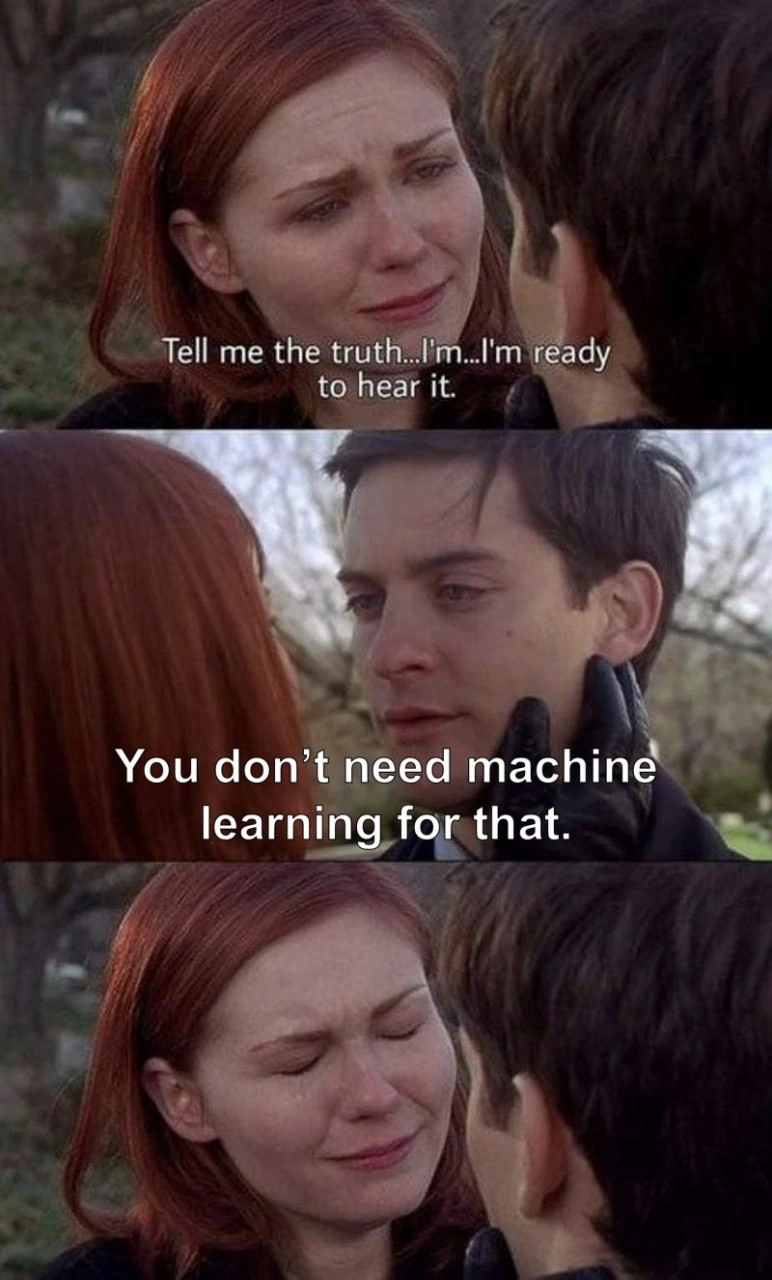
Why is this DesignPatterns Architecture meme funny?
Level 1: Just Add AI!
Imagine you have a simple, well-known rule, like a recipe or a math fact, that everyone agrees on. For example, think of the basic math fact 2 + 2 = 4. Now picture someone coming along and saying, “Actually, 2 + 2 = 4 + magic!” and claiming that adding this magic word will change the world. 🤷 Everyone who hears that just stops and goes, “Wait... what?” because it sounds so silly. Adding a random word doesn’t actually change the answer – it’s still just 4, and the “+ magic” part means nothing.
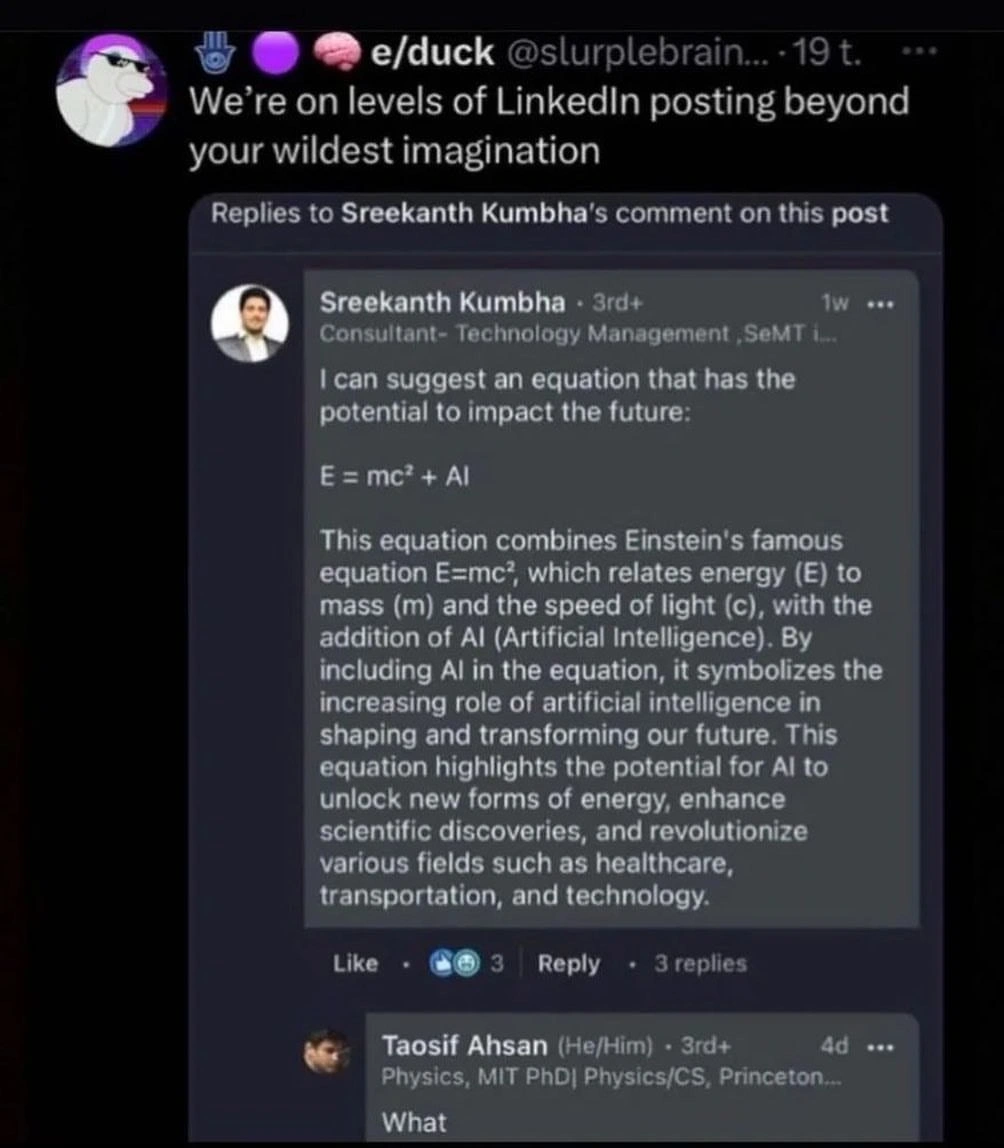
That’s exactly what happened in this meme. A person took Einstein’s famous science equation (the one that’s like the 2+2=4 of physics, known as E=mc²) and randomly added “+ AI” to it, as if that suddenly makes it new and super powerful. AI is a real thing (computers trying to act smart), but you can’t just glue it onto an unrelated formula like a sticker. It would be like sticking a “✨SUPERCHARGE✨” label on your homework and expecting it to get an A+ automatically. It doesn’t work that way! The funny part is that the person who did this on LinkedIn was probably trying to sound very smart and visionary (“Look, I merged a famous science idea with a hot tech buzzword!”), but instead it came out absurd. People who actually understand the original equation reacted just like you would to the “2+2=4 + magic” claim — completely puzzled and a little amused. In the meme, a physics expert literally replies with “What.”, just like a confused friend would.
So the humor here is like a kid adding “and then magic happens!” to the end of a well-known rule. It shows how some grown-ups on professional sites try too hard to impress others with trendy words. Everyone who knows the real rule can see the extra part is nonsense. We laugh because it’s a ridiculous attempt to make something sound revolutionary, and the only sensible response is an incredulous, “What did you just say?”
Level 2: LinkedIn Hype Decoded
Let’s break down what’s going on in simpler terms, and why developers find it funny:
E = mc² – This is Einstein’s famous equation from physics. It says that energy (E) and mass (m) are two forms of the same thing; you can convert mass into energy using the factor c² (which is the speed of light squared, an enormous number). In plain language, a tiny bit of mass can become a huge amount of energy – that’s why nuclear bombs and the sun work. It’s a fundamental scientific formula, not something you casually change or add to.
“+ AI” – AI stands for Artificial Intelligence. In tech, AI usually means computer systems that mimic human intelligence, like learning from data or making decisions (think of speech recognition, image classification, or chatbots like ChatGPT). It’s a buzzword in business right now – lots of people mention “AI” to make their product or idea sound cutting-edge, even if it’s only loosely related. In this LinkedIn post, the person literally tacks “+ AI” onto Einstein’s equation. They’re implying that adding AI somehow elevates or updates the equation for the future. But scientifically, this doesn’t make sense at all. It’s like saying “water = H₂O + AI” – it’s gibberish if you take it literally. They’re using “AI” as a metaphorical sprinkle of futurism.
Hype – Hype means exaggerated excitement or claims about something. The AI hype these days is massive: you’ll hear that AI will revolutionize healthcare, transportation, education – almost every field. Some of that is true in a gradual, realistic sense (AI is genuinely improving many areas), but a lot of it is over-the-top. A hype cycle often goes like: everyone talks about the new tech like it’s magic, then reality sets in about what’s actually hard or possible, and the excitement cools down. Here, the LinkedIn post is 100% hype. It uses big words (“revolutionize,” “unlock new forms of energy”) without any concrete explanation how. It’s essentially saying “AI will make everything better!” by attaching it to a physics formula, which is a huge stretch.
LinkedIn “thought leader” culture – LinkedIn is a professional social network where people post about their careers, achievements, or industry ideas. There’s a trend on LinkedIn of people trying to brand themselves as “thought leaders.” That means they want to be seen as experts or visionaries in their field. Sometimes this leads to genuinely insightful posts. Other times, it produces posts that feel forced or cringey, where someone takes a random inspirational quote or, say, a famous equation, and adds a trendy tech twist to sound smart. There’s even a running joke about “LinkedIn cringe” – posts that try so hard to be profound or motivational that they become unintentionally funny or eyeroll-inducing. This “E = mc² + AI” is a prime example of that. The author likely wanted to sound visionary by linking AI (the hot topic in tech) with Einstein’s theory (the iconic science reference) to get attention. Instead, it comes off as silly to people who actually understand those things.
Buzzwords and Clout – A buzzword is a word or phrase that becomes popular more for marketing appeal than for any deep meaning. “AI” is a buzzword right now; even companies that do simple automation might rebrand it as “AI-powered” because it sounds impressive. Clout means influence or fame on social media. On LinkedIn, clout can come in the form of likes, comments, and shares on your posts. So some individuals use a lot of buzzwords or dramatic statements to go viral or build their personal brand. By writing "E = mc² + AI will unlock new forms of energy and revolutionize X, Y, Z," the poster was probably aiming for that wow-factor to get shares – basically chasing clout through hype.
Why developers and scientists laughed – In the meme, a physicist (with a real PhD) just replied “What.” That single-word response shows how nonsensical the original post is to someone who knows the subject. For a junior developer or someone new to tech, it’s important to see why this is funny: the LinkedIn poster is treating AI like a magic ingredient you can add to anything. It’s as if they believe just mentioning AI alongside a big concept instantly makes it innovative. Developers often encounter such attitudes in the tech industry – maybe a boss says “we need some AI in this product to make it sound modern” or a client demands “add blockchain to our app” even if it doesn’t fit. Early in your career, these buzzword-driven requests can be confusing. You might wonder, “Am I missing something? Can AI really just be plugged in everywhere to fix things?” With more experience, you realize that AI, like any technology, has specific use cases and limitations. It’s not a silver bullet you can randomly insert; it has to make sense for the problem you’re solving.
Thought-Leadership Theater – This phrase refers to people putting on a show of being visionary without real substance. In this context, the LinkedIn author was performing thought leadership: using grand language and big concepts to inspire or impress. But to the audience who knows better, it feels like theater because it’s not backed by reality. Senior engineers and scientists often develop a bit of cynicism towards this. They value concrete results and accurate information over flashy statements. When they see a post claiming something as absurd as “E = mc² + AI” will change the world, they react with humor and skepticism. It becomes a shared joke, as we see with the tweet spreading this screenshot and calling it out.
In summary, a LinkedIn user combined a famous physics equation with the currently fashionable term “AI” to create a viral-sounding one-liner. Instead of being deep, it turned out satirical – people are mocking it as an example of how over-the-top the tech hype culture can get. If you’re new to the developer community, this meme is a lighthearted lesson: always think critically about grand claims. Just because someone adds a hot buzzword to a statement (even something as solid as Einstein’s equation!) doesn’t mean it makes sense. The meme resonates in developer communities because it highlights the contrast between real knowledge and social-media posturing. It’s a funny reminder that no matter how many trending terms you throw into a sentence, truth and logic still matter – and the folks who understand the tech or science will definitely call you out (maybe with a one-word “What.” if they’re as polite as that physicist).
Level 3: Mass-Energy-Hype Equivalence
The meme shows Einstein’s iconic equation getting a cringeworthy LinkedIn “upgrade” — a consultant literally writes E = mc² + AI. This is AI hype on steroids, and every experienced engineer or scientist reading it probably did a double-take. In the screenshot, a LinkedIn user proudly posts: “I can suggest an equation that has the potential to impact the future: E = mc² + AI.” Then they launch into a grandiose spiel about how appending “+ AI” will revolutionize everything (healthcare! transportation! scientific discoveries!) as if Artificial Intelligence is some magical additive. It’s the ultimate linkedin cringe: taking one of physics’ most fundamental equations and slapping on the trendiest tech buzzword for maximum clout. The Twitter user who shared this meme nailed it:
“We’re on levels of LinkedIn posting beyond your wildest imagination.”
Why is this hilarious (and painful) to those of us in tech? Let’s unpack it. E = mc² is a precise scientific formula from Einstein’s theory of special relativity (1905). It elegantly states that energy (E) and mass (m) are interchangeable; they’re related by the constant c² (the speed of light squared). This equation underpins nuclear power, atomic bombs, and a century of physics research. It’s serious stuff – a proven law of nature, with each symbol carrying units and meaning. Now along comes a “Technology Management” consultant on LinkedIn who decides Einstein forgot to include “+ AI”. 🤦 Just toss in AI, problem solved! From a senior engineer’s perspective, this is absurd to the point of satire. In mathematics or physics, you can’t just add a term like “AI” without any definition, unit, or dimension. It’s not like Einstein accidentally left a placeholder for Artificial Intelligence in his equation for mass-energy equivalence. This isn’t just hype math – it’s nonsense math. If you try to treat “AI” as a term in the equation, you’d get laughed out of any science discussion (or a compile-time error in code). In fact, imagine implementing this in code:
m = 1.0 # mass in kilograms
c = 299_792_458.0 # speed of light in m/s
E = m * c**2 # E = mc^2, a huge number (~9e16 Joules for 1 kg)
E_hyped = E + "AI" # Trying to add a string "AI" to a number...
TypeError: unsupported operand type(s) for +: 'float' and 'str'
Just like Python throws a TypeError when you add a number and a string, the physics community throws a figurative error when you add “+ AI” to a physics formula. Units don’t match: energy on the left, energy on the right… and “AI” has what units? (Mega-hype Units? Clout per second?) It’s a classic case of a buzzword void of meaning in this context. The LinkedIn poster isn’t really doing science; they’re doing “thought-leadership theater” – performing innovation for applause. Seasoned developers and scientists have a radar for this kind of thing, because we’ve seen it time and again. It screams, “I have no idea how AI/ML actually works or what Einstein’s equation means, but I know both are famous, so voilà!”
This perfectly illustrates the AI hype vs reality gap. Reality: AI is a powerful tool, but it doesn't defy the laws of physics or magically unlock unlimited energy. Hype: “Just add AI and change the world!” It’s reminiscent of past tech hype cycles in our tech culture. Veterans remember when every product became “+ Cloud” or “+ Blockchain” overnight. We’ve seen businesses shoehorn hot keywords into their name or mission statements just to ride the wave. (Hello, blockchain soda companies! 🍹🚀) Just as in the dot-com era a .com at the end of your company name doubled your stock, today slapping “AI” onto ideas is the shortcut to attention. It’s an industry irony that smart people in business settings often encourage this fluff. The result? Industry satire like this meme basically writes itself. What’s next — someone claiming “F = ma + IoT” to revolutionize physics, or “a² + b² = c² + Cloud” to modernize Pythagoras? It sounds ridiculous, but that’s exactly how buzzword alchemy looks to those of us who’ve been around. We chuckle because it’s true: the industry trends push folks to sprinkle “AI pixie dust” on anything and everything, no matter how incongruent, to appear cutting-edge.
Notice the response in the meme from Taosif (the physicist with actual MIT credentials). He simply replies: “What.” One word, flat and perplexed. That “What” is priceless — it’s the sound of a scientist’s brain short-circuiting at the sheer emptiness of that statement. It’s the same head-shaking developer cynicism you’ll hear in engineering circles when marketing buzz overruns logic. The physicist doesn’t even bother to write a whole rebuttal; “What” alone conveys “What on Earth did I just read?” It’s a mic-drop of disbelief. In dev terms, it’s like receiving a pull request that says // TODO: implement AI here to fix everything – you’d respond with “…what?!” too. The meme hits home for many of us because we’ve felt that exact exasperation seeing non-technical managers or LinkedIn “gurus” propose impossibly grand solutions with a straight face.
Ultimately, this meme skewers a specific community and culture moment: the over-the-top LinkedIn post where tech culture meets pseudoscience. It’s funny because it’s true — true that LinkedIn is overflowing with people chasing clout by overusing buzzwords, and true that experts are left speechless by how far it goes. It’s a communal eye-roll that unites developers, scientists, and anyone who values actual substance over hollow hype. Sure, AI can do amazing things, but it’s not a magic word you can tack onto E = mc² to suddenly usher in a utopia. If only solving real problems were as easy as “Just add AI!” We laugh at this because we know that when your code is on fire in production at 3 AM, no mystical equation tweak or buzzword is going to save you — you need real solutions, not LinkedIn hype math. In short: this meme is developer humor aimed at the current absurd level of AI hype, and it highlights the sanity gap between dev communities (who demand logic) and the professional social-media pontificators (who sometimes lose the plot). It’s a cautionary chuckle: even Einstein’s legacy isn’t safe from the AI buzzword bandwagon, apparently.
Description
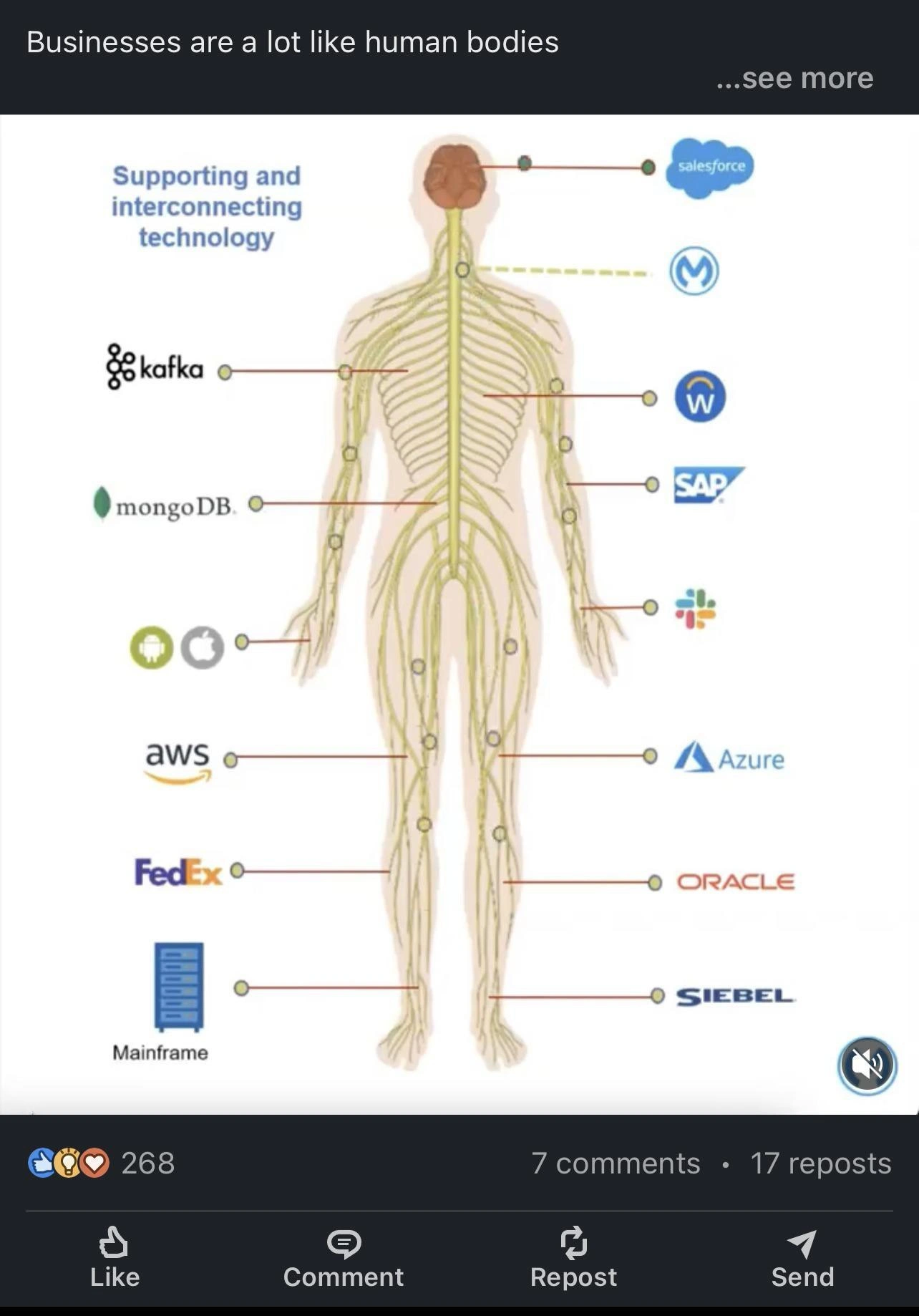
An infographic that uses an anatomical diagram of the human nervous system to represent a business's technology stack. The title at the top reads, 'Businesses are a lot like human bodies', followed by 'Supporting and interconnecting technology'. Various tech company logos are mapped to different parts of the body, creating a metaphor for their function. For example, Salesforce is connected to the brain (decision-making/CRM), Kafka to the spinal cord (data streaming), MongoDB to the gut (data storage), and AWS and Azure to the legs (foundational infrastructure). A 'Mainframe' is humorously depicted as a server rack icon by the foot, representing old, foundational, and often painful legacy systems. Other logos like SAP, Oracle, Siebel, FedEx, Slack, and mobile OS icons (Android/Apple) are also placed on various nerve endings. The diagram humorously and surprisingly accurately depicts how different technologies form the 'nervous system' of a modern enterprise
Comments
7Comment deleted
Of course the mainframe is at the foot; it's the legacy system you keep shooting yourself in, preventing any real forward movement
If tacking “+ AI” onto E=mc² really unlocked new energy, LinkedIn would’ve solved the heat-death of the universe - sadly, the only thing it powers is engagement metrics
This is the same consultant who adds "blockchain" to ACID properties and wonders why his distributed transactions are still slow
When your LinkedIn thought leadership attempts to add AI to fundamental physics equations, you're not revolutionizing science - you're just demonstrating that your understanding of both domains is approximately O(1/∞). The MIT PhD's single-word response 'What' carries more intellectual weight than the entire buzzword-laden paragraph, proving that sometimes the most devastating code review is the shortest one. This is the enterprise consulting equivalent of trying to fix a segfault by adding 'blockchain' to your variable names
Dimensional analysis of "E = mc^2 + AI" only balances if a marketing constant k≈0 multiplies AI - so in production it still reduces to E = mc^2
E=mc²AI: the only equation where substituting hype for c² yields infinite consultant energy, zero peer review
Dimensional analysis says E=mc²+AI is nonsense; on LinkedIn, though, AI has units of engagement, so the equation balances right after the seed round