Skip to content
DevMeme
5834 of 7435
An Engineer's Self-Aware Debrief After a Sales Call
Communication Post #6391, on Nov 20, 2024 in TG

An Engineer's Self-Aware Debrief After a Sales Call

Why is this Communication meme funny?

Level 1: Two Languages

Imagine you have a friend who is a brilliant inventor but a really shy person. They can build an awesome treehouse or create a cool new toy without any trouble. But when it’s time to show-and-tell that invention to the class, they get nervous and start mumbling. In our story, the engineer is like that inventor. He went with a salesperson (kind of like a smooth-talking friend) to meet a customer. The customer started asking questions about a product, and the engineer tried to answer but felt he wasn’t speaking clearly – sort of like a kid stumbling through a presentation. After the meeting, the engineer felt bad and said, “Sorry if I messed up. I think I was awkward.” He then joked about himself, saying he’s basically like a robot wrapped in a thin human skin whose only job is to take what people want and turn it into a code (the special language that computers understand). 😃 In simple terms, he’s great at building solutions (like that shy inventor making a toy) but not so great at talking about them. This is funny and sweet because it shows how different people have different talents: some are good at talking and selling, others are good at creating and coding. The engineer made fun of himself in a clever way, comparing himself to a machine that converts problems into programs. It’s like saying, “I might not talk smoothly, but I can definitely build what you need!” Everyone laughs a little, not to be mean, but because they recognize a bit of truth in it and appreciate how honest and quirky the engineer is about who he is.

Level 2: Bridging the Gap

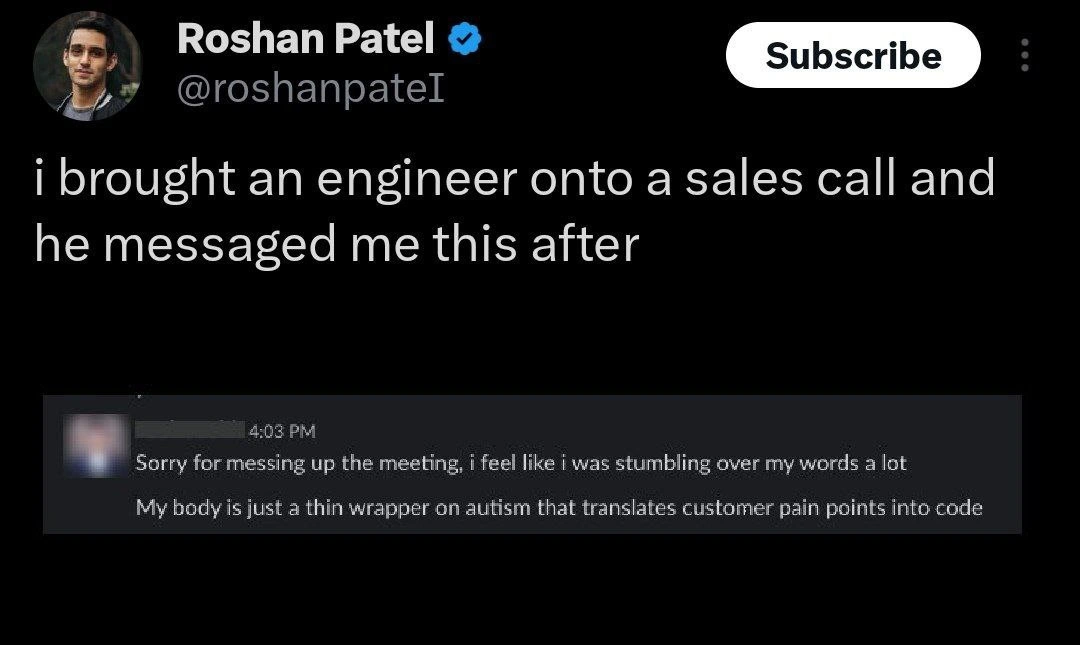
Let’s break down why this scenario is humorous and relatable in simpler terms. The image is a screenshot of a tweet and a chat message. In the tweet, someone says: “I brought an engineer onto a sales call and he messaged me this after.” So, an engineer (a developer who writes code) was invited to a sales call (a meeting or phone call with a customer, usually to discuss the customer’s needs or to help sell the product). It’s not super common for a pure engineer to join a sales or customer meeting, because those meetings are usually handled by sales representatives or product managers who are good at talking with clients (SoftSkills like smooth communication and salesmanship). But sometimes it happens — maybe the client had technical questions, or wanted to meet the team.

After the meeting, the engineer was feeling awkward and sent a message apologizing: “Sorry for messing up the meeting, I feel like I was stumbling over my words a lot.” This shows the engineer was nervous and felt they didn’t speak well. They’re probably used to talking about technical things, not doing more formal or salesy talk. This is already a familiar feeling for many developers early in their careers: that first time you have to talk to a client or present your work, you might trip over your words or use too much jargon. It’s a classic case of MeetingHumor where one side (engineer) thinks in terms of code and truth, and the other side (sales/client) expects clear, simple explanations. That mismatch can cause Miscommunication.

Now, the second line of the engineer’s message is the punchline: “My body is just a thin wrapper on autism that translates customer pain points into code.” Let’s unpack that because it’s layered with tech lingo and meaning:

  • “Thin wrapper”: In programming, a wrapper is a bit of code that “wraps around” something else. For example, you might write a wrapper function that calls another complex function, just to make it easier to use in your code. A thin wrapper means this layer is very small or adds almost no extra logic – it’s mostly just passing things through. By calling their body a thin wrapper, the engineer is humorously saying their human exterior (how they present themselves outwardly) is very minimal or transparent. In other words, they might not have a thick, polished social persona; what you see is what you get.

  • “Autism”: Autism here refers to Autism Spectrum Disorder, a neurodevelopmental condition. People on the autism spectrum often have strengths in logical thinking, focus, and systematic processing (qualities that can make someone good at coding), but they might find social interactions and communication challenging. Of course, every autistic person is different, but a common theme is feeling like social rules are a second language. By mentioning autism, the engineer is likely referring to themselves as autistic (or at least playfully saying they feel like they are very much that way). This is a form of DeveloperSelfDeprecation and also a nod to the fact that many folks in tech are neurodiverse. It’s actually quite accepted in developer circles to talk about being on the spectrum openly, sometimes jokingly but usually respectfully, because a lot of colleagues share those traits.

  • Putting it together: “My body is just a thin wrapper on autism” means “I am basically autistic on the inside, with just a very thin cover making me appear like an ordinary person.” It’s a self-effacing way to say: “I’m not great at the human interaction part; I’m basically running on autistic brain circuitry with very little ‘normal’ social buffering.” This might sound harsh, but the engineer is talking about themselves, likely in a joking manner. It shows they’re aware of their own quirks.

  • “translates customer pain points into code”: This part of the sentence describes what the engineer sees as their main function or skill. Customer pain points is a business term meaning the problems or difficulties that a customer is experiencing — basically, what the customer needs solved. When they say they translate those into code, they mean they take the customer’s problems or requirements and write software to solve those problems. This is essentially what a developer does in a project: listen to what the user or client needs, then design and code a solution. The wording here makes it sound like the engineer is some kind of machine or translator: you input a “pain point,” and they output a code fix or a feature. It’s said in a very dry, technical way (almost like describing a robot), which is why it’s funny in context. The engineer is reducing their whole role to this one function, implying, “I might not be good at talking or presentation, but give me a problem and I’ll code the solution. That’s what I do.”

So why is this message humorous to others? For one, it’s relatable to many tech folks who have felt out of place in a customer meeting or any situation requiring charming communication. The engineer basically apologizes for not having the social interface that a sales person has, comparing themselves to a mostly programmatic entity. The choice of words is very much how a developer might jokingly describe a human if a human were a software component. (Developers often use terms like “wrapper,” “interface,” “compile,” etc., even outside of code, as metaphors — it’s part of DeveloperHumor).

There’s also a grain of truth that gives the joke its edge: being extremely literal, direct, or technically-focused can make an engineer seem awkward in business meetings, and many realize this about themselves. Early-career developers often learn that writing good code is only part of the job; the other part is communicating with your team and with clients or managers. That’s where SoftSkills come in. The meme plays on the stereotype (often true enough) that engineers lack soft skills or polish, sometimes to the point of appearing socially awkward or emotionless. Of course, that’s not universally true, but it’s a common self-stereotype in the community — people joke “I speak fluent C++ and only broken English.” Here the engineer literally frames themselves as a translator machine, not a smooth talker.

In everyday terms: the sales person and the engineer were in a meeting with a customer. The sales person likely led the conversation, and whenever the customer had a specific technical concern or question, they let the engineer chime in. The engineer, being nervous, might have given very detailed answers or stumbled a bit, possibly providing more info than necessary or using technical jargon. After the call, the engineer felt they hadn’t done well. The sales person receives this apologetic message where the engineer basically says, “Sorry, I’m just not built for these meetings — I’m practically an autistic coder robot wrapped in a thin human skin whose purpose is to solve problems, not do sales talk.” It’s a dramatic way to put it, which makes it funny, but a lot of developers reading it think, “Wow, I’ve felt exactly like that!” The meme touches on sales_call_awkwardness and the ever-present engineer_vs_sales culture clash. The fact that it’s posted in a tweet suggests the sales person found it endearing or hilarious enough to share (with permission or anonymized, we hope). The engineer’s vulnerability – admitting anxiety and making a quirky joke – ends up being something many can sympathize with and laugh about.

Level 3: Protocol Mismatch

At the highest level, this meme highlights a classic CommunicationGap between a software engineer and a sales/client context. The tweet sets the scene: an engineer is brought onto a customer Sales call (a meeting with external stakeholders) and afterwards sends an apologetic, self-deprecating message. For seasoned developers, this scenario is painfully relatable and darkly funny. It’s common in tech for highly technical people to feel like fish out of water in polished client meetings (Meetings with non-technical Stakeholders). Here, the engineer realizes they stumbled over their words, essentially saying, “I’m sorry, I’m not great at this talking-to-customers thing.” The humor (and cringe) comes from Miscommunication born of different professional “languages.” Sales folks thrive on soft skills — using smooth, reassuring language, reading the room, managing StakeholderExpectations. Engineers, on the other hand, are used to speaking in precise technical terms and brutal honesty about limitations. When these worlds collide, you get a protocol mismatch: the client meeting is running on the “business small-talk v1.0” protocol while the engineer is defaulting to “techie literal vASCII.” 😅

The engineer’s follow-up message contains the gem: “My body is just a thin wrapper on autism that translates customer pain points into code.” This line is loaded with developer humor and insight. First, calling oneself a “thin wrapper” is a witty programming metaphor. In software, a wrapper is a layer that encases or abstracts something (often to make it compatible with another system or interface). A thin wrapper means it’s minimal – it doesn’t add much beyond what’s inside. By saying their body is a thin wrapper on autism, the engineer implies that beneath a very minimal “human” interface, they are fundamentally autistic (neurodivergent) at their core. It’s a tongue-in-cheek way to describe feeling highly tuned for logic and code, but only lightly equipped for social nuance. This kind of DeveloperSelfDeprecation resonates in the tech community because many developers either identify as neurodivergent themselves or work with colleagues who do. The tech industry has a higher prevalence of autism/Asperger’s and other neurodiversities, and it’s often embraced as part of the culture. The “thin wrapper” quip is both a joke and a truth: the engineer is effectively saying, “I run on a different operating system (autism) and only have a slim user interface layer for meetings.”

From a senior engineer’s perspective, this scenario points to a well-known engineer_vs_sales dynamic. The engineer’s strength is translating requirements into code – or as they put it, “translat[ing] customer pain points into code.” That phrase itself is telling: it frames customer complaints or needs as input, and code as the output, almost like the engineer is a human compiler. In day-to-day development, that skill is gold – taking nebulous client requests and turning them into a working software solution is essentially the whole job. But the flip side is that the engineer may not have a fancy GUI (read: charismatic sales persona) for that process. Instead of sugar-coating or marketing-speak, they process input (customer pain) and produce output (software) with very little filter. It’s efficient, but it can sound robotic or blunt in a meeting. DeveloperHumor often pokes fun at this trade-off: we write elegant code but trip over simple small talk. The tweet’s author (likely the sales or product person on the call) sharing this message shows a mix of amusement and empathy. They expected some awkwardness — bringing an engineer to a client call is like connecting two different systems with only a basic adapter. In fact, many companies mitigate this by employing Solutions Engineers or Sales Engineers – folks who have one foot in each world, acting as a thicker “wrapper” that can speak both business and tech. The existence of those roles is an acknowledgment of exactly what this meme jokes about: pure engineers often operate close to the metal (the raw technical truth), whereas customer meetings sometimes need a higher-level abstraction of that truth.

Ultimately, experienced devs grin at this meme because it’s “too real.” We’ve either been that apologetic engineer or the person who invited them and then watched the facepalm moments unfold. The message “Sorry for messing up the meeting, I was stumbling over my words” shows the engineer’s acute self-awareness and even MeetingHumor in hindsight. We can practically hear the sales lead responding, “No worries, you did fine!” – because in reality, the client probably didn’t mind, or maybe even appreciated the honest technical perspective. But to the engineer, it felt like a failure because it wasn’t perfect communication. That mix of StakeholderExpectations versus personal performance anxiety is something senior folks understand well. Over time, engineers often develop better soft skills (or at least coping mechanisms), but many will always feel like that thin wrapper is barely holding together in social settings. The meme is funny, a bit sad, and ultimately endearing – it reminds us that behind great code are human beings, sometimes awkward, doing their best to bridge two very different worlds.

Description

The image is a screenshot of a tweet by Roshan Patel. The tweet reads, 'i brought an engineer onto a sales call and he messaged me this after'. Below this text is an embedded screenshot of a direct message sent at 4:03 PM. The message says, 'Sorry for messing up the meeting, i feel like i was stumbling over my words a lot' followed by the strikingly candid statement, 'My body is just a thin wrapper on autism that translates customer pain points into code'. This meme captures the classic stereotype of the socially awkward but technically brilliant engineer. The humor lies in the engineer's painfully self-aware and brutally honest assessment of their own communication skills versus their core technical function. For experienced developers, it's a deeply relatable moment that highlights the cultural and communication gap that often exists between engineering and sales departments, and the internal monologue of many who excel at logic but not at live, unstructured conversation

Comments

8
Anonymous ★ Top Pick Sales engineers are just engineers who've had their social awkwardness API patched with a rate-limited small talk module
  1. Anonymous ★ Top Pick

    Sales engineers are just engineers who've had their social awkwardness API patched with a rate-limited small talk module

  2. Anonymous

    In every sales call I’m basically the gRPC stub - you see a polite method signature, but under the hood it’s just a thin wrapper converting “Can we launch next week?” into a 400-line JIRA ticket with six compliance blockers

  3. Anonymous

    The most accurate architectural diagram ever created: Human Interface Layer -> Autism Core -> Code Output Pipeline. At least this wrapper doesn't have memory leaks, just occasional buffer overflow during small talk

  4. Anonymous

    The engineer's self-description as a 'thin wrapper on autism that translates customer pain points into code' is brilliantly architectural - essentially admitting they're running a legacy human interface with minimal error handling, where the core business logic (understanding requirements) works flawlessly but the presentation layer (social interaction) needs serious refactoring. Classic case of optimizing for the wrong metrics: 100% code quality, 30% meeting performance

  5. Anonymous

    Engineers: thin wrappers over autism cores that async-parse 'make it better' into scalable microservices

  6. Anonymous

    Pre‑sales is the only system where the adapter layer lossy‑compresses stakeholder entropy into Jira tickets - then everyone blames the decoder when sprint planning can’t reconstruct expectations

  7. Anonymous

    A sales call with an engineer is like exposing your internal RPC over voice: strict schema, no small-talk retries, but immaculate post-call logs

  8. @Artkash 1y

    I feel him

Use J and K for navigation