The Manager Lifts the Feature, The Engineer Carries the Weight
Why is this Management PMs meme funny?
Level 1: Stuck with the Mess
Imagine your dad decides to surprise the family by bringing home a huge, playful puppy one day. It’s a big deal – everyone is excited and your dad looks like a hero for getting this new pet. That’s like the manager showing off a big new feature. But now think about what happens the next week: the puppy needs to be fed early every morning, taken for walks, and it makes big messes that someone has to clean up. Your dad is busy with work and isn’t around to do all that, so you end up taking care of the puppy every day. Suddenly, what was Dad’s big fun idea becomes your daily chore. In the end, your dad got the fun and credit for bringing the puppy, but you’re stuck with the mess (literally, cleaning up!). This is exactly what the joke in the meme is about: the boss (manager) did something big and impressive, but the hard, messy work of keeping it going falls on the engineer. It’s funny in a “not fair!” kind of way, because we all know how it feels when someone else’s big idea becomes our responsibility to deal with.
Level 2: Support Burden Blues
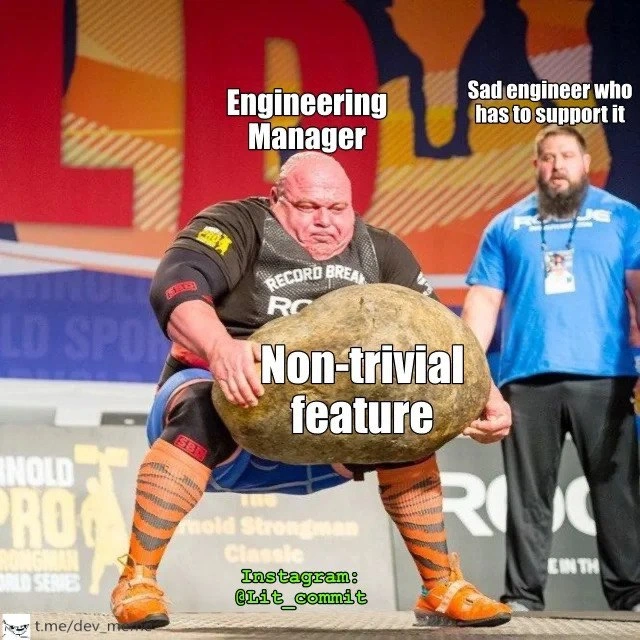
In the image, a champion strongman athlete is doing a famous event: lifting a giant concrete sphere (often called an Atlas Stone in competitions). The meme labels this big stone as "Non-trivial feature" to show it’s a huge, difficult project in a software context. The burly athlete straining to lift it is tagged as "Engineering Manager", implying that the manager is the one who rolls out or pushes up this big feature for the company. Off to the side, there’s another man (with a beard and blue shirt) watching with a gloomy face. He’s captioned "Sad engineer who has to support it". This suggests that once the feature is lifted and shipped, the engineer (likely one of the developers on the team) will be responsible for supporting it, i.e., keeping it running smoothly, fixing any issues, and dealing with the consequences. The engineer looks sad or concerned, which is part of the joke – he anticipates that maintaining this huge feature is going to be a tough, thankless job.
Let’s break down the humor and context:
- Engineering Manager: This is a person who leads an engineering team. They might plan projects, coordinate with Product/Management_PMs on what features to build, and ensure releases happen. Often, managers are not as hands-on with the code; their job is to get things delivered. In the meme, the manager is doing the dramatic work of shipping a big feature (lifting the stone), similar to how a manager might proudly announce a new feature rollout.
- Non-trivial feature: In developer lingo, calling something “non-trivial” is an understated way of saying “this is complex and not easy at all”. It’s a polite warning that the task will take significant effort. Here it’s a giant heavy stone – clearly not trivial to lift! So this label hints that the feature isn’t a simple fix or small update; it’s a large, complicated piece of functionality. For example, a non-trivial feature could be something like adding a whole new payment system to an app or implementing a big redesign – anything that takes a lot of coding and planning.
- Support burden: After a feature is shipped (released to users), support means handling everything that comes next: bug fixes, responding to user issues, on-call duty if the feature causes outages, and generally maintaining the feature so it continues to work. The burden part implies this work can be heavy or difficult. So the sad engineer expects that supporting this huge feature is going to be a big responsibility on his shoulders. This is often the case if a feature was rushed or if it’s very complex – it might have more problems popping up later.
- OnCall_ProductionIssues: These tags refer to being on-call for production issues. On-call is when an engineer is designated to be available (sometimes after work hours, even overnight) to respond if something goes wrong with the software running “in production” (the live system that real customers use). If that big new feature breaks at midnight or causes the website to crash on a weekend, the on-call engineer gets an alert (often via phone or a pager app) to wake up and fix it. It’s a bit stressful – imagine your phone ringing at 3 AM because the website is down due to a bug! The meme plays on this: the manager may not be the one who deals with those 3 AM emergencies; it’s the engineer who does.
- FeatureBloat & TechDebt: These terms connect to why the engineer might be unhappy. Feature bloat means the software keeps getting new features piled on, sometimes too many or too quickly, which can make it overloaded or complicated. Tech debt is a metaphor: like debt you owe, technical debt is the extra work you’ll eventually have to do because you took shortcuts or rushed a job when coding. For instance, if the team rushed to build this non-trivial feature, they might have skipped writing tests or left parts of the code messy. That makes future maintenance harder – and someone will have to “pay back” that debt by fixing or improving the code later (usually the engineers maintaining it).
- ManagementVsEngineering: This tag hints at a common tension. Managers often focus on delivering features quickly (since they have to show progress to higher-ups or clients), whereas engineers worry about building it correctly and keeping systems stable. When a manager says “let’s ship this big thing fast,” engineers know that if it’s not done with care, they will be the ones firefighting any resulting issues. The meme humorously illustrates this dynamic: manager lifts the big stone (hooray, feature delivered!), engineer sighs knowing he’ll be bandaging the inevitable wounds the feature causes to the system.
For a junior developer or someone new to the industry, the meme is showing a lighthearted cautionary tale. It’s very common in companies that a big exciting project is pushed out, and then the developers have to support it long term. For example, imagine you and your team create a complex new login system for your app with lots of bells and whistles. Your project manager is thrilled and launches it to users. If later at midnight users can’t log in because of a bug, someone on the engineering team gets called to fix it right away. If that someone is you, you might think, “Oh boy, I’m the one who has to deal with this now.” The manager probably won’t be the one diving into the code at midnight – that’s on the engineers. This isn’t to say managers are bad; it’s more pointing out a funny imbalance: credit versus responsibility. The manager often gets credit for delivering the feature (“Good job getting that done!”), while the engineer quietly handles the messy aftermath (“Now I have to make sure it actually works…”).
So, the meme resonates with developers because they’ve seen or experienced this scenario. It’s poking fun at CorporateHumor and the reality of production support. If you’re new in tech, it’s a wink to you: be prepared that every shiny new thing you build might become your job to maintain. And the bigger and more “non-trivial” the feature, the more ProductionSupport work it can create. Effective teams try to balance this by planning for maintenance – but as this joke shows, that doesn’t always happen, and that’s why the engineer in the picture isn’t exactly celebrating. 😅
Level 3: Tech Debt Deadlift
This meme captures a too-real dynamic in software teams: a manager proudly deadlifting a massive project (the non-trivial feature) for all to see, while the engineering team braces for the onslaught of support issues that follow. The strongman labeled “Engineering Manager” hoists the huge stone labeled “Non-trivial feature” with great strain – much like a manager pushing an ambitious release to production under a tight deadline. To seasoned developers, the humor comes from knowing that once this heavy feature is dropped into production, the support burden will weigh on the engineers (the "sad engineer" on the side) indefinitely. It’s a classic case of ManagementVsEngineering priorities: shipping new features gets applause in product demos and all-hands meetings, but keeping those features running (especially if they’re rushed or over-scoped) is a grueling long-term lift that falls on the dev team’s shoulders.
The phrase “non-trivial feature” is key here – it’s engineering-speak for “this is going to be hard.” When someone calls a task non-trivial, they mean it will involve significant complexity, unknown challenges, and likely tech debt. In the meme, that innocuous term is slapped on a giant boulder, which is a tongue-in-cheek way to say: this feature is colossal, cumbersome, and will be hard to handle. The Engineering Manager in the picture is straining to launch it, much like in real life a manager might strain to meet a release date by pushing the team. But notice the sad bearded engineer watching – he already knows this heavy feature payload is going to be his problem at 3 AM during the next on-call rotation. The manager might be doing the flashy part (lifting it for the crowd), but the engineer will be carrying its weight long after the manager walks offstage.
In real-world corporate culture, this scenario plays out when upper management or Product says “We need this big feature X by end of quarter to hit our OKRs (Objectives and Key Results) or to impress a client.” The engineering manager, under pressure, acts like a strongman: they rally, maybe cut a few corners, and ship the huge feature (often with a bit of chest-thumping pride – “record break!” as the strongman’s shirt humorously suggests). Initially, everyone celebrates the new feature launch. But then come the ProductionIssues: performance hits, edge-case bugs, midnight pages – the “what could possibly go wrong?” that engineers know all too well. The manager has effectively “lifted” the feature into production, but now the on-call engineers inherit a potential support nightmare. Each bug fix or outage is like holding up that stone again and again, a Sisyphean task that wasn’t fully considered in the rush to release. As a result, the team accumulates TechDebt (shortcuts and unresolved problems) that makes future work harder. Experienced devs recognize this pattern and share a dark laugh: we’ve lived through those heroic big launches followed by pager hell nights. It’s funny because it’s painfully true.
There’s an implicit criticism here of feature bloat and poor planning. Launching a non_trivial_feature without adequate support plan is like a strongman lifting a weight that he can’t hold for long – sooner or later, it’s coming crashing down. In healthy engineering culture, big features come with monitoring, gradual rollouts, and backup plans. But when manager expectations outpace engineering reality, a large feature might ship barely tested, with brittle code. The manager might consider it a job well done (“We delivered on time!”) and move on to the next project, while the dev team is left to patch bugs, write missing unit tests, and handle user complaints. It creates a quiet resentment: the engineer in the meme is “sad” because he’s seen this happen before. He knows the celebratory victory of delivery is short-lived, but the pain of maintenance is long-lasting. In many organizations, engineers joke that being on call for a big new feature is like being the only sober person left to clean up after a wild party – everyone else (management, sales) has already gone home.
The humor really lands with developers who have felt this imbalance. It highlights a CorporateCulture issue: incentives often reward those who ship features more than those who maintain stability. The “Engineering Manager” gets to play the strongman hero lifting the product’s capabilities (and likely gets praise from upper management for the record-breaking release). Meanwhile, the actual strain – the ongoing effort to keep that heavy feature from breaking everything – is borne by the engineering team quietly in the background. Hence, the ManagementVsEngineering tension: managers might say “support is important”, but when crunch time comes, delivering the feature takes priority and support becomes an afterthought delegated to the devs. This meme nails that irony with a single image: we see who lifts and who truly carries the weight in the long run.
Manager (during demo): “Look at this amazing new feature we shipped – rock solid, great job team!”
Engineer (days later, on PagerDuty): “This thing is rock solid alright… it’s heavy as a boulder and hitting our systems hard.” 😓
Description
This meme uses a photo from a strongman competition to illustrate a common dynamic in software development. A large, muscular strongman, labeled 'Engineering Manager', is shown straining to lift a massive, round stone, which is labeled 'Non-trivial feature'. In the background, another large man with a beard looks on with a weary, resigned expression; he is labeled 'Sad engineer who has to support it'. The meme humorously captures the disparity in perspective between management and individual contributors. The manager's focus is on the 'heavy lift' of getting a complex feature developed and shipped, while the engineer in the background is already anticipating the long-term operational burden, maintenance, and on-call responsibilities that will inevitably follow
Comments
7Comment deleted
The engineering manager gets the bonus for shipping the 'non-trivial feature.' The sad engineer gets a PagerDuty alert named after it
Manager deadlifts the feature into prod for the all-hands glory, then hands the 24/7 pager to the name that’s still in git blame from 2014
The engineering manager lifts it once for the demo; the engineer carries it every on-call rotation for the next five years
The real weight isn't lifting the feature - it's the 3 AM pages when that 'non-trivial' boulder inevitably rolls back downhill in production. Management gets the photo op, engineering gets the pager duty and the privilege of explaining why a feature spec written on a napkin somehow requires distributed transactions, eventual consistency handling, and a complete rewrite of the authentication layer
Manager's git commit: world-record stone lift. Engineer's fork: eternal farmer's walk of prod support
Roadmap physics: the EM deadlifts a “non-trivial feature” into Q3; conservation of burden guarantees the on-call rotation carries its mass for the next four quarters
Management can deadlift it into prod; the PR description forgot runbooks, SLOs, and who holds the pager