Skip to content
DevMeme
6564 of 7435
Wholesome Hacker-Founder Exchange: Exploit Disclosed, Lifetime Membership Offered
Security Post #7194, on Oct 2, 2025 in TG

Wholesome Hacker-Founder Exchange: Exploit Disclosed, Lifetime Membership Offered

Why is this Security meme funny?

Level 1: Free Candy for Life

Imagine you have a favorite candy store with a room full of treats behind a locked door. You’re a clever kid and figure out how to slip in without the store owner’s permission, grabbing some candy for free. Now, in most stories, when the owner finds out, you’d get in big trouble, right? But in this happy twist, the owner notices you sneaking in and instead of getting mad, he says: “Wow, that was clever how you found a secret way in! I’ll tell you what – if you show me how you did it and promise not to use that trick anymore, I’ll give you free candy for life.” Surprised but happy, you say deal. You even show him another little gap in the door he didn’t know about, just to help out. He fixes the doors, you get to visit and eat candy anytime without sneaking around, and both of you smile and shake hands. In the end, the store is more secure, and you’re treated like a helpful friend rather than a thief. It’s a feel-good story where doing the right thing and being honest leads to everyone winning – just like in the meme, where the hacker and the company both end up happy.

Level 2: Ethical Hacking 101

At its core, this meme is showing a real example of ethical hacking and a great vulnerability disclosure outcome. Let’s break down the scenario in simpler terms. A user discovered a way to use a paid product without actually paying – that’s what we call a subscription bypass (basically a trick to get around the paywall or subscription check). In other words, there was a security vulnerability in the software that this person figured out how to exploit (use to their advantage). Now, this person wasn’t trying to be a bad guy or cause harm; in hacker terms, they were acting as a white-hat hacker.

White-hat hackers are the “good guys” of hacking – they find weaknesses in systems and then let the owners know so the issues can be fixed, often in exchange for a reward or just the satisfaction of making things safer. This is opposed to black-hat hackers, who exploit weaknesses maliciously or for personal gain without permission. There’s also a middle ground called grey-hat, who might break rules but still disclose issues without intending harm. In this story, our hacker is firmly white-hat: they engaged in responsible disclosure, meaning they politely informed the company of the problem instead of abusing it or publicizing it wildly. Responsible disclosure often involves a private email or report to the company – exactly like we see in the meme – giving the company a chance to fix the bug before it’s widely known.

The company, Simplehuman, responded in about the best way possible. Instead of getting angry or threatening the user, they basically said “Thank you, we’re impressed by your skills.” They even offered the hacker a lifetime membership (free access forever) as a reward for coming forward. This is essentially an informal bug bounty reward. Bug bounty programs are what many companies run these days: they invite hackers to find and report bugs or vulnerabilities, and in return, they pay money or give other rewards if the bugs are valid. Not every company has a formal bug bounty program, especially smaller ones, so sometimes the “reward” might just be a thank-you or some free service. In this case, a lifetime premium plan is a pretty sweet payout for the hacker’s efforts (and it costs the company very little to give, since it’s just one account).

Now, during this whole exchange, a few other technical things were mentioned. The Simplehuman engineer noted the hacker’s trick was messing up their analytics – specifically the count of Monthly Active Users (MAUs). MAUs is a metric companies use to see how many distinct users use their service in a month. Because the hacker’s method apparently made it seem like they were a “new user” each time (perhaps by not storing a consistent user ID or token), it was inflating that count artificially. Think of it like a turnstile counter at a store entrance: the same person kept going in and out and in again, and the counter thought 10 people visited when it was really just 1 person 10 times. The engineer humorously acknowledged that while high user numbers can look good, they prefer to know the real user count. This anomaly is what tipped them off that something unusual was happening.

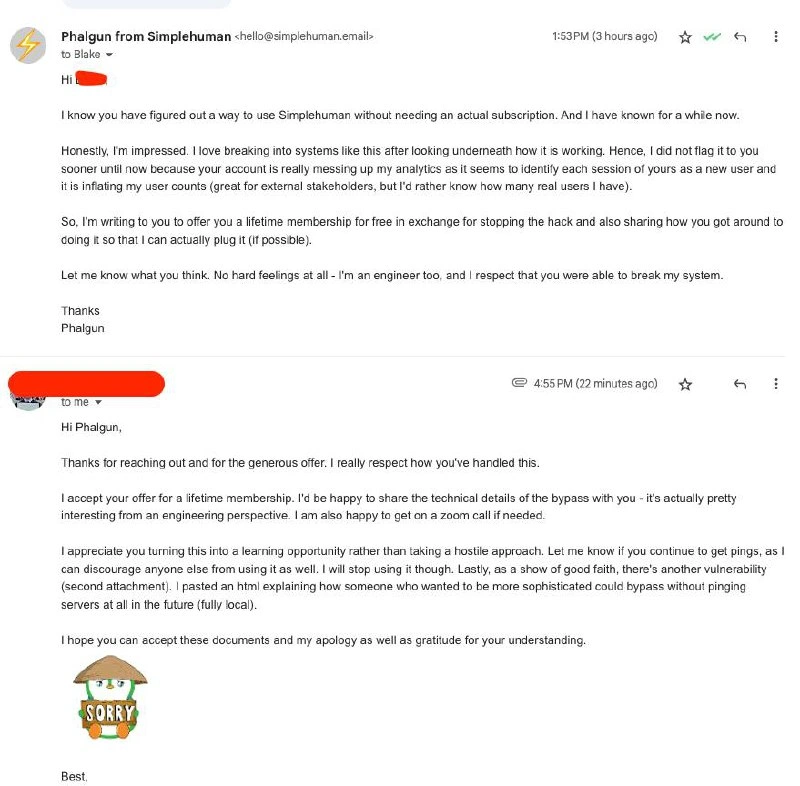
The hacker’s reply was very courteous and thorough. They said they’d stop using the trick (so they won’t keep essentially stealing the service), and they agreed to share the technical details of how they pulled off the bypass. They even went a step further and attached an HTML file showing another variant of the exploit – one that could run fully local (meaning, a way someone could use the product offline without even contacting the company’s servers). This shows the hacker not only pointed out the hole, but also helped demonstrate how to patch another related hole. The little cartoon “SORRY” image they included is just an extra personal touch – it shows they feel a bit bad about breaking the rules, even if it was for a good cause, and they’re grateful the company is being so understanding.

For someone new to this stuff, it might be surprising that a company would reward a hacker instead of punishing them. But in the world of cybersecurity and software, this kind of collaboration is becoming more common and encouraged. It’s called a non-adversarial security response – basically treating those who point out problems as helpers, not enemies. Companies have learned that working with ethical hackers makes their products safer. It’s much better to have a friendly hacker expose a flaw and tell you, than to have a bad actor exploit it in secret. This meme’s email exchange is a perfect illustration of that ideal. The white-hat hacker got what they wanted (access to the service, now freely given and approved) and the company got what it needed (information to fix the security flaws and one less person exploiting them). No one had to argue or go to court; it’s all smiles and thumbs up. In summary, this is ethical hacking in action: a problem was found, responsibly shared, and rewarded in a positive way. It’s a win-win and a great example for newbies that sometimes breaking things (and then telling the owner nicely) is actually how we make technology better and safer for everyone.

Level 3: Exploit Etiquette

This email thread is basically a bug bounty fairy-tale come to life. A crafty user finds a way to get a paid service for free (the classic subscription bypass every startup fears), but instead of a cease-and-desist letter or a quiet ban, the company’s engineer responds with admiration and gratitude. The humor here comes from how unexpectedly wholesome the interaction is. Seasoned developers and security folks are nodding knowingly because we’ve seen the opposite too often: usually, reporting a hack can feel like poking a bear. You half-expect an email from the company’s legal team threatening “unauthorized access” charges. But in this meme, the first email basically says “I’m impressed… no hard feelings at all – I respect that you were able to break my system.” When was the last time a company literally thanked a hacker for exposing a security flaw? It’s a white-hat hacker’s dream scenario and indeed the golden path for handling such incidents.

What makes this funny to an experienced dev is that it’s so ideal it’s almost absurd. We have Phalgun (the engineer at Simplehuman) diplomatically reaching out, and even admitting the exploit was clever (“I know you figured out a way… Honestly, I’m impressed”). He’s basically saying, “I tip my hat, you got us good.” For those of us in tech, that’s a refreshing twist. The usual storyline is more adversarial: think of times where companies reacted to hackers with lawsuits or anger. (There are infamous cases, like researchers finding simple exploits and getting slapped with legal notices – not fun.) Here, Simplehuman does the opposite. They offer a lifetime membership as a peace offering and reward, essentially treating the hacker as a friendly collaborator. It’s the ultimate act of good faith: “We won’t charge you for the service you cleverly avoided paying for – just please tell us how you did it and stop doing it.” This approach turns a potential enemy into a security ally. The meme strikes a chord because it shows the responsible disclosure process working right: the company fixes a hole, the hacker gets a prize, and no one ends up in handcuffs or in a flame war on Twitter.

Why did Phalgun even notice this user in the first place? Here’s the insider insight: the hacker’s account was messing up the analytics. In the email, Phalgun mentions the user’s sessions were skewing the Monthly Active User counts. Imagine being a developer or product manager looking at your dashboard and seeing one user ID behaving like 100 users, starting fresh sessions constantly. That’s a red flag that something weird is going on. It’s actually a little comical – one ghost user haunting the KPI metrics. Sure, a spike in fake “new users” might make some investor update slides look good at first, but any engineer worth their salt would rather have accurate MAUs than fluffy numbers. By reaching out, the engineer essentially says, “You’re giving me phantom users and it’s driving me crazy – but I’d rather fix the code than pretend those ghosts are real.” This honesty and focus on real data integrity are something senior devs respect. It’s common for business types to initially love inflated user counts, but a good engineer knows false data will bite you later.

Another aspect that tech veterans will appreciate is how the hacker handled it. The reply from the user is the model of ethical hacking etiquette. They politely accept the offer, promise to stop the exploit, and even share a detailed technical write-up (with an HTML attachment) showing another variant of the vulnerability – a way to bypass the system without pinging the servers at all. That detail is juicy: it means the hacker not only found one hole, but proactively looked for others and provided a proof-of-concept fix or demonstration. Essentially, they handed the company free consulting on their security flaws. The hacker even added a cute “SORRY” sticker image in the signature, which is both funny and endearing – it’s like the gentlest “my bad” for breaking someone’s app. Seeing that in a disclosure email is not typical; it’s an extra human touch, almost like leaving a thank-you note after finding the key under someone’s doormat and letting them know.

For seasoned engineers, this whole exchange is almost utopian. It shows a non-adversarial security response in action. The company didn’t react with panic or defensiveness. Instead, an engineer reached out peer-to-peer, acknowledging the skill involved (“I’m an engineer too, and I respect that you were able to break my system”). That line is remarkable – it’s the sound of ego being put aside in favor of learning. In many organizations, the instinct might be to quietly patch the bug and maybe silently block the user’s account. But here, the Simplehuman team chose openness and even humility. They recognized that this person effectively did them a favor by uncovering a weakness. By offering a bug-bounty style reward (a free lifetime plan), they created an incentive for the hacker to cooperate fully. It’s a smart move: better to have the person on your side, explaining the vuln, than trying to play whack-a-mole if they stay an adversary. In fact, this is how some companies end up hiring top security talent – today’s polite hacker on your platform could be tomorrow’s security engineer on your payroll.

The meme resonates because it also subtly reminds us of the right way to handle bugs. Bugs and security vulnerabilities are inevitable in any complex system. When one is found, you can either shoot the messenger or you can team up with them. The email chain shows the latter, and experienced devs know this usually leads to better outcomes. It’s a comedic relief to see an email chain where both sides are basically saying “thank you” to each other, instead of exchanging blame. One could imagine the relief on the hacker’s side: they likely knew they were exploiting something and half-expected a stern email or their account to be terminated. Instead, they got what amounts to a friendly handshake and a high-five. For anyone who’s dealt with corporate security policies, it’s almost funny how informal and cordial this is – no hard feelings, just two techies geeking out over a clever hack (one proud to have pulled it off, the other begrudgingly impressed and eager to learn from it).

In sum, why is this meme funny to us tech folks? Because it’s an optimistic twist on a scenario that is often tense. It’s as if the “cops and robbers” game turned into a friendly knowledge exchange. The white-hat didn’t get treated like a black-hat criminal; instead, they got a reward and respect. And the company didn’t get a PR nightmare; they quietly patched things up with help from the very person who broke their system. It’s heartwarming and hilarious at the same time – almost like a buddy-cop ending where both sides walk off into the sunset sharing tips on how to improve the alarm system for next time. For veteran devs, this is both a teachable moment and a light-hearted reminder that sometimes, doing the right thing pays off (literally, in free services). In a world of tense breach stories, this little responsible disclosure email chain feels like a breath of fresh air – and we can’t help but smile at how civil and genuinely collegial it all turned out.

Level 4: The Trust Boundary Trap

At the deepest technical level, this meme highlights a classic security design oversight: trusting the client too much. The white-hat hacker essentially found a subscription bypass because the system’s trust boundary extended onto the user’s device. In robust security architecture, anything running on a user’s machine is inherently untrusted – if critical checks (like verifying a paid subscription) happen only in the client app or front-end, a determined attacker can reverse-engineer or circumvent them. It’s the old principle of “never trust the client” in action. Here, the attacker was able to use the service without an actual subscription by exploiting a weakness in how the app verified subscriptions. The fact that an offline HTML trick could avoid pinging the servers suggests that the subscription check was done locally or could be faked locally, which is a glaring security flaw in the software’s design.

Let’s consider how that might happen. Perhaps the application simply hid premium features in the UI unless a flag was set, or it cached some credential that could be manipulated. For example, if the app’s logic looked roughly like:

// Hypothetical client-side pseudo-code for subscription check
if (user.hasValidSubscription) {
    grantPremiumAccess();
} else {
    promptUpgrade();
}

an attacker with access to the app could find a way to always force hasValidSubscription to true. Since the client was making decisions that the server should have been enforcing, the hacker effectively became an admin of their own app experience. This is why serious systems use server-side checks or cryptographically signed tokens – otherwise a hacker is playing the game on “God mode.” It’s a real-world example of why “security through obscurity” (relying on secret client-side code or hidden URLs) is fragile: once someone looks under the hood, the game is over. In classic infosec terms, this scenario confirms Kerckhoffs’ Principle – a system must be secure even if the attacker knows exactly how it works. Here, once our hacker learned how Simplehuman’s app worked, there was nothing stopping them from exploiting the weakness again and again.

Interestingly, the hacker’s repeated free sessions created a kind of mini Sybil attack on the company’s analytics. In security theory, a Sybil attack is when one entity pretends to be many (like creating hundreds of fake nodes or accounts) to subvert a system. By appearing as a “new user” for every session, this single person’s activity artificially inflated the Monthly Active Users (MAU) count. The backend likely saw a burst of phantom users – a scenario that’s bad for honest metrics (even if it might make some marketing folks briefly cheer the growing user count). This highlights another subtle aspect of system design: identity management. A robust system should reliably distinguish unique users (perhaps via server-verified tokens or device fingerprints) so that one clever individual can’t masquerade as many. In our case, the exploit fooled the system’s accounting of real users vs. fake sessions – essentially MAUs vs. real users diverged, exposing an analytics blind spot.

From a theoretical standpoint, this story is also a case study in the economics and ethics of hacking. The company’s response – offering a reward (lifetime membership) and requesting cooperation – aligns incentives with the hacker. It reflects a strategy akin to “if you can’t beat hackers, hire them”. In game theory terms, they chose cooperation over confrontation, turning a potentially adversarial interaction into a win-win scenario. Many modern organizations formalize this through bug bounty programs and responsible disclosure policies, essentially inviting hackers to attack their systems under agreed rules and then rewarding them instead of punishing them. This approach creates a positive-sum game: the hacker gains recognition or rewards, and the company gains knowledge of vulnerabilities and a chance to fix them before bad actors abuse them. It’s a far cry from the bygone days of knee-jerk legal threats; instead, it’s the embodiment of “proactive security through community.” In fact, global standards and platforms now exist for this: programs on HackerOne or Bugcrowd, and guidelines like ISO 29147 for vulnerability disclosure, all encourage a non-adversarial security response like the one in this meme. The underlying principle is simple but profound – by treating a security vulnerability report as collaboration rather than an attack, everyone walks away better off and more secure.

Description

A screenshot of an email exchange between Phalgun from Simplehuman ([email protected]) and a user named Blake. Phalgun writes that he knows Blake found a way to bypass the subscription system, is impressed, and offers a lifetime membership in exchange for disclosure of the hack and stopping the bypass. Blake responds graciously, accepts the offer, agrees to share the technical details, and even discloses a second vulnerability as a show of good faith. The exchange includes a 'SORRY' sticker with a cute character. This is a heartwarming example of responsible disclosure handled respectfully by both parties

Comments

21
Anonymous ★ Top Pick The best penetration test is the one where the founder emails you saying 'I'm not even mad, that's impressive' and hands you a lifetime license
  1. Anonymous ★ Top Pick

    The best penetration test is the one where the founder emails you saying 'I'm not even mad, that's impressive' and hands you a lifetime license

  2. Anonymous

    Most companies send a C&D letter when you find an exploit. This one offered a lifetime subscription. It's the bug bounty equivalent of getting equity instead of a restraining order

  3. Anonymous

    Finally, a growth-hack that literally hacks growth metrics - good thing legal signed off with a lifetime coupon instead of a cease-and-desist

  4. Anonymous

    The rare moment when a company's bug bounty program is just 'please stop breaking our stuff and we'll give you free access' - essentially paying the ransomware in product licenses instead of Bitcoin

  5. Anonymous

    When your analytics show 10x user growth but it's actually one engineer with a subscription bypass and a for-loop - the SaaS equivalent of discovering your 'viral growth' was a single determined developer who really didn't want to pay $9.99/month. Props to both parties here: one for the creative session management exploit, the other for turning a potential PR nightmare into a teaching moment. This is what 'responsible disclosure' looks like when both sides have actually shipped production code - mutual respect, technical curiosity, and the understanding that today's vulnerability researcher might be tomorrow's security engineer. Plus, offering a lifetime membership is cheaper than hiring a pentester to find what this person already documented

  6. Anonymous

    When auth is enforced by JavaScript, every pentester becomes a growth hacker - and the bug bounty is a lifetime plan

  7. Anonymous

    Pro tip: if a single user can 10x your MAU, you didn’t find product-market fit - you found missing authorization middleware

  8. Anonymous

    Staging auth: so wide open, one curl loop earns you lifetime VIP faster than legit signups

  9. @deimossos 9mo

    Based developers

  10. @hur7m3 9mo

    Dev wants personal details to sue. Hecker attached malicious files to fuck with the dev.

    1. F 9mo

      why suing if the hack makes external stakeholders happy?

      1. @pooyabehravesh 9mo

        Fair enough

      2. @theodolu 9mo

        Money

      3. @JackOhSheetImSorry 9mo

        Not suing the hack. Multiplying users does

      4. @gmayv 9mo

        Because the hacker can now use this newfound knowledge to blackmail him for fraudulently deceiving his investors. This can go down in a number of ways now. It was a really stupid thing to do. I can only make sense of this as him trying to bait the dude into giving his identity so the company can royally fuck him

        1. dev_meme 9mo

          This was literally posted by simplehuman representative

          1. @gmayv 9mo

            They are all retarded then

  11. @Ilg4tto 9mo

    The best love story ever

  12. @deerspangle 9mo

    Oh I love that

  13. @AbolhasanAshori 9mo

    Rise with each other, not on top of each other. 🤝

  14. @hyena_stuff 9mo

    I've read enough yaoi to know where this is going

Use J and K for navigation