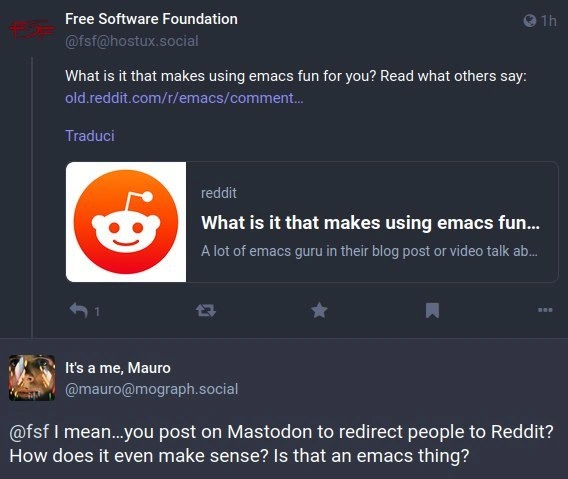
FSF's Platform Choice Sparks 'Is That an Emacs Thing?' Jab
Why is this OpenSource meme funny?
Level 1: Mixed Signals
Think of it like this: imagine your teacher at school always says, “Never use Wikipedia for research, only use the official encyclopedia!” They’re very strict about using trusted, free resources. But one day, that same teacher excitedly tells the class, “Hey everyone, I found some great information for your projects – here’s a link to a Wikipedia page!” You’d probably pause and think, “Huh? Isn’t that exactly what they told us not to do?” It’s confusing and kind of funny to see them break their own rule. In this meme’s story, the FSF is a bit like that teacher. The FSF usually tells everyone to stick with open, community-driven tools (like Mastodon, which is a friendly neighborhood playground on the internet). But suddenly they pointed people to Reddit, which is more like a big commercial venue. It sends a mixed signal – no wonder someone responded with a playful “How does that make sense?”
The second part of the joke, “Is that an Emacs thing?”, is like if one of your classmates joked, “Maybe the teacher’s doing that because they’re such a math nerd (or insert any hobby) – you know how those math nerds do peculiar stuff!” Here, Emacs is that “hobby” or special thing with a quirky reputation. Emacs is a tool programmers either love deeply or find a bit odd. So people often tease that anything weird might be an “Emacs person” thing. In simple terms, everyone’s just having a light laugh because a group known for strict rules did something against their own grain, and it reminds them of that one friend who does everything in a super unique way. It’s the kind of gentle ribbing that happens when someone who always says one thing ends up doing the opposite – we’re surprised, we scratch our heads, and we smile because it’s a little bit silly.
Level 2: Fediverse vs Reddit
Let’s break down why this situation is amusing, in more straightforward terms. The Free Software Foundation (FSF) is an organization that promotes and defends free software. “Free” here means freedom (like free speech), not price – they want software to be open-source so that anyone can use, study, and modify it. The FSF is pretty famous in developer circles for sticking to its principles. They prefer tools and platforms that are community-run, transparent, and not controlled by companies. For example, the FSF helped develop GNU software (part of what we usually call GNU/Linux), and they maintain Emacs, which is a very powerful and customizable text editor. Emacs is one of their hallmark projects: it’s completely open-source and has been around for decades. Emacs enthusiasts love it because you can tweak it endlessly – it has its own built-in programming language (Emacs Lisp) that lets users turn Emacs into almost anything. Some people use Emacs not just for coding, but for email, planning, even browsing the web in a text-only way. This flexibility makes Emacs fun for a certain kind of user – they enjoy bending the editor to their will. There’s even a long-running friendly feud called the editor wars between fans of Emacs and fans of another editor called Vim (and nowadays, throw in VS Code or others). It’s mostly in good humor, but each side teases the other about their preferences and habits. Emacs users are sometimes teased for doing things the “Emacs way,” which can be unconventional or overly complex, albeit powerful.
Now, Mastodon is a social network similar to Twitter, but it’s part of what’s called the Fediverse (short for federated universe). Instead of one big website run by one company, Mastodon is open-source and spread across many servers (called instances) run by different people or organizations. These servers talk to each other, so someone on one Mastodon server can follow and interact with someone on another server – much like how email works (Gmail users can email Yahoo users, etc.). The FSF, loving freedom and decentralization, naturally has an official presence on Mastodon (the instance shown, hostux.social, is one such community server). Posting on Mastodon aligns perfectly with FSF’s values: it’s using a SocialMedia platform that’s built on open, community-driven technology.
Reddit, on the other hand, is a well-known centralized site. It’s basically a collection of forums (called subreddits) on all sorts of topics – from programming to cooking to funny cat pictures. It’s not open-source; it’s a commercial company’s platform. Most developers have probably browsed or asked something on Reddit at some point, because it’s a huge hub of knowledge and discussion (there’s a subreddit for almost any technology, including r/emacs for Emacs users). However, Reddit is very much a mainstream, closed system compared to Mastodon. You typically need an account to participate, and the platform’s code and control aren’t open to the community in the way Mastodon’s are. In the open-source world, Reddit would be seen as a proprietary platform – not evil or anything, but not aligned with the FSF’s usual preference for freedom-respecting tools.
Now here’s the scenario: The FSF’s account on Mastodon made a post asking “What is it that makes using Emacs fun for you?” and instead of just expecting replies on Mastodon, they provided a link for people to click. That link led to an existing Reddit thread where presumably someone had asked the same question and many Emacs users had shared their answers. In other words, the FSF was saying, “Hey, we want to know why you find Emacs fun – go check out what people on Reddit said about this!” This is a bit unusual. It caught people’s attention because cross_posting from Mastodon to Reddit is a little like inviting your friends from a local community park meetup (Mastodon) to continue the chat at a big corporate convention center (Reddit). Given the FSF’s ethos, you’d expect them to keep that conversation in the community-run space, or maybe link to a blog post on fsf.org or an email thread. But nope – they sent folks to Reddit.
One user on Mastodon, named Mauro (@[email protected]), responded with a puzzled comment. They basically said: “@fsf I mean… you post on Mastodon to redirect people to Reddit? How does it even make sense? Is that an emacs thing?” Let’s unpack that: The first part (“you post on Mastodon to redirect people to Reddit? How does that even make sense?”) is pointing out the oddness we just described. It’s like, why are you here (on Mastodon, presumably because you prefer it) just to tell us to go there (on Reddit, which is the kind of platform one would think you avoid)? It struck them as contradictory, almost like a betrayal of the Mastodon/fediverse spirit. This confusion is shared by many who saw it – it’s essentially asking, “FSF, are you aware this looks a bit hypocritical or at least counter-intuitive?”
The second part (“Is that an Emacs thing?”) is where the joke comes in. This commenter is cheekily suggesting that maybe this weird behavior can be blamed on Emacs culture. Emacs has a bit of a reputation in programming circles for doing things differently. For example, an Emacs user might brag about never leaving their editor: they’ll write code in Emacs, compile it in Emacs, read emails in Emacs, and post on forums using Emacs. There’s a running joke that Emacs can even make you coffee if you configure it hard enough. So when Mauro says “Is that an Emacs thing?”, he’s humorously implying, “Oh, maybe this is just one of those quirky things Emacs fans do – like using one social network to point to another – something only they would think makes sense.” It’s a light jab, essentially poking fun at Emacs lovers by suggesting they have convoluted ways.
For someone newer to these concepts, the whole humorous effect comes from expectation vs reality. You have an organization (FSF) that everyone expects to always favor open, free alternatives – yet here they are sending folks to a very popular but not-so-open website. It’s a bit of a gotcha moment. The developer community finds it amusing because it’s an unexpected crossover of two worlds: the Fediverse vs Reddit gap. And tying it to Emacs just adds an extra sprinkle of nerdy humor, because Emacs is often the butt of jokes in the context of IDEsAndTextEditors debates. Emacs devotees and detractors alike will recognize that “Emacs thing” quip and likely chuckle. After all, the question that started this – “What makes using Emacs fun?” – is innocent and genuine. Emacs is fun for its users because it’s endlessly customizable. But seeing the FSF handle that question by effectively saying “check out Reddit” is what transforms a normal community question into a comedy of errors for those in the know. It’s a perfect example of OpenSourceCulture quirks: even the guardians of software freedom sometimes do things that make their followers scratch their heads. And in developer circles, we love to call out and laugh about such moments together.
Level 3: Free as in Irony
At first glance, this meme delivers a rich dose of open-source culture irony. We have the Free Software Foundation (FSF) – the stalwart organization championing software freedom – using a Mastodon instance (a decentralized, federated social network aligned with their ideals) to send readers to a discussion on Reddit (a proprietary, centralized site). For anyone steeped in developer community history, that’s a head-turner. It’s like watching the FSF, known for preaching “free as in freedom”, casually hand out flyers for a walled-garden platform. The contradiction is glaring and darkly funny. Seasoned devs know the FSF’s mantra is to avoid closed platforms; historically, FSF folks stuck to mailing lists, newsgroups, and self-hosted forums. So linking to a Reddit thread feels almost heretical – the digital equivalent of an organic food co-op advertising a fast-food chain.
Digging deeper, the post_redirect_irony in play here is gold. The Mastodon toot asks, “What is it that makes using Emacs fun for you?”, and invites readers to “Read what others say” on a Reddit thread. Essentially, an advocate of federated social media is funneling traffic to a centralized site. This has seasoned devs smirking because it highlights the eternal clash between principles and practicality. The FSF choosing Reddit (with its orange RedditThreads logo glaring in the preview) is pragmatic – Reddit’s where a lot of developers hang out and share ideas – but it’s also off-brand. Developer humor often blooms from these exact moments when lofty ideals meet real-world habits. As an example, the FSF’s founder Richard Stallman famously avoids even websites that require nonfree JavaScript. Notably, the link shared is to old.reddit.com (Reddit’s old minimalist interface); a detail any FSF veteran would appreciate, since the old version is friendlier to text-only browsers and doesn’t shove proprietary scripts down your throat. That subtle choice whispers, “Yes, we’re on Reddit, but we’re doing it the free software way.” It’s a tiny mitigation of the irony, and a pretty OpenSourceCulture move – the kind of detail that makes experienced users grin knowingly.
Then there’s Emacs, the centerpiece of the question. Emacs isn’t just any text editor – it’s practically an operating system masquerading as an editor, with an ecosystem of Lisp extensions that can turn it into an email client, web browser, music player, or games console. Emacs was born in the 1970s and became a flagship of the FSF in the ’80s, so it carries decades of hacker lore. The meme taps into that legacy. Over the years, the playful rivalry of the EditorWars (Emacs vs. vi/Vim, and more recently vs. modern IDEs) has produced countless jokes. Emacs users proudly joke that Emacs can do everything (yes, even browse Reddit via plugins or text-based browsers inside Emacs). Non-users tease that Emacs is overly complicated – “an OS lacking a good editor,” as the old joke goes. When the commenter quips, “Is that an Emacs thing?”, it’s riffing on this exact stereotype. It implies that only Emacs aficionados (or by extension, the FSF crowd) would do something as convoluted as posting on one platform just to redirect to another. It’s a tongue-in-cheek way of saying, “This behavior is as arcane as Emacs itself.” For veterans, this echoes the classic banter: Emacs folks are known to, say, manage their email, agenda, RSS feeds, even Tweeting (Tooting?) all from within Emacs – so why not cross-post between Mastodon and Reddit too? The meme is winking at the emacs_culture of all-in-one workflows and lovingly poking fun at it.
This scenario also highlights a quirk of developer communities: the tension between purity and pragmatism. Long-time open source contributors have seen this movie before. It’s reminiscent of those Linux die-hards from the 2000s who swore off Windows entirely… except for that one dual-boot partition for Photoshop or games. 😏 Here, the FSF’s social media team has its own “dual-boot moment” by stepping onto Reddit for outreach. Historically, Emacs discussions thrived on GNU mailing lists and Usenet groups; seeing an official FSF account nudging folks to Reddit is a sign of the times. It’s both nostalgic and comical – like the Cathedral and the Bazaar essay playing out in real life, with a bazaar-dweller (Mastodon) inviting folks into a cathedral (well, Reddit’s walled garden). Veterans chuckle because they appreciate how far we’ve come: from the early internet ethos of self-hosted forums to today’s reality where even the most principled organizations sometimes leverage mainstream platforms. This “Fediverse vs. Reddit” paradox serves up a hearty dish of cognitive dissonance.
In sum, the meme’s humor operates on multiple levels for the experienced dev. It’s the FSF doing something seemingly against its DNA, causing a bit of collective head-scratching. It’s the absurd image of Free Software advocates inadvertently boosting proprietary social media content. And it’s a nod to Emacs’s legendary flexibility and the OpenSourceCulture quirks that come with it. The whole thing feels like a witty inside joke: everyone involved recognizes the oddness, and that self-awareness is exactly what makes it so funny. The community is effectively laughing with the FSF here, not just at them – because who among us hasn’t bent a rule or two for the sake of convenience? Even our beloved Emacs mavens and freedom fighters aren’t immune to a little pragmatic linkage, and that’s both hilarious and endearingly human.
Description
A screenshot of a conversation on the social media platform Mastodon. The first post is from the Free Software Foundation (@[email protected]), which asks, 'What is it that makes using emacs fun for you? Read what others say:' followed by a link to a discussion on old.reddit.com. Below this is a reply from a user named Mauro (@[email protected]), who questions the logic of the post. Mauro's reply reads: '@fsf I mean...you post on Mastodon to redirect people to Reddit? How does it even make sense? Is that an emacs thing?'. The humor stems from multiple layers of tech culture context. First, there's the irony of the Free Software Foundation, a staunch advocate for open-source and decentralized systems, using Mastodon (a decentralized platform) to promote content on Reddit (a centralized, proprietary platform). Second, the reply cleverly connects this convoluted action to the long-standing stereotype of the Emacs text editor being overly complex, customizable to the point of absurdity, and having a steep learning curve - implying that doing a simple thing in a complicated, roundabout way is characteristic of Emacs users

Comments
11Comment deleted
Of course the FSF links from Mastodon to Reddit. In Emacs, you wouldn't just use a hyperlink; you'd run a shell command inside a buffer that pipes the content through three different parsers before displaying it in another frame. It's about the journey
Apparently the new Emacs TRAMP syntax is `C-x C-f /mastodon@fsf:/reddit:/r/emacs/` - because even our social scrolling now needs three network hops and a Lisp interpreter
The FSF using Mastodon to drive traffic to Reddit is like configuring your .emacs file to launch VS Code - technically possible, philosophically questionable, and guaranteed to start a flame war at the next LUG meeting
The FSF using Mastodon to drive traffic to Reddit is the social media equivalent of writing a shell script that just calls a Python script that imports a JavaScript library. Sure, it technically works, but you've missed the entire philosophical point of why you chose the first tool in the first place. It's like advocating for free software while hosting your documentation exclusively on a proprietary platform - oh wait, that's exactly what's happening here. The real emacs thing isn't the redirect; it's the meta-irony of needing to explain why this defeats the purpose of federation
Only Emacs could turn a federated toot into a centralized 302 - next up, M-x customize-redirect
FSF plugging Emacs on Mastodon via a Reddit link is the most Emacs thing ever: federation as a minor mode, walled garden as the default buffer
Emacs fun: Posting Reddit links on Mastodon so your .emacs can org-capture the ensuing editor war flames
Cool design Comment deleted
Calendar invite? SGTM Comment deleted
Please sign here that you consent before we proceed. ✅I am 18 or over ……………………… Sign on the dotted line. Comment deleted
huh? Comment deleted