Elrond Demands Refactor Be Deployed; Product Manager Says No
Why is this Refactoring meme funny?
Level 1: One Step from the Trash Can
Imagine your room is finally clean — everything sorted into a big garbage bag, and you're standing right next to the trash can. Your friend yells, "Just drop it in! You're RIGHT THERE!" And the person holding the bag calmly says, "No," and carries it back inside, because they're too busy planning a pizza party to take out the trash. It's funny because everyone watching can see this is the easiest possible moment to finish the job — and that saying "no" now means the mess will grow until, one day, cleaning it up becomes a gigantic adventure nobody wants.
Level 2: Why Refactors Die in Planning
Refactoring means restructuring existing code — clearer names, smaller functions, untangled dependencies — without changing what it does. Users see nothing; developers gain speed and safety on every future change. Technical debt is the accumulated cost of skipping that cleanup: like financial debt, it charges interest, paid as slower features and weirder bugs.
A release is a planned bundle of changes shipped to production; a Product Manager (PM) decides what goes in, balancing engineering wishes against business goals. Because a refactor adds no visible feature, it competes badly against "the thing sales promised" — so it gets bumped, release after release.
If you're new to the industry, this meme previews a conversation you will personally have: you'll finish a cleanup you're proud of, propose shipping it, and hear "not this sprint." Two practical survival skills emerge from that scar tissue: frame refactors in business terms ("this cuts bug rate in the checkout flow"), and better yet, refactor incrementally inside feature work (the Boy Scout rule — leave the code cleaner than you found it) so the cleanup never needs its own line item on a roadmap where it can be told "No."
Level 3: The Backlog of Isildur
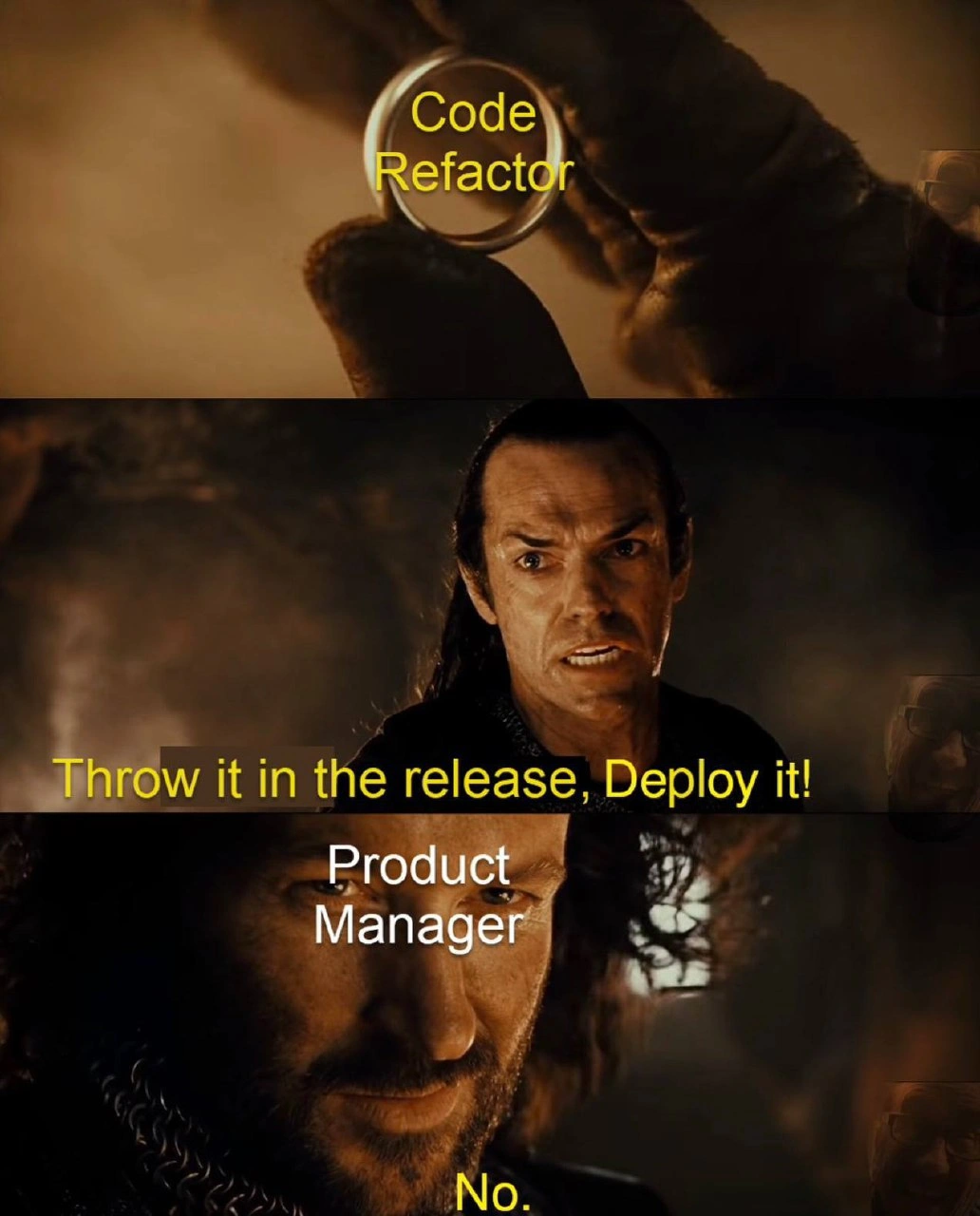
The casting here is surgically precise. The One Ring — held over the fires of Mount Doom in Isildur's hand — is labeled "Code Refactor." Elrond, mid-snarl, delivers the adapted line: "Throw it in the release, Deploy it!" And Isildur, relabeled "Product Manager," turns away with that quiet, infuriating half-smile: "No." Anyone who knows the source material knows what that "No." costs: three thousand years of war, ruin, and a nine-movie-hour cleanup project. Anyone who knows software knows the same thing, denominated in sprints.
The satire targets the feature factory incentive structure with uncomfortable accuracy. The refactor is done — it exists, it's in hand, it's one merge away from the fire. But refactoring has a fatal property in roadmap economics: it produces zero visible change for users and zero demo material for stakeholders, while consuming release capacity and carrying regression risk. A PM's incentives are quarterly: features shipped, metrics moved. Technical debt compounds on a longer timeline than anyone's performance review, so deferring it is individually rational every single time — which is exactly how smart organizations make collectively ruinous choices. Isildur wasn't stupid either; the Ring was just more valuable to him in hand than in lava, that day, in that moment.
The LOTR mapping carries a second, darker resonance the meme earns honestly: unintegrated refactors corrupt. A refactor branch that doesn't ship immediately begins to rot — main drifts, merge conflicts metastasize, and within a few sprints the branch is unmergeable and quietly abandoned, surviving only as legend and as a Jira ticket marked Won't Fix. Meanwhile the duplicated modules and tangled dependencies the refactor would have purged keep whispering to every developer who touches them, slowing each feature a little more, until the org finally funds "The Great Rewrite" — a council of nine engineers walking a much harder road to undo a decision that was once one button-press away.
Description
A three-panel meme using the Mount Doom scene from 'The Lord of the Rings: The Fellowship of the Ring'. The top panel shows Isildur's hand holding the One Ring, labeled 'Code Refactor' in yellow text. The middle panel shows Elrond (Hugo Weaving) shouting angrily, with the subtitle 'Throw it in the release, Deploy it!'. The bottom panel shows Isildur (labeled 'Product Manager') turning away with a quietly defiant face and the caption 'No.'. The meme maps Isildur's fateful refusal to destroy the Ring onto product managers refusing to ship refactoring work because it delivers no visible feature value - dooming the codebase to the slow corruption of accumulating technical debt, just as keeping the Ring doomed Middle-earth
Comments
3Comment deleted
And so the refactor branch lived on for three thousand years, until it was lost in a rebase and passed into legend
refactoring is overrated ngl Comment deleted
Throw it in the sprint* Comment deleted