The New Programmer's Addiction to Python Jokes
Why is this Languages meme funny?
Level 1: Too Much Candy
It’s like a little kid who just tasted candy for the very first time. They find one piece of candy and it’s so yummy and exciting that they can’t stop. Instead of eating a normal amount or having some veggies or dinner first, the kid jumps face-first into a whole pile of candy and chocolates! Imagine the child’s face covered in sugar and chocolate, grinning with wild eyes because they ate way too much all at once. This meme is doing the same thing, but with learning and jokes. The red cartoon character (Elmo) just learned a tiny bit about coding (that’s the new “candy” he discovered). He’s so happy and curious that he immediately goes and gobbles up every single funny joke about Python (Python is a programming language, kind of like a new toy he learned to use). It’s funny because he overdid it – just like a kid eating far too many sweets and ending up with candy all over their face! We laugh because we recognize that over-excited, can’t-get-enough feeling. The picture makes it super silly and clear: sometimes when you find something new and fun, you dive in a bit too much, and it’s a playful reminder of that feeling.
Level 2: From Hello World to LOL
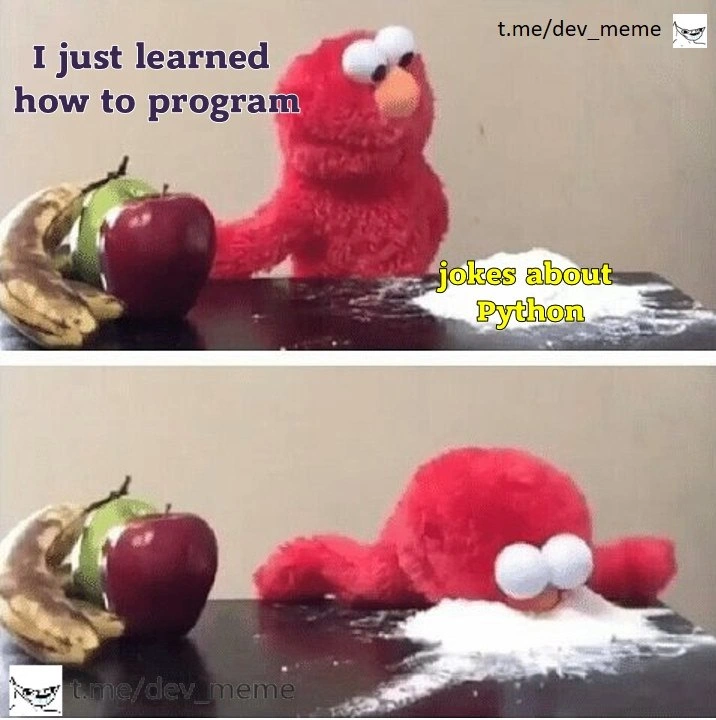
In plain terms, this meme is showing a beginner programmer getting a little too excited about Python jokes right after they start learning to code. In the first panel, the red Muppet Elmo is reaching toward a small pile of white powder on the table and saying, “I just learned how to program.” This represents a brand-new coder, likely someone who just completed their first exercise or wrote their first program (for example, printing "Hello, World!"). It’s that proud moment where you go, “Yes! It ran without errors!” The text on the table in front of Elmo says “jokes about Python” in bright yellow. That pile of “Python jokes” is the temptation awaiting him. The second panel shows Elmo collapsed face-down into that pile of jokes, with his eyes bugging out. In other words, he dove headfirst into all the Python humor he could find and totally overindulged. The meme is exaggerating how quickly newbies can get swept up in the fun parts of programmer culture. Instead of pacing himself or maybe writing a second program (symbolized by the ignored banana and apple — the regular food of learning), our new coder has essentially gorged on jokes (the candy/dessert of the programming world).
Let’s break down why it’s Python specifically. Python is one of the most popular programming languages for beginners because its syntax is simple and readable (you don’t need to add lots of symbols like {} or ;). It’s often the first language taught in intro courses and online tutorials. As a result, Python has a huge community of learners and a ton of related memes and jokes that circulate in dev communities on the internet. When we say “jokes about Python,” we mean all the funny references and puns that people make about Python’s features or its name. For example, Python uses indentation (spaces or tabs at the beginning of lines) to define code blocks instead of curly braces { }. A common joke is that if you mix up tabs and spaces or misalign indentations, you get an IndentationError – and there are memes showing someone panicking over a tiny invisible space character causing an error. Another example: because Python is named after Monty Python (a comedy troupe), many tutorials use silly words like “spam” and “eggs” as placeholder variables (instead of generic names like x or num). New learners often find this amusing or confusing until they get the Monty Python reference. There’s even an official Easter egg: if you do import this in a Python program, it prints a poem called “The Zen of Python” full of wise and humorous principles. One line humorously says, “There should be one—and preferably only one—obvious way to do it.” Newbies might not fully grasp these principles yet, but they love that Python has its own little poem! All these inside jokes make Python feel not just like a coding language, but almost like a fun club.
Now, imagine you’re a junior developer who just wrote your first Python script. You’re super excited and probably you hop online to see what other Python folks are talking about. You quickly stumble upon an avalanche of memes and jokes on Twitter, Reddit, or Telegram (the meme has a watermark t.me/dev_meme, showing it came from a Telegram developer meme channel). You see jokes comparing Python to other languages, snake puns (because “Python” is also a big snake), and humorous tips like “Be careful with indentations or you’ll get snaked!”. It’s all new and hilarious to you. So, instead of, say, starting your next coding exercise, you spend the next few hours laughing at these jokes and sharing them with your friends. That’s exactly what Elmo is depicting: he should maybe eat the apple or banana (i.e., continue learning, get some real substance), but nope – he can’t resist diving into the heap of jokes (the sugary stuff). The white powder is a cartoonish way to represent something addictive; don’t think of it literally as a substance, but as a metaphor for how one can get carried away. The term “faceplant” literally means falling on your face (often due to clumsiness or overwhelm), and here it shows Elmo literally planting his face into the pile of humor content because he just can’t get enough of it.
The meme is very relatable for many in the tech world. New programmers often try to absorb hacker culture and developer humor as part of learning to code. It’s exciting to feel like you’re part of this community that has its own jokes and references. There’s even a bit of flattery in understanding a programming joke — it makes you feel like “I belong, I get it now!” So after learning just a little, beginners might flood their social media with snake emojis, joke about “Hello World taking over the world,” or mock other languages using memes, even if they barely know those languages. It’s all in good fun and shows their enthusiasm. This meme exaggerates that habit by showing Elmo (who’s kind of like a big excited kid here) literally overwhelmed by humor. In summary, a newcomer to coding (especially in Python) often immediately embraces the lighthearted side of programming culture – sometimes to a silly extreme – and that’s what we see illustrated: a newbie dev on a meme sugar-rush right after discovering the joys of Python.
Level 3: Pythonic Overdose
This two-panel Elmo meme hilariously captures a scenario every seasoned developer recognizes: a brand-new programmer instantly OD-ing on Python inside jokes. In the first panel, our red furry friend proudly declares “I just learned how to program” – the classic newbie high from printing their first "Hello, World!". In the very next panel, Elmo’s face is planted in a mound of white powder labeled “jokes about Python”, eyes wild. It’s an over-the-top visual metaphor (channeling a cartoonish overindulgence_humor vibe) for how beginners often go all-in on language fandom. Instead of a measured approach (like eating the proverbial fruit – note the untouched banana and apple on the table, symbols of healthy learning 😅), the newbie binge consumes every Python joke in sight. The healthy knowledge is right there, but the instant gratification of memes is just too tempting! This juxtaposition is what makes experienced devs smirk: we’ve all seen (or been) that enthusiastic junior who would rather scroll through #CodingHumor threads than read the next chapter of a tutorial.
What’s especially clever is how the meme plays on Python’s unique culture. Python isn’t just any language – it was literally named after the British comedy group Monty Python, not the snake. Humor is baked into its very identity. The community has embraced this by sprinkling witty Easter eggs and references throughout Python’s ecosystem. For instance, if you type import antigravity in a Python interpreter, it actually opens a webcomic in your browser (an homage to an XKCD comic about Python). Newbies who stumble on that trick freak out with joy – they’ve discovered a “secret” of the language and feel like they just earned their Geek Badge. Similarly, running import this prints “The Zen of Python,” a list of guiding principles for Python with a couple of tongue-in-cheek lines (one of which jokes “Although that way may not be obvious at first unless you’re Dutch.” – a wink to Python’s creator Guido van Rossum being Dutch). From silly placeholder names in tutorials like spam and eggs (a nod to a Monty Python skit) to the infamous whitespace significance (Python uses indentation instead of curly braces, spawning endless jokes about invisible errors), Python’s lore is rich with inside jokes.
So when a newcomer enters this world, it’s like a kid walking into a candy store. They’ve barely written a few lines of code, yet they’re already laughing about “snake case” vs camelCase or quoting the quirky aphorisms from PEP 20 as if they’re ancient proverbs. The humor is instantly accessible — you don’t need decades of experience to chuckle at a good Python pun. In developer communities (DevCommunities) online, you’ll often see an excited junior share a meme about, say, the dreaded IndentationError or Python being slow vs C, even if they haven’t personally hit these issues yet. It’s a form of eager tribe-identification: they’ve joined the Pythonista club and they want to speak the lingo immediately.
“Why do Python developers wear glasses? Because they can’t C.”
(A classic pun newbies love to repeat – playing on the fact that Python coders don’t use the C language, and “C” sounds like “see.”)
Experienced devs find this meme so relatable because it exaggerates a truth about the LearningToCodeJourney: that intoxicating rush of joining a dev community and suddenly inhaling all the DeveloperHumor. We laugh knowingly because we remember our own first steps — reading one tutorial and then spending hours on Reddit or Telegram channels (like the watermarked t.me/dev_meme) giggling at jokes we only half-understood. It highlights a rite of passage: discovering that programming isn’t just algorithms and syntax; it’s also a vibrant culture with its own memes, puns, and inside jokes. The image of Elmo giddily faceplanting into a pile of Python jokes perfectly parodies that moment when a newcomer’s initial excitement turns into an overdose of community fandom. And let’s be honest, even battle-hardened veterans chuckle at this because it reminds us of the pure, unjaded joy of being a newbie who finds out, hey, coding is not only empowering, it’s also really fun.
Description
A two-panel meme using the 'Elmo's Choice' or 'Elmo with Cocaine' format. In the top panel, a plush Elmo doll sits at a table. On one side is a healthy snack of fruit. On the other is a pile of white powder resembling drugs. Text labels are overlaid: Elmo is labeled 'I just learned how to program', and the pile of powder is labeled 'jokes about Python'. In the bottom panel, Elmo has ignored the fruit and has enthusiastically shoved his face directly into the pile of powder. Watermarks for 't.me/dev_meme' are present. The meme humorously portrays new programmers quickly becoming obsessed with making jokes about Python, often as a way to feel more knowledgeable or part of the 'in-group' in developer culture, instead of focusing on more productive learning paths. It's a commentary on language wars and the behavior of junior developers

Comments
7Comment deleted
The rite of passage for a junior isn't writing 'Hello, World!', it's writing their first 'Python is slow' comment on a pull request that's bottlenecked by a dozen network calls
The junior’s binging on “import antigravity” memes; meanwhile we’re the ones truly hooked - trying to keep that decade-old, revenue-critical cron job alive on Python 2.7 and a mystery fork of urllib none of us remember forking
After 15 years in the industry, I've realized Python jokes are like dependency management - everyone thinks theirs is clever until you've seen the same circular reference a thousand times and just want to import sys and sys.exit() from the conversation
Ah yes, the classic Python learning trajectory: Day 1 - 'Look at me, I can write list comprehensions!' Day 2 - Discovers decorators, metaclasses, and the GIL. Day 3 - Lying face-down wondering why `asyncio` exists and whether Guido van Rossum personally has it out for you. The real joke is that the 'jokes about Python' phase is actually the most dangerous - once you start making snake puns and arguing about whitespace, you're already too far gone. Welcome to the ecosystem where 'there should be one obvious way to do it' somehow resulted in six different async frameworks and a package management situation that makes npm look organized
Fresh devs dive into Python jokes; seniors know the punchline: the GIL throttles your threads while pip, conda, and Poetry argue about which venv you accidentally activated
The real onboarding funnel: learn syntax, import this, then spend a sprint shipping Python jokes to Slack while the staff engineer quietly adds black to pre-commit
Juniors snort Python for that quick high; we architects chase the comedown refactoring their 'scripts' into services