The Real Reason Developers Need More RAM
Why is this Frameworks meme funny?
Level 1: Big Machine, Small Job
Imagine buying a huge truck just to deliver a single small box to your friend. Sounds silly, right? You wouldn’t normally need a giant vehicle for such a tiny task. This meme is joking about the same kind of idea. Here, the “small job” is just using a regular app (like a chat app or simple program), but the “big machine” is a super powerful computer with lots of memory. Why would you need such a big computer for a little app? Because that app is built in a way that carries a lot of extra stuff (kind of like a small toy packed in a giant box full of padding). It’s funny and absurd – the person needs a high-RAM workstation (a really strong computer) just to survive opening one of these apps. In everyday terms, it’s like using a massive hammer to crack a tiny nut. The joke makes us laugh because needing something so powerful for a simple task feels over-the-top and cartoonish, just like using a huge truck when a bicycle would do.
Level 2: Electron’s Appetite
Electron is a popular framework for building desktop applications using web technologies (like HTML, CSS, and JavaScript). Essentially, Electron packages a full Chromium browser (the engine behind Chrome) along with Node.js (so you can use JavaScript outside the browser) to create an app. This means when you run an Electron app, you’re actually launching a mini web browser that loads the app’s code. If that sounds like a lot of overhead – it is! Each Electron app comes with a hefty appetite for memory (RAM).
RAM (Random Access Memory) is your computer’s short-term memory, where running programs keep their data. Heavy-duty tasks like video editing or 3D rendering naturally use a ton of RAM because they handle large files and complex operations. Typically, simply opening an app like a chat client or text editor wouldn’t use gigabytes of memory. But if those apps are built with Electron, they need more RAM – sometimes surprisingly close to what those big tasks would consume. Why? Because under the hood they load so much extra stuff (the entire browser engine and runtime). It’s like carrying a lot of baggage for a short trip.
For example, Slack, Microsoft Teams, Discord, and Visual Studio Code are all Electron apps. These are everyday tools – chat programs or a code editor – not the kind of software you’d think of as “heavy.” Yet, you might notice Slack or Teams easily using a few hundred MB of memory, and VS Code with several extensions and project windows open can climb further. A simpler, native app doing the same job might use far less memory, but Electron apps are essentially web apps in a wrapper, so they come with the weight of a web browser. This can lead to performance issues: if you have a lot of Electron-based tools open, an older computer with limited RAM might start to slow down, freeze, or make the fans spin loudly (as it works hard to keep up). It’s not that Electron apps are doing so much more work for the user; they just carry a bigger “engine” inside them.
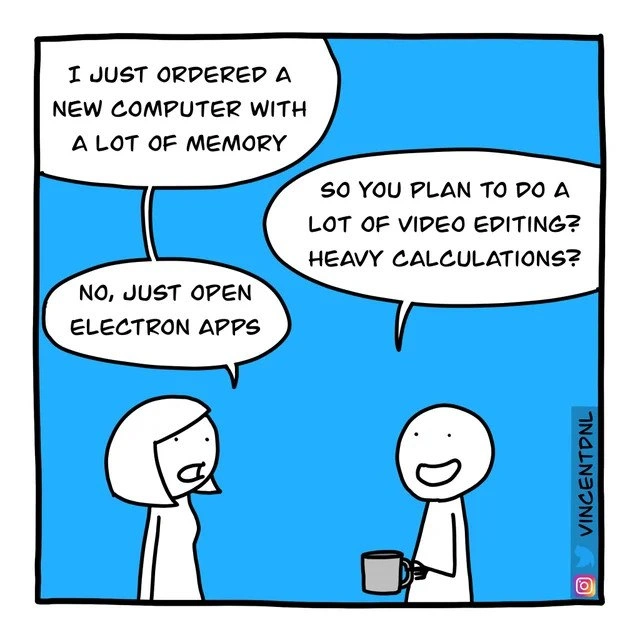
In the comic, one character says they got a new computer with a lot of memory. The other assumes it’s for something obviously memory-heavy (like editing videos or running big calculations, which everyone knows need a powerful machine). But the punchline is the first person actually just needs it for Electron apps! This joke works because it flips our expectations – needing a high-end machine for what sounds like simple tasks. Developers find this funny because it rings true: we often joke that running something like Slack or an Electron-based IDE feels as demanding as running Photoshop or a game. It highlights a bit of frustration with software bloat, where software uses more resources than seems reasonable. There’s even a term “framework fatigue.” That’s when developers get tired of new frameworks that promise easy development but come with their own downsides – here, the downside is using lots of memory. Some devs express tooling frustration about Electron because while it makes development easier (write once, run on Windows/Mac/Linux), it can make the app less efficient on the user’s machine.
So, in simpler terms: Electron apps are kind of RAM-hungry apps. Opening one is like opening a web browser dedicated just to that app. Do that for many apps, and you’ll need a good amount of memory. The meme exaggerates this in a funny way – implying you’d buy a super-powerful computer just to run these chat apps or editors. It’s a lighthearted poke at how a “simple” app can demand surprising levels of hardware oomph.
Level 3: The Heaviest Electron
The meme humorously highlights how Electron apps are notorious for devouring RAM as if it’s an all-you-can-eat buffet. In the comic, a developer says they bought a high-memory workstation, and their colleague assumes it’s for legitimately heavy tasks like video editing or scientific number crunching. The punchline: “No, just open Electron apps.” This lands because seasoned devs know that even simple desktop applications built with Electron can hog as much memory as traditionally heavy workloads. It’s a classic case of software bloat in modern development.
Electron is essentially a framework that bundles an entire web browser engine (Chromium) with a Node.js runtime to create cross-platform desktop apps. The result? Every Electron-based app is effectively a little Chrome browser running your app’s code. That convenience comes at a price: big memory and CPU overhead. Opening a chat app or a code editor built in Electron spawns multiple processes (renderers, the main process, maybe a GPU process) – in other words, a whole mini browser instance – just for that app. Multiply this by several Electron apps running at once (say, Slack, VS Code, Discord, and Teams all open), and suddenly your memory management becomes a serious concern. The system has to keep all those duplicate engines and JavaScript environments in RAM. No wonder developers joke about needing 32GB of memory just to handle their everyday ElectronApps – it’s not that far from reality!
This relatable situation taps into our collective DeveloperHumor and mild despair over PerformanceIssues. We’ve all seen a simple text editor or chat program built in Electron using hundreds of megabytes of RAM while seemingly idle. It feels absurd – akin to using a sledgehammer to crack a nut – and that absurdity is where the humor comes from. On a deeper level, it’s commentary on modern software practices: we have super-powerful computers now, and frameworks like Electron make development faster and easier (great DeveloperExperience_DX), but they also assume you’ve got memory and CPU cycles to spare. It’s a trade-off that can lead to ToolingFrustration: developers love how quick they can build cross-platform apps with Electron, yet cringe at how “heavy” these apps are when running.
Historically, this reflects Wirth’s Law in action – software expands to consume the resources available. As hardware got beefier, frameworks became more abstract and feature-rich, which often means more layers and higher baseline resource use. The meme’s title, “Electron’s memory diet,” is a tongue-in-cheek jab: Electron is ironically on a “see-food” diet (it sees memory, and eats it). The left character’s deadpan response – “No, just open Electron apps” – carries a sarcastic undertone every developer can smirk at. After all, we expect needing 64 GB of RAM for 4K video editing or running VMs, but for an editor or chat app? 😅 It’s the absurdity of needing server-grade specs for everyday apps that makes this joke both funny and a bit too real. The industry knows it has a FrameworkFatigue problem when even simple tools feel overkill in their resource demands. But until leaner solutions (like some emerging lighter frameworks) go mainstream, many of us will keep buying machines with extra RAM – not to render Pixar movies, but just to keep a dozen Electron windows open without swapping to disk.
Description
A single-panel comic with a bright blue background featuring two simple stick-figure characters. The first character says, 'I just ordered a new computer with a lot of memory'. The second character, holding a mug, asks, 'So you plan to do a lot of video editing? Heavy calculations?'. The first character replies with a deadpan expression, 'No, just open Electron apps'. The comic, watermarked by artist Vincent DNL, humorously criticizes the Electron framework, which is used to build desktop applications with web technologies. The core of the joke is that Electron apps are notoriously resource-intensive, particularly with RAM, because each one essentially bundles a full Chromium web browser. For experienced developers, this is a relatable frustration, as common tools like Slack, VS Code, and Discord are built on Electron, and running several simultaneously can consume a significant amount of memory, rivaling traditionally 'heavy' applications
Comments
7Comment deleted
I'm starting a new support group for developers. It's called 'Electron Survivors Anonymous.' We just sit in a circle with our task managers open, crying
Our finance team thinks the extra 64 GB is for our Kubernetes cluster - little do they know it’s just to keep four Chromium instances politely pretending to be “Preferences.”
Remember when we optimized code to fit in 640KB? Now we need 32GB to run a chat app because someone decided wrapping Chromium around every single desktop application was 'cross-platform efficiency.' The real architectural trade-off: ship faster, let the users buy more RAM
Ah yes, the modern developer's dilemma: you need 32GB of RAM not for compiling LLVM or training neural networks, but because opening Slack, VS Code, Discord, and Spotify simultaneously means running four separate Chromium instances just to check messages. It's 2024, and we've somehow convinced ourselves that shipping an entire browser runtime for a chat app is 'cross-platform efficiency.' Meanwhile, your terminal emulator written in Rust uses 8MB. The real kicker? Each Electron app thinks it's the only app on your machine, so they all cache the same web fonts, duplicate the same Node modules, and independently decide that yes, this 'Hello World' definitely needs 500MB of baseline memory. But hey, at least the UI is consistent... consistently eating your RAM
I upgraded to 64GB RAM - not for ML, just so each Electron app can run its own private Chromium microservice
Electron: the stack where 'hello world' is 200 MB RSS and every window is a microservice shipping its own Chromium
Electron: embedding a browser per app since why optimize when you can just spec more RAM and call it 'cross-platform'?