Skip to content
DevMeme
3568 of 7435
When You're an Early Adopter in a World of Normies
DevCommunities Post #3905, on Nov 8, 2021 in TG

When You're an Early Adopter in a World of Normies

Why is this DevCommunities meme funny?

Level 1: Golden Ticket Secret

Imagine you got a special golden ticket to try out a new game or toy before anyone else. You’re at a party, feeling proud and excited about this secret win. But none of the other people at the party even know about that game, so they have no idea why you’re happy. You don’t bother telling them because it would take too long to explain and they still might not understand why it’s cool. So you just smile quietly to yourself.

That’s exactly what’s happening in this meme: the guy has an exclusive little secret (he gets to use a new coding helper early) that makes him happy inside, even though no one around him understands it. It’s funny and a bit sweet, because he’s basically celebrating in his own head while everyone else is just having their normal fun, totally unaware. It’s the feeling of having something special that matters a lot to you, but realizing it’s too niche for the crowd around you. He feels like he’s in on something awesome, even if it’s a party of one.

Level 2: AI Pair Programming

Let’s break down the scenario in simpler terms. GitHub Copilot is an AI coding assistant – basically a tool that helps you write code by predicting what you might want to type next. Imagine as you write code, it suggests the next line or even a whole function, kind of like an autocomplete but way more powerful. It’s called “AI pair programming” because it’s a bit like having a programming buddy (a “copilot”) who’s an AI. In normal pair programming, two developers work together on one computer, helping each other. Here, the second “person” is an AI inside your code editor that can offer suggestions or even generate code snippets for you in real-time.

For example, if you start writing a Python function and add a comment saying what the function should do, Copilot can suggest the entire function body. Say you type:

def is_prime(n):
    # Check if n is a prime number

Copilot might automatically continue with:

    if n < 2:
        return False
    for i in range(2, int(n**0.5) + 1):
        if n % i == 0:
            return False
    return True

It looked at the function name and the comment, and guessed you wanted to check for prime numbers, then wrote the typical code for that. It’s pretty astounding to see an AI partner write out logic that correctly.

Now, what does “Technical Preview” mean? That’s basically an early version of a software released to a limited group of people for testing. Think of it as a beta or an invite-only sneak peek. In 2021 when Copilot was brand new, you couldn’t just get it immediately. Developers had to sign up on a waitlist to try it out. If you were lucky (or signed up early), you’d get an email saying you’ve been accepted to the technical preview, and then you could install the Copilot extension in your code editor and start using it. This felt exciting because you got to play with cutting-edge AI technology before most others. It’s like being the first kid on the block to get a new game console — there’s a bit of pride in that. Among programmers, having early access was something to brag about a little, because it meant you were in the know and experiencing the future of coding tools firsthand.

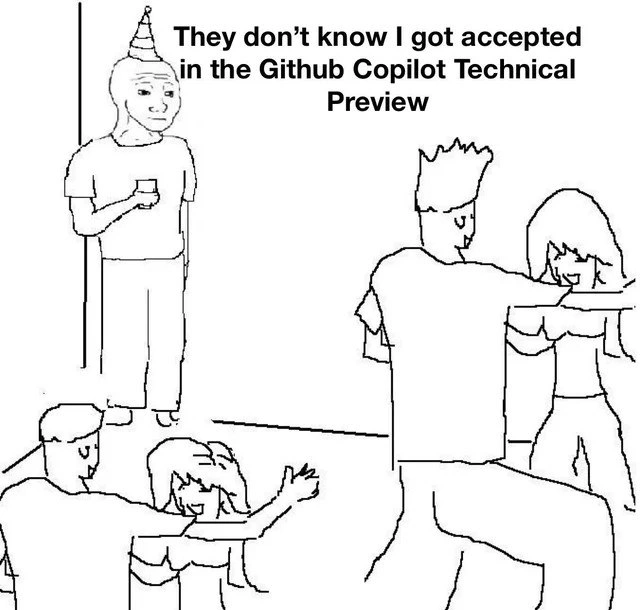
So in the meme image, the guy at the party is that developer who just got this special access. The caption “They don’t know I got accepted in the GitHub Copilot Technical Preview” hovers above him. This caption is written in a style that’s a staple of an internet meme format (often called the “They don’t know” meme). Usually, it shows a person in a social setting thinking “They don’t know [something about me].” It’s a way to highlight a funny or ironic secret that the person has. Here the secret is: I have this cool AI coding tool that hardly anyone else has right now.

Why is this funny or notable? Because of the contrast between how important that feels to the developer and how unimportant it is to everyone else around him. He’s at a normal party where people might be dancing, chatting about everyday stuff, maybe sports or the latest TV shows. Meanwhile, he’s standing there, holding his drink, feeling quietly triumphant about an abstract tech achievement. If he blurted out, “Guys, I got into the GitHub Copilot preview!” most people there would probably respond with puzzled looks or just say “Uh, cool?” and then continue dancing. They simply don’t have the context to understand why that’s exciting. So he doesn’t say it out loud; he just enjoys that feeling privately.

To someone who’s not a programmer, we need to explain that GitHub is a popular website where programmers store and share code. And GitHub Copilot is a new service from GitHub that uses AI (Artificial Intelligence) to help write code. It’s like having a super-smart autocomplete that can sometimes even write whole sections of code from just a prompt. It was developed in collaboration with a company called OpenAI (famous for their AI models). Copilot was big news in the programmer world because it felt like the first time an AI could genuinely assist with coding in a flexible way, not just trivial suggestions. Some people even described it as a kind of AI pair programmer, almost like coding with Jarvis from Iron Man.

During the technical preview phase, developers were really curious and excited to test Copilot’s capabilities. It wasn’t open to everyone, which naturally created some buzz and a bit of envy. If you got access, you might mention it on Twitter or to your programmer friends and they’d go, “No way, you got in? How is it? Is it good?” There was definitely some developer FOMO – those who hadn’t gotten in yet felt they might be missing out on something revolutionary.

So, the meme shows a programmer experiencing this little victorious moment, but he’s in the wrong crowd to appreciate it. It’s poking fun at how specialized our tech excitement can be. A developer might be over the moon about an algorithm, a new framework, or in this case an AI assistant, but to a random crowd it’s like he’s speaking gibberish. The image of him standing aside with a party hat is funny because parties are usually where you boast about more universally understood things (like a promotion, or a funny story, or even showing off a new gadget). Instead, he’s effectively partying by himself over an email from GitHub.

In short, GitHub Copilot’s preview access was a nerdy sort of golden ticket, and this meme captures the feeling of having that golden ticket in a place where no one else even knows the lottery was happening. It’s a gentle joke at the expense of both the excited developer (for being a tad out of place with his pride) and the oblivious partygoers (who have no clue what cool thing they’re missing out on). For anyone who’s into programming, it’s easy to sympathize with that guy and also laugh at how perfectly this scenario sums up our occasionally awkward relationship with the non-tech world.


Level 3: Exclusive Access Flex

At the core of the humor is the contrast between developer insider bragging rights and ordinary social settings. The lone guy in the party is internally beaming with pride because he got into the GitHub Copilot technical preview – essentially an exclusive early-access club for this fancy new AI coding tool. This was a big deal in developer circles around 2021; not everyone who applied got in, so receiving that invite email felt like winning a prize. It’s a classic case of early adopter bragging: you have something cutting-edge that most others don’t, and you kind of want to show it off.

But here’s the catch: he’s at a generic party where probably no one else is a programmer. So he’s leaning against the wall with that party hat, thinking “They don’t know I got accepted...” precisely because if he told them, he’d get blank stares or polite “Uh, okay?” nods at best. They don't know because outside the bubble of software development, saying “I have an AI pair programmer in preview” doesn’t earn you any cool points – it might just confuse people. The meme plays on that social disconnect: a developer’s source of pride or excitement can be utterly arcane to others.

For seasoned developers, this scenario is painfully relatable. We’ve all had moments of niche tech pride that we realized wouldn’t translate well to a general audience. Maybe you solved a tricky bug that had been haunting the team for days, or you got early access to a new framework's beta, and you’re dying to talk about it – but who outside your coder friends would care? It’s the same vibe as being proud you finally mastered some obscure tool or contributed to an open-source project, yet at a family gathering, nobody has the context to appreciate it. The party meme template exaggerates that by literally isolating the person with his thought bubble amid oblivious revelers. It’s both funny and a little sympathetic: he’s proud of something legitimately cool (to us developers), but he can’t share it with his current crowd.

This “They don’t know...” format has become a staple for highlighting these insider moments. In this case, the insider knowledge is that GitHub Copilot exists and that being in its technical preview is exciting. The other partygoers represent the vast majority of people (even many programmers at the time) who might not have heard about Copilot yet, or don’t grasp why having it early is a thrill. There’s definitely an ego boost in being on the cutting edge — it’s a subtle flex within dev communities. In fact, when Copilot’s preview launched, there was a flurry of FOMO (Fear Of Missing Out) on tech Twitter and forums: folks either proudly tweeted “Just got my Copilot invite!” or lamented “Still waiting on my Copilot access 😕”. It’s akin to getting beta access to a hot new game or a cool gadget before it hits the shelves; among enthusiasts, that’s social capital.

Now, an experienced engineer might also feel a mix of excitement and skepticism about such a tool. A little inner voice might quip, “Sure, let the AI write code — who’s gonna fix its bugs at 2 AM? Probably me.” Early users of Copilot found it could produce impressively correct code one moment and something completely off the next. So while he’s thrilled to have this advanced tool, he likely knows it’s not a magic bullet. But none of that nuance can be shared with this partying crowd either! The image of him standing there, half-smirking, captures that dual reality: externally quiet, internally giddy (with a pinch of trepidation known only to him).

From an industry perspective, the meme pokes at how developer tooling breakthroughs create mini-tribes of insiders. The technical preview was invite-only, which inherently sets up an “in-crowd” vs. everyone else dynamic. In the office, someone with Copilot preview might feel like they have a secret weapon, a productivity booster that colleagues lack. Or at least, they have bragging rights for being the first to try the “next big thing” in coding. The humor here lies in the context mismatch: bragging about that at a normal party is pointless. It’s like trying to impress a bunch of dancers by saying you just upgraded your text editor – it falls flat outside the niche where it matters.

So, the meme resonates because it captures that mix of pride and isolation that comes with niche achievements. It’s funny to us developers because we see ourselves in that guy: I’ve felt that exact mix of smugness and social awkwardness. It’s a gentle self-own, acknowledging how esoteric our triumphs are. We find it amusing that what’s a huge deal in our tech bubble can be meaningless to others. And let’s be honest, part of the fun of getting early access to something like Copilot is exactly this feeling of having a cool secret that most people around you don’t. The meme nails that sentiment with one picture and a single line of text, which is why it got a knowing chuckle from so many in the programming community.


Level 4: Transformer-Fueled Coding

In the deepest technical sense, GitHub Copilot is a manifestation of modern AI research in code generation. It's powered by a large-scale language model (OpenAI's Codex, based on the GPT-3 family) that has been trained on billions of lines of source code from public repositories. This means the AI has essentially "read" countless GitHub projects in multiple languages, learning statistical patterns of how code is written, how functions are structured, and how common algorithms are implemented. At its core is the Transformer architecture, a neural network design renowned for its ability to handle sequential data (like text or code) with an attention mechanism. This transformer model doesn't just look at the last few tokens typed; it considers the broader context of the code file, comments, and function names to predict what comes next.

When the meme’s text says “They don’t know I got accepted in the GitHub Copilot Technical Preview,” it hints at having access to this cutting-edge AI coding assistant before it became widely available. During the technical preview (mid-2021), Copilot was essentially a novel experiment in pairing a developer with an AI partner that writes code. Under the hood, it's performing something akin to advanced autocomplete: given the current file's content and your new line (perhaps just a function signature or a comment describing a function), it generates likely continuations. However, unlike trivial autocomplete, Copilot's suggestions can be entire blocks of logically coherent code, even using relevant library calls or following the project's coding style.

From a theoretical standpoint, this is a significant leap in AI-assisted programming. Program synthesis and code generation have long been challenges in computer science. Traditional IDEs offered code completion using simple heuristics or predefined templates, but an AI like Copilot uses learned knowledge. It's essentially modeling the conditional probability P(code | context) to spit out code completions. Because it's trained on such a massive corpus, it has a sort of generalized knowledge of programming idioms, algorithms (like how to iterate a linked list or implement a bubble sort), and even common pitfalls. Of course, it doesn't reason about correctness like a human would; it doesn't truly understand the code's intent or semantics. Instead, it leverages patterns – for example, having seen thousands of examples of a function called compute_average or a comment "# check if prime" and the code that typically follows, it can produce a plausible solution. This pattern-matching on a grand scale is why its suggestions can feel eerily on-point, almost like magic.

There's also fascinating complexity in making such a tool practical. The model behind Copilot is huge (on the order of many billions of parameters), which means running it requires significant computation. Yet, thanks to optimized cloud services and caching, GitHub made it possible to use it nearly in real-time in a developer's editor. The AI takes an embedding of your current code context and, with its vast learned knowledge, produces a suggestion typically within a second. This is an engineering feat: bridging high-powered AI inference with the responsiveness of a coding workflow.

One underlying challenge with such a model is the question of software correctness and security. The AI doesn't know if the code it suggests is efficient, secure, or even compiles – it only knows that the code looks statistically like something that could belong. It might suggest a typical implementation which could have a subtle bug or a security flaw if those patterns existed in the training data. Also, because it learned from public code (some possibly under restrictive licenses), there's an open question about it unintentionally regurgitating licensed code. During the technical preview, users and researchers kept an eye on how often Copilot might output verbatim snippets from training vs. truly original combinations. Solving these issues (making suggestions correct, secure, and license-compliant) is part of why Copilot spent time in preview to begin with.

In essence, being part of the technical preview means you got to witness firsthand a state-of-the-art AI model effectively collaborating on your code. It's like having an AI intern who read the entire Stack Overflow and GitHub archives and can offer a suggestion at any time. That early access gave developers a peek into the future of coding, where interacting with an AI might become a natural part of day-to-day development. The meme’s humor is rooted in this advanced technical milestone: the partygoer is proud of being ahead of the curve, having access to an AI tool that represents bleeding-edge machine learning applied to software development. To those in the know, it's as if he's secretly carrying the power of a supercomputer trained on code in his editor – an almost sci-fi level DeveloperExperience (DX) upgrade. But to everyone else at the party, it's completely opaque why that matters.


Description

A classic 'They Don't Know' meme format, presented as a simple black-and-white line drawing. In the top-left corner, an isolated, sad-looking Wojak character with a party hat stands alone, holding a cup. The text above him reads, 'They don't know I got accepted in the Github Copilot Technical Preview'. The rest of the scene depicts other crudely drawn figures dancing and socializing, completely oblivious to the Wojak character's internal monologue. The meme humorously captures the feeling of having a significant, niche technical achievement that is completely unrelatable and unimpressive to a non-technical audience. The joke lands with experienced developers who remember the initial hype and exclusivity of the GitHub Copilot technical preview in 2021, making it a badge of honor within the dev community but meaningless outside of it
Comments

10
Anonymous ★ Top Pick The real test of Copilot's intelligence wasn't generating code, it was trying to generate a socially acceptable conversation starter for me at that party
  1. Anonymous ★ Top Pick

    The real test of Copilot's intelligence wasn't generating code, it was trying to generate a socially acceptable conversation starter for me at that party

  2. Anonymous

    Copilot wrote the module in ten minutes; now I just need the rest of Q4 to convince legal that 47% similarity to the Linux kernel isn’t “derivative work.”

  3. Anonymous

    The real technical preview was discovering how many developers would rather debug AI-generated regex patterns than admit they still Google basic syntax after 15 years of experience

  4. Anonymous

    The real technical preview is discovering that your GitHub Copilot acceptance email generates more dopamine than any social interaction at the party - though explaining to non-devs why an AI autocomplete for code is exciting proves harder than debugging a race condition in production. At least Copilot understands your context switching

  5. Anonymous

    Copilot preview is great - my PRs now have a silent co‑author named Tab, but I still write the tests and the postmortem

  6. Anonymous

    They don’t know I got into Copilot preview - and I don’t know which licenses its suggestions came from, so we’re even

  7. Anonymous

    Copilot preview: it writes the CRUD, I just veto the inevitable microservices hallucination

  8. @karim_mahyari 4y

    It feels good, after you get your tenth rejection email in a row

    1. @TERASKULL 4y

      you guys got rejections?

  9. @AHNayef 4y

    Same here

Use J and K for navigation