Elite Optimization Tip: Remove the Forgotten Sleep Call
Why is this Performance meme funny?
Level 1: No More Waiting
Imagine you’re about to start a race, but you have a strange rule: after the starter says “Go!”, you wait 30 seconds before you actually begin running. Sounds silly, right? Maybe one day you put this rule in place for fun or practice, and then you forgot about it. So every race, you’re standing there watching everyone else sprint off while you’re still waiting for an extra half-minute. Of course, all your races go badly because you gave everyone else a big head start! Then one day you suddenly remember, “Oh wow, I was the one who decided to wait for 30 seconds. I don’t actually have to do that!” You stop following that silly rule. Next race, when they say “Go!”, you take off immediately. Boom – you’re 30 seconds faster out of the gate. You feel happy you fixed the problem and a bit goofy for having caused the delay in the first place.
That’s exactly what happened in this programming joke. The app was slow to start because the programmer accidentally told it, “Hey, wait around doing nothing for 30 seconds every time you launch.” When they finally noticed and removed that instruction, the app started much faster. Everyone finds it funny because it’s a big delay caused by a tiny mistake. The programmer jokes that they have “elite skills” for fixing it, but really it was like realizing you shouldn’t wait when the race starts. It’s a simple fix that makes a huge difference, and we’re all laughing with relief that the solution was so easy.
Level 2: The Unnecessary Pause
Breaking this down: sleep(30) is a programming command that tells the computer to pause for 30 seconds. It’s like saying “do nothing for a little while.” Developers use such sleep calls intentionally sometimes — for example, to wait for another service to start up, or to simulate a delay when testing a loading screen. But you’re never supposed to leave a long sleep in the final product if you don’t need it. In this meme’s story, the app had an unnecessary 30-second pause in its startup sequence, which means every time you opened the app, it would sit idle for 30 seconds before actually doing anything useful. That’s a huge delay! We call that a startup_delay, and here it was entirely artificial.
So why was it there? The tweet implies the programmer themselves put that sleep(30) in a month earlier (perhaps as a temporary workaround or a debugging step) and then forgot to remove it. This kind of forgotten_code is a common source of problems in software. It’s an easy mistake: you add a quick fix during troubleshooting and think “I’ll remove this later,” but later never comes – maybe you got distracted or thought it wouldn’t matter. A month down the road, you or your users notice the app is really slow to start, and you’re scratching your head during Debugging trying to figure out why. Debugging is like detective work for programs: you look for clues in the code, logs, or use tools to see what the program is doing. In this case, any such investigation would eventually point to that pesky sleep(30) line, essentially saying “hey, the app is just waiting here doing nothing for 30 seconds.” It’s a blatant performance bug (an accidental_performance_bug, as the tags call it) once you spot it.
Now, calling the removal of sleep(30) an “optimization tip” is pure tongue-in-cheek humor. In serious software engineering, Performance Optimization often involves profiling (measuring where the time is spent), improving algorithms, or refining code to handle data more efficiently. For example, you might optimize a sorting function or reduce how many times you access a database. Those tasks can be quite complex and require true expertise. Here, by contrast, the “optimization” was dead simple: just delete the line of code that says “pause for 30 seconds.” It’s the kind of fix that makes you simultaneously happy and a bit embarrassed. Happy, because wow – you immediately gain 30 seconds on every startup! Embarrassed, because that delay was totally avoidable. The meme’s author jokes about their “elite programming skills” precisely because no elite skill was needed, just the common sense to remove a mistake. It’s a form of self-deprecating DeveloperHumor that many coders appreciate. We’ve all had moments where the solution to a slow program or weird bug was, hilariously, to undo something dumb that we ourselves did.
The Twitter format amplifies this joke. The tweet reads like a mini-guide: “Here’s some optimization tips:” – implying there might be a list of clever tricks. But the only tip given is “1. Remove the sleep(30) call…”. By formatting it as a numbered list with just one item, the poster is parodying the style of those clickbait tech articles (“10 Tips to Speed Up Your App”) while delivering a one-liner punchline. It’s as if to say, “You want to make your app faster? Here’s a pro tip: don’t make it wait 30 seconds for no reason!” The huge number of retweets (over 2,000) and likes (over 10,000) shown in the image indicate that this struck a nerve with the developer community. So many people find it funny because it’s a shared experience: most developers, even juniors, have encountered a situation where a program was slow or buggy and the cause turned out to be something obvious they overlooked. It’s both comforting and comical to realize others have been in the same boat.
In summary, for a newer developer or someone learning to code: always double-check for any quick hacks or test code you might have forgotten in your program. A simple thing like a sleep call can have a huge effect on performance. Before you dive into rewriting everything for speed, make sure you’re not inadvertently waiting or doing extra work that isn’t needed. The biggest improvements often come from removing the biggest bottlenecks – and sometimes you put that bottleneck there yourself without realizing it. This meme is a lighthearted reminder of that lesson, packaged as a joke.
Level 3: Sleeping on the Job
Seasoned developers recognize the irony immediately: an app’s startup was 30 seconds slower only because of a sleep(30) call left in the code. In other words, the program was literally sleeping on the job for half a minute every time it launched. This meme blends PerformanceOptimization with self-deprecating DeveloperHumor by highlighting a hilarious CodingMistake. Normally, shaving 30 seconds off startup time would be cause for celebration – often requiring complex refactoring or algorithm improvements. But here the “elite programming skill” was simply deleting one line of forgotten_code that did nothing except wait. It’s a classic accidental performance bug: the kind that makes you facepalm when you find it, because the fix is embarrassingly simple.
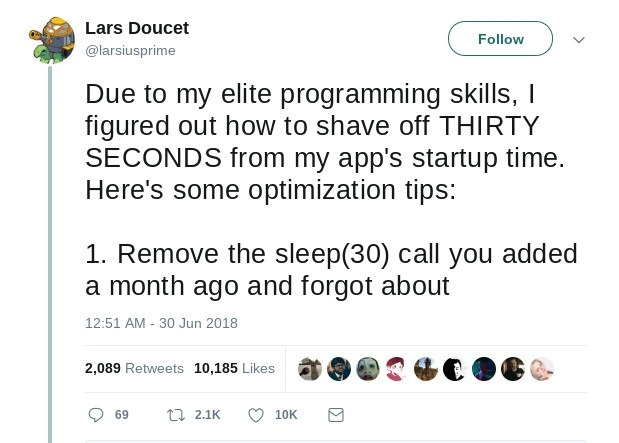
Let’s unpack the scenario. The tweet (in the familiar twitter_meme_format screenshot) is from a programmer joking about their “elite” optimization tip:
Tip #1: Remove the
sleep(30)call you added a month ago and forgot about.
There’s no Tip #2 — that’s the joke. The tweet is structured like a pro tip list, but it only contains a single, obvious step. This exaggeration pokes fun at all those elaborate optimization guides; here the guide is basically: stop doing the thing that’s wasting time. And it struck a chord: thousands of retweets and likes indicate many devs have had similar “D’oh!” moments. It’s both comforting and comical to realize that a massive slowdown was self-inflicted by a stray line of code.
From a senior developer’s perspective, this is a shining example of the mantra “the fastest code is code that doesn’t run.” A sleep(30) literally tells the app to do nothing for 30 seconds. Removing that is the ultimate low-hanging fruit of optimization. It’s not even premature optimization – it’s fixing a blatant mistake. Experienced engineers have war stories of mysterious slowness caused by things like debug logging, unnecessary loops, or bogus waits. Perhaps someone put in sleep(30) as a quick hack (to wait for a service, or simulate load time during testing) and intended to remove it later. But in the chaos of development, it got overlooked in production code. The result? Every user gets a 30-second startup_delay, essentially a timeout for no reason. It’s the kind of bug that is frustrating while it’s happening (“Why on earth is this so slow?!”) but darkly funny once discovered. A profiler or debug log would show a huge 30-second gap where the app isn’t doing anything productive — a dead giveaway for a rogue sleep_call.
# Hypothetical code causing the slow startup
print("Initializing app...")
time.sleep(30) # Oops: a 30-second pause left in by mistake
load_all_resources()
print("App is ready!")
For the grizzled veterans, this tweet is a gentle reminder: before diving into sophisticated profiling and micro-optimizations, first ensure you haven’t shot yourself in the foot with something obvious. It brings to mind the old Dwight D. Eisenhower quote adapted for coding: “What is important is seldom urgent, and what is urgent is seldom important.” In performance terms, that means the urgent need to speed up often comes down to something important we overlooked. In this case, the developer essentially removed a self-imposed sleep and instantly “optimized” the app. The tongue-in-cheek brag “due to my elite programming skills” gets a laugh because every programmer knows it doesn’t take a genius to delete a bad line of code — it takes humility and good debugging. The real skill was admitting the slowdown was your own doing. This mix of relief and chagrin is what makes the meme so relatable and funny in debugging culture. After all, finding a bug you introduced is humbling, but fixing it with one keystroke (goodbye, sleep(30)) and seeing a 30-second improvement feels like winning a jackpot you didn’t know you were holding. 🏆
Description
A screenshot of a tweet from Lars Doucet (@larsiusprime). The tweet reads: 'Due to my elite programming skills, I figured out how to shave off THIRTY SECONDS from my app's startup time. Here's some optimization tips: 1. Remove the sleep(30) call you added a month ago and forgot about'. This is a highly relatable joke for experienced developers, who have almost certainly spent time hunting down a performance issue only to find it was caused by leftover debugging code, such as an artificial delay. The humor lies in the sarcastic 'elite programming skills' juxtaposed with the trivial and embarrassing nature of the actual 'fix.' It's a classic self-deprecating jab at the sometimes-foolish mistakes even senior engineers make
Comments
12Comment deleted
My greatest optimization wasn't a clever algorithm; it was a 'git blame' on a 30-second sleep call that was added to 'temporarily' fix a race condition two years ago
Spent all morning decoding a 700-node flame graph - turns out the hottest “function” was the sleep(30) I wrapped in a TODO “remove before prod.” Profiling is just archaeology with better stories
The most impactful performance optimization is often removing the 'temporary' debug code that's been in production for three quarters and survived two architecture reviews because everyone assumed it was load-bearing infrastructure
Ah yes, the classic 'performance optimization' journey: profiling tools, flame graphs, algorithmic complexity analysis... only to discover the real bottleneck was that sleep(30) you added during a late-night debugging session and promptly forgot existed. Nothing says 'elite programming skills' quite like accidentally shipping a hardcoded 30-second delay to production and calling its removal an optimization win. At least the O(1) improvement is technically correct - the best kind of correct
We nearly rewrote the bootstrap in Rust to fix cold starts, then grep showed our readiness check was sleep(30) - a 2018 race-condition bandaid that quietly became our main scheduler
Senior perf win: unearthing that 'temporary' sleep(30) from last quarter's demo prep haunting production latencies
After instrumenting with eBPF and chasing GC pauses for a week, the flamegraph’s hottest function was nanosleep()
next step: do real optimization and add sleep(x + 5) where x is saved time Comment deleted
lmfao why do i relate so much Comment deleted
Couldn't be me,haha Comment deleted
Microsoft actually did this in Internet Explorer few years ago Comment deleted
and that's why code review shouldn't be optional Comment deleted