
The Classic Trade-Off: Dynamic vs. Static Typing
Description
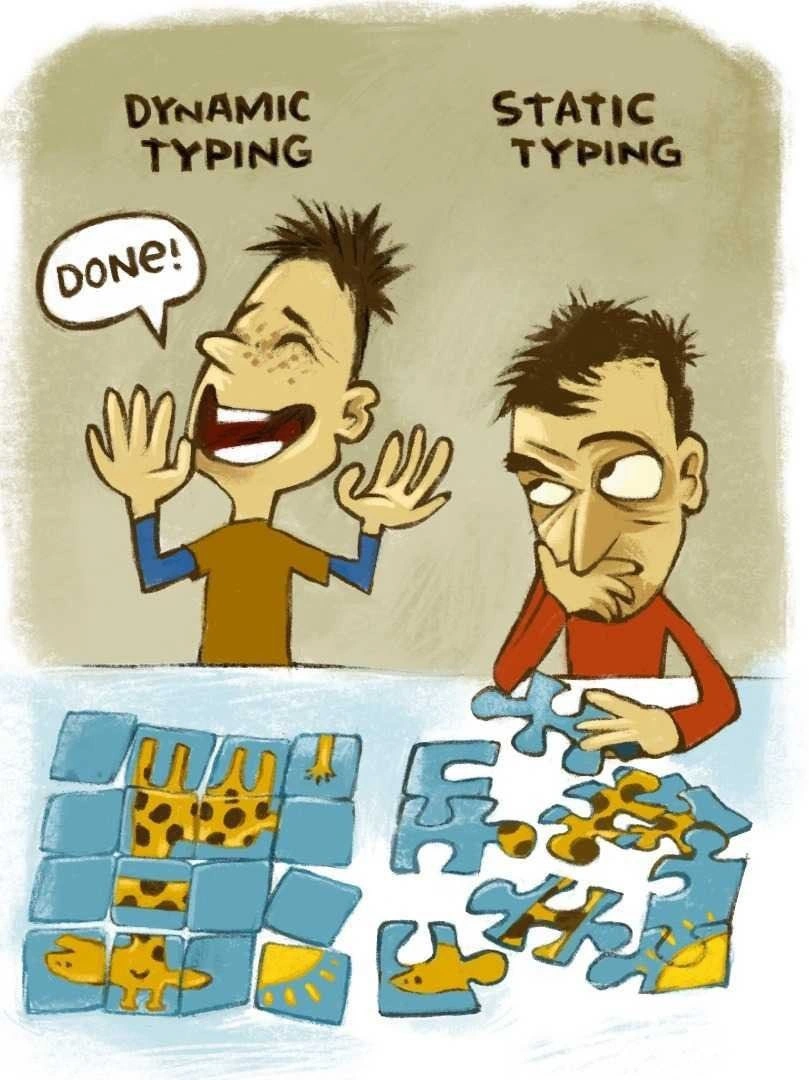
A two-panel cartoon visually contrasts 'DYNAMIC TYPING' and 'STATIC TYPING'. On the left, under 'DYNAMIC TYPING', a cheerful, spiky-haired character throws his hands up and exclaims 'DONE!'. Before him is a completed picture of a giraffe made from simple square blocks, but the blocks are arranged incorrectly, resulting in a jumbled and nonsensical image. On the right, under 'STATIC TYPING', a focused, serious-looking character carefully contemplates a complex jigsaw puzzle, with intricate, interlocking pieces scattered on the table. He is still in the process of solving it, implying a slower, more deliberate effort. This meme humorously illustrates the fundamental trade-off between programming language paradigms. Dynamic typing (like in Python or JavaScript) offers flexibility and rapid development, but can lead to runtime errors that are hard to spot, much like the incorrectly assembled block puzzle. Static typing (like in TypeScript, Java, or C#) requires more upfront work and stricter rules, enforced by a compiler, which can feel slower but ultimately ensures that the components fit together correctly, preventing a class of bugs and leading to more robust and maintainable systems


Comments
16Comment deleted
Dynamic typing is like building a skyscraper with LEGOs - fast and fun until you hit the third floor and realize you've used Duplos for the foundation. Static typing is realizing that on the blueprint
Dynamic typing is proudly declaring the puzzle “shippable” the moment it’s rectangular; static typing insists it’s not definition-of-done until the giraffe no longer implements IFish
The real puzzle is explaining to the PM why the 'simple' dynamic typing approach that shipped in record time is now taking three sprints to debug a production issue that TypeScript would have caught at compile time - but hey, at least we saved two hours not writing those interface definitions!
Dynamic typing's 'DONE!' has an implicit footnote: undefined is not a giraffe, discovered Friday at 5pm in production
The meme perfectly captures the Dunning-Kruger curve of type systems: dynamic typing gives you that dopamine hit of 'DONE!' at 2 PM, while static typing makes you question your life choices until 2 AM - but only one of them will still be running correctly in production six months later when the original author has left the company and nobody remembers why that function sometimes returns a string, sometimes a number, and occasionally a Promise that resolves to undefined
Static typing is when the compiler rejects your nonsense at 2pm; dynamic typing is when production accepts it at 2am
Dynamic typing ships a demo by lunch; static typing makes you fix the giraffe‑implements‑IFish bug before PagerDuty learns your number
Dynamic typing: Ship the puzzle with giraffe fins - 'It works!' Static: Eternal edge-matching for a crash-free picture
Рантаймы: прости, если ошибка на строке 45 нельзя прибавить интеджер к словарю Runtimes: what if you wanted to go to heaven but you can't add 'dict' and 'int' on line 45? Comment deleted
@trainzman please speak english or provide an english translation for your text Comment deleted
👍 Comment deleted
is this a rule or commentators just bitching about it? Comment deleted
both Comment deleted
why would you like to make such an operation? Comment deleted
dynamic typing doesn't say you you can't do something until you launch Comment deleted
One word: typecast Comment deleted