Skip to content
DevMeme
7093 of 7435
Dwarf Fortress Bug #13172: Babies Are Born Worshipping Unknown Gods
Bugs Post #7777, on Mar 1, 2026 in TG

Dwarf Fortress Bug #13172: Babies Are Born Worshipping Unknown Gods

Why is this Bugs meme funny?

Level 1: The Toy That Tells Its Own Stories

Imagine a kid builds an enormously elaborate dollhouse where the dolls have jobs, families, moods, and even their own made-up religions. One day the kid notices something they never intended: every new baby doll arrives already praying to gods that don't exist anywhere in the dollhouse. It's a mistake — a wire crossed somewhere deep in the toy — but instead of being annoying, it's beautiful, like the dollhouse started writing its own ghost story. That's why people on the internet are sharing this screenshot with reverence: a glitch so strange it stopped being an error and became a tiny poem.

Level 2: Dangling Pointers, but Make It Theology

A few terms doing the heavy lifting here:

  • Bug report: a ticket in an issue tracker describing unintended behavior. Real trackers force a one-line summary — and #13172's summary happens to scan like Lovecraft.
  • Procedural generation: content created by algorithms instead of by hand. Dwarf Fortress generates entire worlds — geology, history, civilizations, and yes, pantheons of gods — from rules plus randomness.
  • Emergent behavior: outcomes nobody explicitly programmed, arising from simple systems interacting. The developer wrote "babies inherit traits" and "entities can worship deities"; nobody wrote "infants shall venerate the nameless."
  • Dangling reference: data that points at something which no longer exists (or never did). Picture a contact list entry whose phone number belongs to nobody — the baby's "religion" field points at a god the game can't look up, so it reports the god as unknown.

Early in your career, you learn that bugs are usually dull: an off-by-one, a typo, a null check you forgot. This meme is the counterexample every junior secretly hopes for — proof that in a sufficiently ambitious codebase, even your mistakes can be magnificent. It's also a quiet introduction to why simulation games are brutally hard to test: the more honest your model, the more your bugs look like events.

Level 3: Accidental Scripture in the Bug Tracker

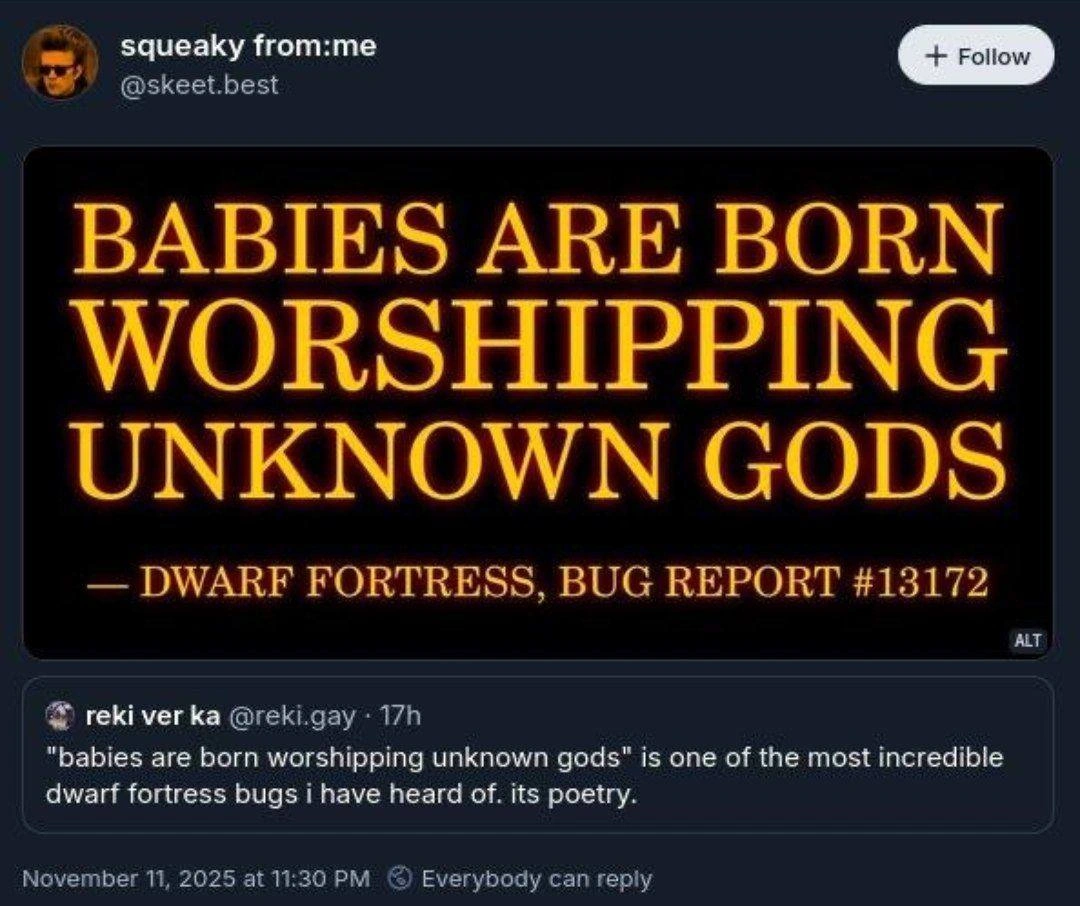
BABIES ARE BORN WORSHIPPING UNKNOWN GODS — DWARF FORTRESS, BUG REPORT #13172

Rendered here in glowing golden serif on black like the title card of a cosmic horror film, this is a real artifact of Dwarf Fortress development culture — and the Bluesky quote-post beneath it ("its poetry.") captures exactly why the programming community keeps passing it around like a relic.

Dwarf Fortress, Tarn "Toady One" Adams' decades-long simulation project, doesn't script its world; it derives it. Religion isn't a hardcoded list of deities — gods are procedurally generated entities with spheres of influence, and dwarves acquire worship relationships through simulated life events. A baby "born worshipping unknown gods" is what happens when an entity reference survives where its referent doesn't: inheritance logic copies a parent's religious affiliation (or rolls a new one) pointing at a deity ID that was never properly instantiated, was culled from world generation, or lives outside the set of gods the current site knows about. In any ordinary CRUD app, this exact defect class has a profoundly boring name: a dangling foreign key. An orphaned reference. A join that returns NULL where a name should be.

The humor — and the genuine awe — comes from the gap between the defect's mundane mechanical nature and its emergent narrative weight. Because Dwarf Fortress models theology as first-class data, a null-reference bug doesn't print undefined; it manifests as infants arriving in the world already devoted to gods no one can name. The simulation is so semantically rich that its failure modes read as lore. This is the same phenomenon behind other legendary DF defects (cats dying of alcohol poisoning because they licked spilled beer off their paws — which wasn't even a bug so much as the systems interacting honestly): when every subsystem is a real model rather than a façade, edge cases become stories.

There's a sharper engineering lesson under the wonder. Emergent systems resist conventional QA: you can't write a regression test for "theological state of newborns" if you never imagined newborns had theological state. Bug #13172 is what testing folks call an unknown unknown — the spec didn't forbid it because no spec could enumerate the state space. Deep simulations trade predictability for richness, and the bug tracker becomes the only honest documentation of what the system actually does.

Description

A Bluesky post from 'squeaky from:me' (@skeet.best) showing a stylized image with glowing golden serif text on a black background: 'BABIES ARE BORN WORSHIPPING UNKNOWN GODS - DWARF FORTRESS, BUG REPORT #13172'. Below, a quoted post from 'reki ver ka' (@reki.gay, 17h) reads: '"babies are born worshipping unknown gods" is one of the most incredible dwarf fortress bugs i have heard of. its poetry.' Posted November 11, 2025 at 11:30 PM. The meme celebrates how Dwarf Fortress's legendarily deep simulation produces bug reports that read like cosmic horror literature - emergent behavior so strange that defect tracking becomes accidental poetry

Comments

3
Anonymous ★ Top Pick Severity: cosmic. Repro steps: be born. Status: working as simulated
  1. Anonymous ★ Top Pick

    Severity: cosmic. Repro steps: be born. Status: working as simulated

  2. @NickNirus 4mo

    not a bug, accurate representation of local reality

  3. @nolemocius 4mo

    dwarf fortress is a glorious world simulation, blinding in its delicate mix of accurate detailed mechanics and game-breaking bugs stemming from those very mechanics. When i first built the eponymous Dwarven Water Reactor, my glee was endless. Strike the earth!

Use J and K for navigation