Dutch Government Nationalizes Chinese-Owned Chipmaker Nexperia
Why is this Hardware meme funny?
Level 1: Saving Snack Time
Imagine you and your friends are building a huge LEGO castle at school, but only one friend has the special pieces needed to finish it. Now what if that friend’s older cousin from another town suddenly tells him, “Don’t share those pieces anymore”? The whole project would be in trouble because without those pieces, the castle can’t be completed. So the teacher quickly steps in, takes that box of LEGO pieces and says, “We’ll keep these here in class so everyone can use them to finish the castle.” It might seem like a bold move, but it saves the project from falling apart. That’s basically what happened in real life: the Dutch government (like the teacher) took control of a chip company (the box of special pieces) to make sure the country’s businesses (the class) can keep making cars and gadgets (the castle) without running out of chips. It was a quick, emergency fix to prevent everything from breaking down – kind of like a fast solution to keep the fun going for everyone.
Level 2: Hotfixing Hardware
Let’s break down the joke and the context in simpler terms. In software, a hotfix is a quick emergency update to fix a critical bug in a live system. Imagine a website crashing and an engineer hurriedly patching it so users aren’t left hanging – that’s a hotfix. Now apply that idea to the real world of hardware: Europe saw a looming “bug” in its economy – a possible chip shortage, or losing access to important chip technology – and the Dutch government rushed out a fix. By taking control of Nexperia, they effectively patched a hole in the chip supply chain. It’s like they said, “We can’t wait around, let’s fix this now,” much as a developer would push quick code changes to stop an ongoing outage.
The meme’s title uses Git terminology: force-pushing to main. In Git (the version control system developers use to manage code), main is typically the primary branch – the official storyline of the project. Normally, you’re not allowed to rewrite history on main without everyone agreeing; there are protections in place (like requiring code reviews or passing tests before merging). A force push is when you override those protections and push your changes anyway, even if it might erase or conflict with what was there. It’s usually a no-no except in dire situations. Here, saying the Dutch government "force-pushes Nexperia to main" humorously means the government unilaterally shoved through a big change (changing who owns/runs Nexperia) without the usual slow process. They bypassed the normal “branch protection” of economics (i.e. the standard legal and market procedures) because they felt it was urgent. In plain terms, they didn’t ask nicely or wait for board approvals – they just did it, the way an ops team might apply a production hotfix at 2 AM without waiting for Monday’s meeting.
Now, who is Nexperia? It’s a company that makes semiconductor chips – those tiny electronic brains that go into everything from cars to smartphones. Nexperia was owned by a Chinese company called Wingtech. Wingtech being on the US “entity list” means the U.S. government has flagged it as a potential security threat, so American companies need special permission to work with it. That’s like being blacklisted. This made European officials nervous: if Nexperia’s parent company is blacklisted and facing restrictions, maybe someday Nexperia itself wouldn’t be able to sell chips freely or might be pressured to prioritize someone else’s interests. Think of it like a vital open-source library suddenly maintained by a group that others distrust – you’d worry about continuing to rely on it. That’s supply chain risk: if one key piece of your system is controlled by someone who might pull the plug or inject problems, your whole project (or country!) is in trouble. Just as developers learned from incidents like the famous left-pad snafu (when a tiny NPM package removal broke thousands of apps) or security breaches in dependencies, governments are learning that relying on foreign tech suppliers can be a single point of failure.
To prevent a disaster, the Dutch government used a law called the Goods Availability Act. This is basically an emergency rule that lets the government step in and take charge of a company if it’s necessary to guarantee important supplies (like chips for cars and electronics). It’s the kind of law usually reserved for wartime or big crises. You can think of it like the government’s “in case of emergency, break glass” option. In tech terms, they had an admin override: the ability to grab control of a resource when normal operations might lead to a crash. By invoking this act, they legally nationalized Nexperia – meaning they moved the company into Dutch control, at least temporarily. That’s like a developer forking an open-source project to a personal account to make sure it stays up, or a company bringing a third-party service in-house because they can’t afford it going offline. It’s a dramatic form of vendor lock-in avoidance: Europe didn’t want to be locked into a situation where a foreign owner could decide the fate of its chip supply, so it took ownership of that vendor. The trade-off here is pretty clear: normally, you want to keep markets open and avoid heavy-handed interference (free trade is like the agile, distributed approach), but the risk of doing nothing was too high. So they traded a bit of openness for control – a classic security tradeoff. They chose the safety of having those chips onshore over the convenience (and diplomatic calm) of letting business run as usual.
This meme falls under Hardware and Security because it’s about physical tech components and the security (and continuity) of having them available when you need them. It’s also about IndustryTrends, since it references a growing trend: countries taking a stronger hand in technology supply chains. Lately, there’s a lot of talk about “tech sovereignty” and ensuring supply chain resilience – fancy terms for “we want to make our own stuff or at least not be totally dependent on others for critical tech.” For a junior developer, you can relate this to when a company you work for says, “Hey, maybe we shouldn’t rely 100% on that one external API. What if it goes down? Let’s have a backup or bring it in-house.” Here it’s the same idea but with microchips and national economies. The joke in the meme is essentially comparing a serious international move to something a coder might do during a late-night deployment. It’s funny because it makes the big political action seem like just another gritty bug fix. The image of government officials essentially doing a git commit to save the day is both absurd and relatable to anyone who’s been in the hot seat trying to fix a critical error under pressure.
Level 3: Bypassing Branch Protection
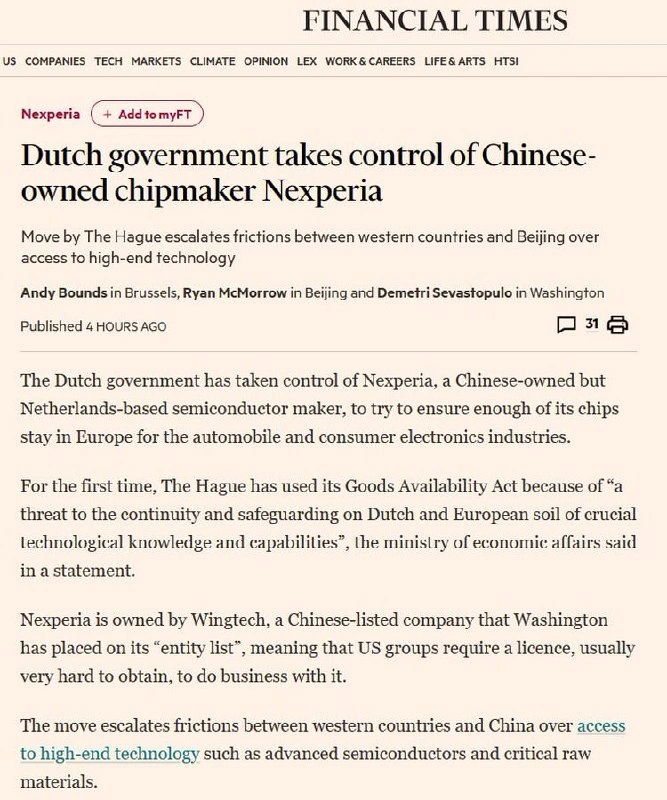
In the developer lexicon, a force-push to main is the nuclear option: it’s what you do when you need to override history and push changes directly into the most important branch, bypassing all the usual checks. In this meme, the Dutch government essentially did a geopolitically-scaled git push --force by seizing control of Nexperia — a major chip manufacturer that was a “branch” owned by a Chinese company (Wingtech). The Financial Times screenshot isn’t your typical meme template, but here it’s repurposed as the commit log detailing a real-world hotfix. The headline acts like a commit message: “Dutch government takes control of Chinese-owned chipmaker Nexperia” might as well read fix: ensure local chip supply by merging Nexperia into national control. It’s the ultimate production patch: The Hague hit the big red merge button to keep Europe's tech stack running.
Why is this drastic move analogous to bypassing branch protection? Normally, critical infrastructure (like a nation’s semiconductor supply) operates under free-market rules — think of those as the branch protection and code-review policies of the economy. Companies get acquired, supply chains are global, and everything is supposed to follow the plan. But when a production incident looms — here, the risk that European industries might run out of chips or that crucial chip technology could slip out of local control — those normal rules get overridden. The Netherlands invoked its emergency Goods Availability Act, which is basically a root-level override command. It’s the legislative equivalent of an admin user turning off branch protection because the build is about to break. In developer terms, the government didn't have time for a polite pull request or months of stakeholder review; they force-merged the entire company into “Team Europe” to patch a critical vulnerability in the supply chain.
This escalation is darkly funny to engineers because it parallels a scenario we know too well: you discover a critical flaw in production on Friday and end up applying a dirty creative fix directly to main just to keep the system alive. Here the “system” is the European automotive and electronics industry, and the bug is a potential chip shortage (or a security leak of chip IP) due to foreign control. Nexperia’s owner, Wingtech, landing on the US "entity list" — essentially a trade blacklist — is like finding out a library your project relies on was flagged as malicious. Imagine your top npm package maintainer suddenly getting banned; you’d scramble to fork that repo or vendor the code internally, right? That’s precisely what The Hague did, but with fabs and factories instead of code. It’s a real-life example of supply-chain risk management, just at the silicon level rather than the software level. The geopolitical tussle between Western countries and China over high-end tech is the backdrop — kind of an all-hands war room call that led to this extreme commit.
For seasoned devs, tags like HardwareEvolution and VendorLockIn resonate here. In software, we gripe about being tied to a single cloud provider or a crucial API — and then having to do heroics when that provider goes down or changes the rules. Now scale that up: Europe realized it was locked-in to a foreign-owned chip supplier. The short-term benefits of outsourcing (cheaper chips, no need to invest in local fabs) turned into a long-term risk (SecurityTradeoffs). The “hotfix” was to nationalize the supplier – basically forking the hardware project under a local maintainer to guarantee future updates. It’s a brute-force solution, much like a reckless git push --force: not elegant, potentially messy, but sometimes necessary when the alternative is an even bigger crash. In policy-speak, the goal was supply chain resilience and European tech sovereignty — making sure the EU’s technological main branch isn’t subject to an unfriendly upstream’s whims. The meme tickles the tech funny bone by showing that even governments sometimes solve problems with the subtlety of a stressed DevOps engineer at 3 AM, bypassing all the usual rules and committing straight to production because hey, it works on my machine (or in my country).
Description
A screenshot of a Financial Times article with the headline 'Dutch government takes control of Chinese-owned chipmaker Nexperia'. The subheadline reads 'Move by The Hague escalates frictions between western countries and Beijing over access to high-end technology'. Written by Andy Bounds in Brussels, Ryan McMorrow in Beijing, and Demetri Sevastopulo in Washington. Published 4 hours ago with 31 comments. The article details how the Dutch government used its Goods Availability Act for the first time to take control of Nexperia, owned by Chinese-listed Wingtech (on the US entity list), to ensure semiconductor supply remains in Europe for automobile and consumer electronics industries
Comments
29Comment deleted
The Netherlands: where they'll let you smoke anything, but touch their semiconductor supply chain and suddenly they remember they have a nationalization law
Remember when we worried that left-pad’s disappearance would break the internet? Now entire governments are doing a git-force-takeover to make sure 45-nm nodes don’t get npm-uninstalled from Europe
When your semiconductor fab gets nationalized faster than your CI/CD pipeline can deploy to production, you know the geopolitical tech stack has entered a new abstraction layer - where 'sudo apt-get install sovereignty' requires government-level permissions
When your chip fab gets nationalized faster than your CI/CD pipeline can deploy to production. Turns out 'continuous delivery' has a whole different meaning in geopolitics - the Dutch just implemented the ultimate rollback strategy, reverting Nexperia's ownership to a previous state. At least they didn't have to deal with merge conflicts, though I suspect the post-mortem is going to be classified
Geopolitical merge conflict: The Hague force-pushes ownership while Beijing disputes the diff on critical silicon repos
The Hague shipped a prod hotfix: chown -R nl:nl /nexperia; when vendor lock hits the supply chain, root ownership becomes the package manager
The Hague toggled a global feature flag - GoodsAvailabilityAct - and suddenly 'vendor-agnostic' roadmaps need a country_of_origin field and ASML lead times
просто отжали Comment deleted
More like full-on-trade-war preparation Comment deleted
More like trade war declaration Comment deleted
More Like trade war escalation Comment deleted
Please, only use English around dev meme 🙏 Comment deleted
Simply depressed 😁 Comment deleted
This is europe so probably the fare market price has been paid as a compensation to owner. And owner can sue for bigger compensation. Comment deleted
u live in land full of pink unicorns? Comment deleted
And you think they took private company under control without compensating the owner? Comment deleted
easly in EU Comment deleted
Well I think you have to prove your words, this sounds like BS. The BS we get to hear a lot from a certain Mordor country on the east. Comment deleted
https://www.ft.com/content/f4fd3ccb-ebc4-4aae-9832-25497df559c8 unicorn boy Comment deleted
you gave link to paywalled article Comment deleted
awww can't pay? Its FT man Comment deleted
where are the factories located Comment deleted
and people in my Eastern European country are being told it's only our government that's so corrupt it would take away a business from its owners 💅 Comment deleted
The funniest thing is that I still don't know what country you are from Comment deleted
In essence, they just replaced the director through court proceedings. Comment deleted
The director is not the owner of the company. So the owner will still have dividends, could sell and etc. Ok owner has lost control but its justified by court. Comment deleted
That's exactly what I'm talking about. Everyone's trumpeting about some kind of "takeover," but in reality, the government simply blocked the malicious activity. Comment deleted
Почему в Европе нет биг теха действительно Comment deleted
Please, only use English for all communications around dev_meme 🙏 Comment deleted