The Cynical Tech Company Career Page Starterpack
Why is this CorporateCulture meme funny?
Level 1: Candy for Chores
Imagine you have a teacher who really wants kids to join the after-school club and get their homework done. To make it sound super exciting, the teacher puts up a big poster. On the poster, all the kids in the club are wearing the same cool T-shirt with a big fun logo – it looks like they’re all part of a special team. There’s a photo where the group has boys and girls of all different backgrounds smiling together – the teacher is showing, “See, everyone is welcome here!” In another picture, the kids are finger painting and doing craft projects instead of regular boring stuff – it’s like a little art party, almost like kindergarten playtime. There’s also a silly picture where some of them even dressed up in animal pajamas one day, just being goofy. Another shot shows them outside playing dodgeball and laughing, like it’s the best time ever. And in big letters the poster says “Free pizza and snacks for club members!” with a tiny note that you only notice later which says “(served at 8 PM, after we finish all our work).”
Now, if you’re a kid looking at this poster, you’d probably think, “Wow, that club looks so fun! Everyone’s happy, there’s art, games, and even free pizza!” It’s a lot more attractive than a plain old club where you just do homework quietly, right? But the little secret is, the teacher is using all those fun-looking things to get you to stay late and do more homework. All the matching shirts and smiles are there to make you feel it’s friendly and awesome. The diverse group photo is to show anyone can join and feel included. The arts and costumes are to prove it’s not all work – it’s play, too! And the dodgeball game shows you’ll get exercise and good times, not just studying. The free pizza? It’s real, but you’ll get that treat only after you’ve stayed in school until 8 o’clock doing club activities (which, let’s be honest, is kind of like doing extra homework or chores).
In simple terms, this meme is like that poster. It’s pointing out how a tech company (like the teacher) might make their workplace (the club) seem like a super fun, magical place so that people (the kids) want to join. It’s funny because we all kind of know what’s going on: the treats and fun are there to sugarcoat the hard work underneath. Just like you might giggle if you realized your teacher’s cool club is partly a trick to get you to do more homework, people in tech laugh at this because they’ve learned that sometimes a job’s “cool culture” is a bit of a trick to get you to work a lot. It’s not mean-spirited – it’s just a wink saying, “Hey, we’ve all seen this before!” So, the meme uses a joking tone to remind us: when something looks too good and fun, check if there’s a little catch in the corner (maybe written in tiny letters). Just like how you’d enjoy the candy or pizza but still notice if it means doing extra chores, grown-ups learn to enjoy the office perks but keep an eye out for the real deal at work.
Level 2: Breaking Down the Career-Page Tropes
For newer developers or anyone not yet jaded by tech life, let’s decode what’s going on in this “Tech company career page starterpack.” A starter pack meme is basically a collection of images or phrases that, together, give you the essence of a concept. Here the concept is “the typical tech company careers webpage.” Each part of this collage represents something you almost always see when browsing the “Careers” or “Join Us” section of a tech company’s site. These are common employer branding tactics – basically marketing strategies to attract job seekers. Let’s break down each item and explain what it means in the real world of tech workplaces:
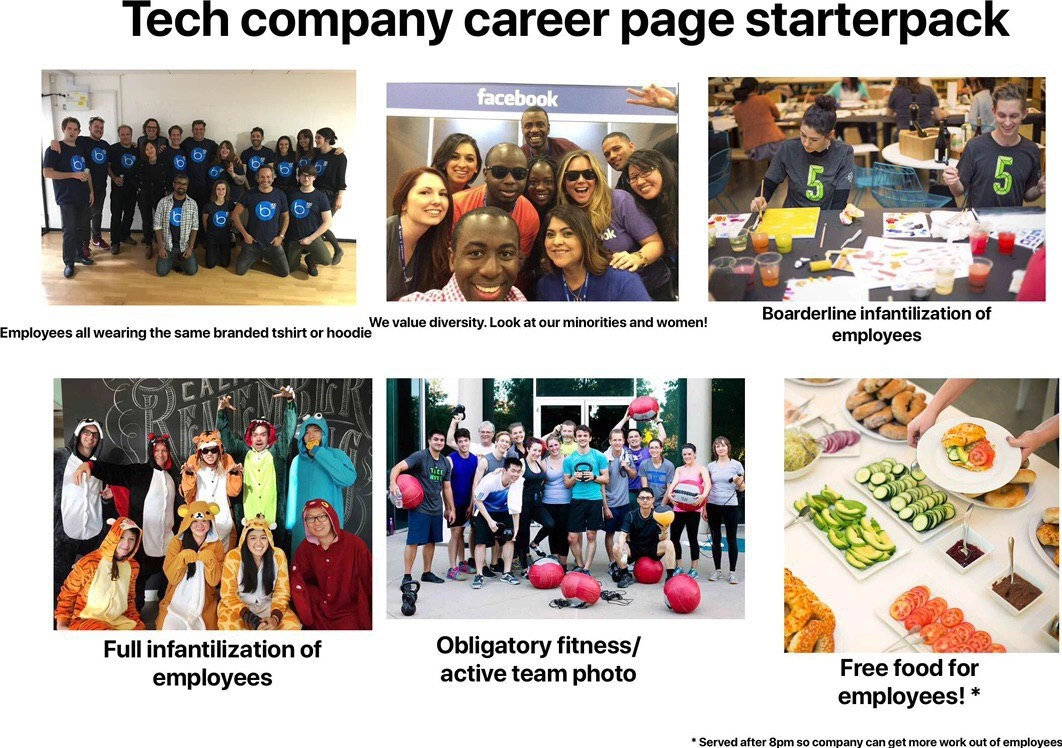
Employees in matching branded T-shirts or hoodies: This is a common sight in tech company photos. The picture shows a group of employees all wearing the same navy-blue shirt with the company’s logo. In reality, companies often give out free shirts or hoodies (called swag) to their staff. On career pages, they’ll show a whole team wearing this swag to look unified and proud. It’s like saying, “Look, everyone here loves the company so much they even wear the shirt!” As a new hire or applicant, you might think, “Cool, free shirts and team spirit!” And yes, it can feel nice to get free gear and be part of a team. Just know that it’s also carefully staged: they probably had a company event (like a Hackathon or an offsite meeting) where everyone put on the shirt for a group photo. It’s a bit like a uniform that creates a visual sense of belonging. Early in your career, you might be excited to wear your company’s hoodie (it feels like a badge of honor), and there’s nothing wrong with that! The meme just points out that every company uses this same photo-op because it reliably sends the message of camaraderie. It’s a friendly form of CorporateCulture branding – but when you see it everywhere, you realize it’s almost a cliché.
“We value diversity” group photo: Here we see a group selfie with a mix of people of different genders and ethnic backgrounds, captioned with a tongue-in-cheek quote: “We value diversity. Look at our minorities and women!” In simpler terms, diversity in tech means having employees who aren’t all from the same background – for example, including more women, people of color, etc., in an industry that’s often mostly white male engineers. Companies want to show they are inclusive and welcoming to everyone. It’s a very positive thing to strive for! On their career page, they’ll almost always have a photo where they highlight this diversity – often showing smiling women and minority team members in prominent positions in the picture. If you’re a student or junior dev, seeing people who look like you can indeed make you feel more comfortable applying. The meme is playfully mocking how overt these photos can be. Sometimes it’s so on-the-nose that it feels like the company is basically saying, “See? We have diversity!” The joke here isn’t that diversity itself is funny (it’s not; it’s important), but that companies often present it in a somewhat forced way in marketing. As a newcomer, it’s good to recognize that every company will put their best foot forward – they’ll show these photos even if, say, only 5 out of 100 engineers are women. They want to reassure you, but the meme is hinting: take it with a grain of salt. In your early career, you might join a company expecting a wonderfully diverse team because of that photo, then find out that picture was, well, carefully selected.
“Borderline infantilization” – arts and crafts at work: In the top-right image, employees are doing arts-and-crafts, like painting with little cups of juice around. The caption says “Boarderline infantilization of employees” (misspelling “borderline,” but we get the idea). Infantilization means treating adults like children. Here it’s “borderline” because arts-and-crafts are things we usually associate with kindergarten, but some companies incorporate them into work life as a fun activity. Many modern tech offices have creative corners or will host small craft events (like pumpkin carving contests at Halloween, coloring book stations to de-stress, etc.). The idea is to make the workplace more playful and creative. As a junior employee, you might find it awesome – “Wow, my office has a finger-painting day? Neat!” It can indeed be fun and break up the monotony of coding all day. The meme, however, is gently poking fun at this trend. It’s saying, “Look, they’re almost treating employees like kids with these kiddie activities.” It’s borderline infantilization – not full-on treating you like a child, but kind of close. In the real world, you’ll see things like LEGO-building competitions or Play-Doh on the tables at some quirky startups. It’s part of a larger WorkplaceCulture of keeping things feeling youthful and fun. There’s often a genuine good intention: creativity can spark when you’re relaxed. But the joke is, when every company brags about their “fun, wacky office,” it starts to feel a bit staged.
“Full infantilization” – employees in onesies: Now the meme doubles down with the bottom-left image: staff wearing cartoon animal onesie pajamas, grinning and posing. This is labeled “Full infantilization of employees.” This one is pretty extreme (and meant to be exaggerated for comedic effect). Some companies do encourage playful dress-up days – for instance, Onesie Fridays or costume parties if it’s Halloween. A onesie is a one-piece pajama or costume that often looks like an animal or character – basically something you might wear to a goofy slumber party. Seeing adults in an office dressed like, say, tigers and Pikachus is definitely not traditional! As a new hire, this might seem hilarious or super fun if you encounter it. And to be fair, many people enjoy these breaks from formality; it builds team bonding and makes work feel less like work. The meme calls it “full infantilization” meaning the company has gone all-in on the kid-like atmosphere. In plain terms, it’s like your workplace sometimes resembles a daycare or a playground. The reason this is part of the “starterpack” is that tech companies often highlight how fun and non-corporate they are by showing these kinds of antics. They want to distance themselves from the old stuffy office image (suits and ties, boring cubicles) and instead say “Look, we’re young, hip, and zany!” For someone early in their career, this can be both exciting and bewildering – “I get to wear a Kigurumi (costume onesie) to the office? Is this work or a pajama party?” The meme’s point is that, yeah, it’s fun, but almost every company now has some version of this to show they’re uniquely fun – which ironically makes none of them unique.
Active team outing photo: The bottom-middle image shows a team holding dodgeballs, presumably after a game, captioned “Obligatory fitness/active team photo.” A lot of tech companies promote a “work-life balance” or “wellness” culture. One way to do that is to have group activities like sports or fitness challenges, then put photos of those on the career page. “Obligatory” here means it’s almost required – like, if a company didn’t show at least one picture of employees outside in athletic clothes smiling together, did they even really build team spirit? 😅 Common examples: company hiking trips, a company team that runs a 5K charity race, yoga sessions in the office, or group sports like soccer, ultimate frisbee, or in this case, dodgeball. If you’re new to the workforce, seeing this might assure you, “Great, I won’t be chained to a desk 24/7. They have fun outings and care about health!” And indeed, many companies do try to organize such events for morale. It can be genuinely enjoyable and a nice break. The meme calls it out because again, it’s so common that it feels staged. Every tech career page has that one photo where everyone is in gym clothes, maybe sweaty but happy, showing we’re energetic and fun! It’s almost a trope that during intern season or new hire orientation, they’ll have a day where everyone goes outside for a goofy activity (and of course, a photo for LinkedIn). For a junior, it’s nice to know the company does things together outside of work. Just remember, if every single company shows the same kind of images, those images alone don’t tell you what it’s really like to work there day-to-day. It’s marketing. They probably picked the one day when most people showed up to play dodgeball and had a professional camera ready. The meme’s humor is pointing out the tech_career_page_tropes: oh look, another dodgeball photo, what a surprise!
“Free food for employees!” (with fine print): Lastly, bottom-right, we see a buffet with yummy food and a sarcastic caption: “Free food for employees!” and then in small text, “ Served after 8pm so company can get more work out of employees.” Let’s unpack that. Free meals are a very common perk in many tech companies, especially well-funded startups and big firms. Free lunch, free dinner, fully stocked kitchen with snacks – these are selling points to entice people. If you’re a student or new grad, you might be thrilled at the idea: “They feed us for free? That’s amazing!” And it is nice – who doesn’t like free dinner? However, the little asterisk here is revealing a not-so-obvious catch. Some companies provide free dinner, but only late in the evening (for example, after 7 or 8 PM). Why that late? Because it subtly encourages employees to stick around and keep working until dinner time. If you know dinner is provided at 8, you might stay in the office rather than go home at 6. From the company’s perspective, they get a couple more hours of your time in exchange for a meal. The meme explicitly spells this out as a joke: the perk comes with strings attached. This is often not mentioned outright on career pages — they’ll just proudly list “Free dinner daily” under perks, leaving the “when” part ambiguous. As someone early in a career, it’s a little reality check: perks are awesome, but always ask yourself, why is the company offering this? Free dinner might mean people regularly work late. Unlimited vacation (another common perk not shown here) often comes with the unwritten rule that taking time off is actually hard because of workload. The meme’s fine print delivers that punchline. It’s a classic case of MarketingVsReality: big bold claim, tiny disclaimer. In other words, “There’s no such thing as a free lunch (or dinner)”. Companies aren’t purely altruistic; perks usually align with the company’s interests too.
All these elements together paint the picture of a modern tech company’s culture as advertised to job seekers. If you’re just starting out, you’ll encounter these kinds of images and promises often. The important takeaway (and the reason this meme is funny to those who’ve been around) is that every company does this. It’s like a checklist for them: show off swag, highlight diversity, mention fun & games, include sports, and list cool perks like food. They do it because it works to some extent – it creates an appealing image. But the meme is a friendly reminder not to be too starry-eyed. Just because you see a ping-pong table and free snacks in a photo doesn’t guarantee the job will be a utopia. Many new employees have that moment where they realize, “Oh, the free dinner is so I stay late… got it,” or “Sure, we have a rock-climbing wall, but I’m too busy to ever use it.” This isn’t to say tech jobs aren’t fun – many are! – it’s just that these images are a Marketing slice of reality. They emphasize the good bits (and sometimes exaggerate them) while glossing over the harder parts (deadlines, bugs at 2 AM, stress, etc.). As a junior developer, you can absolutely enjoy these perks and events (who doesn’t love a good dodgeball game or a free burrito?). Just keep in mind, the meme is teaching you to see the wink and nod behind the shiny facade. The people who made this meme have likely been through it: they’ve worn the shirt, eaten the free pizza at midnight, and realized that company culture is more than just fun pictures – it’s about how you’re treated day in and day out. And that understanding is part of growing from a newbie into a seasoned pro in the tech world. 😉
Level 3: The Culture Fit Circus
Tech career pages have a way of looking eerily similar, almost like they’re following a template. This meme calls it out with a “starter pack” – a collage of all the stereotypical marketing shots companies use to sell their WorkplaceCulture. Any experienced developer flipping through these pages will recognize the pattern and likely chuckle (or groan). The humor comes from seeing these overused tropes laid out like ingredients in a recipe. It’s a CorporateCulture satire that exposes how formulaic employer branding in tech has become. Each image in the meme is a carefully crafted facade, and together they form a kind of recruiting theater – what I’m calling the “culture fit circus.” Let’s walk through the ring:
Matching branded T-shirts: The top-left image shows a dozen employees all in identical company-logo shirts. This is the classic “team spirit” photo op. Companies love these shots because seeing everyone in the same hoodie or tee screams “Look, we’re a big happy family!”. It’s meant to convey unity and enthusiasm – a key part of employer_branding. But the cynical take? When every career page has the same grin-and-wear-our-logo photo, it starts to feel less like genuine team pride and more like a CorporateHumor inside joke. Seasoned devs sometimes joke it’s almost cult-like: you trade your individuality for free swag and a forced smile. The joke here is recognizing that practically every tech Career_HR site has this exact picture. It sets the stage: Yep, we’ve got matching outfits – move along, nothing unique to see here!
“We value diversity” group photo: In the top-middle, there’s the obligatory diversity poster-image – a bunch of smiling faces of different genders and ethnicities (the meme even uses an actual Facebook team photo). The caption bluntly reads: “We value diversity. Look at our minorities and women!” This is poking fun at how companies often market diversity visually. It’s a well-known trope in TechRecruiting: if you have even a sprinkle of diversity on the team, you showcase it front and center on the career page. The humor (tinged with discomfort) is that the company is basically saying the quiet part out loud. It’s as if they’re over-eagerly pointing: “See? We have women! We have people of color! Please applaud our inclusivity!” The meme’s phrasing exaggerates what’s often only slightly hidden in marketing language. For those in the industry, it hits home because we know tech’s diversity issues are real – if the company truly had balanced representation, they wouldn’t need a staged United Colors of Benetton-style photo op. The senior perspective recognizes this photo as a checkbox item: real inclusion goes beyond a smiling snapshot, and highlighting “minorities and women” so pointedly can feel performative. This part of the starterpack points out the gap between MarketingVsReality: outwardly trumpeting diversity versus whatever the everyday workplace reality might be (often far less diverse, especially in engineering roles).
Infantilization through “fun” activities: The top-right image shows employees doing arts-and-crafts with juice cups, captioned “Boarderline infantilization of employees.” (Yes, “boarderline” is a spelling slip – perhaps ironically underscoring the juvenile theme.) Then the bottom-left escalates it: staff dressed in full cartoon animal onesies, labeled “Full infantilization of employees.” This pair is highlighting a common WorkplaceCulture trend in tech: the office as a playground. Companies proudly roll out quirky, childlike activities – finger painting sessions, Lego-building corners, Nerf gun battles at lunch – all in the name of creativity and fun. Some startups even institute Onesie Fridays, where people literally wear pajamas or costumes to work for laughs. The borderline infantilization might be the mild stuff (arts and crafts, coloring books in the break room, a scooter to zip around the office), and the full infantilization is when grown professionals are hopping around in Pikachu pajamas during office hours. 😜 The meme exaggerates to make a point: what’s pitched as “fun company culture” can cross into treating adults like overgrown kids. Experienced folks have mixed feelings here. On one hand, yes, coding can be intense, and a bit of silliness or creative play can relieve stress and spark innovation. On the other hand, you’ll hear the cynical veteran voice saying, “Great, they turned the workplace into a daycare. Next, nap time and gold stars for deploying to prod.” The humor comes from that tension – are these perks actually fostering creativity, or are they a sign that management thinks pizzas and playtime are an adequate swap for, say, decent work-life balance? The dark joke underlying this: sometimes these “childlike fun” perks are a band-aid over adult problems like burnout and long hours. It’s easier (and photo-friendly) to hand out onesie costumes than to fix systemic issues, right?
Mandatory team fitness photo: Bottom-middle we see a group of employees outside, grinning and holding dodgeballs, captioned “Obligatory fitness/active team photo.” This is another check-the-box item on the tech career_page_starterpack. It’s the “We’re not just coding nerds, we’re active and cool!” image. Companies love to flaunt their team outings, whether it’s a Tough Mudder team, a Friday kickball league, a group hike, or in this case, dodgeball. The word “obligatory” in the caption suggests that including a sporty team pic is almost a requirement for any self-respecting tech career page. Insiders recognize the scenario: HR corrals everyone for a one-off photo op on Sports Day to prove the office has
work-life balanceand cares about fitness. The senior dev smirks because often the only exercise employees get is rushing to fix a server outage, not weekly dodgeball. The humor here is also about Marketing vs Reality: the careers page implies a vibrant, health-conscious community where coworkers bond through physical activity. In reality, half the team might dread the annual “mandatory fun” field day, and nobody’s had time to hit the gym in weeks because of crunch time on a project. It’s a classic CorporateCulture move to show “we play as hard as we work.” But when every company does it, it feels staged. So this meme makes us laugh by pointing out how predictable it is – of course there’s a dodgeball group pic, because how else would we know it’s a “cool startup”? It’s practically satire of a stock photo at this point.Free food perk – with a catch: Finally, bottom-right, there’s a mouth-watering buffet spread: sandwiches, veggies, and snacks with the caption “Free food for employees!” and a tiny footnote: “ Served after 8pm so company can get more work out of employees.” This one hits hard because it’s a WorkPerk illusion almost every tech veteran recognizes. Many tech firms proudly advertise free meals. In theory, it’s a generous perk – who wouldn’t want dinner on the company’s dime? But the devil’s in the footnote. Serving it late (8pm) is not accidental; it’s a strategic play. It encourages (or implicitly requires) employees to stay in the office well into the evening. Free dinner isn’t just a gift; it’s bait. The company gets more coding hours, and the employee gets some lukewarm pizza at 8:30 PM as consolation for missing another evening at home. This part of the meme is a wink to all the times engineers have joked, “Sure, we’ve got free dinner – if you’re still here coding at 9 PM.” It’s HiringHumor 101: highlight the perk in big letters, hide the expectation in fine print. The humor is sharpened by how brazen the footnote is in the meme: it openly states the usually unspoken truth. It’s funny because it’s true: behind many flashy perks is a calculated ROI for the company. Experienced devs often swap stories of jobs where free catering, on-site laundry, even a nap pod, all served one goal – to remove reasons for you to ever leave work. So this image neatly skewers that reality. The tiny asterisk text is also a classic satire of marketing: it looks like the fine print in an ad that nobody reads, except here it’s spilling the beans.
Put together, these six images form the ultimate tech career page tropes collection. The meme is pointing out that a lot of TechRecruiting looks the same: a polished facade of “cool culture and happy coders” that every company seems to copy-paste. The laugh (or cry) comes from recognition. If you’ve been around the industry, you’ve seen this Marketing playbook at almost every company, from scrappy startups to big-name giants. The collage format screams: “Seen one, seen ’em all!” It’s a gentle roast of how companies sell themselves versus what they really offer. For a senior engineer who’s maybe been wooed by these promises before, there’s a knowing smirk: Oh, I fell for the free-food-and-hoodie trick once… never again. This shared cynicism is what makes the meme resonate. It highlights the WorkplaceSatire of modern tech: despite all our innovation, we still haven’t innovated past using the same old perks and stock photos to attract talent. In other words, the corporate perks meme is funny because it’s a mirror – one reflecting the shiny, at times superficial side of tech culture that we’re all complicit in, whether we admit it or not. And as any battle-scarred engineer will tell you with a chuckle, if a company is hyping free dinners and onesie days, just make sure you read the fine print on what they expect in return.
Description
A 'starterpack' meme titled 'Tech company career page starterpack', consisting of a 2x3 grid of six images, each with a cynical caption. The top row shows: a team in matching branded shirts ('Employees all wearing the same branded tshirt or hoodie'), a diverse group at a Facebook event ('We value diversity. Look at our minorities and women!'), and employees doing arts and crafts ('Boarderline infantilization of employees'). The bottom row shows: a team in animal onesies ('Full infantilization of employees'), a group posing in workout gear ('Obligatory fitness/active team photo'), and a buffet of food ('Free food for employees! *'). A footnote clarifies the asterisk: '* Served after 8pm so company can get more work out of employees'. This meme satirizes the clichéd and often disingenuous marketing tactics used in tech recruiting, critiquing the manufactured 'fun' culture, performative diversity, and perks that are designed to increase working hours. It resonates with experienced professionals who are skeptical of such corporate branding
Comments
7Comment deleted
Our culture is amazing! We have beanbags, catered dinner, and unlimited vacation. Just don't ask about our engineer turnover rate, the on-call rotation, or what 'unlimited' actually means
The louder the hoodies, onesies and dodgeball pics on the career page, the quieter they’re being about the 400-kLOC PHP monolith that still deploys via scp - hence the “free” dinner after 8 PM
The ping pong table in the office is load-bearing infrastructure - remove it and the entire illusion of work-life balance collapses, taking your retention metrics with it
Ah yes, the classic tech company career page: where 'unlimited PTO' means guilt-tripping you for taking any, 'we're like a family' translates to 'we expect you to sacrifice personal boundaries,' and that catered dinner at 8pm isn't a perk - it's a retention strategy to keep you at your desk until midnight. The animal onesies and mandatory fun are just Stockholm syndrome with better lighting. At least the food is free, assuming you consider trading your evenings for hummus and baby carrots a fair exchange rate
Rule of thumb: the more matching hoodies and dodgeball on the careers page, the worse the DORA metrics - if dinner is “after 8pm,” they’ve optimized Mean Time to Pizza, not Mean Time to Recovery
Career page starterpack: matching hoodies (label propagation), dodgeball “health checks”, craft-hour innovation theater, and free dinner after 8pm - the marketing microservice that hides a monolith and a 2am pager
Free food on the career page, but in production it's just crumbs from the last sprint retrospective