Skip to content
DevMeme
4710 of 7435
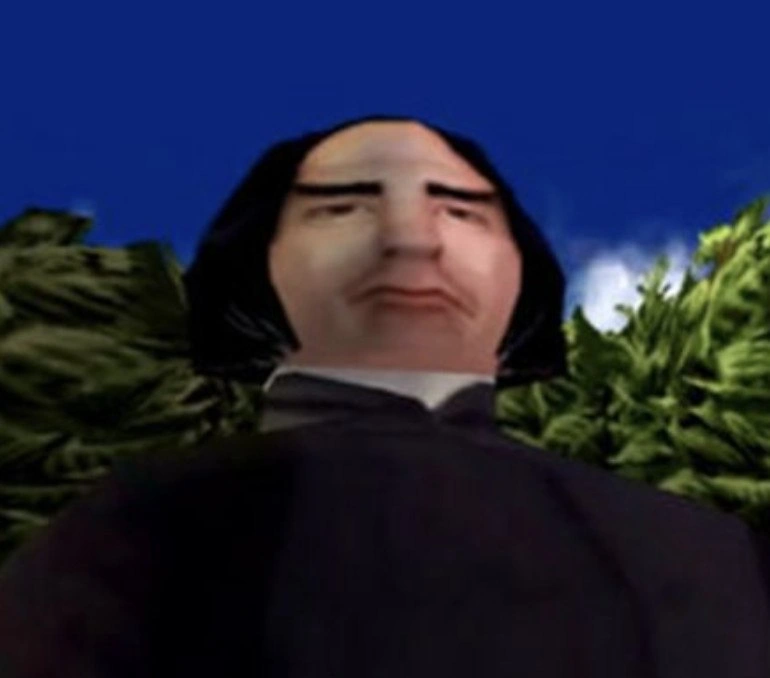
When the low-poly NPC model confronts you with 2001 GPU limits
GameDev Post #5160, on Apr 29, 2023 in TG

When the low-poly NPC model confronts you with 2001 GPU limits

Why is this GameDev meme funny?

Level 1: Minecraft by Accident

Imagine you’re trying to make a person in a video game using building blocks – but you only have a few big blocks to work with. The result would look kind of chunky and not very detailed, right? That’s exactly what happened with old video game characters! This picture shows a really blocky guy from an early 2000s game. He looks like he’s made of simple shapes (sort of like a LEGO figure or a Minecraft character), and that’s not on purpose for style – it’s because back then the computers weren’t powerful enough to use a lot of small pieces. So game creators had to use only a few shapes to build each character. The joke here is that this low-detail character pops up and reminds us of how games used to look. It’s funny and heartwarming because it’s like seeing an old toy from your childhood: even though it’s simple and a bit silly by today’s standards, it brings back memories and makes you think “Wow, games have come a long way!” In short, this meme makes us laugh by showing a really old-school video game character confronting modern us, and we can’t help but smile at how blocky and simple he is compared to today’s super realistic game characters.

Level 2: Retro Graphics 101

Okay, let’s break down why this low-polygon character is funny and what it means. In the image, we see a very blocky-looking 3D character – the kind you’d find in a video game from around the year 2001. Why does it look so blocky? Because back then, computers and game consoles weren’t nearly as powerful as today. The GPU (Graphics Processing Unit) in a 2001 machine had a limited amount of processing power and memory. Imagine you’re a game artist in those days: you have a strict polygon budget for each character. A polygon (usually a triangle in games) is like a tiny flat tile used to build 3D models. The more of these tiles you use, the smoother and more detailed your character can be. But in early 3D games, you could only use a few hundred or a few thousand triangles for an entire character model! If you tried to use too many, the game would slow down or not run. So developers had to make characters with as few polygons as possible – hence the term low-poly (low polygon count). That’s why the character’s face in the meme has sharp edges and looks a bit like a geometric shape rather than a smooth, round face.

Another limitation was textures. Textures are images that are painted onto those 3D models to give them color and detail (like the character’s face, clothing, etc.). In 2001, there was very limited memory for textures – sometimes only a few megabytes total for the whole game scene. That’s tiny! For reference, one photo you take on your phone today might be larger than the total texture memory of an entire level in an old game. Because of that, artists often used a single small image (a texture atlas) and squeezed all the character’s details into it. This meant the resolution was low, and if you zoomed in, things looked blurry or blocky. The meme’s character has that blurry, painted-on face look, which is exactly how many game characters appeared in the early 3D era. The trees in the background are just simple green shapes probably mapped with a very small leafy texture, and the sky is a flat blue – simple, because it had to be; complex scenery would eat up too many resources.

So why is this funny? It’s a mix of nostalgia and contrast. For folks who grew up with or started in game development back then, seeing this image brings back memories of those older games (it’s a nostalgia_meme for sure). It reminds us of popular old titles on the original PlayStation or early 2000s PC games where everyone looked a bit like this. For example, there’s a well-known joke about an old Harry Potter game on PS1 where Hagrid (a big character) looks hilariously blocky – the tag low_poly_hagrid refers to that. Gamers and developers share these images as inside jokes. On the other hand, if you’re used to modern games, this image looks ridiculously primitive. Today’s GameDevelopment technology lets characters have tens of thousands of polygons (even a single character’s face might have more polygons than an entire scene from a 2001 game) and very high-resolution textures with advanced lighting. We have things like PBR (Physically Based Rendering) which make materials (skin, cloth, metal) look real, and even real-time reflections and shadows. Seeing a character with a plain flat look, no real shading, and blocky features is almost like seeing a caveman in the era of astronauts – it’s a huge contrast.

The meme is essentially a joke that this old-school NPC (Non-Player Character) model is “confronting” us with the reality of those old hardware limits. It’s like the character stepped out of 2001 to remind us, “Hey, remember when I was as good as graphics got?” For a junior developer or someone new to graphics, it’s a neat reminder of how far we’ve come. Early 3D GraphicsProgramming was all about clever tricks to make the most of weak hardware: using simple shapes, repeating small textures, and optimizing everything by hand. This image encapsulates that lesson in one funny snapshot. It’s part of GamingCulture to poke fun at old graphics while also appreciating them. After all, if those limits hadn’t been pushed back then, we wouldn’t have the gorgeous games we have now. So, in summary: the character looks blocky and simple because 2001-era GPUs couldn’t handle anything more detailed in real-time. We find it funny and endearing because it’s such an obvious relic of that time – a reminder of video game history that makes us smile.

Level 3: Polygon Budget Blues

For veteran game developers, this meme hits like a nostalgic punch: it’s a GamingCulture inside joke about how characters used to look when we were squeezing 3D games onto turn-of-the-millennium hardware. The low-poly NPC (Non-Player Character) staring back at us is funny because it’s so relatable to anyone who remembers early 3D games. Back then, every artist and programmer knew the pain of the polygon budget blues – if you busted your polygon budget or your texture limits, the game would chug or outright fail on a PlayStation 2 or a circa-2001 PC. Here we have what looks like a retro boss or quest-giver character with a face made of a few flat planes and a blurry texture stretched over it. That visual screams “early console graphics,” calling to mind infamous blocky characters like the meme-worthy low_poly_hagrid from the 2001 Harry Potter game. In meetings back in those days, graphics engineers would literally confront designers saying, “We can’t add more detail; the GPU will melt!” This image playfully personifies that scenario: a low-poly NPC confronts you with the reality of 2001 GPU limits, almost as if saying, “Hey, remember when I was the best you could do?” It satirizes the trade-offs of old-school GameDevelopment: to maintain a steady frame rate, developers had to chop models down to bare essentials. Facial features were often just a few polygons with a single 128x128 pixel texture slapped on. Animations were stiff, and the lighting was baked or very simple, because dynamic lights were expensive. The humor also comes from the contrast with today’s standards. In modern games, even minor NPCs have high-poly models, detailed normal maps, and sophisticated shaders – their hair, skin, and cloth look realistic. So seeing a character that looks like it escaped from a 2001 cut-scene is both hilarious and endearing to senior devs: it’s a reminder of how far we’ve come. It’s the absurdity of an ancient game_asset_optimization staring you down. We’ve gone from worrying if a character should have individual fingers or just a mitten-like hand (to save polygons), to now debating how many millions of polygons are enough for a hero character’s detailed facial expressions. This meme encapsulates that journey in one image. There’s also a bit of shared trauma and pride here: old-timers remember crunching numbers and optimizing every draw call to hit 30 FPS on the dot. Seeing this blocky robed figure with flat eyebrows and a potato-like head, we nod knowingly – yep, been there, made that. It’s a loving roast of the early 3D era. No one is actually upset about it; in fact, many devs are proud of those days when PerformanceOptimization wasn’t just a niche skill, it was daily survival. The meme basically says, “Check out what we used to consider good graphics!” and lets everyone marvel (and chuckle) at the rapid evolution of technology. It’s an inside joke about GamingReference history – if you recognize the style, you’re part of the club that lived through the transition from blocky pixels to the lush, high-fidelity worlds we have now.

Level 4: Fixed-Function Flashbacks

This image is a time capsule from the era of fixed-function GPUs, when 3D graphics were ruled by hard limits on polygons and texture memory. The character’s blocky, faceted face highlights a strict polygon budget – basically a cap on the number of triangles a model could have given 2001 hardware constraints. Early GPUs had a fixed rendering pipeline: you fed in vertices, and the hardware handled transformation and lighting in a very rigid way (no custom shaders!). Developers working on GameDev back then balanced every vertex and every pixel of texture. The Graphics pipeline couldn’t do fancy per-pixel lighting or shaders; at best you got Gouraud shading (lighting calculated at vertices and interpolated across faces) and maybe a single cheap shadow or reflection trick. Physically Based Rendering (PBR) and real-time ray tracing? Completely out of the question – those concepts lived in research labs and CGI films, not in real-time GraphicsProgramming on a 32 MB GPU. The humor here comes from recognizing those fundamental limitations: the early_3d_graphics aesthetic of flat shading and chunky geometry wasn’t a stylistic choice, it was enforced by the math and silicon of the day. The GPU could only push so many triangles per frame (think tens of thousands, not the billions of triangles modern GPUs crunch through). Memory was measured in single-digit megabytes, meaning texture atlases were tiny and low resolution – often 256×256 pixels or smaller for a character’s entire face and outfit. This is why the trees in the background look like simple green blobs and the sky is a flat blue: with a ps1_texture_budget mindset, you couldn’t afford high-res, detailed scenery. It’s a nod to the RetroComputing constraints that game developers faced: every additional triangle or draw call had a direct performance cost on those 2001-era machines. In hardware terms, the rasterization process back then had limited parallelism and no unified shaders – you had separate fixed units for vertex transformations and pixel fill rate. If you violated the unwritten rules of polygon count or texture size, you’d get a nasty performance hit or even outright crashes. Seasoned graphics engineers remember techniques like early LOD (Level of Detail) systems, where distant characters were shown with even fewer polygons, or creative use of billboards (flat sprites) for things like foliage to save on poly count. The meme’s low-poly NPC instantly triggers these PerformanceOptimization memories. It’s essentially showing an artifact of a solved technical problem: we laugh because we’ve transcended those limits, yet here we’re confronted with a living fossil of graphics history. To a graphics engineer, this blocky robed figure is practically shouting, “Behold, I am built under polygon_budget_constraints!” – a nostalgia_meme that celebrates how far rendering technology has come by playfully poking at its primitive past.

Description

The image shows a low-angle shot of a blocky, low-polygon 3-D character wearing a dark robe, standing outdoors against a deep-blue sky and stylized green trees. The character’s face is intentionally blurred for privacy, but the rigid geometry and flat shading clearly evoke early-2000s console graphics. No on-screen text is present; the humor comes from the unmistakable ‘retro game cut-scene’ aesthetic that reminds developers of strict polygon budgets, tiny texture atlases, and fixed-function GPUs. For seasoned game engineers, it’s a nostalgic nod to the era when performance meant squeezing every vertex count and draw call, long before PBR pipelines and real-time ray tracing
Comments

6
Anonymous ★ Top Pick PM: “Just make it photoreal, we’re still targeting the 2001 GPU.” Me: “Great - here’s a 600-triangle NPC; tell me which vertex is your must-have feature.”
  1. Anonymous ★ Top Pick

    PM: “Just make it photoreal, we’re still targeting the 2001 GPU.” Me: “Great - here’s a 600-triangle NPC; tell me which vertex is your must-have feature.”

  2. Anonymous

    When the junior dev's PR has a 500-line function that "works perfectly in local" but they forgot to mention it's O(n³) and makes direct database calls in a loop

  3. Anonymous

    That sublime moment when your 3-month feature branch with 847 commits finally merges cleanly into main - no conflicts, CI green, and you realize you've successfully avoided the rebase apocalypse your team lead kept warning about. Now you just need to explain why the bundle size increased by 40%

  4. Anonymous

    SEV1s are basically Skyrim carts for prod - you wake to “you’re finally awake,” grep the logs, realize a K8s liveness probe has been rebooting a memory-leaking daemon since 2019, and everyone calls it self-healing

  5. Anonymous

    That stare when the 'microservices refactor' just spawned a distributed monolith chasing eventual consistency in a transaction-heavy app

  6. Anonymous

    Skip the canary, flip the flag to 100%, and the Error Budget Reaper shows up to collect your SLO and your weekend

Use J and K for navigation