AI Coding Assistant Rage Quit
Why is this AI ML meme funny?
Level 1: The Unhelpful Helper
Imagine you have a little robot friend who’s supposed to help you solve problems. You ask this robot, “Hey, how do I fix this toy?” The robot gives you an answer, but it’s not working. So you ask again, “No, that didn’t work. Can you try something else?” But the robot keeps giving you the exact same answer, over and over. By the tenth time, you’d probably feel really annoyed, right? It’s like if you said, “I can’t find my homework,” and your friend just keeps pointing at the same empty desk each time you ask – not helpful at all! Now, getting angry is a normal feeling when you’re frustrated, but what if someone got so angry that they threw a temper tantrum like a little kid, except they’re a grown-up with a big computer? That’s what this funny (and extreme) story is about.
The person in the meme asked a computer program (an AI helper) to help with some coding work, but that helper was being stubborn or not smart enough to change its answer. It was like a broken record, saying the same thing again and again. This made the person so mad that they actually smashed their computer screen. Picture someone getting so upset at a video game or a TV that they punch the screen – definitely an overreaction, right? In the story, it happened at a party with 30 guests watching! So all these people saw him basically destroy his fancy wide monitor (a big screen) in a burst of anger. It would have been a shocking and pretty scary scene – the screen broke into pieces, the keyboard and stuff on the desk went flying, and glass shattered on the floor. Not only were the guests stunned, but his wife and kids got really upset too (the kids even started crying because it was loud and scary). His wife decided, “Okay, that’s enough. We’re going to a hotel for a week to calm down,” and took the children away from the house for a while.
All of this happened because the “helper” computer program wasn’t actually helpful and the person couldn’t control their temper. It’s meant to be a joke (nobody really should do this in real life!) showing an extreme case of frustration. The reason it’s funny in a way is because it’s such an over-the-top reaction to a pretty small problem. We all know it’s annoying when a helper doesn’t help – like if you asked a friend for homework help and they just repeated the wrong answer, you’d groan or maybe yell. But most people wouldn’t smash a computer or ruin a whole party over it! The meme is exaggerating to make us laugh and also kind of say, “Hey, we’ve all felt like this when technology drives us crazy, but this is taking it to a hilarious extreme.”
So, in simple terms: the computer helper (AI) kept not listening and giving the same answer, and the person got so mad they broke their own computer in front of everyone and caused a big family fuss. It’s funny (in a silly way) because it’s like watching a cartoon character have a meltdown – it’s absurd and we know real life shouldn’t be like this. The core idea is something anyone can understand: being super frustrated when something that’s supposed to help isn’t helping at all. The meme just shows that in a blown-up, crazy way, to give fellow developers (and really anyone who’s dealt with a stubborn gadget) a laugh and a reminder: don’t be that guy — no matter how mad you get at a machine, breaking your stuff (and scaring your family) is not the best solution!
Level 2: Snippet Déjà Vu
Let’s break down what’s happening in this meme in more straightforward terms. A developer was using an AI assistant (specifically something like ChatGPT powered by GPT-4) to help write or fix some code. Now, GPT-4 is a Large Language Model developed by OpenAI – basically, an AI system that can generate text, including code, based on the prompts you give it. Think of it as an extremely advanced autocomplete: you ask a question or describe a problem, and it tries to give you a helpful answer or snippet of code. It’s part of a wave of AI tools meant to boost developer productivity and improve Developer Experience (DX) by handling routine or tricky coding tasks, almost like a super-charged Clippy for programmers (if Clippy had Stack Overflow and all of GitHub wired into its brain).
In this scenario, the developer kept asking GPT-4 (humorously called “GPT4o” in the meme, possibly just to sound like a variant or maybe a pun) to provide some code. Unfortunately, the AI kept giving the exact same code snippet over and over — literally ten times in a row — instead of a new solution. This is what we mean by “repeated_code_snippets.” It’s like hitting refresh on a webpage and seeing the same page each time, or asking a friend for different ideas but they repeat their first idea again and again. In coding, a snippet usually refers to a small piece of code. Boilerplate code is a term for standard, routine code that’s used so often it becomes generic – often necessary, but not very creative or specific. Here, GPT-4 was probably spitting out boilerplate or the same known solution that didn’t actually solve the developer’s problem. To the developer, it felt like the AI was stuck in a loop (like a record skipping, playing the same line of a song repeatedly). This is immensely frustrating when you’re looking for a fresh approach to debug or implement something.
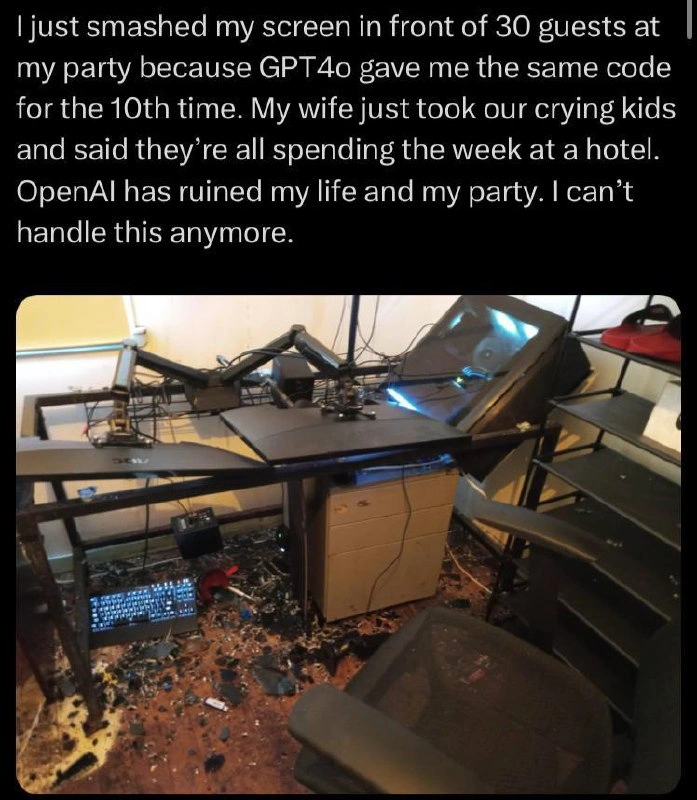
Now, about the hardware: “ultrawide” refers to an ultrawide monitor, which is a type of computer screen that is very wide (often with a 21:9 aspect ratio or similar). Developers and gamers love these because you get a ton of screen real estate to spread out your windows, code editor, logs, etc. They are usually expensive and definitely something you’d call a prized gadget on your desk. In the photo, we see a shattered display that looks like it was an ultrawide screen, now lying face-down among broken glass. It seems our developer literally smashed his monitor in anger. There are also dual-monitor arms (the metal adjustable stands that hold up multiple monitors) that are twisted out of shape, and a mechanical keyboard on the ground (mechanical keyboards are those clacky, tactile keyboards many programmers prefer for their feel and feedback). The scene basically shows a broken_workstation: the whole desk setup is destroyed. This visual punchline emphasizes just how over-the-top the reaction was. Cables are hanging loose (the description jokingly likens them to “forgotten micro-services” – a tongue-in-cheek reference to how disconnected and messy everything looks, akin to stray services in a messy microservice architecture).
So, why did this happen? Because the developer got incredibly angry — so angry that they physically “rage_quit” their coding session by busting their equipment. The term rage quit comes from gaming: it means quitting a game in a fury (often loudly or by breaking something) when you’re too frustrated to continue. Here, instead of quitting a game, the dev quit the whole situation by smashing the screen. It’s an extreme form of expressing frustration. The text describes this happening “in front of 30 guests at my party.” So apparently, this person was hosting a party and maybe decided to show off this cool AI coding assistant to the guests (perhaps to demonstrate some programming magic). That backfired spectacularly. When GPT-4 kept giving the same unhelpful answer, the developer couldn’t handle the embarrassment and frustration, and lost their temper big time. The result: a very loud, glass-shattering scene in front of all their friends and family.
The meme tweet goes on to say, “My wife just took our crying kids and said they’re all spending the week at a hotel.” This line injects a bit of dark humor by showing the personal consequences of the meltdown. Essentially, the developer’s spouse was so upset by this outburst (and perhaps worried for the kids, who got scared and started crying) that she decided to leave the house with the children for a while. This is obviously an exaggeration meant to be humorous — it’s unlikely a real scenario would escalate that far from a coding issue. But it underlines just how badly this person overreacted. They let a coding frustration not only wreck their gear but also wreck the mood of an entire party and upset their family. The line “OpenAI has ruined my life and my party. I can’t handle this anymore.” is written in the style of an overly dramatic complaint you might see on social media. It implies the person is blaming OpenAI (the company behind GPT-4) directly for what happened, as if the AI forcing them to repeat code is the culprit for all this chaos. In reality, of course, smashing your screen is a choice you make — the AI didn’t reach out of the monitor and punch itself. But in the heat of the moment, the developer is so angry they externalize the blame to the tool.
This ties into a real developer experience: working with new tech like AI assistants can sometimes be frustrating if the tool doesn’t understand your problem. While these AIs can be amazingly helpful, they have limitations. They don’t truly know why code might be wrong; they just try their best to give an answer based on patterns. So if you’re in a tricky situation and the AI keeps misunderstanding you, it can feel like talking to a wall. A junior developer (or anyone new to using AI for coding) might not realize that sometimes you need to adjust your prompt or give more info to get a different answer. If you just keep saying “do it again” without clarifying, you might indeed get the same answer again. It’s a bit like debugging: you have to change something in your approach to get a different result. The meme really exaggerates what happens when someone doesn’t handle that well.
In summary, at this level, the meme is about a developer getting maddeningly frustrated with a piece of AI software (ChatGPT/GPT-4) because it was stuck in a loop of giving the same code. The developer lost his cool so badly that he destroyed his monitor at a party, and even his family got caught up in the fallout. It’s a comedic cautionary tale about managing your temper and remembering that AI tools can mess up or be unhelpful at times. We’re not meant to take it literally (hopefully no one is out there actually smashing ultrawide screens over code), but it highlights in a very dramatic way how a bad experience with a supposedly smart assistant can push someone to the brink. In real life, the takeaway is: know the limitations of your tools (AI included), and maybe don’t stake your reputation (or your hardware… or your marriage!) on an AI performing perfectly, especially not in front of an audience.
Level 3: Rage Against the Machine (Learning)
From a senior developer’s perspective, this meme hits on a painfully familiar scenario: developer frustration reaching critical mass thanks to a supposedly smart AI assistant that just isn’t listening. The tweet-style text sets the scene: our hapless coder is presumably demoing something in front of 30 party guests (perhaps showing off how “awesome” GPT-4 is at coding) and things go horribly wrong. GPT-4 – here playfully nicknamed GPT4o – keeps providing the exact same code snippet no matter how many times he asks for a revision. We’re talking copy-paste deja vu ten times over. You can practically hear the eye twitching by the third repeat. Any seasoned dev who’s wrestled with an overly confident IDE suggestion or a teammate who won’t let go of their favorite (flawed) solution is nodding along: “Yep, been there – though I didn’t literally smash a screen... not yet anyway.”
The humor (tinged with horror) comes from the wild overreaction. This guy’s ultrawide monitor — a coveted piece of hardware for programmers, providing massive screen real estate for code and logs — has been physically smashed to bits. The photo evidence shows a warzone of shattered glass and toppled peripherals. Dual monitor arms are twisted like a pretzel, one display lies face-down in what looks like the aftermath of a bar fight, the mechanical keyboard’s strewn on the floor amidst debris, and cables dangle everywhere like disemboweled microservices. It’s an exaggerated visualization of the term “rage quit.” Instead of Alt-F4 on a game, it’s Alt-Fist through a monitor. This is the literal hardware equivalent of a Ctrl+C on the whole situation.
Why would a developer reach this comical breaking point? Because AI limitations can be infuriating when you’re depending on the tool to actually help. The meme underscores a key aspect of modern Developer Experience (DX): the introduction of AI coding assistants like ChatGPT or Copilot has added new joys and new sorrows to our workflow. When it works, it’s almost magical – your productivity skyrockets as the AI suggests the perfect snippet or saves you from digging through documentation. But when it fails, especially in a repetitive or obtuse way, it can feel even worse than a normal bug. Here, the AI is not just failing silently; it’s actively mocking the dev by repeating the same answer, like a stubborn parrot. That stochastic parrot effect (AI echoing training data without truly understanding) becomes an inside joke among us: the large language model is basically saying “I have exactly one idea, and I’m sticking to it.”
For a senior engineer, this triggers war flashbacks to other troubleshooting nightmares. Think of a time when you kept searching Google for a very specific error, and every result was the same copied Stack Overflow answer that didn’t work — page after page of Google just showed the identical snippet on different websites. That’s the human equivalent of what this AI is doing. After the 10th time, you’re ready to pull your hair out. In the meme, hair-pulling wasn’t enough; a monitor paid the price instead. It’s a satirical take on how Developer Frustration escalates: first we curse under our breath, then we slam the desk, and in this dark comedy version, we go full Hulk Smash on our equipment.
The mention of the wife and crying kids heading to a hotel adds an extra layer of absurdity (and dark humor). This poor developer didn’t just ruin a piece of tech – he ruined the whole party. He had 30 guests over, presumably to celebrate something, and instead they got front-row seats to a meltdown. It’s an extreme case of letting work stress (or in this case, AI-induced stress) bleed into real life. The family drama element—wife packing up the kids after dad yeets a monitor in front of everyone—illustrates how completely the situation went off the rails. It’s the kind of embarrassing horror story you’d hear and think, “Ouch, someone needs a vacation…maybe not at a hotel without him, though.” The meme exaggerates to drive the point: don’t let coding frustrations get this far. Most of us have felt a spike of anger when a build fails for the 100th time or when “it works on my machine” but nowhere else. But punching your screen at your own party takes it to a mythic level of DevOps gone wrong.
There’s also a sly commentary here about blame. The tweet text says, “OpenAI has ruined my life and my party.” The dev squarely points the finger at the AI company, as if blaming ChatGPT for his own outburst. A seasoned engineer reading this will smirk, because we’ve seen this movie before: blaming the tool or the language or that one scary regex for our woes, when often it’s our misuse or unrealistic expectations at fault. Sure, GPT-4 gave him the same code repeatedly, but smashing a monitor is not OpenAI’s recommended debug method. 😅 The “trust boundary” with the AI was too brittle — he trusted it to perform live in front of an audience (bold move, honestly), and when that trust broke, so did everything else. It’s a cautionary tale: if you’re doing a demo or relying on an AI assistant in production, always have a backup plan (or at least anger management techniques).
This scenario also parodies the hype around AI in developer tools. Not long ago, people touted GPT-4 as the end of searching docs or the cure to rubber-duck debugging. But reality sets in when you hit the model’s edge cases. A senior dev reading this recognizes a classic pattern: New tool is amazing! → use it for something it’s not 100% reliable for (like live coding in front of guests) → tool fails spectacularly → user loses it. It’s happened with new frameworks, libraries, you name it. The difference now is our new coding buddy is essentially a black box AI. When it acts up (like looping the same suggestion), it feels irrational and infuriating, almost like dealing with a teammate who isn’t listening. Except this teammate was trained on half the internet and still can’t take a hint when you say “No, that code is not what I need.”
In short, at the senior level, the meme is a hyperbolic nod to the limitations of AI assistants and the all-too-human rage quit response when our tools betray us in crunch moments. It highlights how fragile the developer-productivity paradise can be: one moment you’re cruising with AI-generated code, the next you’re picking shards of your broken workstation out of the floorboards. It’s both a warning (“don’t let it get this bad, folks!”) and a dark chuckle at what we’re capable of when a debugging session goes completely off the rails.
# Rough simulation of the meltdown scenario (do NOT try this at home)
for attempt in range(1, 11):
result = GPT4o.ask(question)
if attempt == 10 and result == last_result:
raise MonitorSmashError("Same code for the 10th time!") # uh-oh, here we go...
last_result = result
# After this unhandled exception, the system (and the monitor) crashes.
# Wife and kids initiate emergency rollback to a hotel.
Level 4: Mode Collapse Meltdown
At the deepest technical layer, this meme underscores a quirk of Large Language Models (LLMs): sometimes they collapse into repeating the same solution when prodded repeatedly. In machine learning terms, one might jokingly call this a "mode collapse" in the context of code generation — the model has latched onto one plausible code snippet (one mode of its output distribution) and stubbornly serves it up each time, ignoring the user’s desperate attempts to get a variation. GPT-4 (here satirically called "GPT4o") is a state-of-the-art Transformer-based AI. It generates code by predicting what token comes next, based on probabilities learned from mountains of training data (like an ultra-smart autocomplete on steroids). If the prompt doesn’t change much and the model has a high confidence answer (say, a common snippet it’s seen thousands of times on Stack Overflow), it may keep regurgitating that boilerplate with uncanny determination.
Under the hood, models like GPT-4 use something akin to a giant neural network with an attention mechanism to weigh context. But they lack a true “internal monologue” or problem-solving feedback loop beyond pattern matching. If the user just repeats “Try again” without providing new information or negative feedback the model can understand, the AI has no sure way to know why its answer was unsatisfactory. It isn’t actually running the code or debugging the issue — it’s simply generating what seems like a valid solution. Without extra instructions, it might produce the same code snippet verbatim or with only trivial changes, because that snippet scores highest in its probability model as the correct answer. Essentially, the model is stuck in a deterministic loop from its own perspective — a high-probability rut.
There’s also the matter of decoding strategy. GPT models can be tuned for more creative or varied output using a higher temperature (adding randomness) or techniques like top-k/top-p sampling. But if the assistant was configured (or fine-tuned via RLHF, Reinforcement Learning from Human Feedback) to prioritize safe, high-confidence answers, it may intentionally avoid too much creativity. The result? A frustratingly identical answer on the 10th try, because by its training, that answer is consistent and presumably correct. We’re basically witnessing an AI pair programmer stuck in an infinite loop of its own: the user keeps hitting "regenerate", and the AI, like a well-behaved but oblivious function, keeps returning the same output for the same input. In formal terms, it’s like calling a pure function with the same arguments over and over – expecting a new result is folly unless something external changes. This is a fundamental limitation of present AI assistants: they don’t truly understand why code fails or how frustrated you are; they have no built-in mechanism to say “oh, I already tried that approach, let’s invent a new one” unless explicitly instructed.
The meme exaggerates this concept to a darkly comic extreme: the “brittle trust boundary” between developer and AI shattered (quite literally) by this repetitive output. That term hints at a serious issue in AI-assisted development — trust is built quickly when the AI magically completes a task, but it’s fragile. One too many wrong or repetitive answers and the illusion of a helpful, clever partner collapses. Here, trust wasn’t just broken; it was obliterated in a shower of LCD glass. The developer’s rational mind likely hit a runtime exception after the 10th identical answer. The theoretical fix might be to improve the AI with better context awareness or allow it to run and test code (so it learns from mistakes during the session), but current GPT models don’t do that out-of-the-box. Without that, they can inadvertently troll a programmer by confidently providing the same wrong solution repeatedly. In summary, on a deep technical level this meme highlights an AI failure mode – the model’s inability to adapt or escape a local optimum without explicit feedback – and how that can drive a human to an abrupt, system-crashing human exception. The result? An ultrawide monitor meeting a very ultra-wide demise.
Description
The image displays a tweet-like text overlaying a photo of a completely destroyed computer setup. The text reads: 'I just smashed my screen in front of 30 guests at my party because GPT4o gave me the same code for the 10th time. My wife just took our crying kids and said they're all spending the week at a hotel. OpenAI has ruined my life and my party. I can't handle this anymore.' The photo below shows the aftermath of a violent outburst: a computer desk is in disarray, a monitor is shattered, and debris litters the floor. This meme is a hyperbolic and humorous take on the intense frustration developers can experience with AI coding assistants. It satirizes the moments when AI tools like GPT-4o get stuck in a loop, providing the same unhelpful solution repeatedly, escalating a common technical annoyance into a life-destroying catastrophe for comedic effect

Comments
15Comment deleted
It's not a bug, it's just GPT-4o aggressively caching the wrong solution. The real system failure is expecting deterministic output from a stochastic parrot while your family is watching
Pro tip: set exponential backoff on the completion API - monitors don’t support idempotent retries
The real bug here isn't in the code GPT-4o generated - it's believing that smashing hardware would produce a different output than the AI. Should've tried turning the relationship off and on again instead of the monitors
When your AI pair programmer has the memory retention of a goldfish and the creativity of a cached response, but you're the one who ends up in production - explaining to your family why 'temperature=0' means you got the exact same broken implementation ten times in a row. At least the LED strips survived; they're probably running more reliable code than GPT-4o's context window at this point
He needed RAG, not rage; smashing the monitor doesn’t evict the LLM cache - or change a temperature=0 greedy decode
GPT-4o: Nailing ML reproducibility by outputting the same suboptimal code until hardware enforces diversity
Pro tip: if GPT-4o returns the same snippet ten times, that’s not hallucination - it’s your prompt converging at temp=0; the only side effect in the pipeline was the monitor
Dont use ai. Don't use gpt, copilot or any of this shit. Plain old dumb code complete is ok and enough, but not required. Write the code yourself. Use SO in desperate situations only. Read, and thoughtfully, official docs and official examples. Comment deleted
Didn't SO sell out to AI already? Comment deleted
Even worse then Comment deleted
fucking nerd Comment deleted
Bebebebebe. And it's not just because it is "the right way" it is because it will make you much much healthier mentally and psychologically. Comment deleted
no, using ai is much simpler it's like when you use turtles to mine resources instead of doing it manually in Minecraft Comment deleted
Not fully. AI must be used for stupid tasks automation: CRUDs, java getsetters, any language boilerplate. Still the brain must be the main tool to use. Wish the author spends some days in a rehab Comment deleted
I know, and Spring data for CRUDs. it's just an example, sometimes boilerplate is still unavoidable Comment deleted