Skip to content
DevMeme
1968 of 7435
Linus Torvalds on UI Design: A Fate Worse Than Death
UX UI Post #2190, on Oct 23, 2020 in TG

Linus Torvalds on UI Design: A Fate Worse Than Death

Why is this UX UI meme funny?

Level 1: Better Off Stuck

Think about something you really hate doing – maybe cleaning your room. Now imagine you’re stuck in your messy room, and your parents say the only way you can go outside or play your favorite game is if you clean everything until it’s perfectly tidy. If you hate cleaning that much, you might throw up your hands and joke, “Fine, I’ll just stay in my room forever then!” Of course, you don’t actually want to stay there forever. You’re just exaggerating to show how much you dislike that chore.

In this meme, that’s exactly what’s happening with a programmer and making a “pretty” screen. The programmer is joking that he’d rather be stranded on a deserted island (a really bad situation) than have to design a nice-looking user interface for an app. It’s a silly overstatement that makes us laugh because it highlights in a playful way just how uncomfortable he is with that kind of task.

Level 2: Full-Stack Friction

This meme highlights a classic divide in programming: backend vs frontend. The man speaking is a backend developer – someone who writes the behind-the-scenes code (think databases, server logic, APIs). He’s used to solving problems with algorithms and handling data, not picking colors for buttons. When he says if he was stuck on an island and the only escape was to make a pretty UI, he’d die there, it’s a tongue-in-cheek way of saying “I’m so bad at designing user interfaces that I wouldn’t even try, even in a life-or-death situation.”

Let’s break down the key terms and why this scenario is funny:

  • UI (User Interface): This means the parts of an app or website that users see and interact with – the buttons, text fields, layouts, and overall look. A “pretty UI” means a user interface that looks attractive and well-designed.
  • Frontend: The development work that focuses on the UI and user experience. Frontend developers use languages like HTML, CSS, and JavaScript to create those visuals and make sure the app is easy to use.
  • Backend: The development work that happens behind the scenes. Backend developers handle things like database interactions, server-side logic, and performance. They might code in languages like Java, Python, or C# to ensure everything works under the hood.
  • Full-stack: A developer or approach that covers both the front end and back end of a system. A full-stack developer is comfortable doing both UI work and server work. Not everyone is full-stack; many people specialize in one side.
  • Developer stereotypes: In tech, there are running jokes about different types of developers. One stereotype is that backend devs are great with logic and data but not so good with design or making things pretty. Conversely, frontend devs are joked about as loving visuals and CSS but avoiding heavy server code. These are oversimplifications, but they appear often in developer humor.

Now, the humor here comes from exaggeration and contrast. This backend dev compares making a nice UI to an impossible challenge – so impossible that he’d rather accept “certain death” (staying stranded on the island) than attempt it. It’s funny because building a basic interface isn’t actually life-threatening, of course, but he’s acting like it’s the most daunting thing imaginable. It shows just how uncomfortable he is with that kind of task.

For a junior developer or someone new to this, imagine it like this: suppose you’ve gotten really good at building the engine of a car (that’s like backend coding), but now someone asks you to also design the car’s look and paint it beautifully (that’s like frontend/UI design). You might panic because painting and styling require a totally different skill set than engine mechanics. In the same way, a backend specialist can feel completely lost when asked to create a polished interface. It’s not that they aren’t smart or capable – it’s simply that they haven’t practiced that kind of work and it feels foreign to them.

This meme is a bit of relatable humor in the tech world. Developers often joke that they’re either “a backend person” or “a frontend person” because each side of development feels like its own world. The guy on stage is basically poking fun at himself: he’s saying “I’m such a back-end guy that I’d fail horribly at making things look good.” The serious interview setting makes it extra absurd, as if he’s delivering some solemn insight when really it’s a goofy exaggeration. Anyone who’s ever felt out of their depth with a certain tool or project can chuckle at this. It’s a lighthearted reminder that in coding (just like in anything else) people have different strengths, and someone who’s a wizard in one area might feel like a newbie in another. And that’s okay – it’s what makes this joke so relatable.

Level 3: Pretty UI or Perish

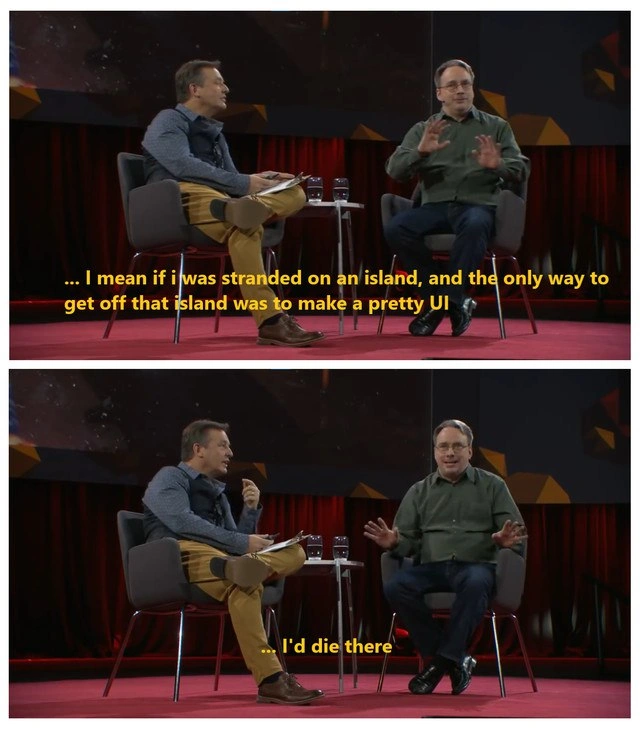
A seasoned backend developer sits on a stage, facing an interviewer, and drops the ultimate hyperbole: if escaping a desert island required building a pretty user interface, he’d rather remain stranded. “I’d die there,” he declares, to the laughter of the tech crowd. This darkly comic scenario nails the essence of BackendVsFrontend humor. It highlights a divide where a hardcore backend engineer – the kind who eats database queries and API endpoints for breakfast – feels utterly out of his depth with something as seemingly innocuous as making a screen look nice. The absurdity lands because so many developers have seen or lived it: ask a server-side guru to fiddle with fonts and color palettes and you’ll get panic in return. It’s the shared pain of crossing domain boundaries, magnified into a life-or-death metaphor.

The meme leverages classic developer stereotypes. The speaker is the quintessential frontend-averse backend engineer – proud of his server-side prowess, dismissive of “pretty UI” work, yet ironically acknowledging he can’t do it. By using an island survival analogy, he makes the situation hilariously extreme: normally, anyone would do whatever it takes to get off a deserted island, but this guy won’t even code a UI to save his life (literally). This kind of scene is a staple of tech humor on dev forums and Slack channels: it’s funny because it rings true. We can practically hear half the audience of developers groaning in sympathy and the other half (the front-end folks) cackling because they’ve heard these dramatic declarations before. The stage interview format (complete with red carpet and a serious host) adds to the joke – the line is delivered with a straight face in a formal setting, making it even more absurd and relatable.

Under the laughter, there’s real insight about specialization in software development. Why would a backend dev dread UI work so much? Here are a few reasons that make “just make it pretty” feel like a herculean ordeal:

  • Completely different skill set – Back-end work is all about logic, data, and invisible processes. Front-end work is visual and interactive, demanding an eye for design and user experience. It’s like an electrician being asked to paint a mural: similar realm (both involve a house) but entirely different talent. Our back-end dev might architect complex server logic in his sleep, but choosing fonts or crafting a pixel-perfect layout makes him break out in a cold sweat.
  • Unfamiliar tools & tech – A backend dev might live in a world of server frameworks, databases, and orchestrating microservices clusters. Suddenly, they’re expected to wrangle HTML/CSS and client-side JavaScript. Terms like 'display: flex' (a CSS layout style) or “responsive design” might as well be a foreign language. He’s comfortable with query optimizers and memory profilers, but CSS syntax and browser dev tools feel alien.
  • Ever-changing ecosystem – The front-end world evolves at breakneck speed. There’s always a new JavaScript framework du jour (React, Angular, Vue, Svelte – pick your poison) or a hot CSS library. Our stranded dev might joke that by the time he learns the latest UI framework, ten new ones will have washed ashore. In contrast, backend technologies (databases, server languages) tend to change more gradually, so this rapid churn is intimidating.
  • Underestimating complexity – To the uninitiated, “make it pretty” sounds easy – just some colors and buttons, right? Wrong. Building a polished, user-friendly interface (UI/UX) can be as meticulous as debugging a tricky concurrency bug. Aligning elements, managing layouts across different screen sizes, ensuring accessibility – it’s detailed work. A backend dev used to abstract logic might not realize how much trial-and-error and finesse goes into those “simple” pretty screens.
  • Personal loathing (the X factor) – Let’s face it: some engineers just hate doing UI work. It doesn’t “spark joy” for them. Maybe they had a traumatic experience wrestling with CSS in the past. Maybe they find front-end frustratingly imprecise compared to back-end. Whatever the reason, a strong personal bias can make a developer avoid UI at all costs. This meme cranks that feeling up to 11 for comedic effect – he’d literally rather die than open Photoshop or debug CSS.

All these factors mean that telling a backend specialist to whip up a pretty UI can feel like asking a fish to climb a tree. Now put that in a do-or-die survival scenario, and the joke practically writes itself. The meme is exaggerating a real truth: stepping far outside one’s expertise can be scary and comical, especially in the world of programming where niches run deep.

From a Developer Experience (DX) perspective, it’s also a commentary on how developers perform best when working with tools and tasks they know. Tossing your database guru into the UI/UX deep end without a lifeline is a recipe for frustration (for them and for anyone using the end result!). It’s why many companies value full-stack developers – those rare folks comfortable on both the front and back ends – but also why not everyone claims that title. The full-stack unicorn might chuckle at this meme, whereas the pure backender is nodding frantically in agreement.

In the end, the phrase “I’d die there” is a tongue-in-cheek way to say “Nope, not doing that!” It resonates through dev humor circles because it’s a shared experience packaged in an outrageous scenario. As over-the-top as it sounds, it hits close to home for many. Given a choice between debugging a 3AM server crash or styling a UI form, plenty of veteran backend devs will take the 3AM pager duty every time. That’s why this meme draws knowing laughs – it captures the exaggerated truth that for some coders, pretty interfaces are a fate worse than being stranded on a desert island.

Description

A two-panel meme featuring Linus Torvalds, the creator of Linux, during an interview on a stage with a red floor and dark red curtains. In the top panel, an interviewer sits opposite Torvalds, who is gesturing with his hands as he speaks. The subtitled text reads, '... I mean if I was stranded on an island, and the only way to get off that island was to make a pretty UI'. In the bottom panel, Torvalds leans back with a definitive expression, and the subtitle concludes, '... I'd die there'. The meme captures a famous and widely circulated quote from Torvalds, reflecting his well-known disdain for user interface aesthetics in favor of backend functionality and kernel engineering. The humor is rooted in his deadpan, absolute rejection of UI work, a sentiment that deeply resonates with many systems, kernel, and backend developers who prioritize function over form
Comments

18
Anonymous ★ Top Pick The three great fears of a kernel developer: a memory leak, a race condition, and a Figma link from the design team
  1. Anonymous ★ Top Pick

    The three great fears of a kernel developer: a memory leak, a race condition, and a Figma link from the design team

  2. Anonymous

    I can re-derive Paxos on a whiteboard, but ask me to get a button’s border-radius consistent in Chrome, Safari, and that one VP’s IE VM and I’ll start drafting my own post-mortem

  3. Anonymous

    After 20 years of shipping products, I've learned that 'pixel-perfect' is just management speak for 'the backend team has another sprint to figure out why the CSS grid breaks in Safari while you argue about border-radius values.'

  4. Anonymous

    This perfectly captures the backend engineer's hierarchy of needs: given the choice between death and centering a div with CSS, they'll take their chances with the island's wildlife. It's not that they can't build a UI - it's that they've seen what happens when you accidentally nest three more divs than necessary and suddenly your z-index is 9999 and you're questioning every life decision that led to this moment

  5. Anonymous

    Backend escapes UI island with a 200 OK; frontend devs perish optimizing the error page's box-shadow

  6. Anonymous

    I’d survive by implementing Raft across coconuts, but if the only raft off the island was “make a pretty UI,” I’d die arguing CSS specificity

  7. Anonymous

    I’ll ship a Raft-backed, zero-downtime migration before reproducing a Figma mock - Safari’s subpixel rounding, stacking contexts, and flex-gap quirks are my deserted island

  8. @artem222012 5y

    тут один и тот же админ что и у профунктора или он просто тут пиздит мемы?)

    1. @freeapp2014 5y

      Это 99% с реддита, а там уже все берут когда увидят

      1. @artem222012 5y

        ну это понятно)

        1. @freeapp2014 5y

          Хммм, кста мне было интересно как вы пишете в чат и вас тут нет? Типа это комментарии?

          1. @Lord_Evil 5y

            Именно

          2. @artem222012 5y

            Да, мы пишем в комментариях к посту а сюда идёт какая то пересылка

  9. @vl_sheiko 5y

    Ахахахах, вполне возможно)

  10. @Garrusvik 5y

    Хорошо что разрабы Pantheon дизайнят. Но так то Лайнус прав. Гтк3 то еще говнище

    1. @bit69tream 5y

      >торвальдс говорит, что не умеет в ui >"...Лайнус прав. Гтк3 то еще говнище"

  11. @nameToString 5y

    That's what would happen to most of backend developers

  12. @writeme 5y

    CLI*

Use J and K for navigation