Skip to content
DevMeme
2356 of 7435
Good Developers Copy, Great Developers Steal from Stack Overflow
DevCommunities Post #2619, on Jan 17, 2021 in TG

Good Developers Copy, Great Developers Steal from Stack Overflow

Why is this DevCommunities meme funny?

Level 1: Like Copying Homework

Imagine you have a difficult homework problem, and you don’t know how to solve it. You peek at the answers in the back of the book or copy a friend’s work to get the solution. Then you stand up and proudly declare, “I’m such an amazing student, I solved it all by myself!” – even though you really didn’t. That’s exactly the joke here, but with computer code.

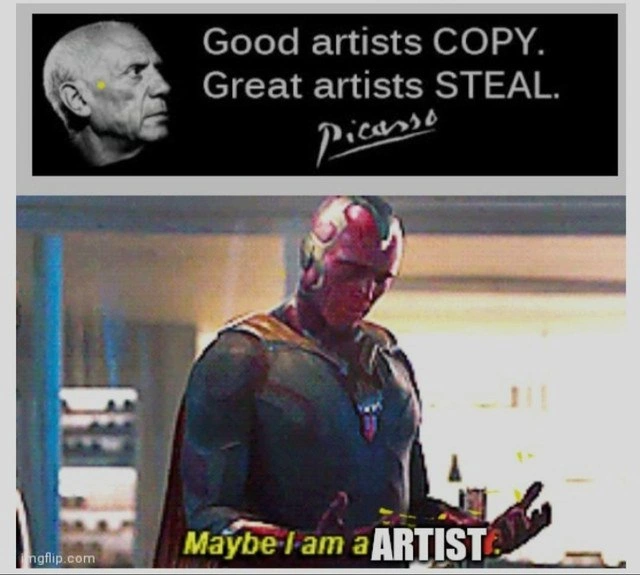
In the meme, a programmer “solves” a coding problem by copying someone else’s code from a website (instead of figuring it out on their own). It’s like tracing a famous drawing and then calling yourself Picasso. The top part of the meme even quotes a saying: “Good artists copy, great artists steal,” which the programmer uses to feel better about copying. The bottom part shows a superhero character (Vision from Marvel) looking proud and saying, “Maybe I am an ARTIST.” He’s basically thinking, “If stealing ideas makes someone great, and I just stole some code, then wow—I must be great too!”

We find this funny because it’s a silly mix-up of pride and shortcut-taking. Just like you’d giggle at a classmate who boasts after copying homework, we laugh at ourselves as programmers for feeling like geniuses when we simply pasted someone else’s solution. The meme playfully shows that while copying can save time, bragging about it is pretty goofy. It’s a lighthearted way of admitting that everyone cheats a little in programming – and that’s okay, just don’t take yourself too seriously when you do it!

Level 2: Copy-Paste 101

So what’s happening in this meme? Let’s break it down in simpler terms. We have a famous saying, “Good artists copy, great artists steal,” attributed to the painter Pablo Picasso. This quote is often used in creative fields to suggest that taking existing ideas and making them your own is part of genius. In the context of coding, the meme humorously twists this idea: a developer copies code from Stack Overflow and feels like a “great artist.”

Stack Overflow, by the way, is a hugely popular Q&A website where developers ask programming questions and get answers, often with useful code snippets. If you’re stuck on a coding problem (like “How do I center a div in CSS?” or “Why is my loop off-by-one?”), a quick Google search will likely lead you to Stack Overflow. The site is an incredible resource in the DevCommunities world. It’s practically a rite of passage for new coders to visit Stack Overflow frequently. You’ll find thousands of answers there, written by other programmers, ready to copy.

Copy-paste programming (sometimes jokingly called CopyPasteCoding) is exactly what it sounds like: taking code written by someone else (from a blog, Stack Overflow answer, GitHub project, etc.) and dropping it into your own code. We’ve all done it, especially when learning or when working under time pressure. For example, say you need a function to calculate factorial of a number. You could write it yourself, but it’s faster to search “Python factorial function Stack Overflow” and just paste what you find. Boom, problem solved in seconds. This quick-fix approach is often humorously celebrated and also gently mocked among developers. It’s funny because it feels a bit like cheating on a test — but in the software world, using available resources is usually seen as smart as long as you understand and integrate it properly. The meme’s developer is skipping that “understand” part and jumping straight to feeling proud.

Now, the phrase “Maybe I am an ARTIST” in the bottom panel is styled as a reaction. It’s from a Marvel movie scene featuring Vision (an android superhero known for being logical and somewhat naive about human traits). In meme culture, people use that Vision image with the subtitle “Maybe I am a ___” to joke about suddenly identifying as something after meeting a very low bar. Here, the developer hears that great artists steal and thinks “Hey, I steal code… so maybe I’m a great artist too!” It's a playful self-own. Developers often feel a mix of relief and cheeky pride when a copied snippet works. We know it’s not “artistry” in the traditional sense, so calling it that is an ironic joke.

Let’s touch on the code quality aspect. In software engineering, Code Quality means writing code that is clean, understandable, and maintainable. Copy-pasting code verbatim can be a code smell – an indicator of potential problems. For instance, if you paste code without adapting it, you might get variables or functions that don’t match the rest of your project or do extra things you don’t need. It might work initially, but later you or your teammates could be confused by it. That’s why ideally a developer will refactor (modify) copied code to fit their context and ensure they actually get what it’s doing. In reality, novices might just leave the code as-is because “hey, it works!” The meme is funny to developers because it exaggerates this scenario: instead of feeling a little guilty or cautious about copying code, the developer boldly compares themselves to Picasso, as if copying were a high art 🤦.

And what about licensing? This is something newbies often aren’t aware of: code on Stack Overflow is usually shared under a Creative Commons license (CC BY-SA 4.0). That means you’re free to use it but technically should credit the source. Hardly anyone copying a small snippet for personal or commercial code actually adds a comment like “// Code from Stack Overflow answer by user123”. It’s generally overlooked for tiny bits. The meme hints at this “license? never heard of it” attitude – calling it stealing in a joking way. In normal terms, using others’ code without credit could be called plagiarism or unauthorized use, but within developer culture, grabbing a few lines is incredibly common and usually harmless when done in moderation. The humor is that the developer isn’t worried at all about these nuances; instead, they’re patting themselves on the back.

In summary, Level 2 takeaway:

  • Meme Setup: Famous quote about copying art + Developer copying code.
  • Stack Overflow: the go-to site for code solutions, where the copying happens.
  • What dev does: Copies a solution from the internet exactly.
  • Joke: Developer calls that act “artistry” with a proud grin.
  • Why funny: Because writing code is usually hard work, but here someone skips to the solution and still feels like a genius. It’s playful hypocrisy that every coder recognizes.

Level 3: Steal Like a Dev

At the highest technical level, this meme pokes fun at the unofficial software engineering strategy often known as Stack Overflow–driven development. The top panel quotes Picasso (or actually a well-worn tech mantra): “Good artists COPY. Great artists STEAL.” This line, often echoed in startup and coding circles, suggests that reusing and repurposing existing work is a mark of genius. In the bottom panel, we have Vision (the Marvel android from Avengers), who hears that great creators steal and smugly concludes, “Maybe I am an ARTIST.” It’s a perfect storm of developer humor: equating shameless copy-paste coding with high art. 🤖🎨

On a serious note, this highlights a classic programming anti-pattern: grabbing code snippets from Stack Overflow or GitHub without fully understanding them. Pretty much every senior developer has seen code in a codebase that’s suspiciously similar to the top answer of a Stack Overflow question — sometimes even with the same variable names and comments. This shared experience is what makes the meme painfully relatable: we’ve all been that desperate coder at 2 AM, Googling error messages and copy-pasting the first snippet that “works”. The humor comes from how we justify it. We tell ourselves “Don’t reinvent the wheel!” or quote that Picasso line to feel innovative rather than lazy. It’s developer artistry irony at its finest: turning plagiarism into a proud moment.

Under the hood, real software engineering best practices encourage code reuse — but usually in the form of well-vetted libraries, modules, or frameworks (with proper attribution and licensing). Copying 5 lines of code from an answer might seem trivial, but it raises CodeQuality flags:

  • Maintainability: If you don’t deeply understand the borrowed code, you might struggle to debug or extend it. It’s like importing a black box into your app.
  • Consistency: The snippet might not follow your project’s style or could use different naming conventions, creating a jarring mismatch.
  • Hidden Bugs: That magical Stack Overflow one-liner might handle the basic case but can harbor edge-case bugs or performance issues. (Ever copied a sorting algorithm without noticing it was $O(n^2)$ quadratic for large inputs? Oops.)
  • Security & License: On the extreme end, blindly copy-pasting code can introduce security vulnerabilities. And let’s not ignore copyright and licensing: code posted on Stack Overflow is typically under a Creative Commons license (CC BY-SA), meaning technically you’re supposed to credit the source if you use it. Most developers… well, pretend they didn’t see that ignore it. This meme cheekily glosses over that “licensing ignorance” — the coder crowns themselves an artist for stealing code, rather than admitting they perhaps infringed a teeny bit.

The juxtaposition of Picasso’s quote with a Marvel character encapsulates a senior developer inside joke: in practice, software engineering thrives on shared knowledge. The entire open-source movement is built on the idea that we copy, adapt, and build upon each other’s code legally. But here we’re talking about those quick copy-paste fixes from random forums – a habit often frowned upon in code review. The meme exaggerates it to comedic effect: the developer is not just okay with copying, they’re proud enough to call it “developer artistry.” It satirizes the mental gymnastics we do to feel genius when all we did was hit Ctrl+C / Ctrl+V.

Historically, even industry icons have celebrated stealing (in a tongue-in-cheek way). Steve Jobs famously appropriated the quote to describe Apple’s own creative process. In coding, we often say Good developers write code, great developers reuse code.” This meme is essentially a tongue-in-cheek remix of that idea. It underscores a reality of the modern DevExperience (DX): with the vast knowledge of developer communities at our fingertips, the skill isn’t knowing everything, it’s knowing how to find and apply solutions quickly. The laugh comes from the absurd self-congratulation: treating a quick copy-paste fix as if it were the Mona Lisa of coding solutions. And let’s be honest, when that borrowed code does miraculously solve our production bug, for a split second we do feel like 🎨 code artists 🎨. Sure, it’s half joking and half coping mechanism, but it’s a feeling many a battle-scarred programmer can relate to.

Description

This is a two-panel meme that humorously justifies the common developer practice of copying code. The top panel features a famous quote attributed to Pablo Picasso: 'Good artists COPY. Great artists STEAL.', displayed next to a black and white portrait of him. The bottom panel shows the character Vision from the Marvel Cinematic Universe, looking down at his hands with a contemplative expression. The subtitle reads, 'Maybe I am a ARTIST', which is an altered version of his original line. The meme cleverly equates the act of 'stealing' code from sources like Stack Overflow or open-source repositories with high art, tapping into the shared experience of developers who often reuse existing solutions rather than reinventing the wheel. For senior engineers, it's a self-aware nod to the pragmatism and efficiency that often trumps originality in software development
Comments

8
Anonymous ★ Top Pick The difference between a junior and a senior dev isn't whether they copy from Stack Overflow, it's that the senior knows which outdated, unvetted, and subtly broken answer to steal
  1. Anonymous ★ Top Pick

    The difference between a junior and a senior dev isn't whether they copy from Stack Overflow, it's that the senior knows which outdated, unvetted, and subtly broken answer to steal

  2. Anonymous

    Picasso-Driven Development: steal the Stack Overflow gist, rename the variables, and hope the SPDX audit can’t recognize the brushstrokes

  3. Anonymous

    After 15 years of architecting distributed systems, I've learned that the real art isn't in copying Stack Overflow answers - it's in knowing which deprecated jQuery solution from 2011 to avoid while your junior devs insist on reimplementing authentication from scratch because 'OAuth is too complex.'

  4. Anonymous

    Every senior engineer knows the Picasso principle: junior devs copy-paste from Stack Overflow with shame, but architects 'draw inspiration' from open-source repos, refactor the variable names, and call it a design pattern. The real art isn't writing code from scratch - it's knowing which MIT-licensed implementation to 'strategically incorporate' while maintaining plausible deniability during code review

  5. Anonymous

    It’s plagiarism until you wrap it in an Adapter, add metrics, file an ADR titled “Strategic Reuse,” and pray the SCA bot doesn’t notice the GPL-2.0-only header

  6. Anonymous

    Good devs copy SO answers. Great ones, like Thanos, steal entire patterns from prod outages and snap into resilience

  7. Anonymous

    Good engineers copy snippets; great engineers “adopt a battle-tested reference implementation” - and inherit the CVEs, implicit SLAs, and decade-old edge cases

  8. Deleted Account 5y

    An*

Use J and K for navigation