Skip to content
DevMeme
6114 of 7435
The Human Engine for Creating Technical Debt
CS Fundamentals Post #6703, on Apr 25, 2025 in TG

The Human Engine for Creating Technical Debt

Why is this CS Fundamentals meme funny?

Level 1: Sledgehammer to Kill a Fly

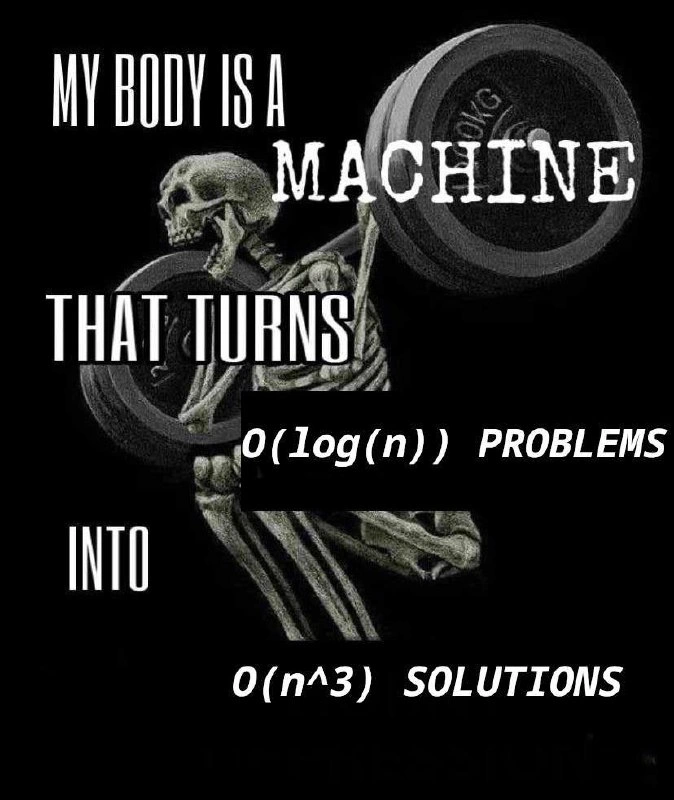
Imagine you have a tiny problem to solve, like picking up a toy from the floor. But instead of just bending down and picking it up, you build a giant robot with three arms to do it for you. The robot takes a ton of time and effort to set up, and by the time it actually picks up the toy, you could have done it a thousand times over yourself. Sounds silly, right? That’s exactly the kind of silly feeling this meme is joking about. In the picture, a skeleton is doing an insanely heavy squat lift for what should be a light task. It’s like using a huge sledgehammer to swat a tiny fly. The words on the meme say the person’s body (the developer) is a machine that turns a small, easy problem into a huge, slow solution. In everyday terms, it’s poking fun at doing way too much work for something simple. It’s funny because it’s obviously a goofy, over-the-top mistake – we can all laugh because we know nobody would intentionally do that. But sometimes, without meaning to, people do solve simple things in a really complicated way. The meme is a playful reminder of that, making us chuckle at how absurd it looks when you go overboard to solve a basic task.

Level 2: Big O Oops

Let’s break down what’s happening in this meme in simpler terms. At its heart, this is about Big O notation, which is a way programmers describe how slow or fast an algorithm is as the amount of work grows. You’ll often hear it in CS fundamentals and when discussing Performance. For example, O(log n) (pronounced “order of log n”) means that if you double the size of your input n, the number of steps the algorithm needs only increases a little bit (logarithms grow very slowly). Many efficient algorithms, like binary search for finding an item in a sorted list, run in logarithmic time. It’s the kind of complexity you want for large datasets because even huge inputs don’t faze it much.

On the other hand, O(n^3) (pronounced “order of n cubed”) means if you double your input size, the work goes up by a factor of 2×2×2 = 8. If you triple the input, work goes up 27 times (3^3). That’s cubic time, and it gets out of hand fast. An algorithm with O(n^3) often involves three nested loops or doing something three times for every element. For instance, a naive triple loop to compare every trio of elements in a list would be O(n^3). This kind of complexity is usually only tolerable for very small inputs; as n grows, O(n^3) becomes extremely slow. So in terms of performance trade-offs, O(n^3) is about as trade-off-unfriendly as it gets when n is large — you’re trading speed for… well, nothing useful in this case, just inefficiency!

Now, the meme text says: “MY BODY IS A MACHINE THAT TURNS O(log(n)) PROBLEMS INTO O(n^3) SOLUTIONS.” This is a funny way of saying the person (a developer) habitually takes problems that should be quick to solve and writes code that is overly slow. It’s calling out a kind of inefficient algorithm or overengineering in coding. Overengineering means designing a solution that's far more complicated than necessary. Here, an “O(log n problem” implies something that has a simple, efficient solution or inherently doesn’t require much work. But the “O(n^3) solution” implies the solution they came up with is massively inefficient. It’s like turning a quick chore into an all-day project. The meme jokingly presents this as if it’s the developer’s superpower or purpose: “My body is a machine that turns coffee into code” is a proud statement; similarly, “turns O(log n) problems into O(n^3) solutions” is structured like a boast, but it’s really a self-deprecating joke. Algorithm humor often uses this contrast for comedic effect — everything is phrased seriously, but the content is an obvious facepalm for those in the know.

The image of the skeleton weightlifting amplifies the joke. Why a skeleton? A skeleton is basically a dead body, and weightlifting is an intense, heavy activity. One interpretation is that by attempting such a heavy computational task (the O(n^3) solution), the developer or the machine has worked itself to death — hence, only a grinning skeleton is left doing the “heavy lifting.” The barbell with huge plates represents the massive load of all those unnecessary computations. The skeleton still grins, as if it’s perversely proud of managing an insanely heavy (but pointless) workload. It’s a dark, humorous way to show the pain of slow code. The phrase “turns problems into solutions” is normally positive, but here it’s ironic: those solutions are vastly over-complicated. In meme culture, pairing that phrase with the math notation O(log n) and O(n^3) is a nerdy twist that targets programmers specifically. It’s the kind of joke you might see on a programming forum or group chat where people share developer memes after a long day of debugging.

For a junior developer or someone new to algorithm complexity analysis, here’s why this is funny: usually we try to make our code faster and more efficient. Big O notation is one of the first tools you learn in computer science to compare algorithms — you want smaller growth rates like O(log n) or O(n) whenever possible, because they mean the algorithm scales well. So, if you have a problem that can be solved in O(log n), that’s great! It means even if you have a million items, it might only take around 20 steps to solve (since log2(1,000,000) ≈ 20). Now imagine someone coming along and solving that same problem in O(n^3). If n is a million, O(n^3) means on the order of 10^18 steps (that’s a billion millions!). It’s an almost unimaginably wasteful solution for something that had a quick fix. The humor is in this absurd contrast. It’s relatable humor among coders because we’ve all had moments starting out (or under pressure) where we wrote code that was far from optimal. Maybe you wrote a triple nested loop because it was the straightforward way to implement a solution, only to realize later you could have done it with a single loop or a built-in method much more efficiently. This meme playfully acknowledges those goofs. It’s basically saying, “I tend to over-complicate things, haha oops.”

The tags like #o_log_n and #o_n_cubed directly reference the terms in the meme. #BigONotation and #AlgorithmComplexityAnalysis indicate the meme’s content is all about understanding algorithm efficiency. And yes, this is definitely a form of #DeveloperHumor or #CodingHumor – you might not find it on a general meme page, but among programmers it’s gold. The meme also touches on performance trade-offs: sometimes we add extra code or steps for clarity or features, but here it’s joking about a needless performance hit that doesn’t even give a benefit. There’s no real trade-off here except trading speed for complexity by mistake.

Finally, let’s demystify the overengineering_joke aspect: Over-engineering often happens when someone builds a very elaborate system to solve a simple problem, maybe because they’re practicing patterns they learned or anticipating problems that don’t exist. In algorithms, overengineering could mean picking a more complex algorithm when a simple one works, or combining many steps and data structures when one or two would do. The result can be code that’s not only slower, but harder to understand. This meme exaggerates that to the extreme, implying the developer consistently does this as if it’s their mission. It’s funny in the same way it’s funny to say, “I could just make a sandwich, but I wrote a hundred-page manual on sandwich-making instead.” If you’re new to these concepts, don’t worry – the takeaway lesson hiding in the humor is: try to be the person who turns O(n^3) problems into O(log n) solutions, not the other way around! In other words, strive for simpler, efficient approaches before resorting to super heavy ones. Your programs (and your teammates) will thank you.

Level 3: Algorithmic Overkill

This meme is Big O Notation humor in full force. It highlights a classic case of overengineering an algorithm: taking a problem that could be solved in O(log n) time and instead delivering a solution that runs in O(n^3) time. For context, O(log n) (logarithmic time) is extremely efficient – the work grows very slowly even as input size n increases. In contrast, O(n^3) (cubic time) is painfully slow – the work grows in proportion to the cube of n, which becomes enormous as n gets large. The meme’s text riffs on the familiar developer mantra “my body is a machine that turns coffee into code”, swapping in algorithmic complexities for a hilarious twist. Here, the developer (embodied by the grinning skeleton weightlifting a massive barbell) proudly proclaims their “machine” of a body turns easy O(log n) problems into needlessly inefficient algorithms with O(n^3) solutions. It’s a tongue-in-cheek self-burn about writing monstrously slow code for a simple task – essentially an algorithmic overkill.

Experienced engineers see the humor because they’ve witnessed (or written 😅) code that balloons in complexity. The skeleton straining under heavy iron plates is a perfect visual metaphor for a program straining under an absurd load of computations. A task that should be lightweight – like a quick lookup or a simple loop – ends up bogged down by triple-nested loops or convoluted logic. It’s the software equivalent of using a freight train to deliver a pizza. The meme screams “performance anti-pattern”: instead of using a lean, efficient method (like binary search or a hash map lookup), the solution is doing far more work than necessary. In Big O terms, it’s like choosing an algorithm with a growth rate that’s astronomically worse for no good reason. Senior developers immediately recognize this as the hallmark of a code smell or a big PerformanceTradeoff gone wrong. We strive for scalable solutions, yet here the “solution” would grind to a halt on any moderately large input.

What makes this especially funny (and painful) is how relatable it is. In DeveloperHumor circles, we joke about that one teammate (or phase in our career) where every problem inexplicably turns into a complex monstrosity. Maybe a simple data fetch ends up iterating through the dataset in triplicate, or a straightforward calculation is handled by an overly general framework that loops a billion times. This meme’s AlgorithmHumor exaggerates that scenario to the extreme. The text “O(log(n)) problems” versus “O(n^3) solutions” is a nerdy way to say “I can make any simple problem horribly slow”. It satirizes the tendency to write overcomplicated code (sometimes due to lack of experience, other times due to trying to be clever or overly generic).

To put the performance gap in perspective, consider how these complexities scale: if n = 1,000, an O(log n) algorithm might do on the order of ~10 operations (since log₂(1000) ≈ 10), whereas an O(n^3) algorithm would require around 1,000,000,000 operations (that’s one billion!). 😱 Multiply n further and the cubic solution becomes practically impossible to run. No wonder the meme’s skeleton is grinning — perhaps it knows the code will take so long that we’ll all be skeletons by the time it finishes. The dark humor hits home because slowness of that magnitude is a real horror story in programming: it’s the stuff of laggy applications and frozen servers. Seasoned devs have hard-earned scars from performance bugs where an innocuous-looking function turned out to be looping far more than expected. This shared experience is exactly what DeveloperMemes tap into: everyone laughs, nods, and maybe winces a little remembering the last time a seemingly trivial fix caused an inefficient algorithm to bog down production.

The phrase “Guys, n^3 was a reference” in the post caption even winks at meme culture — likely hinting that the O(n^3) was referencing some known joke or trope (possibly the infamous “my code is a machine that turns X into Y” meme format). In any case, the core joke stands on its own. It’s a brilliantly nerdy one-liner where the punchline is hidden in math notation. By evoking CS_Fundamentals like algorithmic complexity, the meme gives those in the know an extra sense of insider camaraderie. You have to recall your Big O analysis to fully appreciate why turning an O(log n) task into an O(n^3) solution is so absurd. This little piece of AlgorithmComplexityAnalysis tucked in a joke is what makes it pure coding humor gold. It’s a reminder that understanding fundamental concepts like Big O notation isn’t just academic – it’s extremely relevant in practice, often spelling the difference between a snappy program and one that grinds your system to dust. And sometimes, realizing you (or a colleague) accidentally coded the latter is so tragic it’s funny.

To illustrate the absurdity in code, imagine a simple task: checking if a number is in a sorted list. A proper solution uses binary search in O(log n) time. A ridiculously over-engineered solution might use three nested loops (O(n^3)), like so:

# Efficient O(log n) approach (binary search in a sorted list)
def find_item_logN(sorted_list, target):
    left, right = 0, len(sorted_list) - 1
    while left <= right:
        mid = (left + right) // 2
        if sorted_list[mid] == target:
            return True   # found in roughly log2(n) steps
        elif sorted_list[mid] < target:
            left = mid + 1
        else:
            right = mid - 1
    return False

# Absurd O(n^3) approach (three nested loops over the list)
def find_item_n3(items, target):
    for a in items:
        for b in items:
            for c in items:
                if c == target:
                    return True  # will find the target, but at what cost? ~n^3 checks!
    return False

In the first function, each step cuts the search space in half – a classic O(log n) pattern. In the second, we’ve gone full overkill: iterating over the list three times in a triple loop, performing about n * n * n checks even though a simple scan or binary search would do. This is a comical performance blunder. No sane developer would intentionally write find_item_n3 for this task, but the joke lands because we’ve all seen code that feels just like that — solutions that are way more complicated and slower than they needed to be. It’s an exaggeration that underscores a real lesson from Software Performance 101: always be mindful of your algorithmic complexity. If you don’t, you might end up lifting a barbell of computations for a problem that only needed a feather. In other words, you risk making your life (and your CPU’s life) a lot harder than it has to be. And as this meme humorously shows, that’s a heavy price to pay for solving a light problem.

Description

A meme with a black background featuring a skeleton lifting a heavy barbell, in a style often associated with edgy gym motivation posters. Overlaid in bold white text is a self-deprecating computer science joke: 'MY BODY IS A MACHINE THAT TURNS O(log(n)) PROBLEMS INTO O(n^3) SOLUTIONS'. This uses Big O notation to describe algorithmic efficiency. A logarithmic time problem, O(log n), is extremely efficient and easy to solve. A cubic time solution, O(n^3), is notoriously inefficient and scales terribly as the input size (n) grows. The humor lies in the relatable developer experience of taking a simple, well-defined problem and producing an overly complex, slow, and inefficient solution, a common source of technical debt and project frustration


Comments

9
Anonymous ★ Top Pick I once turned a simple boolean check into a distributed consensus problem that required a 3-phase commit. The original problem was O(1), my solution is probably O(n!) if you factor in the number of meetings it now requires
  1. Anonymous ★ Top Pick

    I once turned a simple boolean check into a distributed consensus problem that required a 3-phase commit. The original problem was O(1), my solution is probably O(n!) if you factor in the number of meetings it now requires

  2. Anonymous

    Architectural fitness: start with an O(log n) lookup, bulk it up with decorators, event sourcing, and a cross-cluster saga coordinator - by the time it hits prod the profiler thinks we’re benchmarking matrix multiplication

  3. Anonymous

    After 20 years in the industry, I've mastered the art of turning elegant binary search trees into triple-nested loops with a HashMap of HashMaps 'just in case we need that flexibility later.' The skeleton isn't dead from age - it's from watching the profiler results

  4. Anonymous

    The real tragedy isn't the O(n³) implementation - it's that we spent O(log(n)) time in the design review convincing everyone it would scale, then discovered during the production incident that our 'n' wasn't the 100 records in the test database, but the 10 million in prod. At least the skeleton has better posture than most of us after that all-nighter optimizing nested loops

  5. Anonymous

    O(log n) in, O(n³) regret out: every architect's legacy feature

  6. Anonymous

    Give me an O(log n) problem and I’ll ship an “enterprise” O(n^3) solution with Kafka, CQRS, seven microservices, and three compliance gates - slow, but auditable

  7. Anonymous

    When the requirement is 'binary search,' but the architect ships a multi‑region event‑sourced CQRS microservice with saga orchestration - converting O(log n) into O(n^3) and O($cloud) per month

  8. @SamsonovAnton 1y

    PEPE EVERYWHERE! 🤗

  9. @artafps 1y

    f math

Use J and K for navigation