When Project Managers Silence Quality Assurance
Why is this ProjectManagement meme funny?
Level 1: The Smoking Gun at the Microphone
Imagine a kid playing with a tower of blocks. Their friend says, "Maybe we should check if the bottom blocks are steady before we build higher." The kid knocks their friend over, turns to the grown-ups, and sweetly announces, "Let's build it as tall as possible right now — we can steady it afterwards!" Everyone watching knows the tower is going to crash, and everyone knows whose job it'll be to pick up the blocks: the friend lying on the floor. The meme is funny because the manager pretends the dangerous idea was a perfectly normal one — while the person who warned him is still slumped on the couch.
Level 2: But Did You Test It?
Key terms hiding in the punchline:
- Testing here means more than clicking around. It covers unit tests (checking individual functions), integration tests (checking that components work together), and QA passes (humans trying to break the build). Each layer catches a different class of bug before users do.
- A release is the moment code leaves the safety of development and lands in production — the live system real customers use. Before release, a bug is a ticket; after release, it's an incident.
- "Update later" refers to patching: shipping a follow-up fix after launch. It sounds harmless, but a patch fixes the bug only after users have already hit it, support tickets exist, and someone got paged.
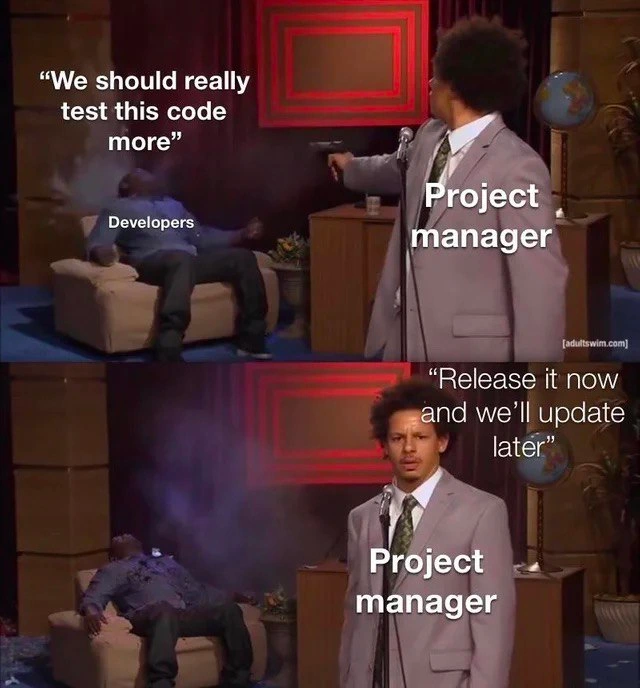
The format itself is one of the internet's most reused templates: comedian Eric Andre shoots his own co-host Hannibal Buress mid-show, then acts baffled that anyone is upset — note the [adultswim.com] watermark from the original clip. It maps onto any situation where someone causes a problem, then poses as an innocent bystander to that exact problem.
If you're early in your career, the first time you live this meme is unforgettable: you flag that a feature has no tests, you're told the deadline is immovable, the feature ships Thursday, and Friday evening you learn what an on-call rotation is. The lesson juniors eventually internalize is that "we'll fix it later" is not a plan — it's a deferral, and deferred costs in software accrue interest.
Level 3: Hotfix-Driven Development
The Eric Andre "Why would they do this?" format is doing surgical work here, because its two-beat structure mirrors the actual organizational ritual perfectly. Beat one: the developer on the couch says the unsayable — "We should really test this code more" — and is executed mid-sentence. Beat two: the Project manager stands at the microphone, smoke literally still hanging in the air over the slumped body, and delivers the line every engineer has heard in a Friday standup: "Release it now and we'll update later." The killer's feigned innocence is the joke. Nobody in the room acknowledges what just happened to the testing conversation. It just... stopped happening.
What makes this too real rather than merely funny is that the PM isn't depicted as stupid — he's depicted as acting rationally within his incentive structure. Project managers are measured on dates shipped, roadmap items closed, and stakeholder promises kept. They are almost never measured on defect escape rates, on-call pages, or the slow rot of a codebase shipped under release_now_fix_later doctrine. Meanwhile the developer absorbing the 2 AM hotfix carries all the downside. When the costs and benefits of skipping QA land on different people, the gun comes out every sprint. Smart people keep making this "mistake" because, for the person holding the gun, it isn't one.
The promise "we'll update later" deserves its own autopsy. It's technically true and operationally fraudulent. There will be an update — but "later" arrives as an emergency patch, not as the calm, scheduled hardening sprint the phrase implies. The hardening sprint is the Bigfoot of agile planning: frequently reported, never photographed. Once the feature ships and the demo gets applause, the unfinished testing work converts silently into technical debt, the backlog ticket labeled add integration tests sinks below the fold, and the next deadline starts the cycle again. Veterans call this hotfix-driven development: production is the test environment, users are the QA team, and the incident retrospective is where test plans go to be promised a second time.
There's also a quieter casualty in that top panel: psychological safety. After a developer gets metaphorically shot for raising quality concerns once or twice, they stop raising them. The org doesn't notice the silence — it reads it as alignment. Then a release detonates, leadership asks "why didn't engineering flag this?", and the couch, conveniently, cannot answer.
Description
A two-panel meme using the 'Who Shot Hannibal?' format from The Eric Andre Show. In the first panel, a man labeled 'Developers' is slumped over on a couch, having been metaphorically shot. A speech bubble above him reads, 'We should really test this code more'. Standing over him with a smoking gun is another man labeled 'Project manager'. The second panel shows the 'Project manager' looking towards the audience with a nonchalant expression, asking, 'Release it now and we'll update later'. This meme humorously illustrates the common conflict between developers who advocate for thorough testing and project managers who prioritize meeting deadlines above all else. It speaks to the pressure in many software development environments to ship features quickly, often at the expense of code quality, leading to technical debt and the 'we'll fix it in post' mentality that frustrates engineering teams
Comments
8Comment deleted
Some project managers treat the 'testing' phase as a mere suggestion in the Jira ticket, while developers see it as the only thing preventing a sev-1 incident from becoming their entire weekend plan
“Shipping untested code is just management’s way of crowdsourcing chaos engineering - prod gets the chaos, on-call gets the engineering.”
The PM just discovered the secret to infinite job security: every "quick fix" spawns three critical bugs that become next quarter's roadmap
'We'll update later' is the most reliable promise in software: there will definitely be an update, at 2am, labeled hotfix-final-v3-REALLY-FINAL
The PM's favorite deployment strategy: 'We'll just ship it to production and use our users as QA - they're great at finding edge cases we never thought of, usually at 3 AM on a Friday.'
PM optimization at scale: hit the ship date by refinancing QA into the error budget and using prod as the integration test
PMs redefining 'continuous integration' as 'gunpoint deployment'
Nothing says enterprise agility like skipping the quality gate, shipping to prod, and scheduling the postmortem in the same calendar invite