The Four Stages of Clueless Project Management
Why is this ProjectManagement meme funny?
Level 1: A Simple Circus Analogy đȘ
Imagine your teacher tells you today that by tomorrow you must put on a huge carnival in your backyard. You ask, âWhat rides or games should I have?â and they say, âI donât have any written list or plan â just make it like Disneyland, you know, super fun and big.â They also say, âIt should be easy for you, a piece of cake, even a beginner could do it.â Then, every 20 minutes, that teacher pops their head in to ask, âIs it done yet? How much have you finished? I need to tell the principal itâs almost ready by the end of today.â Sounds ridiculous, right? Youâd probably laugh because setting up a carnival like Disneyland is huge work, definitely not an overnight job, and the teacher clearly has no clue how hard it is â especially if they keep interrupting you! In this story, the teacher is acting pretty silly â almost like a clown đ€Ą â because of how unrealistic theyâre being. Thatâs exactly what the meme is showing with a software project: a boss asking a programmer to create a giant new feature (like making a mini-Facebook) in just one day, with no instructions, while checking in every few minutes. Itâs funny (and a bit painful) to programmers because itâs like a real-life circus theyâve experienced â an impossible task with a boss who doesnât realize theyâre asking for something crazy. Just as you canât build Disneyland in your backyard overnight, a developer canât build a complex Facebook-like feature overnight, and someone demanding that is being pretty clownish.
Level 2: The Feature Request Circus for New Developers
Letâs break down whatâs happening in this meme in more straightforward terms, as if youâve just started working on software teams:
Feature Request with a Tight Deadline: A feature request means someone (often a client or a product manager) is asking the development team to add new functionality to the software. Here, the stakeholder says, âwe're gonna need it by tomorrow.â Thatâs a 24-hour turnaround, which is extremely fast in software development. Most substantial features take days, weeks, or even months to design, code, and test properly. So asking for a complex feature âby tomorrowâ is a huge red flag â it indicates DeadlinePressure that is likely unrealistic. New developers learn quickly that UnrealisticDeadlines often lead to lots of stress and late-night coding sessions, and usually the result isnât pretty.
No Written Requirements, âmake it like Facebookâ: Requirements (or a spec, short for specification) are the detailed description of what the feature should do. In a healthy project, youâd have something like user stories, acceptance criteria, or at least a clear list of functionalities. Here the stakeholder literally says there are no written requirements. Instead, they vaguely instruct, âjust make it sorta like, you know, Facebook.â This is a classic example of RequirementsAmbiguity. For a new dev: imagine being told to build something, but not given any design or instructions â just âoh, youâve seen Facebook, right? do that.â Facebook has countless features (profiles, news feed, friend system, messaging, notifications...). Without clear guidance, a developer can only guess what the stakeholder actually wants. Ambiguous requirements often cause scope creep, which means the project keeps growing or changing because nobody defined the boundaries. Itâs like aiming at a moving target â youâll never know when youâre âdone,â because the definition of done keeps shifting. This panel highlights how frustrating it is to work when the acceptance criteria are basically âIâll know it when I see it.â
âEntry level stuff, right?â â Undervaluing the Work: The stakeholder then says, âIâm sure you guys can easily get it done, this is just entry level stuff, right?â This is them claiming that the feature is simple or trivial. For context, âentry levelâ in job terms means tasks a beginner or junior employee could do. So the stakeholder is implying that even a newbie developer should whip this up easily. This often happens when non-technical managers donât understand whatâs hard and whatâs not in software. A seemingly simple feature (like a âlogin with Facebookâ button or a âreal-time chatâ) can hide a lot of complexity under the hood (security, databases, third-party APIs, error handling, etc.). By saying itâs âjust entry level stuffâ, the stakeholder is trivializing the effort. This can be demoralizing to the team: it feels like your expertise is being dismissed. New devs might doubt themselves (âAm I dumb if this isnât easy for me?â), while experienced devs just shake their head knowing nothing is âeasyâ when you start integrating with a large platform or scaling a feature. Itâs important to learn that sometimes people will underestimate engineering work â not necessarily out of malice, but because they truly have no idea how software is built. Part of a developerâs job often becomes educating stakeholders about what is realistically feasible.
Micromanagement â Frequent Check-Ins: Finally, the stakeholder says, âOk Iâll be back in twenty to check on your progress, I want to send them an update by end of day.â This means they plan to come back in twenty minutes (!!)** to see how much progress has been made. This is an example of micromanagement, where a manager constantly monitors and pesters for updates instead of trusting the team to work. For a developer, especially if youâre new, this is nerve-wracking. Writing code and fixing bugs often requires concentration and sometimes hours of uninterrupted work to solve a problem. Having someone come by every 20 minutes asking âIs it done yet? How about now?â breaks your focus (context switching) and actually slows down development. Itâs like trying to do homework while your teacher asks you after each sentence if youâve finished the entire assignment. Frequent status updates can be useful in some scenarios, but here itâs comically excessive. The stakeholder also mentions âI want to send them an update by end of day.â Likely âthemâ refers to higher-ups or the client waiting on the feature. This indicates the stakeholder is concerned with optics â they want to look like progress is happening. In agile teams, we do have daily stand-ups or regular check-ins, but not every 20 minutes! New devs learn that good managers shield the team from unnecessary interruptions, not bombard them. The humor is that this stakeholder is doing everything counter-productive: no planning, too much pressure, and constant distraction â a trifecta that almost guarantees a blow-up.
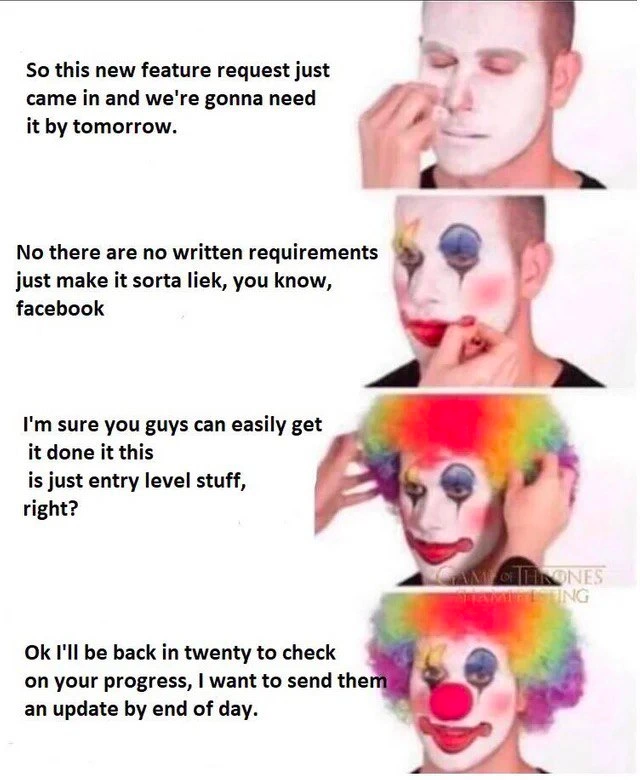
Clown Meme Format â Visual Metaphor: The image itself is a popular meme format where someone applies clown makeup step by step. In internet culture, âputting on clown makeupâ symbolizes someone progressively turning into a clown â meaning theyâre acting more and more foolish or unrealistic. Each panelâs text is the stakeholderâs quote, and as the quotes get more ridiculous, the person becomes more of a clown. By the final panel, the stakeholder is in full clown costume â implying that by making all these crazy demands, theyâve basically turned into a clown in the eyes of the developers. Itâs a cheeky way to say âthis is clown behaviorâ without literally calling the person a clown to their face. As a new member of a dev team, you might not immediately call out a stakeholderâs request as absurd, but internally the team might be sharing knowing glances or Slack messages with the clown emoji đ€Ą whenever stuff like this happens.
Key concepts for newcomers: This meme is about the pain of ScopeCreep (unchecked expansion of a projectâs scope), unclear requirements (RequirementsAmbiguity), UnrealisticDeadlines (demanding too much too fast), and poor management practices. If youâre just entering the field, know that good projects usually have clear requirements (even if high-level), realistic timelines (with buffer for testing and revisions), and managers who trust you to do the work without breathing down your neck every 20 minutes. When those principles are violated, the situation devolves into chaos â and thatâs why developers joke about it with memes to blow off steam. This meme is basically every developerâs nightmare condensed into four sentences. Itâs funny because itâs true: many of us have had a boss or client like this, and while it was infuriating at the time, seeing it presented as a clown transformation helps us laugh about it now.
Level 3: Clown-Driven Development
At the senior engineering level, this meme hits uncomfortably close to reality. It lampoons the classic scenario of a clueless stakeholder or manager demanding a massive new feature on an impossible timeline with zero guidance. Each panelâs text piles on another layer of absurdity (just like the layers of clown makeup), highlighting well-known software project anti-patterns:
No Requirements, No Spec: The stakeholder breezily says âNo there are no written requirements, just make it sorta like, you know, Facebook.â This is RequirementsAmbiguity on steroids. With no specification or documentation, the dev team is forced to guess what âlike Facebookâ even means (News Feed? Chat? Ads system?). Lack of clear requirements is a guaranteed recipe for ScopeCreep: the projectâs scope will inflate unpredictably as everyone scrambles to define the feature on the fly. Experienced devs have seen this clown act before â without a written spec, youâll get a parade of âOh actually, can we also add X? This isnât what I picturedâŠâ as the goalposts keep moving.
âJust Make It Like Facebookâ â Underestimating Complexity: This line is where every senior devâs eye starts twitching. Facebook isnât a single feature; itâs a constellation of complex systems built by thousands of engineers over years. The stakeholder reducing it to âentry level stuffâ is beyond parody. It reflects a pervasive misunderstanding in non-technical management: assuming software components are like LEGO blocks you just snap together. In reality, mimicking even a small part of a platform like Facebook entails serious work â databases, real-time updates, authentication, UI/UX design, scalability concerns, etc. The humor here is darkly cathartic: weâve all had someone ask for a mega-feature that took FAANG companies a decade to perfect, and they want it by tomorrow morning. Sure, let me just sprinkle some magic code dust and whip that up!
Trivializing the Effort (âentry level stuff, right?â): By the third panel, the stakeholderâs clown transformation is almost complete â rainbow wig and all â as they utter the infamous phrase âthis is just entry level stuff, right?â This is where the seasoned engineers either burst out laughing or groan in pain. Calling a complex request âentry levelâ is classic StakeholderPressure combined with ignorance. Itâs a cheap attempt to reduce estimated effort: if itâs âeasy,â thereâs no excuse not to deliver overnight, huh? Senior devs recognize this as a form of management gaslighting â downplaying the teamâs specialized skills needed. Itâs akin to telling a pilot that landing a plane is âjust pressing some buttons.â The meme nails this toxic mindset: the stakeholder isnât just asking for a miracle, theyâre also insulting our profession by implying any newbie could do it in a snap. DeveloperFrustration intensifies here because it shows a total lack of respect for the craft.
Unrealistic Deadlines & Constant Check-Ins: In the final panel, our stakeholder-turned-full-clown says âOk Iâll be back in twenty to check on your progress, I want to send them an update by end of day.â This perfectly skewers UnrealisticDeadlines coupled with micromanagement. Not only is the feature due in 24 hours, but the stakeholder thinks progress can be meaningfully checked every 20 minutes! Seasoned developers know that development doesnât work like a pizza tracker (â% of feature baked: 25%â). Frequent context-switching for status updates actually slows down progress â it yanks developers out of the flow state needed for deep work. The clown here embodies a PM whoâs more concerned with giving the illusion of control (âsending updatesâ) than realistically supporting the team. Itâs a circus of poor project management: setting a crazy deadline, offering no help or clarity, then hovering anxiously over the teamâs shoulders. The result? Probably a half-working feature, lots of bugs, and an exhausted team â all so the stakeholder can save face in an update email.
This meme resonates with veteran developers because it compresses so many project management failures into one clown-faced timeline. Itâs practically the origin story of technical debt: when you rush a âFacebook-likeâ feature overnight without requirements, you end up with spaghetti code that will haunt the codebase for years. We laugh (or cry) at this because weâve been in that sprint-from-hell, building castles on quicksand because someone upstairs promised a client the moon. StakeholderExpectations often ignore the Iron Triangle (scope, time, quality â pick two). Here they picked all scope (âlike Facebookâ) and no time (âby tomorrowâ), so quality becomes the sacrificial lamb. The clown makeup is a brilliant metaphor: by the end of these demands, the stakeholder has effectively painted themselves as ridiculous. To senior devs, the joke is a coping mechanism â if we didnât laugh, weâd be screaming. We recognize the clown not as a literal circus performer, but as that well-meaning yet utterly out-of-touch boss or client weâve all dealt with. In short, this meme encapsulates the surreal circus that software development can turn into when Management_PMs make decisions completely divorced from engineering reality.
Subtle inside joke: In some dev circles, weâd call this scenario âClown-Driven Developmentâ â where features are decided by absurd requests rather than coherent planning. The only thing missing is the stakeholder asking, âCanât you just copy-paste the code from Facebook?â (Yes, someone has actually asked that in real life). The humor is equal parts catharsis and cautionary tale: if you ever find yourself making demands like these, congrats, youâre the clown. đ€Ą
Description
A four-panel meme using the 'Putting on Clown Makeup' format to satirize a project manager or stakeholder making increasingly unreasonable requests. In the first panel, a person applies white face paint with the caption: 'So this new feature request just came in and we're gonna need it by tomorrow.' In the second panel, clown makeup is added around the eyes and mouth with the text: 'No there are no written requirements just make it sorta liek, you know, facebook'. In the third panel, the person dons a rainbow clown wig, with the caption: 'I'm sure you guys can easily get it done it this is just entry level stuff, right?'. In the final panel, the person is a full clown with a red nose, and the text reads: 'Ok I'll be back in twenty to check on your progress, I want to send them an update by end of day.' The meme humorously depicts the transformation of a requestor into a complete clown as they pile on impossible deadlines, vague requirements, condescending assumptions, and micromanagement - a deeply relatable scenario for many software developers
Comments
7Comment deleted
This manager's JIRA board probably just has one column: 'Magic', and every ticket is a single story point, including 'Build Facebook.'
Sure, Iâll re-implement Facebookâs trillion-edge social graph, ad auction, and GDPR pipeline between lunch and your 2 pm status ping - should I bundle zero-downtime deploy or extra clown makeup with that?
The real circus trick is how we've normalized building distributed systems with eventual consistency to solve problems that a single Postgres instance handled fine in 2008, all while pretending that "make it like Facebook" is somehow less complex than the actual Facebook that employs 70,000 engineers
The real tragedy here isn't the impossible deadline or vague requirements - it's that 'make it like Facebook' somehow counts as a technical specification in 2024. At least when they said 'make it like Google' in 2005, we only had to build a search box. Now we're expected to architect a globally distributed social graph, implement a recommendation engine with ML pipelines, handle real-time messaging at scale, and somehow make it GDPR-compliant... all by EOD. The clown makeup is just our daily standup routine at this point
âMake it like Facebook by tomorrowâ - scope creep in O(â), with the PM polling every 20 minutes like a misconfigured readiness probe
PMs calling Facebook clones 'entry-level' - as if sharding petabytes and taming CAP theorem is freshman comp sci
âMake it like Facebook by tomorrow, no spec - entry level.â Translation: build a planet-scale social graph with ML-ranked feed, moderation, and GDPR, and call it a 2âpoint MVP