The Overwhelming Heat of the Java Ecosystem
Why is this Languages meme funny?
Level 1: Hear No Alarm
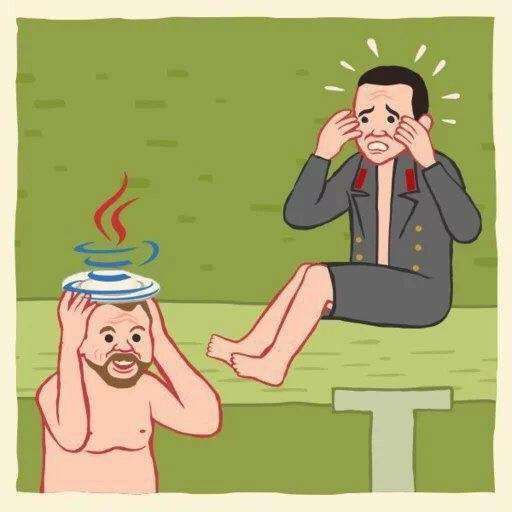
Imagine you’re at home and a smoke alarm starts blaring loudly because something’s burning in the kitchen. Instead of getting up to check or trying to put out the fire, you simply cover your ears and pretend nothing’s wrong. You even see smoke (uh oh, something’s really burning), but you just squeeze your eyes shut and hope it stops on its own. Sounds silly, right? That’s exactly the joke here. In the picture, the first man covering his ears is like someone refusing to listen to a fire alarm. The second man with a hot bowl on his head is like the thing that’s actually on fire (imagine he’s the kitchen or the burning food) – he’s obviously hurting, but he’s also covering his ears as if to ignore the alarm. It’s funny because it’s a ridiculous way to handle an emergency. We all know if there’s a real fire or a real problem, ignoring the alarm won’t make it go away – it will probably just get worse. But sometimes, when people feel tired or scared, they act like it’s not happening for a moment. This meme makes us laugh at that feeling: the idea that if I don’t hear the bad news, maybe it’s not real. It’s a bit like a child plugging their ears and saying “La la la, I can’t hear you!” when they’re being told to do something they don’t want to do. We laugh because we recognize it’s a very human reaction – not a good one, but an understandable one. So, in simple terms: the picture is joking that the engineer’s plan for a big problem is to ignore it completely, which is as silly as ignoring a fire alarm and just hoping the fire goes out on its own. The humor comes from how obviously wrong that is, and yet how tempting it can feel when you really, really don’t want to deal with a mess.
Level 2: PagerDuty Snooze 101
Let’s break down the meme in simpler terms. We have an engineer on call (the guy in the uniform on the bench) and a broken service (the poor shirtless guy with the hot bowl) in a production outage. PagerDuty is a service that companies use to alert engineers when something goes wrong in production (the live, user-facing environment). Think of PagerDuty as a loud alarm on your phone that won’t stop until someone responds. In the meme’s story, that alarm is going off – essentially screaming “Service on fire! Something’s terribly wrong!” Normally, an on-call engineer would jump into troubleshooting mode: get out of bed, open the laptop, check logs and dashboards, and try to fix the issue (this is called incident response). But here, the on-call engineer’s “strategy” is literally to cover his ears and ignore it. The meme title spells it out: ignoring pager duty is your only incident response strategy. In other words, the engineer isn’t going to acknowledge the alert or fix the bug at all; he’s just pretending nothing’s happening. Meanwhile, the service (our shirtless friend with the steaming bowl on his head) symbolizes the actual application or server that’s malfunctioning. The bowl is boiling over – a visual metaphor for something like an overloaded server (CPU overheating, memory maxing out) or an error that’s causing the system to “boil.” The service is clearly in pain (red and blue steam lines to show it’s burning hot), and even that guy is covering his ears! It’s as if the system itself is screaming in agony (maybe error logs and alerts are blasting out), but both the service and the engineer on call are just like, “Nope, not listening.” It’s a comical illustration of a very bad practice.
Now, why would this situation ever happen in real life? One reason is alert fatigue. This term refers to when someone gets so many alarms and alerts that they become desensitized – basically exhausted by all the noise. For example, if an on-call newbie gets paged five times in one night for things that aren’t actually critical (say, a spike in traffic that recovers on its own, or a minor bug that users can refresh to fix), they start to lose trust in the alerts. After a while, you might assume “Eh, it’s probably another false alarm.” OncallNightmares is a tag for exactly this: the nightmare of being woken up repeatedly for no good reason. So in the meme, the engineer looks frantic and tired because he’s likely been through this many times. The phrase “only incident response strategy” being ignoring it suggests that perhaps this engineer has no energy or idea left to actually solve the problem. It’s possible he’s tried before and things only got worse – or maybe whenever he touches the system, it catches fire even more (some systems are so fragile that any change could break them further – that’s often due to technical debt in the code). Technical debt means the system has lots of old, quick-and-dirty fixes and fragile code that haven’t been improved, causing frequent issues. A junior developer might not have heard the term “technical debt,” so think of it as a messy workaround that later causes headaches. If a service has tons of technical debt, it might page the on-call constantly with problems. After the 100th alert, an exhausted engineer might just mentally check out – which is what’s shown here.
Let’s also explain PagerDuty snooze. PagerDuty (or any on-call alert system) usually has a feature to snooze or silence an alert temporarily. This is like hitting the snooze button on a morning alarm clock. It stops the noise for a bit, under the assumption that you’re working on the problem. Usually, you snooze after acknowledging the incident – meaning you indicate “I’ve seen this, I’m on it.” In a well-run team, ignoring an alert isn’t acceptable – someone must at least acknowledge it, or it will escalate to the next person (maybe your manager, eek!). But here the joke is that the person’s only action is essentially hitting snooze (or worse, just not hearing it at all). They cover their ears (like putting the phone on silent or throwing it in a drawer) and do nothing. This is absolutely not what you’re taught to do. If you’re a junior dev on call for the first time, your instinct is to respond to every page immediately – your heart races, you log in and try to debug the issue. Debugging means going through logs (ignore_the_logs_strategy is the opposite of that – it’s literally not looking at any logs or metrics) and finding what’s wrong. Bugs in production can be scary, but ignoring an alert means the bug is not getting fixed. The fire is still burning, you’re just pretending you don’t see the flames.
Another factor here is fear or risk: sometimes engineers hesitate to intervene in a live system, especially outside normal hours. If it’s 3 AM on a Saturday, you might be thinking, “If I try a quick fix now, I might crash everything. Better to leave it until the team is around.” There’s even a common wisdom: don’t deploy on Fridays (because if something goes wrong over the weekend, it’s a nightmare to fix alone). In this meme, that idea is taken to the extreme by not doing anything at all until, presumably, Monday. The description even jokes “nobody wants to touch it before Monday.” This implies the issue started on a weekend and the team collectively decided to ride it out. Junior devs might find that shocking – “They’d just let it burn?!” – and that’s exactly why it’s funny and absurd. It’s poking fun at a worst-case DevOps scenario. If you’ve ever been on call and felt the dread of yet another alarm, this image hits a nerve. It’s essentially SRE humor about burnout.
So in summary at this level: the meme is saying sometimes engineers do the WRONG thing on purpose when they’re completely burned out. It uses a silly cartoon: one guy = the engineer, covering ears = ignoring the pager; another guy = the service, bowl on head = the system burning up, covering ears too = the system is blaring alarms. It’s a joke about how not to handle a production outage. If you’re new to this stuff, take it as a cautionary laugh: ignoring an alarm is funny in a cartoon, but in real life it’s how small problems become big ProductionIncidents. The reason it’s relatable is that being on call can be really stressful – after dozens of false alarms or unresolved issues, a tired dev might wish they could just ignore it all. The meme gives a visual form to that wish (with a healthy dose of DeveloperHumor exaggeration). It’s like a comic strip telling new engineers: “Don’t let it get to this point – fix your alerting and your systems, or you’ll end up like this guy, doing the hear no evil routine while your servers melt down.”
Level 3: All Quiet on the Prod Front
This meme captures a darkly comic truth of on-call life in DevOps/SRE: sometimes engineers are so overwhelmed or jaded that covering their ears feels like the only response to a blaring alarm. In the image, a uniformed man with sweat flying off represents the on-call engineer (decked out like a battle-weary general in the war against outages), and he’s literally ignoring PagerDuty. On the ground, the shirtless fellow balancing a steaming bowl on his head is a brilliant metaphor for the service on fire – the production system is boiling over (red-hot soup bowl) and in obvious pain, yet nobody wants to deal with it. The on-call SRE’s expression screams panic and resignation at the same time. He’s essentially thinking, “Maybe if I don’t acknowledge that alert, it’ll just… go away.” It’s the “this is fine” mentality turned up to eleven – akin to that cartoon dog sipping coffee in a burning room, but here the engineer just clamps his hands over his ears. The humor hits home because it’s an exaggeration of a real on-call nightmare: an engineer so tired of constant pages that they’d rather ignore the alarms than jump back into firefighting mode yet again.
Why would any sane engineer adopt this “ostrich strategy” (burying their head in the sand) for incident response? One word: alert fatigue. In a perfect world, every PagerDuty alert means a critical issue that must be addressed immediately. But in reality, noisy alerts and false positives are rampant – the database CPU spikes for 30 seconds at 3 AM, triggers a critical page, and by the time you VPN in, it’s fine. Repeat that 100 times and you’ve got a bleary-eyed on-call dev who’s learned to snooze alerts on reflex. It’s a coping mechanism. The meme exaggerates it to the extreme: the engineer isn’t just hitting the pagerduty snooze button, he’s physically covering his ears. This is alert_fatigue_realness – when you’ve been paged so many times for so many inconsequential hiccups that a genuine production fire is indistinguishable from the noise. The ignore_the_logs_strategy (literally ignoring the screaming error logs and metrics) starts to feel justified at 3 AM when every log line looks like gibberish through your sleepy eyes. It’s a tragic comedy: everyone in tech knows ignoring an alert is bad, but many of us have been tempted, even if only for a few minutes of precious silence.
Of course, there are deeper systemic issues being skewered here. If “ignoring it” is the only incident response strategy, that implies a failure in process and technology. Perhaps the team has so much technical debt that the service is always half-broken – so they’ve become desensitized to constant ProductionIncidents. It might be a commentary on organizations where on-call engineers get paged for every little thing (CPU high, disk 80% full, one user’s error) until they mentally file everything under “probably not a big deal.” Over time, when real ProductionOutage emergencies happen, the instinct is still to dismiss the alarm as another cry-wolf false alarm. The meme shows the absurd endgame of that: production is literally burning (like that scalding bowl on the poor service’s head) and the on-call person is doing nothing but covering their ears. It’s an indictment of bad DevOps practices: no clear prioritization of alerts, no automated remediation, possibly no secondary on-call to escalate to. In a healthy setup, if one person ignores an alert, it will escalate to someone else or trigger fallback systems. But here, the implication is everyone’s ignoring it – maybe it’s the weekend and the whole team collectively agreed “we’ll deal with it Monday.” Nobody wants to touch it before Monday – famous last words in many post-mortems. This scenario is like an SRE horror story that seasoned engineers chuckle at nervously because they’ve seen companies where this almost happens.
Let’s be clear: ignoring PagerDuty is not in any official runbook. It’s the opposite of how OnCall_ProductionIssues are meant to be handled. Typically, a proper incident response involves acknowledging the alert, collecting logs, triaging the issue, maybe rolling back a deploy or applying a quick hotfix_in_prod (a direct fix on a live system) to stop the bleeding. There are playbooks, rotations, and escalation policies for outages. But this meme throws all that out and says: nope, our strategy is literally to ignore and pray. It’s funny in the way dark humor is funny – it shouldn’t happen, but it does resonate because so many of us have felt that despair. Think of the uniformed guy as the senior dev who’s seen this service crash 5 times this week; he’s got pager PTSD and is just done. The shirtless “service” character is basically the product of all that technical debt and neglect – it’s suffering constant pain (steam coming out, i.e. constant errors), yet it’s kept running somehow, probably by sheer luck and maybe a cron job restarting it when it falls over. The image suggests that even the service itself is trying to cover its ears – as if the servers are personified and also can’t stand their own error alarms! That’s a subtle nod to how absurd things have become: even the system is like, “please make the monitoring stop; I know I’m on fire, but the alarm isn’t helping.”
From a senior engineer’s perspective, this scenario is both hilarious and painfully real. It highlights the unspoken truth that sometimes the hardest part of on-call isn’t fixing the bug, but having the will to jump in one more time when you’re exhausted. The veteran voice in this meme would say with sarcasm: “Ah, yes, the cover-ears-and-do-nothing protocol – my favorite deployment strategy for Friday midnight.” It also pokes at the blame game: if you ignore it, you can later claim you didn’t hear the alert. It’s like a willful ignorance defense – not exactly something you can put in the post-mortem report (“Incident unresolved due to engineer not listening”). The title text nails it: “When ignoring pager duty is your only incident response strategy” – it’s a tongue-in-cheek way of saying this team has no real plan for outages besides denial. Every experienced dev has seen some flavor of this, whether it’s a colleague who always mutes their phone, or a team that sets alerts to auto-resolve after a while, effectively pretending things are fine. It’s a shared trauma in DevOps circles – thus a prime piece of DeveloperHumor and SREHumor.
To drive the point home, consider a snippet of pseudocode for this anti-pattern:
// 🙉 On-call incident response algorithm (anti-pattern)
if (pagerDuty.isAlerting()) {
pagerDuty.snooze(alert.id); // silence the alarm, don't investigate
console.log("Ignored alert. Hoping the issue resolves itself by morning...");
}
Normally, you’d never write code like this – you’d be logging the alert, not ignoring it. But as a joke, this snippet is basically what the meme’s protagonist is "executing" in his head: snooze and hope. The pagerDuty.snooze() line is equivalent to covering your ears. The comment don’t investigate is exactly what real incident response guides say not to do (they say “investigate immediately!”). And the console.log message – “Hoping the issue resolves itself by morning...” – is the kicker. It’s a cynical commentary that sometimes people do just wait, crossing fingers that an outage will magically fix itself (maybe a self-healing service will restart, or the traffic will dip and the system recovers). Hope is not a strategy, but at 4 AM, it sure is tempting. Seasoned developers will recognize this as the deadly sin of on-call: giving in to alert fatigue and doing nothing. They laugh at the meme because it’s a scenario they’d never officially endorse, yet perhaps secretly empathize with after one too many sleepless nights. In summary, Level 3 analysis reveals that this meme uses absurd imagery to highlight real DevOps problems – alert fatigue, poor incident processes, technical debt – and it resonates especially with battle-hardened engineers who have seen the ugly side of on-call duty. It’s funny, it’s a bit sad, and it’s a cautionary tale all at once.
Description
A cartoon illustration depicting two men in what appears to be a sauna or steam room with olive green walls. On the left, a shirtless, bearded man is balancing a steaming plate on his head; the red and blue steam cleverly forms the iconic Java coffee cup logo. He seems content. On the right, a man wearing a dark, military-style jacket sits barefoot on a bench, looking distressed. He is covering his ears with his hands, his face contorted in annoyance, with white stress lines radiating from his head. This meme humorously visualizes the experience of developers from other ecosystems (perhaps C++ or a scripting language, represented by the rigid uniform) when confronted with Java. For senior engineers, the 'heat' symbolizes not just the language's popularity but also its perceived verbosity, the resource-intensive nature of the JVM, the complexity of enterprise frameworks, and the often-heated culture of language debates

Comments
7Comment deleted
That's the face a C++ developer makes when they hear 'memory management is handled automatically.' The heat isn't from the sauna, it's from the garbage collector thrashing in the background
Classic site-reliability philosophy: if the alert can’t reach your eardrums, the SLA breach clearly falls under ‘eventual consistency.’
When you're watching kubectl get pods refresh for the 47th time while your distributed tracing shows the actual bottleneck is the legacy monolith's stored procedure that nobody wants to touch because the DBA who wrote it retired in 2019
When your Java application finally makes it to production and you realize that 'works on my machine' wasn't just a meme - it was a warning. The coffee cup on the head perfectly captures that moment when the JVM is happily running your code while you're having a full existential crisis about that 'temporary' workaround from three sprints ago that's now serving millions of requests
When you're the sole maintainer spinning that legacy monolith while Kubernetes evicts the revenue-critical pod into flames
Sev1 is boiling over the error budget; on‑call wears the hotfix like a hat while leadership improves MTTA by muting PagerDuty and calling it ‘alert hygiene’
Sev1 incident response: SRE wears the hotfix hat while exec enables selective-alert suppression - proof Conway’s Law ships faster than our pipeline