The Political Compass of Software Developer Stereotypes
Why is this DevCommunities meme funny?
Level 1: The Dev Family Reunion
Imagine walking into a huge family reunion or a school cafeteria where every kind of person is sitting at a different table. There’s the rich uncle in a fancy suit bragging about his big paycheck, the chill cousin in a T-shirt who builds cool stuff for free, the tired parent who’s been up all night fixing problems, and the quirky aunt who’s off in the corner talking about some conspiracy or secret project. This meme is doing exactly that, but for software developers – it’s like a big cartoon class photo of 36 wildly different programmers all lined up.
The joke is that even though all these characters are “developers,” they are as different from each other as can be. One is like a straight-A student who stayed in school (the Master’s student) while another is a kid who dropped out to play with rockets for the government. One might remind you of a hardworking dad with a stable (but boring) job (the legacy code guy in an old company), and another is like a rebel teenager hacking away in the basement (the dark web admin doing illegal stuff). By putting them all on one chart, it’s a funny contrast – kind of how seeing a knight, a clown, a scientist, and a pirate together would make you chuckle because it’s so absurd to group them.
In easy terms, the meme is saying: “Look at all these different kinds of people who write code!” – from the very strict and rule-following ones at the top (think of someone in a military uniform following orders) to the very free-spirited and chaotic ones at the bottom (like an outlaw or a mad scientist doing whatever they want), and from the community-focused, sharing types on the left (like a friendly co-op chef who shares recipes) to the money-driven, secretive types on the right (like a businessman who won’t tell his trade secrets). It’s funny because usually we don’t imagine such a variety when we hear “programmer” – but in reality, the coding world has all these people.
At its heart, the meme gets us to laugh at how extreme and colorful the programmer world can be. If you’re not a tech person, think of it like this: the same way a zoo has everything from tiny birds to huge lions, the software field has everyone from quiet academic researchers to flashy app millionaires to underground cyber-criminals. Seeing all those extremes side by side is both surprising and comedic.
And just like in a big family or a group of very different friends, each character in this grid has their own quirks and flaws that we tease them for. There’s the one who’s super smart but maybe not practical, the one who works really hard but doesn’t get paid much, the one who’s rich but maybe a bit out of touch, and even the one who’s kind of the “black sheep” doing sketchy things. The meme exaggerates each person’s traits to make it obvious and funny (for example, saying the on-call DevOps guy hasn’t slept in 3 days, which is a joking way to show he’s overworked).
Overall, you can think of this meme as a big inside joke among programmers: it’s as if we’re all at a party pointing at each table and chuckling, “Oh, I know that type of guy!” Even if you don’t know the technical details, you can feel the humor that it’s a big collection of very different caricatures. The feeling it gives is similar to when someone says, “It takes all kinds to make the world go round.” Here it’s saying, “It takes all kinds to make the tech world go round – and isn’t that crazy (and kind of fun) to see?”
Level 2: Meet the Archetypes
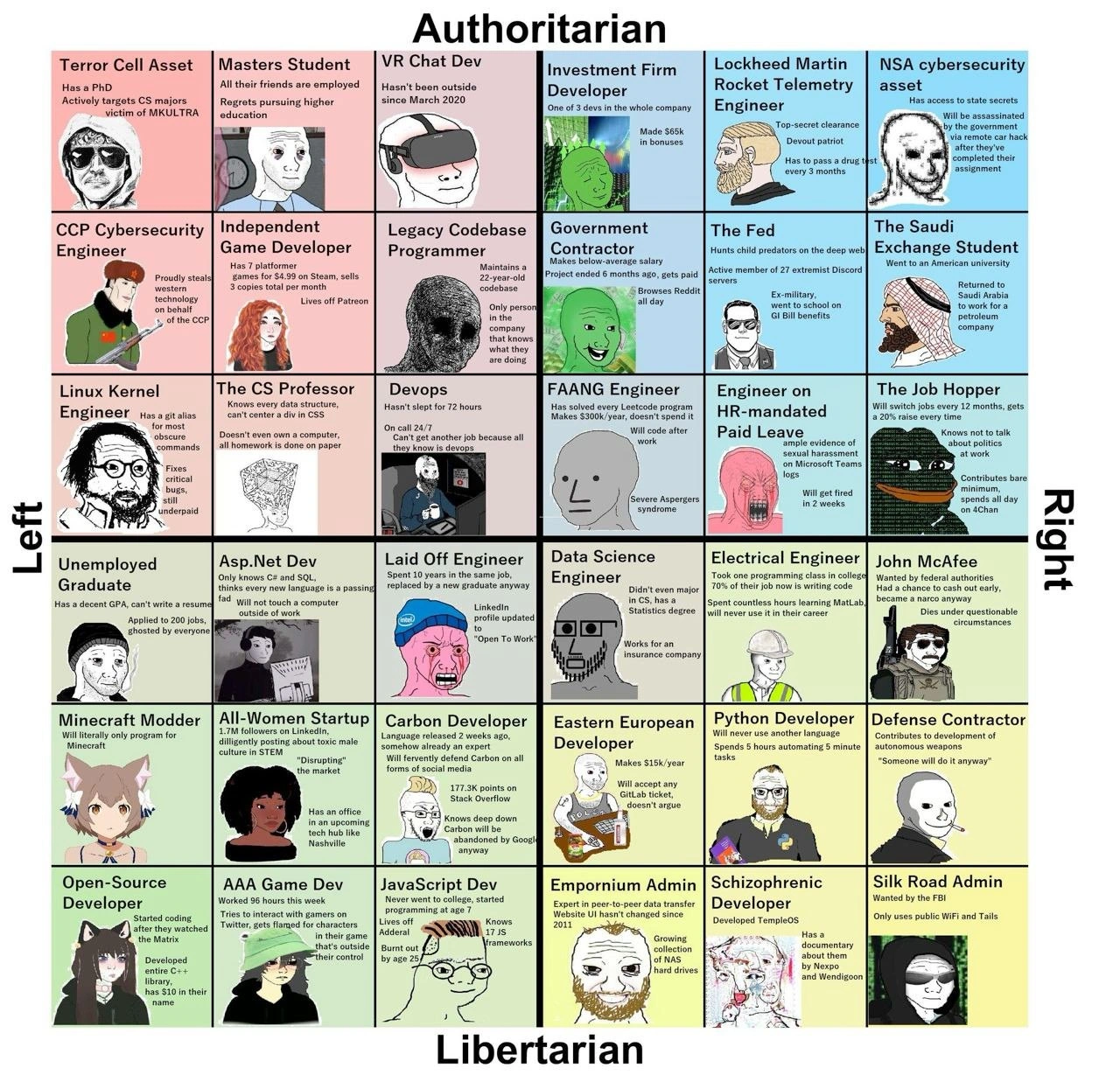
This meme is essentially a big map of developer stereotypes presented in a format parodying the “political compass.” A political compass is a grid used to chart political beliefs on two axes: a Left-Right axis (usually representing economic or social policies) and an Authoritarian-Libertarian axis (representing how much control or freedom one prefers). Here, those labels are used loosely and humorously to categorize tech personas instead of politics. Each of the 36 squares in the six-by-six grid shows a different “developer archetype,” which means a typical example of a certain kind of developer. The meme is packed with inside jokes, but we can break down a few to understand what’s going on.
Visual Layout: There are 36 little cartoon figures (many are Wojak-style avatars, a popular meme character format with simple drawn faces that often represent certain emotions or “types” of people). Each figure has a bold title naming the type of developer they are, and a short list of bullet points that read like comically exaggerated résumé entries or personal stats. The background colors of each square vary by quadrant (top-left might all be one color, top-right another, etc.), hinting that each region of the chart groups similar “flavors” of devs. The labels Authoritarian/Libertarian on the vertical and Left/Right on the horizontal edges intentionally mimic the look of a political_compass_meme. But instead of serious ideologies, the positions are determined by things like how corporate vs. independent the developer is, or how rule-following vs. free-spirited their career seems.
Let’s walk through a few example squares and decode them:
“FAANG Engineer” – FAANG is an acronym for the big tech giants Facebook, Apple, Amazon, Netflix, Google. A “FAANG Engineer” is someone who works at one of these prestigious companies. The meme jokes that this person “Makes $300k/year” and uses only internal company tools (meaning they’re so deep in the proprietary systems that they might not be using common open-source tools like everyone else). This highlights the stereotype of big-company developers having high salaries and great benefits, but perhaps being a bit isolated in their own corporate technology bubble. The bullet may also mention something like “LeetCode wizard” (implying they aced those coding interview puzzles to get hired) or even “Severe Asperger’s” – that last bit is a crude joke referring to a stereotype that some engineers are socially awkward or on the autism spectrum. It’s not exactly kind, but it’s playing on a trope that many in tech have unusual social skills; the meme uses it for shock value and to underline how different the FAANG engineer’s personality might be.
“Open-Source Developer” – This one likely appears on the opposite side of the spectrum from the FAANG engineer. Open-source developers are people who write code that is publicly available for anyone to use, modify, and distribute. Importantly, open-source work is often unpaid or underfunded (done for passion or community benefit rather than profit). The meme’s bullets say things like “Works for free on projects used by millions” and “Lives off Patreon”. That means many companies rely on this person’s free code, yet the person themselves might be scraping by on small donations via Patreon (a platform where fans can sponsor creators). It’s calling out a real issue in software: critical open-source tools sometimes depend on volunteer maintainers who don’t get salaried for that labor. So the DeveloperHumor here is bittersweet – the open-source dev is portrayed as both a hero (their code powers the world) and a martyr (they’re broke and overworked). It’s a relatable stereotype: lots of devs contribute to GitHub projects on nights and weekends while holding a day job to pay the bills. Seeing that exaggerated as “unpaid labor for the masses” is a nod that the community recognizes this pattern.
“Legacy Codebase Programmer” – The word legacy codebase refers to an old software system that a company still uses. It might be written in outdated languages or style, often poorly documented, but it’s mission-critical (the business relies on it every day). Maintaining such a codebase is often a thankless job – new developers usually don’t want to touch the “old mess,” so it falls to someone who’s been around forever. In the meme, this archetype’s bullets might read: “Maintains a 22+ year-old codebase; Only person who knows how it works; Project code name: Big Ball of Mud; Has Stockholm syndrome.” Stockholm syndrome is a psychological term where hostages develop affection for their captors. Used here jokingly, it means the programmer has been “held hostage” by this awful old system for so long that they’ve started to love it and fiercely defend it. They won’t let anyone rewrite it because “if it ain’t broke, don’t fix it,” as their boss says. This stereotype will resonate with many devs who have had to work with very old code or ancient frameworks. It’s common in enterprises or government agencies where systems can live for decades. The humor is in how pitiable yet familiar this scenario is – one person keeping a creaky system alive, half-proud and half-cursed by the responsibility.
“DevOps” – This stands for Development Operations. It’s a role (and culture) in tech aimed at integrating software development with IT operations, so you can deploy code more frequently and reliably. In practice, a DevOps engineer often handles servers, cloud infrastructure, CI/CD pipelines (continuous integration/continuous deployment), and is frequently on pager duty to respond to outages. The meme’s depiction (lack of sleep, on call 24/7) is a humorous exaggeration of the demanding nature of DevOps jobs. “Hasn’t slept in 72 hours” and “Can’t escape because everyone wants DevOps” highlight two things: one, the on-call rotations can lead to late-night work when systems break (imagine being woken up at 3 AM because the website went down – that’s the life of on-call DevOps). And two, DevOps skills are so in-demand that recruiters keep offering them more similar jobs, which is ironically a blessing and a curse. If you’re a junior dev seeing this, it’s basically saying: DevOps folks are extremely valuable but often overworked, and sometimes they feel stuck in that stressful niche.
“Masters Student” – This is a lighter one but very relatable for anyone who went to grad school. The Masters (or PhD) Computer Science student often faces a funny situation: many of their undergraduate friends went straight into industry jobs and are already earning real salaries, while they stayed in school for further studies. The meme bullet “All their friends are employed” and “Regrets pursuing higher education” captures that angst. In tech, a Master’s degree isn’t always required to get a good job (many people get hired with just a Bachelor’s or even without a degree if they have the right skills). So students sometimes feel FOMO (fear of missing out) seeing peers working at cool companies, while they are still eating ramen and doing homework. Of course, pursuing higher education has long-term merits, but the joke here is the immediate envy and second-guessing that can happen. It’s a good-natured rib at those who chose academia: “Was this really worth it? All my buddies have nice apartments and I’m still writing research papers….”
“Unemployed Graduate” – This one hits home for many recent grads. It says: “Has a decent GPA, can’t write a résumé, Applied to 200 jobs, ghosted by everyone.” Ouch! It’s a comedic reflection of how breaking into tech (or any field) can be tough, even if you did well in school. A lot of new grads send out tons of applications and either never hear back (that’s what “ghosted” means – the companies never respond) or get rejection emails. Not having a good résumé or real experience is a classic early-career hurdle. The humor is empathetic here: every developer remembers the painful job-hunt of entry level, tweaking their résumé and waiting endlessly. The meme exaggerates it to “200 applications” which, honestly, some people do end up hitting if the market is rough! It’s labeled unemployed Graduate (likely placed on the left-bottom side indicating maybe young/libertarian-left) to contrast with others who have jobs; it’s a bit of gallows humor for all the folks still looking for that first break.
“ASP.Net Dev” – This refers to a developer specializing in ASP.NET, which is a web application framework by Microsoft (part of the .NET family). ASP.NET was extremely popular in corporate and enterprise environments, especially in the 2000s and 2010s, for building internal company websites and services. The stereotype here is that an ASP.NET dev might be a bit stuck in the Microsoft ecosystem and behind current trends. The meme bullet likely says something like “Only knows C# and SQL; Calls new language a ‘toy’; Will not touch Node.js.” It pokes fun at how some enterprise developers don’t keep up with the latest JavaScript frameworks or hip new languages. They’re comfortable with the Microsoft stack (C# language, .NET runtime, MS SQL database) and might dismiss newer tech as fads. Also, ASP.NET devs sometimes get stereotyped as the folks maintaining old corporate intranet sites – not exactly the cutting-edge of tech. So in this giant grid, the ASP.NET Dev represents the solid, old-school corporate programmer who might be a bit out-of-place among the Silicon Valley types.
“All-Women Startup” – This one is referencing a startup company composed entirely of women, which in the male-dominated tech industry is noteworthy. The bullets humorously say something like “71 followers on LinkedIn; Still hasn’t shipped a product; Invites men to ‘allyship’ events.” This mixes a couple of satirical points: it highlights how such a startup might get attention for being all-female (followers on LinkedIn, press coverage perhaps) but at the same time jokes that they might not have a viable product yet. The bit about inviting male allies suggests they’re very focused on the diversity and inclusion aspect (which is good!) but the meme satirically implies maybe they lean on it for publicity. Essentially, it’s ribbing both the media hype around diversity and the challenges that any startup faces (like struggling to actually build and ship something). If you’re new to tech, know that the industry has been pushing for more diversity, and an all-women team is still rare enough to be talked about – that’s the context for this humor. It’s not knocking women in tech per se, it’s poking fun at how the CorporateCulture sometimes tokenizes these efforts (counting LinkedIn followers rather than real progress).
“Eastern European Developer” – There’s a stereotype that many brilliant programmers come from Eastern Europe (countries like Russia, Ukraine, Poland, Romania, etc.). In competitive programming contests and math olympiads, Eastern Europeans are famously strong. Also, a lot of outsourcing companies and freelance devs hail from that region due to a combination of strong education in math/CS and lower labor costs. The meme gives this persona a “141 IQ” and might say something like “Makes $15/hr, still can’t get visa; Uses Stack Overflow like copy-paste bible.” This highlights a paradox: someone very smart and capable, but perhaps undervalued in the global market or stuck doing contract gigs for cheap, possibly due to geopolitical limitations (like difficulty getting work visas to the US tech hubs). It’s also a playful jab that even super-smart devs use Stack Overflow (the go-to Q&A site for coding) heavily – implying maybe he speed-codes by quickly grabbing solutions online. The subtext here is friendly: within developer communities, there’s both respect and joking envy for the “Eastern European coder” who learned to code on bare metal, writes assembly in their sleep, but might be too blunt or “get it done quick” in style (hence copy-paste jokes). It’s a hat-tip to a known demographic in tech.
“Defense Contractor” – This is a developer working on military or defense projects, likely through contracting companies that supply tech to the government (think companies like Raytheon, Northrop Grumman, or any firm making software for the military). The meme notes “contributes to development of automated kill vehicles” and the motto “Someone else would do it anyway.” This digs into the moral gray area these engineers operate in: they’re building weapons or surveillance tech, which can be controversial, but they justify it by saying if they didn’t do it, someone else surely would. It also points to a bit of fatalism or cynicism in that line of work. Additionally, defense tech can be lucrative and uses a lot of specialized, sometimes outdated technology (for security reasons, they might use old programming languages or very rigorous processes). So this persona might brag about having a high security clearance or access to fancy equipment. The “Authoritarian Right” corner of the compass is basically tailor-made for this one: very aligned with government/military hierarchy and right-leaning in the sense of supporting defense and industry. For a new developer, it’s interesting to know this world exists: programming isn’t all web apps and mobile games – some write code for fighter jets or missile systems! The meme both acknowledges that and teases the ethical quandary lightly.
“John McAfee” – Yes, that John McAfee! This is one of the only squares named after a real individual rather than a generic type. John McAfee was the founder of McAfee antivirus software back in the 1980s, and later in life became notorious for a wild, eccentric and law-skirting lifestyle. He cashed out of the antivirus biz, dabbled in crypto, evaded taxes, ran from the law, tweeted bizarre things, and was even a fugitive living on a yacht for a while. He died in 2021 in a Spanish prison under what some consider mysterious circumstances (officially a suicide, but he had tweeted that he “wouldn’t kill himself” if ever found dead – spawning conspiracy theories). In the meme, McAfee represents the archetype of the brilliant tech entrepreneur gone rogue. The bullets likely reflect his saga: perhaps “Worth $100M by 30, Became a narco by 50; Died under suspicious circumstances.” His placement on the grid is probably on the far right (libertarian right, since he was very anti-government and libertarian-minded). Newcomers might not know him, but think of him as a reminder that some tech figures end up living like rockstars or outlaws. It’s a legendary “off the rails” career tale in software circles, so including him in this roster of dev archetypes adds a dash of real-world craziness.
Those examples cover just a handful, but illustrate the pattern: each square mocks a particular career path or persona in tech. Collectively, the meme is showing how incredibly varied developers’ lives and jobs can be. From someone coding alone in their basement on edgy projects (like the Silk Road Admin running an online drug market, or the Schizophrenic Developer making a personal fantasy OS) to teams in huge corporations (like the Investment Firm Developer who is proud of making big $$$ bonuses optimizing finance algorithms), to public sector roles (Government Contractor or The Fed, slang for an FBI/NSA agent developer who might be hunting bad guys online). It even includes people adjacent to coding: “The CS Professor” who teaches computer science but isn’t in industry, and “Masters Student” or “Unemployed Graduate,” who are on the periphery trying to enter the field. It’s essentially a panorama of tech careers, exaggerated for effect. If you’re a junior developer or just learning about the industry, this meme is throwing a lot at you, but each bit is rooted in something real – a common joke or story from developer communities.
A few terms and references for clarity:
Wojak – An Internet meme character, usually drawn as a simple outline of a bald man’s head with various expressions (smiling, crying, smug, etc.). Variants like “Doomer” (depressed), “Zoomer” (Gen-Z youth), “Soyjak” (over-excited geek) have proliferated. The meme uses these to visually express each dev type’s mood (e.g., the DevOps guy might be a weary “Doomer” Wojak with dark circles under his eyes, whereas the FAANG engineer might be a smug “Yes Chad” or similar). It’s basically meme art to quickly convey personality.
Patreon – A platform where creators (like open-source devs or indie game devs) can get financial support from fans or users via monthly subscriptions. If the Open-Source Developer “lives off Patreon,” it means they rely on donations from the community because their work itself doesn’t pay a salary (no company payroll).
LeetCode – Mentioned maybe implicitly with FAANG engineer. It’s a popular site for practicing coding interview problems. Many applicants to big tech companies grind hundreds of LeetCode problems to prepare for tough algorithmic interviews. Saying someone is a “LeetCode grinder” indicates that they spent a lot of time on these puzzles – a common in-joke about FAANG hiring.
SQL – A database query language. The ASP.NET Dev “only knows C# and SQL” means they are basically versed in the Microsoft ecosystem stack: C# for application code, SQL for database. That suggests a certain narrow skill set focused on enterprise web apps.
Stack Overflow – A Q&A website where developers ask and answer programming questions. It’s extremely widely used; copying code snippets from Stack Overflow is almost a running gag in programming (“I don’t know it by heart, but I can find an answer on Stack Overflow!”). The Eastern European Developer copying from it or any dev referencing it is a nod to the reality that even experienced devs often search online for solutions.
On call – If someone is “on call 24/7” (like the DevOps square), that means they are responsible for responding to issues around the clock. Companies have on-call rotations where someone always has the “pager” or alert system at hand. If the site or service breaks at 2 AM, the on-call person has to wake up and fix it. It’s a stressful duty, hence the meme implying the DevOps guy hasn’t slept.
Top-secret clearance – Some roles (Lockheed Martin Engineer, NSA cybersecurity) mention this. A security clearance is what you need to access classified government information. Top Secret is one of the highest levels. Boasting a clearance means the person works on highly sensitive projects (like rockets or hacking tools for the government). It’s funny in the meme because saying “Has a Top-Secret clearance, can’t even tell spouse what they do” is both a brag and a restriction. People actually do humble-brag about having a clearance in real life (“I could tell you, but then I’d have to…” – you know the joke). So the meme pokes at that culture.
MKULTRA – This one is more obscure. It was a real CIA program in the 1950s-60s aiming to research mind control and interrogation methods, often associated with unethical experiments (LSD, etc.). The meme references it for the “Terror Cell Asset” character, implying a wild conspiracy backstory where this developer was brainwashed or involved in dark government ops. It’s basically seasoning the meme with some edgy internet lore, fitting for the top-left “authoritarian left” crazy scenario.
GI Bill – Possibly mentioned with “The Fed” square (“after 27 arrests still on GI Bill benefits”). The GI Bill is a U.S. program that provides education benefits to military veterans. If an FBI or Fed agent dev “hunts predators on the deep web” and is still using GI Bill, it suggests maybe he came from the military, got an education in cyber-security through the GI Bill, and is now using those skills to catch criminals online. It’s adding a bit of realism: many cyber crime fighters have military backgrounds. It’s also a slight jab that even after doing intense work, they’re making use of any benefit they can – showing government pay might not be stellar or that they’re still connected to military life.
Given all these, what’s the overall point? This meme is a giant parody of the tech world’s diversity. It’s titled “Political-Compass Meme Charts 36 Developer Archetypes in One Grid,” and that’s exactly what it is: 36 types of developers, each crammed with satire. If you’re relatively new to the field, don’t worry if every reference doesn’t immediately click – even experienced developers might need a second to remember or learn a couple of these (some are niche, like TempleOS or the specifics of John McAfee’s fate). The key takeaway is that the software industry isn’t monolithic; it’s full of very different people and career paths.
The meme exaggerates those differences to make you laugh. It’s saying, “look, in one corner we have the buttoned-up corporate engineer bathing in stock options, and in the opposite corner we have a half-crazy guru coding a hobby OS believing it’s a divine mission – and you know what? They’re both ‘software developers’!” That contrast is inherently funny. It resonates as CareerHumor because as you progress in this industry, you really do cross paths with all kinds – the idealists, the mercenaries, the burned-out veterans, the fresh-faced geniuses, the rule-breakers, the rule-followers, and yes, even the occasional morally ambiguous hacker.
The RelatableDevExperience here is that tech folks love to categorize and poke fun at themselves. Developer communities often share memes about “types of programmers” – like the frontend vs backend jokes, or the ten types of coders (the optimist, the pessimist, the ‘works on my machine’ guy, etc.). This meme dials it up to 36 and puts it on an alignment chart, which is almost like an advanced version of those “which type are you?” quizzes turned into a comprehensive joke poster. It’s self-deprecating and inclusive at the same time – almost everyone can find a square that makes them go “hey, that’s kinda me” or “I know someone like that!”
So, in simpler terms: The meme is an inside joke for developers about developers. It enumerates the wild range of jobs and personalities under the umbrella of “programmer” and exaggerates each for comedic effect. The political compass style just adds another layer of nerdy humor by pretending these tech archetypes are as opposed as communists vs capitalists. In reality, of course, a single person could embody multiple of these over a career (today’s VR Chat Dev could be tomorrow’s FAANG engineer, who knows?). The seasoned folks know that, and that’s why the subtitle teased “seasoned devs who have survived every square.” It implies a kind of collective veteran knowledge: we’ve seen it all, kid. And if you hang around in this industry long enough, you too will accumulate war stories about each of these roles.
Level 3: Senior Engineer Bingo
At first glance, this image looks like a chaotic political compass for tech careers – a dense 6x6 grid mapping developer stereotypes as if they were factions on an ideological chart. The vertical axis is labeled Authoritarian (top) to Libertarian (bottom), and the horizontal axis goes from Left to Right. But instead of politicians, each cell contains a developer archetype: from the elusive “NSA cybersecurity asset” to the humble “Minecraft Modder,” each complete with a tongue-in-cheek mini résumé. This mashup is peak TechSatire and DeveloperHumor. It parodies how incredibly broad the software industry is – skewering everyone from government hackers and corporate drones to indie dreamers – all in one meme.
For a seasoned dev (the kind who’s been around long enough to earn some battle scars), this grid is essentially a “senior engineer bingo” card. Every square is a wry nod to an IndustryStereotype that veteran engineers either worked with, managed, or even became at some point. The humor lands because it’s alarmingly accurate beneath the exaggeration. It captures the absurd breadth of career paths in tech, and it does so by arranging them on a familiar “political compass” format that meme connoisseurs recognize instantly. This format is normally used to show extreme differences in ideology for laughs – here it’s repurposed to show extremes in developer lifestyles and values.
Notice how the Left vs Right axis is being cheekily mapped to tech culture. In politics, “Left” might imply community/public-good orientation, while “Right” leans more individualistic or profit-driven. The meme leverages that: the left side of the chart features roles steeped in academia or communal efforts (like the Linux Kernel Engineer or Open-Source Developer), whereas the right side highlights the money-driven or rogue roles (like the Investment Firm Developer who “Made $85k in bonuses” or the Silk Road Admin doing outright illegal stuff on the dark web). Meanwhile, the Authoritarian vs Libertarian axis here plays on how structured or freewheeling the environment is. Up top (Authoritarian) we see highly regulated, secretive, or hierarchical contexts – e.g. the Lockheed Martin Rocket Telemetry Engineer with “Top-secret clearance” or the CCP Cybersecurity Engineer “proudly stealing tech” under state sponsorship. By contrast, the bottom row (Libertarian) is full of unorthodox free agents: the All-Women Startup founder trying to disrupt the market, the JavaScript Dev living in a jungle of npm packages, the paranoid Schizophrenic Developer who built a homemade OS, and finally the infamous Silk Road Admin who “only uses public WiFi and Tails” to hide from authorities. Essentially, the grid’s axes provide a tongue-in-cheek coordinate system for the culture of each role – from heavily structured to completely lawless, and from altruistic to capitalistic. It’s an alignment chart for devs, and a career_path_parody at that.
What makes this hilarious to insiders is the recognition factor. Each persona is a roast of a well-known DeveloperStereotype or niche community:
The “FAANG Engineer” (somewhere in the right-middle) brags “Makes $300K/year, uses only internal tools.” Everyone in tech knows FAANG (Facebook, Apple, Amazon, Netflix, Google) gigs pay absurdly well, but the meme highlights a secret cynicism: developers at big-name companies often get so specialized using proprietary in-house systems that their day-to-day coding might not even look like “real world” programming. The bullet about “Severe Asperger’s syndrome” is the meme’s edgy way to poke at the stereotype of brilliant but socially awkward engineers – a nod that in some circles, having a touch of autism/Asperger’s is jokingly considered part of the FAANG job description. It’s uncomfortable humor, acknowledging how tech has many neurodivergent folks, but it’s presented with dark irony (a cynical veteran might smirk and think, “seen a bit of that at BigTech, yeah”).
Just a few squares away, the “DevOps” engineer is depicted as a literal zombie. The meme text reads something like:
DevOps
- Hasn’t slept in 72 hours
- On call 24/7
- Can’t get another job because all recruiters want DevOps
This is a punchy summary of DevOps life in corporate culture: always on-call, sleep-deprived, and paradoxically in demand yet feeling trapped in the role. It satirizes the idea that once your résumé says DevOps (the folks who keep servers and CI/CD pipelines running), every company will hound you for those skills – so you might never escape the 2 AM outage pager. The veteran chuckles here because it rings true: DevOps teams often joke about drinking Monitoring-driven coffee and surviving on PagerDuty alerts. It’s humor born from shared suffering.
Over in a more academic corner (upper-left-ish) sits “The CS Professor.” The bullets under that avatar mock how a tenured academic might be out-of-touch with real-world coding: “Knows every data structure, Can’t code a day in a CS job, Still uses FORTRAN on paper”. This jabs at the classic disconnect between computer science theory and practical software engineering. Many seniors recall professors who could prove the runtime of an algorithm in their sleep but hadn’t written a production app in decades. It’s affectionate ribbing of academia – a DevCommunities inside joke about how theory and practice diverge.
Diagonally opposite, near the bottom-right, you have edgy figures like “Schizophrenic Developer” and “Silk Road Admin.” These are references to infamous real-world personas known on internet forums. The Schizophrenic Developer clearly points to Terry A. Davis, the creator of TempleOS – a one-man homemade operating system. Terry was a brilliant programmer who also suffered from schizophrenia, famously claiming to talk to God through his code. The meme distills that unusual story (often discussed in niche tech communities) into a stereotype: the lone coder who’s both genius and unhinged, operating completely outside the industry. It’s a dark, almost reverent meme inclusion – older devs on forums still swap tales of TempleOS as a mix of awe and tragedy.
Meanwhile, the Silk Road Admin is a stand-in for Ross Ulbricht, who under the pseudonym “Dread Pirate Roberts” ran the Silk Road marketplace on the dark web. His bullets (“Only uses public WiFi and Tails”) reference the OPSEC (operational security) habits of dark web operators – Tails is a secure, amnesic OS and using only public WiFi is meant to avoid leaving traces. This archetype is the uber-libertarian techie: facilitating free trade of, uh, illegal stuff online, thumbing his nose at any government (Libertarian Right, indeed). Seasoned devs find it perversely funny because it’s such an extreme path for someone with coding skills – yet it really happened. It underscores that coding knowledge is a double-edged sword, empowering both ethical innovation and illicit schemes.
Between those extremes, the meme covers everything else: Government contractors who “make below-average salary” while their projects stall, the archetypal Legacy Codebase Programmer proudly maintaining ancient 22-year-old systems (and probably suffering Stockholm syndrome – starting to love the very spaghetti code that imprisons them). There’s an Asp.NET Dev stuck in a Microsoft tech stack far from the hype of Silicon Valley (the joke being that knowing only ASP.NET and SQL in 2024 makes you a bit of a corporate relic among hip JavaScript kids). There’s even an “All-Women Startup” CEO persona, highlighting how rare female-led dev teams are treated almost as mythical – “71 followers on LinkedIn” suggests they get more social media pats-on-the-back for diversity than actual customers. That square wryly comments on CorporateCulture and media: companies love to celebrate diversity stories, but the meme hints it’s often hype over substance if the product isn’t there.
Crucially, the entire collage feels relatable to anyone who’s been in tech for a while because the RelatableDevExperience is that our field is extremely diverse in career outcomes. One friend ends up at Google making bank, another grinds away in a government cubicle, someone else becomes an indie game dev living on ramen, and someone literally joins a hush-hush defense project or a sketchy crypto startup. We’ve all met the “job hopper” who’s been at five startups in five years (the meme gives him a box: “Will switch jobs for 20% raise; puts AWS expert on resume after one week; knows about 401k from 4chan” – jabbing at opportunists padding their CVs). We’ve also met people like “Unemployed Graduate” (applied to 200 jobs, ghosted by everyone) – a painfully real scenario in tough job markets or for those without connections. The Career_HR aspect of the humor comes through here: it’s riffing on the hiring and firing realities in tech. For example, Laid-Off Engineer with a crying Wojak face: “Spent 10 years at the same job, replaced by a new grad; profile pic has the ‘Open To Work’ banner.” That hits close to home in an era of mass layoffs – it’s funny and sad because many of us know someone in that boat after the latest corporate belt-tightening.
Even the more sinister or absurd squares are based on whispers and truth. The “Terror Cell Asset” in the top-left (supposedly “has a PhD” and “actively targets CS majors as part of MKULTRA”) is this meme’s darkest parody – a techie involved in extremist plots or brainwashing conspiracies. It’s like an amalgam of urban legends: think of terrorist organizations recruiting engineers for cyber warfare, or the whole MKULTRA reference (a CIA mind-control experiment program from the Cold War) suggesting this poor soul was a victim of government brainwashing. It’s outrageous, but it tickles a cynical funny bone because even that storyline has flickered through news or fiction (e.g. rogue states seeking developers to build cyberweapons, etc.). A veteran developer with a dark sense of humor chuckles, “Well, that’s one way to apply a CS degree!”
The meme’s aesthetic ties it all together. Each box uses a Wojak-style avatar – those simple, cartoonish meme faces each customized to fit the role. For instance, the “Linux Kernel Engineer” might show a scruffy bearded Stallman-lookalike (free software guru vibes), while the “Investment Firm Developer” has a smug Wojak with a suit and dollar signs in eyes. These drawings are intentionally low-fidelity but instantly readable to internet insiders. They amplify the stereotypes: the expressions and accessories (like the VR Chat Dev looking pale and wearing a VR headset, implying he “hasn’t been outside since March 2020”) do half the storytelling at a glance. It’s visual shorthand that triggers the “I know that type!” reaction even before you read the text. This interplay of image and text bullet points is a hallmark of DeveloperHumor memes – mixing relatable caricatures with in-jokes in writing.
In summary, this meme is a tech insider’s field guide to every quirky character you might encounter in your coding journey. It’s funny because it’s true – albeit truth stretched to caricature. By casting these roles onto a political compass, the creator is joking that the software industry is as ideologically diverse (and absurd) as an entire political landscape. Older engineers laugh both at the jokes and at themselves: it’s a mirror of how one’s own career (or colleagues’ careers) could have zig-zagged across this grid. It’s relatable satire. Under the humor, there’s even a hint of catharsis – a cynical veteran vibe that says, “Yup, seen all this. We’re a wild bunch, aren’t we?”
Description
A political compass meme format adapted to satirize various roles within the tech industry. The image is a four-by-six grid with 'Authoritarian' at the top, 'Libertarian' at the bottom, 'Left' on the left, and 'Right' on the right. Each square contains a title, a Wojak-style or other meme character illustration, and a short, stereotypical description. For example, the 'Authoritarian Left' quadrant includes roles like 'Linux Kernel Engineer' and 'CCP Cybersecurity Engineer.' The 'Authoritarian Right' quadrant features 'FAANG Engineer' and 'NSA cybersecurity asset.' The 'Libertarian Left' has 'JavaScript Dev' and 'Open-Source Developer,' while 'Libertarian Right' contains 'Defense Contractor' and 'Silk Road Admin.' The meme humorously maps tech industry archetypes onto the political spectrum, creating a satirical commentary on the diverse and often conflicting subcultures within the developer world. The humor derives from the clever, albeit exaggerated, stereotypes assigned to each role, which resonates with experienced developers who have encountered these archetypes throughout their careers
Comments
21Comment deleted
The only accurate political compass for engineers is a single dot fluctuating wildly based on caffeine intake, the quality of the latest pull request, and whether the current bug is in their code or a third-party library
The real senior-level achievement isn’t landing in a particular quadrant - it’s realizing you’ve been refactored into every single box after 20 years and still compile without errors
The real political compass test for developers: Do you fix the bug in production at 3am because you're authoritarian (the company demands it) or libertarian (you refuse to let bad code exist)? And are you left-aligned (using vim) or right-aligned (defending your IDE's 8GB memory footprint as 'necessary for productivity')?
The political compass perfectly captures the industry's spectrum: from the Authoritarian quadrant's defense contractors passing drug tests every 3 months while maintaining COBOL for nuclear systems, to the Libertarian corner's Silk Road admins who only use public WiFi and Tails. Meanwhile, the true center of the tech world isn't some mythical 'balanced engineer' - it's the Legacy Codebase Programmer, maintaining that 8-year-old monolith because they're the only person left who knows what the hell it's doing, trapped in a prison of their own expertise while everyone else argues about Rust vs Go on Twitter
Linux kernel engineer in lib-left: peak anarchy, until Linus' commit log becomes the supreme court
Our org retro looked exactly like this grid - DevOps is on call, FAANG optimizes comp, the contractor schedules a three‑week review, the open‑source dev refuses Jira - and the only real axis is who can restart prod without opening a ticket
After a couple decades you realize the real axes aren’t left/right - they’re greenfield vs. clearance and pager ownership; whichever box you start in, entropy drifts you toward “Legacy Codebase Programmer.”
bottom right Comment deleted
almost everyone Comment deleted
left libertarian Comment deleted
My guys are the bottom left 🦊 Comment deleted
your frens? Comment deleted
center Comment deleted
> Severe Asperger's syndrome That's called autism my dude. Also autists rock. Comment deleted
Just don’t forget that for many many people it’s just a curse which doesn’t help them to succeed in any of aspects of their life Comment deleted
Meooooooooooow? Comment deleted
why is independent developer on authoritarian side? Comment deleted
yes he is russian Comment deleted
Embedded dev is missing Comment deleted
Kinda sad about devops (its me) Comment deleted
🐍 snek Comment deleted