Developer memory: last week's code vs. ancient reposts
Why is this MentalHealth meme funny?
Level 1: Remembering the Wrong Stuff
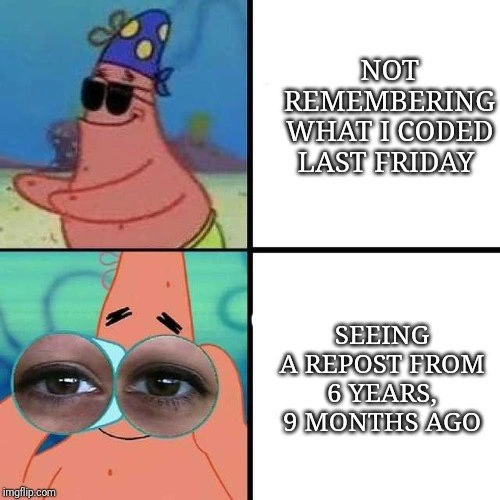
Imagine you did something important like your homework on Friday, but by Monday you totally forgot what it was about. However, you can easily remember a funny cartoon or joke from years ago as if you just saw it. Kinda silly, right? This meme is joking about that exact thing. In the picture, a happy starfish (that’s Patrick from SpongeBob) represents a programmer. In the first part, he’s saying, “I don’t remember what I coded last Friday,” which is like you saying, “I don’t remember the homework I did on Friday.” He’s all cool about it, even though forgetting your work is a bit funny (and maybe a little bad!). In the second part, the same starfish suddenly recognizes a meme from 6 years and 9 months ago – that’s a really long time! It’s as if you saw a funny picture or heard a joke that you last heard when you were much younger, and you go, “Hey, I know this one!” right away.
The humor comes from the contrast: the programmer’s brain forgets something important and recent (their code, like your homework) but remembers something silly and old (an internet joke, like your cartoon). It’s poking fun at how our brains can be a bit naughty, keeping the fun stuff on top of the mind and letting the work stuff slip away. We all kind of do this: maybe you can’t recall what you ate last week, but you remember a random TikTok song from two years ago. It feels upside-down! So the meme makes us laugh because we recognize that feeling. It’s saying, “Isn’t it funny that I can’t remember my own work from a few days back, but I can remember a goofy thing from almost seven years ago?” In simple terms: sometimes our brains remember the wrong things – the fun, useless trivia sticks, and the useful, recent info disappears. And seeing that expressed with a cool-looking Patrick Star just makes it extra fun and easy to understand. The developer in the meme isn’t really upset; they’re chuckling at themselves. And we laugh along, because we’ve all been there in our own way!
Level 2: Friday Fog, Meme Clarity
Let’s break down the joke in more straightforward terms. On the left side of the meme, we see Patrick Star (the lovable pink starfish from SpongeBob) wearing black sunglasses and a party hat, with his arms confidently crossed. This cartoon image is being used to represent a developer – a programmer – who’s looking very sure of himself. Now, the text in the top-right says: “NOT REMEMBERING WHAT I CODED LAST FRIDAY.” This means the developer (Patrick in this case) has completely forgotten the code they wrote just a few days ago (on Friday). Imagine that – you write some code, the weekend passes, and by Monday you’re like, “Wait, what did I do? Did I really write this?”. It’s a pretty common feeling in software development, almost a running joke. We even have a playful term for it: code amnesia (amnesia meaning loss of memory). A lot of devs will nod and say “yep, been there!” – it’s that foggy feeling after a break where your recent coding work is a blur. This is partly due to context switching: when you stop working on one thing and then try to come back to it later, your brain might drop the details. A weekend is a big context switch – you relax, do non-coding things, and your brain’s “cache” of what you were doing might get cleared out. Think of it like your brain doing a refresh; the settings from Friday just aren’t loaded anymore. That’s why Monday morning developers sometimes spend time just re-reading their own code to remind themselves what’s going on. (It’s also why some people jokingly avoid coding late on Fridays – they know Monday-self might suffer!) This meme really captures that DeveloperExperience_DX frustration – it’s extremely relatable for productivity: you can’t be productive if you don’t even recall what you were working on! It’s portrayed in a humorous way here, with Patrick’s chill pose suggesting the dev is casually admitting “Yep, I have no idea what I did, oh well.”
Now, the bottom-right text says: “SEEING A REPOST FROM 6 YEARS, 9 MONTHS AGO.” And again we have Patrick on the left looking cool (though the image is noted to be “partially blurred” – maybe to imply a sudden focus or him squinting to recognize something). This part means that when the developer comes across a post or meme on the internet, they immediately realize “Hey, this isn’t new, I’ve seen this before!”. Not just “seen it before recently,” but seen it 6 years and 9 months ago – which is a very specific and long time ago. Essentially, it’s saying the dev can remember an old meme from nearly seven years back with perfect clarity. The word “repost” is key: in DevCommunities and online forums, a “repost” is content that someone posts again, but it’s not original – it was posted in the past by someone else. A lot of community members (especially long-time followers) have a keen eye for reposts. They might call it out like, “This is a repost, I saw this years ago.” Here, the meme exaggerates that habit by giving an exact age: 6 years, 9 months. It sounds funny because normally we’d just say “years ago,” but the precision is comedic – it’s poking fun at how proud people are about remembering the exact timeline of an old post. So our developer, who couldn’t remember Friday’s code, does remember this random meme from ages ago. Patrick’s confident look in this panel comes off like the dev is proud of catching that repost. It’s the same crossed-arms, sunglasses attitude: “I may be forgetful about code, but oh ho, I never forget a meme.” 😎
This contrast sets up the joke. Why is it funny? Because it’s highlighting a long_term_vs_short_term_memory quirk: the developer’s short-term memory (what happened last week in code) failed them, but their long-term memory (something they saw on the internet many years prior) is working flawlessly. It feels backward – shouldn’t recent, important work be easier to recall than some random old internet joke? One would think so, but many of us (not just devs, honestly) experience the opposite. Think about it: you might forget what you had for lunch last Friday (recent mundane info), but remember a silly song or a TV show episode from childhood (old fun info). For developers, the “recent info” is code they wrote, and “old fun info” might be a meme or a legendary story from the dev community. The meme uses computing terms to label this phenomenon: “brain cache miss” for the forgotten code and “perfect cache hit” for the remembered meme. Let’s explain that metaphor: In computing, a cache is a special high-speed storage (like a little memory pool) that stores recently or frequently used data for quick access. If the processor needs some data and finds it in the cache, that’s a cache hit – things go fast. If it’s not there, that’s a cache miss – the system has to go look in slower memory or disk, which takes longer. Now apply that idea to the brain: The developer’s brain cache did not have last Friday’s code in it (missed it), meaning the info wasn’t readily accessible in his head. He’d likely have to go “fetch” it by, say, opening his code editor and reading the code (just like a computer would fetch from slower RAM or disk). But when it came to the old meme, the brain did have it stored and ready – a perfect hit – he recognized it immediately without any external help. So the developer memory cache metaphor is a playful way to say “forgot the first thing, instantly recalled the second.” It’s using tech jargon to describe a human memory quirk, which is pretty common in CodingHumor memes. We often compare our brains to computers in jokes: “Paging my brain” or “brain.exe has stopped working,” etc. Here, it’s the cache analogy.
Let’s talk a bit about Patrick Star’s appearance and why it’s used. Patrick is a goofy character, and seeing him with sunglasses and a party hat is inherently funny (it’s actually a popular image from SpongeBob used in memes to signify cool obliviousness). By using Patrick, the meme adds a light-hearted, silly tone. The sunglasses on Patrick give that vibe of “I’m not bothered by anything, I’m cool.” So in the first panel, that suggests the developer isn’t even ashamed he forgot his code – he’s almost owning it with a shrug. In the second panel, you could interpret Patrick’s look as the dev being smug about catching the repost. The subtle blur on the second Patrick image might imply a comedic zoom-in, like focusing on his eyes or expression to show he’s really noticing that repost (sometimes memes will zoom into a character’s eyes to indicate sudden realization or intense focus). So visually, it’s the same scenario (Patrick looking cool) applied to two opposite memory situations. This consistency makes the meme funnier: the dev has the same demeanor whether he’s forgetting or remembering – which is absurd and therefore humorous.
We should also touch on the fact that devs often spend a lot of time in DevCommunities (like subreddits, Twitter, Stack Overflow, Hacker News, etc.). Over years of being in these communities, certain jokes, posts, and memes become part of the culture. If you’ve been a subscriber to something like r/ProgrammerHumor or follow a popular dev meme account for long enough, you start seeing patterns and repeats. A meme from 6-7 years ago might resurface (either someone reposts it for new members or it just cycles back around), and veteran members will immediately flag it – not out of maliciousness, it’s almost a game or a point of pride: “Ha, I remember when this first made the rounds.” That’s exactly what’s being referenced. The Post Message says “Typical @dev_meme subscriber,” implying that anyone who’s a regular follower of these meme pages would display this behavior: forgetting their own recent work but spotting reposts in a heartbeat. It’s affectionate ribbing of the audience itself. In a way, the meme is winking at us: “This is you, isn’t it?” And many of us have to laugh and agree, it kind of is!
To further clarify the tech terms: “brain cache miss” isn’t a real scientific term, it’s borrowed jargon. A cache miss in computing means the quick access memory didn’t have what we needed. Here it means “I tried to recall (from brain cache) what I did Friday, and nothing came up – memory not found.” “Cache hit” in the second part means “I immediately recognized this, my memory served it up instantly.” The numbers 6 years, 9 months emphasize long-term. That’s practically “forever” in internet time. The meme could have said “from years ago,” but choosing such a specific duration is a tongue-in-cheek way to say, this is ridiculously old content and I STILL remember it. It’s similar to someone saying, “I haven’t heard that song in 10 years and I still know all the lyrics!”
One more developer-specific tidbit: earlier we mentioned git blame. Git is a version control system that programmers use to track changes in code. git blame is a command that tells you who last modified each line of a file, essentially “who to blame” (it’s a joke name; it’s actually useful for tracking history, not really blaming). Developers sometimes genuinely use it when they encounter code and think, “What is this? Who wrote this nonsense?” Running git blame often reveals the author… and sometimes it turns out to be you, just a younger you (like last week you!). This scenario is so common it’s meme-worthy on its own. In our context, if the dev doesn’t remember Friday’s code, they might resort to checking the Git history to recall what happened. It’s an example of how we have external tools as a “backup” for our brain’s short-term cache. The meme doesn’t explicitly mention git blame, but the tag git_blame_who clues us in that it’s related. It’s another layer of developer humor: “did I seriously write this? Let me check… oh, it says I did, oops!” Everyone from junior devs to seniors learns this humility eventually.
So, summing up in plain terms: This meme humorously points out that as developers (and human beings), we often forget the recent, important stuff (like the code we just wrote), but we remember random old things (like a meme or joke from years ago). It’s funny because it feels so backward – logically, it should be easier to remember recent work than an old comic, but our brains don’t always work logically. This resonates a lot in the programming world where keeping track of details is hard, and yet we fill our heads with tech trivia and community jokes. The categories like DeveloperExperience and DeveloperProductivity are touched here: forgetting code can hurt your productivity (you have to spend time to get back in the zone), and it’s a common experience in the life of a developer. The communal aspect (DevCommunities) is also highlighted: the meme itself references being a subscriber to a dev meme page and seeing reposts, which is part of that community life. It’s relatable developer humor at its finest – we laugh, perhaps a bit ruefully, because we’ve all been Patrick Star in this scenario!
Level 3: The Senior Memory Paradox
Every experienced developer knows the Monday morning fog: you open up code that you yourself wrote last Friday and think, “Who on earth coded this?!”. It’s the code amnesia phenomenon – after a mere couple of days (and perhaps a well-deserved weekend), the intricate logic you were so deep into has partially evaporated from your mind. This meme nails that shared pain: not remembering what you coded last Friday is hilarious because it’s so true. Seasoned devs chuckle (with a hint of pain) since they’ve been there many times. It’s why we have version control, commit messages, and the infamous git blame – not just to find out which colleague to tease, but often to remind ourselves that “oh… I’m the one who wrote this!”. When the caption jokes about a “brain cache miss,” senior devs nod knowingly: our brains often fail to fetch the last-known context from short-term memory, forcing us to do a cold reload (skim the code, read our notes, check Jira tickets) to reconstruct what we were doing. We’ve learned the hard way that pushing code on a Friday can lead to Monday confusion, a sort of mini hangover where your productivity dips as you page everything back into mental memory. In large projects, this context-switch cost is non-trivial – it’s a real hit to Developer Productivity. Ever come in on Monday, see a weird function and mutter “WTH is this for?” until you dig through git log and see your own commit message from Friday 5:30 PM? Yep, typical developer experience (DX) right there. 😅
On the flip side, the meme’s second punchline — immediately recognizing a repost from 6 years, 9 months ago — captures that peculiar superpower veteran devs (and active community members) develop. We might forget our code, but show us an old Stack Overflow question, a joke from the forums, or a classic DevCommunity meme, and we’ll instantly recall seeing it years before. It’s a playful jab at how our brains prioritize memories. Why can we recall a silly image from ages ago with crystal clarity? Possibly because it made us laugh or because we’ve seen it multiple times. Devs who hang out in meme groups or forums for years accumulate a mental catalog of inside jokes and popular posts. So when a “new” meme shows up that’s actually a repost, the senior dev brain goes “Hold on, I’ve seen this exact thing, circa late 2012!”. The meme specifies “6 years, 9 months” which is oddly precise — that exaggeration is part of the joke, implying the dev not only remembers seeing it before, but almost down to the timestamp! It’s a bit of hyperbole that heightens the humor. (In reality, someone might say “I saw this years ago,” but stating the exact years and months is cartoonishly specific, underlining how ridiculously good our memory for trivial internet lore can feel.)
Now, the absurd memory hierarchy comes into full view: trivial community trivia is stored reliably, but mission-critical recent knowledge is on the tip of our tongue one day and gone the next. It’s a paradox: the senior developer can instantly perform pattern recognition on an old meme (like a human search engine with excellent recall), yet their working memory for code is fragile and context-dependent. There’s some reality behind it. Coding is a complex cognitive task; it demands focused context. When you drop that context (say, over a weekend or switching to another task), the details dissolve unless reinforced. But a funny meme or anecdote? That’s lightweight, context-free, and often emotionally charged (humor triggers emotion, which aids memory retention). So it sticks, lurking in the back of your mind ready to spring out when triggered. Many devs will relate how they can quote an old coding joke or remember a classic xkcd comic number, yet struggle to recall the syntax of a function they used last week without checking the docs again. We’ve effectively trained our long-term memory on community content by repeated exposure and the sheer novelty or hilarity of it. Meanwhile, day-to-day code tends to blur together unless it was especially exciting or we revisited it often. It’s a bit like our brains do selective backup: fun culture, saved forever; routine work, ephemeral.
The image choice amplifies the joke. Patrick Star in sunglasses (from SpongeBob SquarePants) appears in both the top and bottom-left panels. Patrick’s got this goofy, overly-confident pose — arms folded, rocking a party hat and shades like he’s the coolest starfish in Bikini Bottom. For the top caption (“not remembering what I coded last Friday”), Patrick’s swagger makes the situation extra funny: it’s like the dev is unabashedly nonchalant about forgetting their own code (“Yup, I have no clue what I wrote, and I’m cool with that”). That’s the irony; we usually should be embarrassed or worried that we forgot, but truth is, it’s so common you just shrug it off. In the bottom panel, Patrick is basically the same, maybe a bit zoomed-in or blurred for comedic effect, but effectively still looking smug. The caption has him seeing a repost from 6y9m ago, and you can almost imagine him going “aha!” behind those sunglasses. He’s proud of recognizing the recycled meme, as if it’s a badge of honor to remember DevCommunity trivia. The consistent pose in both frames – cool and confident – highlights the absurdity: this dev persona is equally unfazed by not knowing something important and by definitely knowing something completely trivial. It’s a sarcastic developer humor way to say, “Yeah, my brain’s priorities are totally skewed, isn’t it great?”
From an organizational angle, this resonates with any team lead or project manager too: they know when a dev returns from vacation (or even just a weekend), there’s ramp-up time to reload that mental context – it’s practically expected. Some teams even avoid end-of-week deployments or complex tasks on Friday because of this Friday code oblivion. And here we are playfully blaming our brain’s “cache” for it. Meanwhile, the same devs might be on Reddit or Slack channels remembering jokes from eons ago, which doesn’t directly improve the codebase but certainly builds camaraderie. It’s a reminder that devs are human: our minds wander, our memory is fallible in work but strangely robust in play. The meme strikes a chord because it’s relatable developer experience distilled: a mix of frustration (“ugh, I forgot my own code”) and humor (“lol, but I recall this meme from ages past”). It’s basically the embodiment of “I can’t remember what I had for breakfast, but ask me lyrics from a 90s cartoon theme – no problem.” In dev terms, “I can’t recall the algorithm I implemented on Friday, but I can cite that Stack Overflow answer I read in 2013 verbatim.” Priorities!
To put it in pseudo-code form, the brain of this “typical dev_meme subscriber” might be doing something like:
if (brainCache.has(oldMemePost)) {
console.log("Cache hit 🤓: Seen this meme before (2012 flashback)!");
}
if (!brainCache.has(lastFridayCode)) {
console.log("Cache miss 🤔: Who wrote this code? Let's git blame...");
}
In reality, we laugh, then we cope: by meticulously writing things down on Friday (maybe a quick comment or // TODO: refactor this note), or by simply accepting that Monday will start with a brief reacquaintance with our own work. And we keep scrolling through those dev meme pages, ironically training our memory on the least mission-critical data. This shared absurdity is what makes the meme DeveloperHumor gold – it’s funny because it’s true, and every dev reading it feels a little less alone in their forgetfulness. After all, if Patrick Star can be a programming star while forgetting code but remembering memes, maybe we’re all gonna be okay. 😎
Level 4: Weekend Cache Invalidation
In computer architecture, we talk about cache hierarchies – from the tiny L1 cache closest to the CPU, down to main memory and even disk. Our brains seem to have a similar multi-level memory setup. Here, the developer’s brain behaves like it has an L1 cache (fast short-term memory) that unfortunately evicts entries far too eagerly. The code written on Friday lived briefly in this fast brain-cache, but by Monday it’s gone – a classic cache miss scenario. Meanwhile, an old meme from ~7 years ago was somehow still indexed in long-term storage, leading to an immediate cache hit when it popped up again. It’s as if the brain’s eviction policy declared the fresh code as “least recently used” over the weekend and purged it, while the ancient meme remained warm in memory for years.
“There are only two hard things in Computer Science: cache invalidation and naming things.” — Phil Karlton (legendary coder proverb)
Ironically, the brain here struggled with cache invalidation: it invalidated (forgot) the important cache line (the Friday commit) too soon! Think of short-term memory as a volatile cache – high-speed but limited capacity. When too much new info (or a relaxing weekend) comes in, older entries like that code diff get flushed out. Unless you reinforce that knowledge (by reviewing or using the code again), the brain’s caching algorithm (perhaps a LRU Least Recently Used scheme) drops it. On the flip side, recognizing a meme from 6 years, 9 months ago means some pattern of that meme was stored in slower but larger long-term memory (akin to a hard drive). The moment the dev sees the repost, it’s like fetching data with a perfect memory address match – bam, instant recall. In computing terms, that would be like an unlikely cache line from ages ago still sitting valid in L3, ready to deliver a hit despite the long lapse. Real caches don’t work that way (unused data would be long gone), but the human brain is a quirky neural machine. It strengthens memories that either repeat often or carry emotional weight. Perhaps that meme was especially funny or it resurfaced a few times over the years, effectively refreshing its “cached” status in the mind. Meanwhile, the Friday code was one-and-done, so it never graduated to durable storage.
There’s also the concept of garbage collection in high-level languages – automatic memory cleanup. A weekend of rest might be the brain’s GC cycle, clearing out “unreferenced” data (like ephemeral coding details) to free space. Unfortunately, our mental GC sometimes collects the wrong objects! The code context you still needed on Monday gets swept away as if it were garbage, yet some trivial meme image pointer was marked as too significant to drop. It’s almost a memory leak in reverse – vital information gets freed, while junky data sticks around. The humor here is grounded in these fundamental CS ideas: fast vs. slow memory, retention vs. eviction, and the unpredictable ways a “system” decides what to keep. A developer’s brain is both amazing and absurd: it can’t reliably recall a commit from 3 days ago, but it’s running a perfect pattern-matching service for Internet trivia from 2012. In other words, the memory hierarchy in our heads has its own rules, and it often defies the logical optimization we’d expect – much to our amusement (and occasional frustration)!
Description
A two-panel meme featuring the character Patrick Star from SpongeBob SquarePants, contrasting two different states of memory. The top panel shows a relaxed Patrick wearing sunglasses and a bandana, with the adjacent text: 'NOT REMEMBERING WHAT I CODED LAST FRIDAY'. The bottom panel depicts Patrick looking intensely through binoculars, which have been edited to show realistic, focused human eyes. The text next to this panel reads: 'SEEING A REPOST FROM 6 YEARS, 9 MONTHS AGO'. A watermark for 'imgflip.com' is visible in the bottom-left corner. The meme humorously captures a common cognitive dissonance among developers: the inability to recall complex, recent work details while possessing a surprisingly sharp memory for trivial, long-past online content. This phenomenon is relatable to experienced engineers who, after years of projects, find that specific implementation details fade quickly, while cultural artifacts and shared online experiences remain vivid

Comments
7Comment deleted
My brain's garbage collector is ruthless with last week's implementation details, but for some reason, it's maintaining a strong pointer to a meme I saw in 2013
My brain’s LRU eviction tosses last Friday’s commit, yet it still cold-stores the SHA of a 2017 Hacker News meme
My brain has perfect recall for every Stack Overflow answer I've ever downvoted but needs git blame to remember why I wrote that regex yesterday
The paradox of senior engineering: you can instantly recognize a design pattern from a codebase you touched 7 years ago at 2 AM during a production incident, complete with the exact line where you left that TODO comment, but ask what you committed last Friday afternoon and you'll need to run `git log --author=me --since='last friday' --pretty=format:'%s'` just to remember you were even working that day. Bonus points if the 6-year-old code makes you wonder 'who wrote this garbage?' only to discover via `git blame` that it was you, during your 'I can make this more clever' phase
My brain’s cache runs LRU with aggressive GC - Friday’s refactor got evicted, but a 6y9m-old Stack Overflow thread is pinned like a prod hotfix
Senior dev rite: git blame on Friday's commits reveals the real mystery author - you
My brain runs LRU with aggressive context-switch eviction - Friday’s commit was GC’d at standup, but that 6y9m repost is pinned like a prod DB labeled do_not_delete