Skip to content
DevMeme
3499 of 7435
Ignoring Documentation: A Developer's Rite of Passage
Documentation Post #3835, on Oct 19, 2021 in TG

Ignoring Documentation: A Developer's Rite of Passage

Why is this Documentation meme funny?

Level 1: Ignoring the Instructions

Think of it like building a LEGO set without looking at the booklet. 📩 You dump out all the pieces and, instead of reading the steps, you say, “I don’t need the instructions, I can do this myself!” You start connecting bricks in whatever way seems right. For a while it’s fine, you’re confident and things are moving along. But then the spaceship’s wings don’t fit, or you have a strange piece left over that you missed. Uh-oh! All that could have been avoided if you had just followed the little booklet from the start. This meme is joking about the same idea, but with coding: the instructions for the code (the documentation) were there on a big sign, easy to see, but the character proudly ignores it. It’s funny because it’s like a kid saying “You can’t tell me what to do!” and then stumbling because they missed something important. We laugh because we’ve all been that person at some point – skipping the boring instructions and then finding out we should have read them. It’s a friendly reminder that sometimes taking a moment to read the guide can save a lot of trouble later, whether you’re building a toy or writing some code.

Level 2: Documentation Aversion

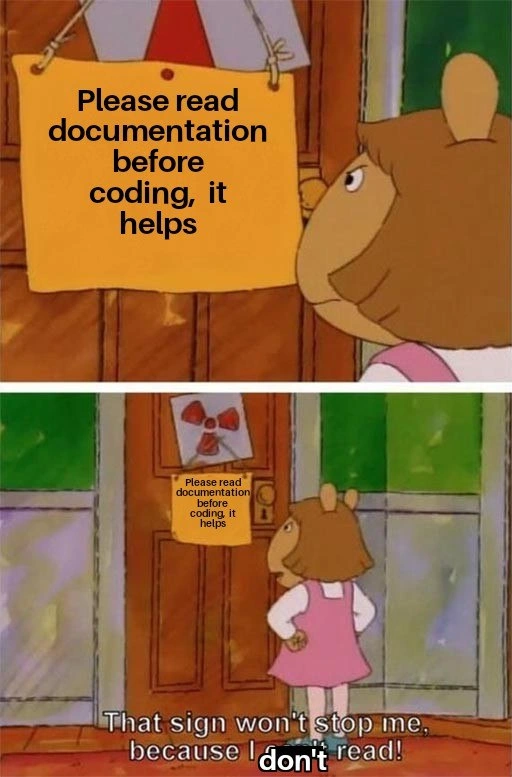
Let’s break down what’s happening here in simpler terms. The meme jokes about a developer who ignores documentation completely, charging straight into writing code. Documentation in programming is any written guide that explains how to use a tool, library, or codebase. It could be an official website with an API guide, a README file in a GitHub repo, or even comments in the code. Good documentation is meant to help developers avoid mistakes and learn the right way to do things. In the image, the sign on the door saying “please read documentation before coding, it helps” is like a big friendly reminder: “Hey, maybe check the instructions first!” The character (D.W. from the Arthur cartoon) represents the developer who looks at that helpful sign and basically says, “Nah, I got this. Rules don’t apply to me.” That’s the documentation aversion the meme is highlighting — a fancy way of saying resisting the act of reading docs.

This is pretty relatable humor for anyone who’s tried programming. A lot of us, especially when we’re new or excited about a project, tend to skip straight to coding. It’s like when you open up a new gadget and don’t read the manual because you want to play with it immediately. In coding, skipping the docs might save a few minutes up front, but it often leads to confusion or errors later. For example, imagine a beginner trying to use a new library to, say, connect to a database. The library’s documentation might have a step-by-step tutorial, but the eager coder dives in without reading it. They write some code and then run into an error they don’t understand. They then spend hours stuck, only to find the answer in the docs that were sitting there the whole time. This feels both frustrating and a little funny in hindsight — funny enough that developers made a meme about it!

The phrase “That sign won’t stop me, because I don’t read!” is the punchline. It’s essentially the coder saying out loud what their actions imply. It resonates as an inside joke among developers because we’ve heard stories or seen peers do this (maybe we’ve done it ourselves). Often, when someone asks a question that’s clearly answered in the docs, experienced team members might tease them with a gentle “did you read the docs?” It’s a part of DeveloperExperience (DX) culture: great DX means having docs so good that developers actually want to read them, but reality shows many devs still skip this step. We also talk about Code Quality: that’s how clean, understandable, and bug-free the code is. When you don’t read documentation, your code quality can suffer. Why? Because you might be using things the wrong way. For instance, not knowing a function’s proper usage or ignoring a recommended best practice from the docs can lead to messy or incorrect code. In short, the meme is a lighthearted reminder: reading the docs might be boring, but it’s there to help you write better code and have a smoother experience. Skipping it is a common habit, and we’re all having a laugh at that habit – and at ourselves.

Level 3: Ignorance-Driven Development

In the top panel of this meme, we see a bright sign on a door that politely pleads, “Please read documentation before coding, it helps.” Any seasoned engineer chuckles here, because we’ve all encountered that one colleague (or been them) who blasts past such warnings with unearned pure confidence. The meme uses the classic Arthur cartoon format (D.W. at the door) to lampoon a common anti-pattern in software teams: ignoring the docs and charging ahead. It encapsulates a bit of dark developer humor: the bold sub-caption proclaims “That sign won’t stop me, because I don’t read!” — a perfect caricature of documentation aversion in action.

This combination of elements is funny and painfully familiar. The sign literally spells out a best practice (RTFM, as the old timers say: Read The Friendly Manual), yet the character confidently declares they won’t be stopped by something they refuse to even look at. It’s a relatable inside joke across programming teams. Everyone knows solid documentation is crucial for Code Quality and smooth Developer Experience (DX). Good docs are like guardrails that keep the code from driving off a cliff. But in reality, there’s a recurring pattern of developers diving in head-first without reading any guides. Why? Sometimes it’s youthful overconfidence (“I can figure this out, I’m a genius!”), other times it’s sheer impatience or time pressure (“Deadlines to meet, who has time to read?”). The result is what we jokingly call “ignorance-driven development” – writing code guided by gut feeling and Stack Overflow snippets rather than the official docs.

The humor lands because it’s too real: skipping docs often leads to absurd scenarios that we could have avoided. We write 100 lines of convoluted code only to discover the framework had a one-liner to do the same thing (had we read page 2 of the manual). Or we spend a day debugging a library call throwing odd errors, only to find a note in the docs: “Make sure to initialize X before calling Y.” That forehead-slapping moment is essentially the meme’s second panel. D.W.’s stance — hands on hips, resolute in ignorance — mirrors the developer who refuses to admit “maybe I should have read that README.” It’s a comedic reflection of pride coming before a fall in coding.

On a serious note, this habit has ripple effects on team DX and project health. Not reading the docs can turn into avoidable bugs and technical debt. For instance, ignoring a section titled “Important: Security considerations” might mean introducing a vulnerability because the dev didn’t realize a function needed special handling. Code written in a documentation vacuum often lacks adherence to recommended patterns, making it harder for others to understand or maintain. Senior engineers know the unspoken horror of inheriting a codebase where the original author clearly skipped the manual – it’s like finding a machine with levers and knobs, but all the labels are scratched off because someone didn’t bother to read or follow instructions. This is why teams emphasize a culture of reading and writing documentation, even if the practice is honored more in breach than observance.

From an organizational perspective, the meme hints at a cycle: developers skip docs, produce shaky code, and then future developers have to write extensive documentation (or cleanup code comments) to explain the weird quirks that arose. It’s both ironic and educational – if we just read the docs first, we’d save ourselves from this self-inflicted pain. Yet, as this meme jokes, the confident coder in us sometimes can’t resist saying “Documentation? That’s for people who don’t know what they’re doing – not me!” (famous last words on many a late-night debugging session). In summary, the meme humorously exposes the gap between best practice (read the docs) and common practice (wing it and pray), a gap that every experienced developer has navigated. It’s laughing at our own folly – a classic piece of relatable dev experience and DocumentationHumor that makes us nod and think, “Yep, been there, done that, got the error log to prove it.”

# Real-world pseudo-code scenario:
# Documentation (that we ignored) said: "Call connect() before send()"
conn = NetworkClient()
conn.send(data)  # Oops, skipped reading docs - this fails because connect() was never called.
# Now we're scrambling to figure out why, combing through code...
# A quick RTFM moment earlier would have saved us this bug hunt.

Description

A two-panel meme featuring the character D.W. from the children's show 'Arthur,' known as the 'That sign won't stop me' format. In the top panel, D.W. glares at a yellow, hand-written sign on a wooden door that reads, 'Please read documentation before coding, it helps.' The bottom panel shows D.W. standing back, looking defiantly at the door, which now has a red and yellow radiation hazard symbol taped above the original sign. The caption at the bottom says, 'That sign won’t stop me, because I don’t read!'. The meme humorously captures the common, often junior, developer tendency to ignore documentation and dive straight into coding, a practice that experienced engineers know is fraught with peril. The added radiation symbol hilariously signifies the predictable danger and toxic fallout of proceeding without understanding the existing framework or API, a self-inflicted wound familiar to many in the industry
Comments

9
Anonymous ★ Top Pick The fastest way to turn a 30-minute task into a 3-day debugging session is to skip the 10 minutes it takes to read the documentation
  1. Anonymous ★ Top Pick

    The fastest way to turn a 30-minute task into a 3-day debugging session is to skip the 10 minutes it takes to read the documentation

  2. Anonymous

    “Skipping the docs feels agile until 3 AM you’re diff-driving through your own code like an archeologist wondering why past-you invented a bespoke RPC over CSV.”

  3. Anonymous

    After 20 years in tech, I've learned that 'RTFM' evolved into 'RTFD' (Read The F***ing Docs), then into Stack Overflow copy-paste, and finally into asking ChatGPT - yet somehow we still end up debugging the same integration issues that were clearly documented in the migration guide we all collectively ignored

  4. Anonymous

    The eternal paradox: we'll spend 6 hours debugging an obscure API behavior rather than spend 15 minutes reading the docs that explicitly warn about it. Then we'll write a Stack Overflow answer about our 'discovery' that's literally copy-pasted from page 3 of the documentation we swore didn't exist

  5. Anonymous

    Doc‑driven development would save a sprint, but the team prefers trace‑driven development - reverse‑engineering the API from 500s and Jaeger spans

  6. Anonymous

    The CAP theorem of docs: Can't Always Persuade, but Availability of dumb questions is eventual consistency

  7. Anonymous

    Documentation is an eventually consistent cache; the code’s the source of truth - so I don’t read the cache

  8. @chekoopa 4y

    "don't" is not necessary here, because actually it's "can't"

  9. @slow2serious 4y

    don't need to read if there are no docs

Use J and K for navigation