Skip to content
DevMeme
4107 of 7435
When the 'Quick Fix' Becomes Permanent Infrastructure
TechDebt Post #4481, on Jun 18, 2022 in TG

When the 'Quick Fix' Becomes Permanent Infrastructure

Why is this TechDebt meme funny?

Level 1: Time for a Break

Imagine you’re looking at a picture puzzle made of colored dots, and hidden inside each dot pattern is a number. Now, instead of the puzzle telling you about your eyes, it’s telling you about YOU. This funny picture says that if you can’t see the number in a certain colored circle, it’s a sign you need to do something simple: like drink water, sleep, eat, or finish something you started. It’s kind of like a traffic light for your body and mind. For example, not seeing the number in the green circle means you’re as thirsty as a plant in a desert, and the picture is cheekily telling you to go get a glass of water. Another circle has no number at all – that’s the jokeiest one – it basically says, “Hmm, you don’t see a number here? That’s because you’ve left things undone! Maybe go finish your little projects or chores.”

Why is this funny? Because normally an eye test wouldn’t tell you “go take a nap” or “hey, eat a snack,” right? That’s what makes it silly. It’s taking a serious test and turning it into a secret message about everyday needs. Developers (the people who write the software on your computer or phone) often get so absorbed in their work or hobbies that they forget to do these basic things. So this meme is like a playful friend tapping them on the shoulder saying, “Psst – if you can’t even see what’s right in front of you, maybe you need a break!” You don’t have to be a programmer to get it: it’s a fun reminder that everyone needs food, water, rest, and to not ignore the stuff they’ve left unfinished. In the end, the picture makes us laugh because it’s a colorful, clever way of saying “take care of yourself!”

Level 2: Developer Diagnostics

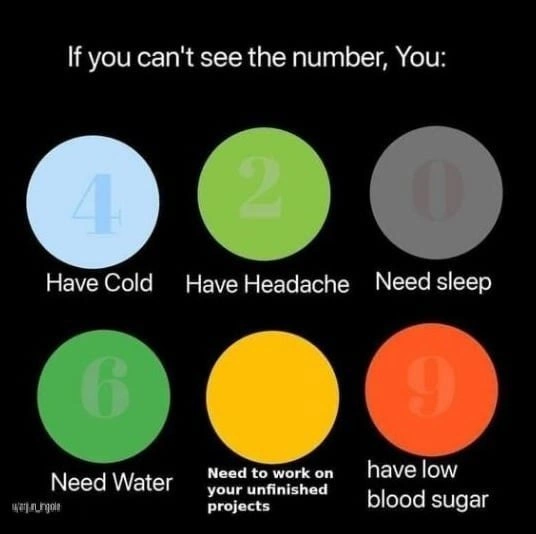
For those newer to the joke, let’s break down what’s happening. The meme uses the style of an Ishihara color blindness test – the dotty circle images doctors use to check your color vision. Normally, each Ishihara plate has colored dots that form a number or shape: if you can’t see the number, it indicates you might be colorblind. Here, though, the test has been repurposed for developers’ well-being. Each colored circle hides a number and has a caption like “Need sleep” or “Have Headache.” It’s a tongue-in-cheek way to suggest that if a dev is so out-of-it that they “can’t see the number,” then maybe they are suffering from one of these conditions.

Let’s decode each circle from the perspective of a developer’s everyday life:

  • Blue circle with a faint 4 – “Have Cold”: You know how when you have a bad cold, your head feels foggy and even staring at your screen is a challenge? This plate jokes that being sick might blur your vision. Having a cold in the developer context is straightforward: you’re under the weather, possibly from all those late nights or a bug going around the open office. It’s the meme’s way of saying “If you can’t focus enough to see the 4, maybe you’re coming down with something. Go rest!”

  • Light-Green circle with a faint 2 – “Have Headache”: Long coding sessions, bright monitors, or not drinking enough water can lead to headaches. If a dev has a pounding headache, tiny faint numbers will be hard to spot. This one is a self-care reminder: headache often means you’ve been staring at code too long without a break. New developers often learn the hard way that debugging for hours without stepping away can literally cause pain. The meme humorously prescribes: “Can’t see that 2? Probably you’ve got a headache – maybe from that wonky bug you’ve been wrestling. Time for a break or painkiller and a walk.”

  • Charcoal-Gray circle with a faint 0 – “Need sleep”: This is a big one in tech circles. Sleep Deprivation is almost a running joke in the programming world – whether from crunch-time, late-night gaming, or just one-more-episode syndrome. If you’re running on 0 sleep, your eyes feel like they have sand in them. The faint “0” is a perfect choice: zero is like “nothing,” which is what you have left in the tank when you’re exhausted. A junior dev might recall their first all-nighter trying to meet a project deadline or learning a new framework until dawn, only to realize the next morning that they can’t read their own code. This plate playfully says: if that gray “0” disappears for you, it’s a sign you desperately need rest.

  • Forest-Green circle with a faint 6 – “Need Water”: Ah, dehydration – the subtle productivity killer. It’s easy to forget to drink water when you’re deep in problem-solving mode. Many devs keep a coffee mug within arm’s reach but forget the water bottle. The result? You feel groggy, maybe dizzy, eyes dry – similar to mild symptoms of color vision issues even. The meme’s green 6 could be seen as a little “6” H2O nudge (chemistry pun, anyone? 😁). For newcomers: if you find yourself rubbing your eyes or unable to concentrate, it might not be a complex bug – you might just need to hydrate. Drinking water is the simplest debug for feeling off, and yes, even the meme health chart includes it.

  • Mustard-Yellow circle with no number – “Need to work on your unfinished projects”: This one’s a bit different. There’s literally no number visible in that circle, which is the joke! In a real Ishihara test, not seeing a number indicates an issue. Here, the issue isn’t with your eyes, but with your project backlog. An unfinished project backlog means all those side projects or tasks you started but never completed. For many developers, especially enthusiastic new ones, it’s super common to begin learning a new technology or make a cool app, get it 40-60% done, and then move on to something else shiny. Over time, you accumulate a whole list (a backlog) of half-done projects. This yellow plate humorously “diagnoses” that condition. If you can’t see a number, well, that’s because you left that project blank or half-finished! It’s telling you in bold letters to go finish what you started. This points to DeveloperProcrastination and a bit of our habit to postpone or avoid wrapping up projects once the initial excitement fades or once things get tricky. It’s a playful prod — no actual eye test can tell if you procrastinate on projects, of course, but every dev knows the slight guilt of that unfinished side-project list. Consider this meme plate a lighthearted backlog grooming reminder.

  • Red-Orange circle with a faint 9 – “Have low blood sugar”: This references something very down-to-earth: forgetting to eat. Low blood sugar happens when you haven’t had food in a while and your body is running out of fuel (glucose). Developers sometimes joke about running on coffee and code, but skipping meals can make you shaky, unfocused, even give you tunnel vision. The faint 9 on a red background is like a warning light – think of it as the body’s equivalent of a low fuel indicator in your car. For a junior dev, it might be surprising how often time flies when you’re engrossed in coding; you look up and it’s 3 PM and you missed lunch. This part of the meme is essentially saying “Hey, if you can’t spot the number 9, maybe your brain is running on empty. Go grab a snack!” It ties into DeveloperExhaustion and physical health awareness in tech. When blood sugar drops, your cognitive functions can glitch just like an out-of-memory error in a program – everything slows down or gets weird. So maintaining your MentalHealthInTech isn’t just about avoiding burnout; it’s as basic as eating on time.

In short, each colored circle is a self-care checkpoint for developers, styled in a playful visual way. The meme uses humor to highlight serious points about DeveloperProductivity and well-being: if you neglect these basic needs, your productivity and code quality will suffer (and apparently, so will your ability to see hidden numbers 😅). A junior dev can take away a valuable lesson wrapped in a joke: your brain is the ultimate compiler, and it needs proper maintenance – enough sleep (to avoid segmentation fault in your head), proper hydration (prevent system overheating), nutrition (fuel for CPU cycles), and yes, even clearing out side-projects (free up mental RAM from guilt or distraction).

So when you see this meme and chuckle, remember it’s okay to pause that marathon coding session and reboot yourself. Your code will still be there after a short break, but you’ll see it with fresh eyes – literally! The humor works because it’s relatable: even early-career developers quickly learn that a debugging session at 2 AM while hungry and tired is rarely effective. It’s better to take care of the basics and come back strong. This meme is the dev community’s wink and nudge: take care of yourself as well as you take care of your code.

Level 3: Backlog Blindness

At first glance, this meme cleverly mashes up a medical eye exam premise with the all-too-familiar reality of developer burnout and backlog guilt. Seasoned devs will recognize the format as a parody of the Ishihara color blindness test – those dotted color plates where hidden numbers reveal if you perceive colors normally. Instead of diagnosing color vision, though, these plates diagnose developer lifestyle issues. It’s a techie in-joke that lands because it layers a serious diagnostic format with absurd everyday developer problems.

In each colored circle, a faint number is barely visible. The top caption reads: “If you can't see the number, You: ...” followed by six circles and their tongue-in-cheek “diagnoses.” For example, a pale blue circle has a faint 4 and is labeled “Have Cold,” suggesting that if your senses are so dulled you can’t spot the 4, maybe you’re coming down with something. A light-green circle hides a 2 (“Have Headache”), and a charcoal-gray circle shows 0 (“Need sleep”) – a particularly brutal call-out for coders pulling one too many all-nighters.

The second row continues the gag: a forest-green circle with 6 (“Need Water”) jabs at those of us who forget to hydrate during marathon coding sessions; a mustard-yellow circle pointedly has no number at all, captioned “Need to work on your unfinished projects.” That one lands a punch – it implies your backlog is so neglected that there isn’t even a number to see! Finally, a red-orange circle has a faint 9 (“have low blood sugar”), reminding us how often devs skip meals when deep in the zone. Each plate’s color isn’t random either – red is an urgent color (low blood sugar is a red alert 🚨 to eat something), gray is lifeless (utter exhaustion), and yellow is the iconic “unfinished project” caution tape calling out unresolved GitHub repos.

What makes this really funny to a veteran developer is the sly exaggeration wrapped in a familiar format. We’ve all squinted at a screen late at night until the code and text blur together. The idea that you might literally "go color-blind" to these numbers if you’re tired or dehydrated hilariously dramatizes how bad dev habits affect us. It’s poking fun at that culture of pushing through discomfort – the same culture that leads to tech folks proudly wearing sleep-deprivation as a badge of honor (until they faceplant on the keyboard). The meme turns common dev self-neglect into a fake diagnostic chart. It’s essentially saying: “Look, if you can’t even see these obvious signs, it’s because you’re suffering from coder-itis: forgetting basic self-care and letting projects pile up.”

Experienced engineers also catch the joke about backlog triage. The bold text in the yellow circle shouts “Need to work on your unfinished projects,” which feels like that nagging Jira backlog or the graveyard of side projects haunting every senior dev. We usually treat backlog grooming seriously – deciding which unfinished work to kill off or finally complete – but here it’s treated as comically dire as a medical condition. It’s a cheeky nod to the guilt many devs carry about half-finished personal projects (that “I really should finish that one day...” feeling). By disguising it as an eye exam result, the meme playfully absolves us: “Don’t blame yourself, it’s official – the test says you just have to address your backlog!”

Another layer seasoned meme-lovers might notice is the sneaky sequence of the numbers themselves. The top row “4-2-0” and bottom row “6 - [blank] - 9” hints at the infamous “420” and “69” – classic internet in-jokes – hiding in plain sight. It’s as if the meme is winking on multiple levels: referencing developer habits, medical tests, and meme culture all at once. A senior dev with a sharp eye (assuming they got enough sleep to see straight!) chuckles at the sheer density of references. It’s humor by way of recognition: each element (the colors, the numbers, the labels) maps to something we’ve experienced in the tech grind. We laugh because it’s true – we’ve all ignored the low battery warnings of our bodies and projects. This meme manages to be a gentle roast of our bad habits and a friendly PSA rolled into one quirky image.

Description

This meme shows a picture of a massive, tangled mess of electrical wires and cables, all held together by a single, flimsy zip tie. The caption reads: 'When you say 'it's just a temporary fix' and it's still in production three years later.' This meme is a visual metaphor for technical debt, where a quick and dirty solution, intended to be temporary, becomes a permanent and precarious part of the system. For senior engineers, this is a deeply relatable and painful truth, a testament to the dangers of sacrificing long-term stability for short-term gains


Comments

7
Anonymous ★ Top Pick In software, 'temporary' has a half-life of about three years. After that, it's not a temporary fix; it's a load-bearing Jenga block
  1. Anonymous ★ Top Pick

    In software, 'temporary' has a half-life of about three years. After that, it's not a temporary fix; it's a load-bearing Jenga block

  2. Anonymous

    Finally, an Ishihara plate that reveals the real blindness: pretending those 214 open TODOs will close themselves

  3. Anonymous

    I can see all six numbers perfectly, which means I'm healthy enough to keep ignoring my health for another sprint

  4. Anonymous

    This Ishihara test for developers reveals a harsh truth: if you can see all six numbers clearly, you're either lying or you're not actually shipping code. The yellow circle's diagnosis is particularly brutal - it's not a health condition, it's a permanent state of existence. We all have that graveyard of half-finished side projects haunting our GitHub profiles, each one a testament to our optimistic sprint planning and our realistic attention span. The real color blindness test is whether you can still distinguish 'just one more feature' from 'scope creep that will consume your soul.'

  5. Anonymous

    Ishihara for engineers: if you can’t read the numbers, fix contrast and nap; if the yellow plate has copy instead of a digit, that’s your backlog sneaking in as a health check - treat it like a P1

  6. Anonymous

    Can't see the 8? That's not color blindness - it's backlog superposition: exists in every state until sprint review forces observation

  7. Anonymous

    Failed the orange circle - the Ishihara test for tech debt; the number is hidden under 12 sprints of carryover, three feature flags, and a “temporary” fork from 2019

Use J and K for navigation