Escape the Room: Developer Edition
Why is this OnCall ProductionIssues meme funny?
Level 1: Locked In With the Mystery Machine
An escape room is a game where friends get locked in a themed room and hunt for hidden keys and clues to get out before the timer rings — it's fun because someone designed it to be solvable. The joke here is that a programmer's worst workday is exactly the same game, except nobody designed it, nothing promises it can be solved, and instead of a prize at the end you just... get to keep your job. Imagine being locked in a room with a broken machine no one understands, secret codes scribbled on random papers, and a countdown clock on the wall. For some people that's a fun Saturday. For developers, that's Tuesday.
Level 2: Inventory of the Room
The puzzle props, decoded for anyone who hasn't been locked in yet:
- Production ("продакшен") — the live environment serving real users. A bug here isn't homework; it's actively costing money or trust while you read this sentence.
- Legacy code ("легаси код") — old code still running the business, typically with no tests, no docs, and no surviving authors. You can't safely change what you can't understand, and you can't understand it quickly.
- Credentials — usernames, passwords, API keys. They're supposed to live in a secure secrets manager; in messy organizations they live on sticky notes, which is simultaneously a security hole and, during an incident, your only way in.
git diff— a command showing exactly what changed between code versions. Printouts of diffs are clues about what changed, but never why — that part lived in someone's head, and that someone is gone.
The early-career rite of passage this describes: your first solo on-call shift, a pager going off for a service you've never opened, and the dawning realization that the runbook's last update predates your hiring. You will grep, you will guess, you will find a password in a file named DO_NOT_DELETE_old2.txt, and you will fix it — or escalate to the one person who remembers, who is on vacation. Either way, you'll exit the room a different developer.
Level 3: The Game Master Never Comes
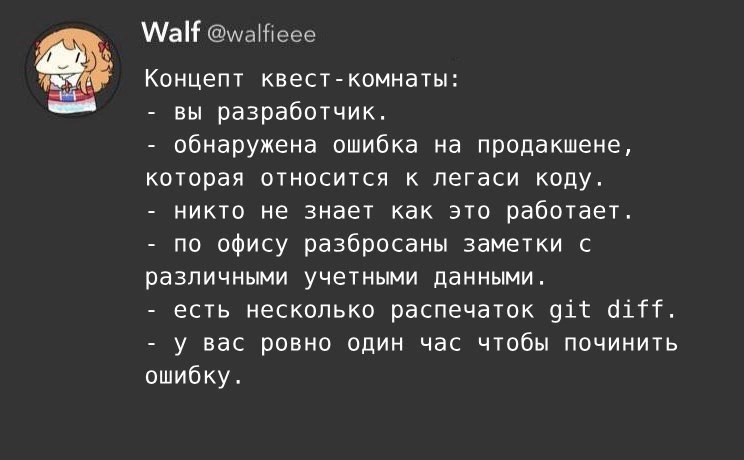
The tweet by Walf (@walfieee) — written in Russian, translating to "Escape room concept: you are a developer. A bug has been discovered in production, related to legacy code. Nobody knows how it works. Notes with various credentials are scattered around the office. There are several printouts of git diff. You have exactly one hour to fix the bug." — is funny because it isn't a parody. It's a field report with mood lighting. Every "puzzle element" listed is a documented, chronic industry pathology, and the joke works by simply recategorizing them as entertainment.
Take the inventory. "Nobody knows how it works" is the textbook definition of legacy code in the Michael Feathers sense — code without tests, whose original authors have left, whose behavior is its specification. The system isn't understood; it's appeased. Credentials on scattered notes is shadow-IT archaeology: the production database password living on a sticky note, in a shared creds.txt, or in a Slack message from 2016, because the "proper" secrets vault was always a next-quarter project. In a real escape room, finding a key under a flowerpot is satisfying; in a real office, finding the prod root password taped to a monitor is a compliance incident that everyone has silently agreed not to see. And the printouts of git diff are the most perfect detail — physical paper implies someone once cared enough to review a change, but not enough to leave behind a commit message explaining why. The clues exist; the narrative doesn't.
The one-hour timer is where the satire bites hardest. Escape rooms are designed — a game master calibrated the difficulty, the puzzles are solvable, hints arrive when you stall. Production incidents have none of these guarantees. The SLA clock runs regardless of whether the bug is solvable in an hour, and the "hint system" is a manager typing "any updates?" into the incident channel. The deep irony the tweet exposes: people pay money for the escape room version because it has the one thing on-call lacks — a guaranteed exit. The room was authored to be escaped. Your legacy billing system was not.
There's also a sly comment here about why this trauma is so universal that it translates across languages without losing a beat. Organizational incentives manufacture this room everywhere: documentation is never urgent until the author resigns, credential hygiene is invisible work, and rewriting the undocumented module loses the planning-poker vote to features every single sprint. The escape room doesn't need a designer. The industry builds it for free.
Description
A meme describing a developer-themed 'escape the room' scenario. The text describes a hellish scenario where a developer is trapped in a room and has to fix a bug in a legacy production system, with no documentation and scattered clues. The caption reads: 'The concept of 'escape the room' quest : - You are a developer - Found a bug on production related to legacy code - Nobody knows how it works - Across the office can be found notes with credentials for different services - And few prints of git diff - You have only 1 hour to solve a problem'. This meme is a humorous take on the high-pressure situations that senior developers often find themselves in, combining the stress of on-call support with the frustration of working with poorly documented legacy systems
Comments
8Comment deleted
The only thing missing from this escape room is the product manager knocking on the door every five minutes asking 'Is it done yet?'
Finally, a team-building exercise that perfectly simulates Friday 4:55 PM when the senior who wrote the code retired in 2011 and the only documentation left is a coffee-stained git diff
Finally, an escape room where the real puzzle is explaining to the CEO why you need more than an hour to fix something that took three years to break
Unlike a real escape room, there's no game master to hint you out - just a Slack channel where the hint is 'any updates?' every ten minutes
An escape room where the real puzzle isn't finding the key - it's deciphering why a critical production system has git diffs printed on paper, credentials on sticky notes, and zero living engineers who understand the codebase. The one-hour timer isn't for drama; it's the actual SLA before the CEO starts asking questions. Bonus points if the legacy code is in a language that predates Stack Overflow, and the only documentation is a README that says 'it works, don't touch it.'
Git diff case sensitivity: the escape room boss where 'file.txt' ghosts past your merges until midnight, courtesy of that one ex-colleague on macOS
The true escape room: 60‑minute SLA, 55 spent finding an owner; git blame says ‘imported from SVN,’ the runbook is a Confluence 404, and the only key is a root password on a Post‑it
Finally, an escape room where the door code is the RTO, the clues are sticky‑note credentials, and the final lock opens only after you revert a printed git diff from a repo with a bus factor of zero