Skip to content
DevMeme
4496 of 7435
Can I legally embed a newline character in my child’s registered name?
DevCommunities Post #4935, on Oct 14, 2022 in TG

Can I legally embed a newline character in my child’s registered name?

Why is this DevCommunities meme funny?

Level 1: Name Tag Surprise

Imagine you’re writing your name on a name tag, and you decide to get extra creative: you write your first name “John”, then you jump to a new line and write your last name “Doe” underneath, all on the same name tag. Now, normally when people write names, they keep the first and last name on one line. If you hand this funky two-line name tag to someone, they might look confused or think the tag is misprinted. This meme is joking about a parent who wants to do that on their baby’s official name – like on their birth certificate! It’s funny because it’s so unusual. It’s as if the parent is treating the baby’s name like a secret little trick or a prank. Every time someone reads the kid’s name on a computer or form, the last name would pop up on a new line, surprising everyone. The reason it’s legalistically odd (and humorous) is that forms and computers really don’t expect a “surprise new line” in the middle of a name. It’s a bit like giving your child a name that includes a sneaky pause or break in it – something normal naming rules would never include. So the core joke is: nobody expects a line break in a name, and imagining the reactions (and the poor paperwork!) makes us laugh. It’s a silly reminder that people can have really wild ideas about something as simple as a name.

Level 2: Edge-Case Baby Names

Let’s break down why developers find this scenario so amusing. First, a newline character is a special invisible symbol in text that signifies the end of a line (like when you press the Enter key, \n in many programming languages). It’s not a normal letter or punctuation mark; it’s a control character that tells computers or printers to start a new line. The person in the meme asks if they can put this newline right in the middle of their baby’s name, so that the child’s first name and last name will always appear on separate lines. In programming, we often manipulate strings (pieces of text), and adding a newline inside a string is a common task. But doing that in a legal name is very unusual!

This brings up Input Validation: a critical concept where software checks any information people type in (names, emails, etc.) to ensure it’s safe and fits the expected format. For example, most online forms for a name field will prevent you from typing weird characters like line breaks or symbols like @#%. They expect letters (maybe a hyphen or apostrophe for double-barreled names) and will often pop up an error if you try something else. That’s DataValidation in action – making sure the data (like a name) is sensible and won’t break the system. A newline in a name is the kind of thing these rules are meant to catch. It’s an edge case, meaning an odd situation at the extreme “edge” of what’s normally expected. Developers often joke about edge cases because handling them can be tricky; you have to think of all the weird things a user might do. This question is basically a giant, tongue-in-cheek edge case: nobody designing a birth certificate form would expect a line break in the name field!

Now, Stack Overflow (and the broader Stack Exchange network) is a question-and-answer community where programmers and other experts help each other solve problems. The post shown in the meme mimics that format. It’s likely from a site like the Law or Parenting section of Stack Exchange, but tech folks spread it around because it sounds like something from a programming forum. The user asks in a very methodical way, almost like they’re debugging a program: “Is it legal or possible to include a line break in my child's name? If so, how would I ensure it appears on the birth certificate?” To a junior developer, this reads like someone is treating a real-life task (naming a baby) as if it were a coding problem. We find it funny because in development, we do think about things like newline characters, but applying that to naming a person is comically literal. It highlights how our coder mindset sometimes escapes the screen and enters real life in strange ways.

So, what would actually happen if you tried this? Most likely, the government’s birth certificate system or form would simply not allow it. The form might ignore the line break, or show a strange symbol, or just give an error saying “Invalid input.” That’s because behind the scenes, the name field in the database is probably defined to only accept certain characters. There might even be laws or regulations specifying which characters are allowed in a legal name (letters from the alphabet, maybe a few special characters like hyphens or spaces, but certainly not an actual newline!). The humor is that a programmer is effectively asking, “How can I hack the system to accept my funky input?” We spend a lot of time in programming dealing with exactly this kind of problem – making sure inputs don’t break things – so seeing someone wanting to intentionally include a potentially breaking character is both ironic and entertaining. It’s like someone asking, “Hey, can I put a line break in my name just to see what happens?” To developers, who are used to testing such boundaries in code, it’s a playful what-if scenario, but to everyone else it’s just a very odd question.

Level 3: Little Bobby Newline

In this Stack Exchange-style post, a user seriously asks if they can embed a newline character in their child’s name – essentially treating the baby’s name like a multi-line string. For seasoned developers, this question hits a perfect trifecta of humor: NamingThings is notoriously hard, this is an extreme EdgeCase of input, and it highlights the kind of InputValidation nightmares we deal with in software. The scenario is reminiscent of the classic “Little Bobby Tables” XKCD comic, where a parent names their kid something like Robert'); DROP TABLE Students;-- to prank the school’s database. Here we have Little Johnny Newline: naming a kid “John\nDoe” so that whenever his name prints, the last name magically jumps to a new line. It’s absurdly funny to an experienced dev because we immediately picture all the ways this would wreak havoc on real systems.

Think about how databases and forms handle names: usually, a newline (\n) is a control character meaning “start a new line.” If you slipped that into a name field, many systems would freak out. For example, a naive CSV export of John\nDoe might split “John” and “Doe” into separate lines, corrupting the data. Or consider a government birth_certificate_schema stored in an old COBOL system – suddenly there’s an unexpected line break in the middle of an entry, potentially messing up print layouts or even causing parsing errors. Seasoned devs have been bitten by similar issues (like unescaped quotes, SQL injections, or emoji in usernames), so the very suggestion tickles our dark humor. We’re laughing and cringing, because we know some poor programmer would have to handle this DataValidation edge case if it were allowed.

The question’s formal phrasing – “If this is legal, how would I ensure the line break is included on the birth certificate?” – reads like a code problem. It implies hacking the real world’s input validation: the parent basically wants to bypass the data format rules of vital records. In dev terms, that’s like asking how to set a first_name string with an escaped newline so it persists in the database and renders on official documents. We can imagine the birth registration software’s validation logic going haywire:

first_name = "John\n"
last_name = "Doe"
full_name = first_name + last_name  
print(full_name)  
# Output would appear as:
# John
# Doe

Any veteran developer immediately thinks: “This will break everything.” Forms typically sanitize or reject strange characters, because input validation exists precisely to avoid surprises like this. The idea of a newline slipping through is both hilarious and horrifying – hilarious because of its audacity, horrifying because we’ve spent long nights fixing bugs caused by far more ordinary inputs. It’s TechHumor gold. Dev communities love sharing these “can you actually do this?!” posts because they underscore the disconnect between how strictly structured our digital systems are and how creatively chaotic user requests can be. Ultimately, this meme pokes fun at the ultra-literal way coders think (“a name is just a string, right?”) and highlights why that mindset clashes with real-world conventions and legal DataFormats. It’s a senior engineer’s inside joke about how even something as human as naming a child can turn into a nerdy boundary test.

Description

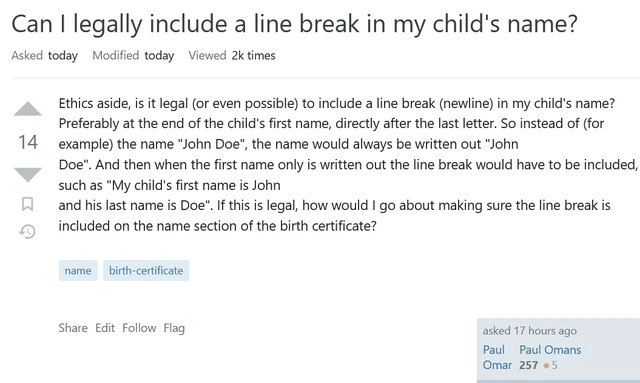
Screenshot of a Stack Exchange question page with the headline, “Can I legally include a line break in my child's name?” The post shows 14 up-votes on the left and has been viewed 2 k times. Body text reads: “Ethics aside, is it legal (or even possible) to include a line break (newline) in my child's name? Preferably at the end of the child's first name, directly after the last letter. So instead of (for example) the name ‘John Doe’, the name would always be written out ‘John
Doe’. And then when the first name only is written out the line break would have to be included, such as ‘My child's first name is John
and his last name is Doe’. If this is legal, how would I go about making sure the line break is included on the name section of the birth certificate?” Tags shown below the question are “name” and “birth-certificate.” The right sidebar credits user Paul Omar with 257 reputation. Visually it mimics typical Stack Overflow styling - white background, light gray text boxes, upvote arrow, and blue link fonts. Technically, the humor arises from treating human names like strings, testing boundary conditions for newline characters, and highlighting real-world input-validation edge cases that databases, forms, and legal systems rarely anticipate

Comments

37
Anonymous ★ Top Pick Go ahead and name him “Evan\n” - just remember to set his middle name to “\r” so at least one of the state’s COBOL birth-registry batch jobs survives the encounter
  1. Anonymous ★ Top Pick

    Go ahead and name him “Evan\n” - just remember to set his middle name to “\r” so at least one of the state’s COBOL birth-registry batch jobs survives the encounter

  2. Anonymous

    Someone's been maintaining legacy government systems for too long and knows exactly which COBOL programs from 1973 will throw a segfault when parsing birth certificates - this is either the ultimate pen test or the most elaborate way to ensure your kid never gets their name spelled correctly on any official document

  3. Anonymous

    This is the inevitable result of spending 20 years debugging why production systems fail on unexpected input: you start wondering if you can inject a \n into the civil registry database. Bonus points if they're also considering whether to use \r\n for Windows compatibility with the hospital's legacy system, or planning a fallback to Unicode line separator (U+2028) if the registrar's validation logic rejects ASCII control characters. The real question isn't whether it's legal - it's whether the birth certificate form uses proper parameterized queries or if this is actually an SQLi vector: "Robert'); DROP TABLE Students;--"

  4. Anonymous

    Name the kid "John\nDoe" - CRLF injection as a parenting style. The hospital EMR thinks you had twins, the DMV issues two records, and every CSV export quietly proves who still doesn’t quote fields

  5. Anonymous

    John\nDoe: Proves even birth registries need better VARCHAR sanitization than most enterprise CRMs

  6. Anonymous

    “John␍␊Doe” isn’t a name, it’s a red‑team test case - HTTP response splitting, CSV formula injection, and log forging, all triggered by a birth announcement

  7. @dvrkplayer 3y

    John <br> Doe

  8. Deleted Account 3y

    Null Doe

  9. @JosTechS 3y

    "John\n Doe"

  10. @FallenChromium 3y

    \n bro. Or \r\n if you're using Windows rather than an actual OS

    1. @choke_hazard 3y

      What is the actual OS?

      1. @jaythemonke 3y

        OS/2

        1. @choke_hazard 3y

          That's not the actual one, only half of it

          1. @jaythemonke 3y

            lies https://en.wikipedia.org/wiki/OS/2

            1. @choke_hazard 3y

              You can't argue when it's literally defined in it's name

              1. @jaythemonke 3y

                idk I’m just a monkey

      2. @FallenChromium 3y

        🐧

        1. @choke_hazard 3y

          Nah man read carefully. I didn't ask about a working model of OS for no-lifers. The question was about actual OS

  11. @maggelia 3y

    Easy, just write John Doe

  12. @affirvega 3y

    ah, this is the slippery road. if this would be allowed, we'll see real life little Bobby Tables in the future

  13. @mcalexvrn 3y

    old but gold

  14. @meisamdev 3y

    😂 🤣 😂

  15. @SamsonovAnton 3y

    How a line break is supposted to match the legal name pattern? /([a-z-]+[ ])*[a-z-]/i

    1. @affirvega 3y

      Why'd you put space in brackets?

      1. @beton_kruglosu_totchno 3y

        Why would you not? It's a valid expression

        1. @affirvega 3y

          well, it is, but feels redundant..

          1. @beton_kruglosu_totchno 3y

            it looks kind of nice, it's somewhat readable

      2. Deleted Account 3y

        obfuscate

        1. @SamsonovAnton 3y

          No, it is all about readability; and expandability, too (for adding alternative word separators if needed).

    2. @RiedleroD 3y

      this can't be the legal name pattern because then just a singular dash would be legal

    3. Deleted Account 3y

      /([a-z]|[a-z][a-z -][a-z])+/i

  16. Deleted Account 3y

    OH NO

    1. @ZgGPuo8dZef58K6hxxGVj3Z2 3y

      Is that a nullbyte?

      1. Deleted Account 3y

        it sure is

        1. @ZgGPuo8dZef58K6hxxGVj3Z2 3y

          So he is now just John?

  17. @glatavento 3y

    Why names can only be strings

  18. @glatavento 3y

    Let's give trees some chance

Use J and K for navigation