Quietly inverting a binary tree while everyone else enjoys the party
Why is this CS Fundamentals meme funny?
Level 1: Party Puzzle
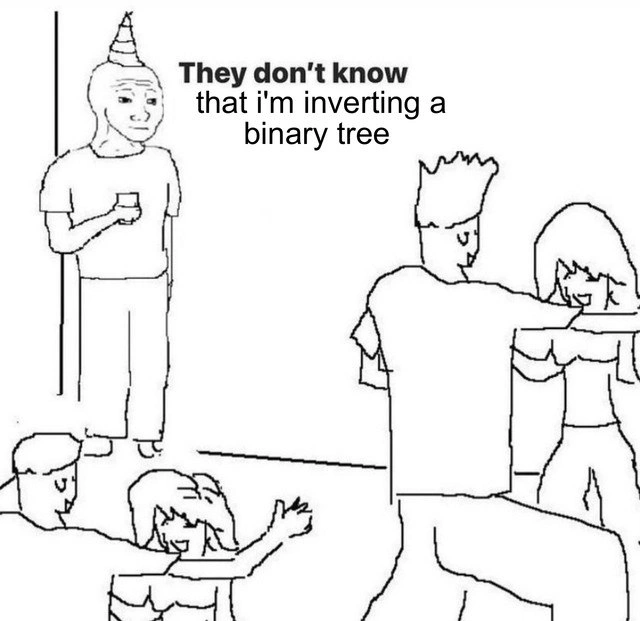
Imagine you’re at a fun birthday party where everyone is dancing, laughing, and having a good time together. But there’s one quiet person standing off to the side, wearing a party hat and holding a drink, who isn’t joining in. Instead of thinking about the music or talking to friends, this person is busy solving a little puzzle in their head. It’s like if you went to a kids’ party and one kid spent the whole time secretly figuring out a Rubik’s Cube or a brain teaser while everyone else played games. The funny part is that nobody else knows what’s going on in that person’s mind – they all think he’s just shy or standing there, but actually he’s working through his own secret game. In this case, the “puzzle” is a computer kind of puzzle (flipping the sides of a pretend tree structure in his imagination). The picture is humorous and a bit sweet because it shows a person who feels a little out of place socially, so they comfort themselves by focusing on something they enjoy and understand well. Everyone around is clueless about it, which makes it a silly little secret. Essentially, it’s saying: while others are partying, this quiet friend is happily doing his own mental mind game, and that contrast makes us smile.
Level 2: Binary Tree Basics
Let’s break down why this scene is funny for those newer to coding or not as familiar with the terms. A binary tree is a fundamental data structure in computer science. Imagine an upside-down family tree or organizational chart: each element, called a node, can branch out to up to two other nodes. We typically call one branch the left child and the other the right child. Now, inverting (or “mirroring”) a binary tree means flipping it around: every left child becomes a right child, and every right child becomes a left child. Picture holding a tree diagram up to a mirror – the structure reflects across an axis. The process to do this in code usually uses recursion (a technique where a function calls itself). You traverse the tree, and at each node, you swap its two children. Keep doing that down the tree and eventually the entire diagram is flipped. It’s a clean, elegant algorithm often taught in school and used as a practice exercise.
So why is this person at a party thinking about that? This is poking fun at the stereotype of a shy or introverted programmer. The text in the image – “They don’t know that I’m inverting a binary tree” – comes from a popular meme template. In this template, a drawn character stands alone at a party thinking “They don’t know that I’m ___,” with the blank usually filled by some personal secret or niche interest. Here, the blank is filled with a super nerdy activity: “inverting a binary tree.” The joke is that everyone else at the party is happily dancing, talking, and having fun, completely unaware that this one quiet individual is mentally running through a coding problem.
Why specifically inverting a binary tree? It’s kind of an inside joke among programmers. In programming interviews — especially for big tech companies — candidates are often asked to solve algorithmic puzzles. BinaryTrees and other data structures come up a lot. “Invert a binary tree” is actually an infamous example of an interview question (it’s even a problem on LeetCode, a website where developers practice interview problems). It’s not a hard question, but it’s well-known. Many people preparing for software engineering jobs spend evenings and weekends practicing problems just like this. So, the cartoon captures a funny reality: instead of enjoying the party, this developer might be so deep in interview prep mode or their own coding world that they’re practicing a solution in their head.
This is humorous because of the contrast. For most people at a party, the furthest thing from their mind would be a computer science problem. The others on the dance floor likely have no idea what a “binary tree” or “inverting” one even means — hence “They don’t know…”. The lone character represents a socially awkward dev, someone more comfortable with algorithms and LeetCodeProblems than with dance moves or small talk. The meme is essentially laughing at how out-of-place that serious computational thinking is in a casual social setting. Yet, it’s also warmly familiar to many programmers who might chuckle and think, “Haha, sometimes I am that person!” It highlights the quirky ways computer science enthusiasts can blend their passion (or anxiety about interviews) with everyday life, even if nobody else around them is aware of it.
Level 3: Recursion on the Rocks
At first glance, this meme hits experienced developers with a wave of recognition and nerdy humor. The party scene is classic: while everyone else is dancing and chatting, our lone wallflower is off to the side, lost in thought. What’s on his mind? Inverting a binary tree – a task so algorithmic and specific that it immediately screams “coding interview prep.” Seasoned devs know this scenario all too well. It’s a tongue-in-cheek nod to how many of us have been that person mentally debugging code in a social setting. In fact, “invert a binary tree” is almost legendary in tech circles: it’s famously known as LeetCode problem #226 and a staple of CS_fundamentals questions. The algorithm itself is straightforward: you take a binary tree (a data structure where each node has up to two children) and swap each node’s left and right children, recursively, throughout the whole tree. The humor here comes from the absurd context switch – a lively party versus an internal whiteboard interview session.
For a senior engineer, the scene is both funny and a little heartwarming. We’ve spent years dealing with complex systems, yet this simple recursive algorithm remains a shared cultural touchstone from our early days. The code for it is practically muscle memory:
def invert_tree(node):
if node is None:
return None
# Recursively invert the subtrees
left_inverted = invert_tree(node.left)
right_inverted = invert_tree(node.right)
# Swap the left and right children
node.left, node.right = right_inverted, left_inverted
return node
This ~10-line function is taught in every introductory algorithms course and revisited in countless interview prep sessions. Its time complexity is O(n) (we visit each node once) and it uses recursive depth proportional to the tree’s height. In other words, it’s a bread-and-butter coding problem – not exactly something you’d expect to be the life of the party! And that’s exactly why it’s hilarious: while the crowd cheers the DJ, our guy is cheering on a different kind of root (the root node of his binary tree). He’s not exactly branching out socially, but he sure is swapping some branches in his mental data structure. 🥳
The meme taps into that shared understanding among developers: sometimes we find comfort in logic puzzles and code, even in the most non-tech settings. It pokes fun at the socially awkward dev stereotype – the idea that writing or visualizing code can feel safer than making small talk. Many of us chuckle because we’ve been there: maybe at a company holiday party or a friend’s birthday, nursing a drink quietly while our mind drifts to that tricky bug or a neat algorithm we read about. It’s an interview humor double entendre too – the phrase “They don’t know that I’m inverting a binary tree” implies the people around him have zero clue about this niche data structure problem consuming his attention. And honestly, why would they? To non-engineers, binary trees and recursion might as well be magic spells. For veteran devs, though, this image triggers fond (or harrowing) memories of late-night coding practice: we remember grinding through dozens of LeetCode problems at the expense of a social life. The meme says: here stands a programmer physically at a party but mentally in a coding interview. It’s a perfect snapshot of the comical disconnect between a developer’s inner world and the surrounding reality.
Description
Black-line cartoon of the classic “They don’t know I’m X” party meme: a lone figure wearing a cone birthday hat stands by the wall holding a drink, looking at a group dancing in the foreground. Above the isolated character, bold text reads “They don’t know” with smaller text underneath saying “that i'm inverting a binary tree.” The drawing is minimalist, with stick-like limbs and simple outlines, emphasizing social distance. The humor comes from a developer mentally performing the well-known recursive algorithm to swap left and right children of every node instead of participating in the social event, a scenario familiar to anyone practicing interview questions like LeetCode 226. The meme highlights the intersection of computer-science problem solving and awkward real-world situations
Comments
6Comment deleted
Let them party - tomorrow the execs will call for an org-chart reorg, and my O(n) left-right swap skills will finally justify all those LeetCode weekends
Twenty years in tech and I'm still mentally inverting binary trees at parties while my actual job is explaining why we can't just "make it work like Google" with our three-person team and technical debt from 2008
The real O(n) complexity here isn't the tree inversion - it's the mental overhead of context-switching between small talk and recursively swapping left and right child nodes. Every senior engineer knows that feeling: physically at the party, mentally traversing a BST, wondering if they should've just used a queue for the iterative approach instead
They're level-order partying; I'm recursively mirroring subtrees without a stack overflow
LeetCode 226 is O(n) to swap children; the senior problem is deciding if the API expects an immutable mirror or in-place mutation - pick wrong and you invert your on-call rotation instead
Senior dev party trick: invert a binary tree - the only mirror where left and right swap predictably and nobody opens a Jira