The One Weird Trick to Get Your JIRA Tickets Noticed
Why is this ProjectManagement meme funny?
Level 1: Chore List Clickbait
Imagine you have a really boring chores list to write for the week. It might say things like “Clean your room,” “Do your homework,” or “Take out the trash.” Pretty dull, right? Now, for fun, imagine writing those chores like they’re exciting news headlines on YouTube or in a comic book. Instead of "Clean your room," you write, "Child Discovers Secret to the Ultimate Room Makeover – Mom Can’t Believe Her Eyes!" Instead of "Do your homework," you write, "You Won’t Believe What Solves This Math Problem – Teachers Are Shocked!". Suddenly, your boring tasks sound like epic adventures or crazy stories. It’s super silly, yes, but it grabs your attention and maybe makes you giggle. That’s exactly why this developer meme is funny. Developers usually have to write down tasks in a plain way at work (like a chores list for coding). But the idea of making those task titles sensational – like wild clickbait headlines – is so over-the-top and unexpected that it makes people laugh. It’s like taking something ordinary and dressing it up in a sparkly, ridiculous costume. The heart of the joke is that we sometimes need to make boring things fun. Even grown-up programmers daydream about making their “to-do” lists exciting. So this meme is funny because it shows a programmer saying, “Hey, what if I wrote my work tasks like they’re the most amazing news ever?!” – which is a crazy thing to do, and that craziness is what makes it hilarious and easy to relate to.
Level 2: Scrum Board SEO
Let’s break this down for those newer to the world of software teams. First off, Jira is a popular tool (made by Atlassian) that software teams use for tracking work. Think of Jira as a giant to-do list specifically designed for tech projects. Each task or issue gets its own card, commonly called a Jira ticket. A ticket typically has a title (a brief summary) and a description with more details. For example, a ticket title might be “Fix the login bug” or “Add search feature to homepage”. These titles are normally straightforward so everyone on the team instantly knows what it’s about. Jira is heavily used in Agile methodologies, like Scrum or Kanban, where teams organize work into a backlog (a big list of all to-do items) and sprints (short development cycles, usually 1-2 weeks long, where a subset of tasks is completed). Teams have regular meetings (daily stand-ups, sprint planning, backlog grooming) to discuss these tickets. So, writing clear and informative ticket titles is actually important – it’s a key part of team communication. If you’re new on a team, you quickly learn that a well-written ticket title helps everyone understand the task at a glance.
Now, what about clickbait? You’ve probably seen clickbait on the internet even if you didn’t know the name. Clickbait refers to those outrageous or curiosity-provoking headlines that beg you to click on an article or video. They often use tricks like withholding key info (“You won’t believe what happens next!”), using emotional adjectives (“shocking”, “amazing”), or listicle formats (“7 Incredible Tips to Improve X”). The goal is to grab your attention so you can’t resist clicking. For instance, a normal news headline might be “Local Cat Rescued from Tree,” whereas a clickbait version would scream “You Won’t Believe How This Heroic Cat Rescue Unfolded!” See the difference? The clickbait one sounds dramatic and exciting, even if the underlying story is the same. It’s like candy-coated text meant to spark curiosity. On social media and content sites, clickbait headlines are everywhere because they drive engagement (more clicks, more reads). We usually associate clickbait with entertainment or questionable “news” sites, not with serious work documentation.
So the joke here is mixing those two worlds: taking serious work tickets in Jira and giving them silly, exaggerated clickbait-style titles. Imagine opening your company’s sprint board and seeing task names that read like flashy headlines! It’s unexpected and that’s why it’s funny. Let’s look at a few hypothetical examples of how a normal Jira ticket vs. a clickbait Jira ticket might sound:
| Plain Jira Ticket Title | Clickbait Jira Title |
|---|---|
| Fix login bug | User Locked Out? You Won’t Believe the Cause! |
| Add a search filter option | This Simple Feature Trick Will Change How You Search Forever! |
| Update outdated library for security | Critical Vulnerability Discovered – The One Update That Could Save Us All! |
In the left column, you have the kind of no-nonsense titles you’d typically see on a Scrum board or Kanban board. They’re short and factual. On the right, we’ve rewritten them to sound like sensational headlines. We’ve thrown in some classic clickbait elements: a question to pique interest, words in bold or all-caps for emphasis (like “Critical Vulnerability”), and dramatic promises like “change forever” or “save us all”. The result is that the mundane task suddenly sounds like a breaking news story or a must-read article. It’s immediately more entertaining, even though it’s describing the exact same work. For someone new to this concept, seeing these side by side makes it clear how much the phrasing changes the tone.
Of course, in a real workplace, people don’t usually write Jira ticket titles like that. There’s an understood professionalism and format to maintain (plus, your project manager might raise an eyebrow if a sprint task reads like a BuzzFeed headline!). The tweet is meant in good fun. It’s poking fun at the idea that developers might resort to marketing gimmicks just to make their user stories or bugs sound exciting. It’s comedy, not a serious best practice. In reality, during backlog grooming (which is a meeting where the team reviews and clarifies those Jira tickets), the focus is on making sure each title and description is clear and accurate, not sensational. Clarity helps the team understand the work and helps new team members ramp up. However, precisely because the process is often so dry and serious, imagining a twist like this is hilarious. It’s like doodling in the margins of a serious document – a harmless way to make yourself smile.
For junior developers or those just starting out, this meme also carries an underlying lesson: don’t be intimidated by all the formal process to the point you lose your sense of humor. Yes, agile workflows and tools like Jira impose structure and sometimes tedious rules (like always writing tasks as user story statements: “As a [user], I want [something] so that [benefit].”). Those are meant to improve communication, but it’s okay to find them a bit ridiculous at times. Many of us have had that first exposure to corporate tools and thought, “Seriously, do I have to fill out all these fields just to say I’m fixing a typo?” That’s a common early-career feeling. What this tweet shows is a bunch of experienced devs essentially saying, “We feel you. We also think it’s overkill sometimes – so much so that we joke about jazzing it up like an online article.” It humanizes the whole process. TechHumor like this also serves as a gentle reminder: work can be fun. A team that can share a laugh over something like this is usually a healthy team! It means people recognize the absurdities and cope together. So next time you’re stuck writing a boring task title, maybe you’ll remember this joke and secretly imagine what the clickbait version would be, just for your own amusement.
In summary, the phrase “writing clickbait titles for JIRA tickets” is a lighthearted way to highlight how dull routine tasks can be made fun and engaging in our imagination. It’s part of the wider genre of DeveloperHumor and AgileHumor that turns the quirks of tech work into something to laugh about. After all, if you can laugh about endless meetings, confusing requirements, or tedious documentation, they suddenly become a bit easier to handle. This meme took a very specific slice of developer life – grooming tickets in an issue tracker – and turned it into a moment of creative comedy. And judging by how many likes and retweets it got, a lot of people in the tech community needed that laugh!
Level 3: Headline-Driven Development
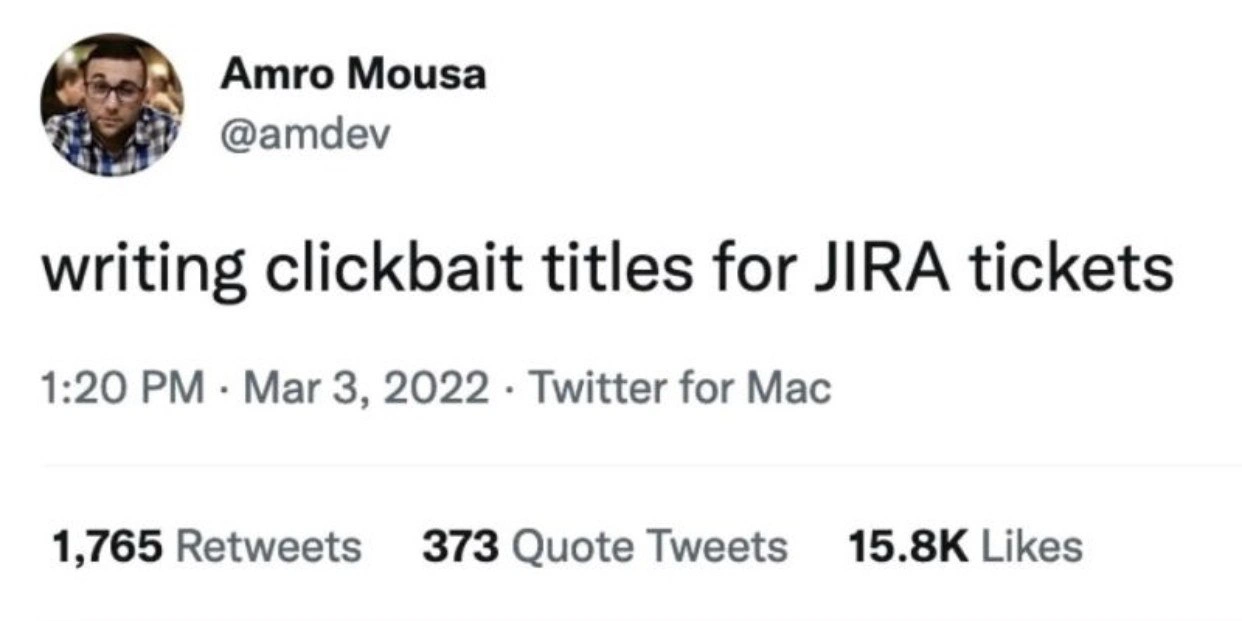
At first glance, this tweet might seem like just a throwaway joke, but to a seasoned developer it reveals a layered commentary on Agile life. Here we have a dev joking about applying BuzzFeed-style tactics to a Project Management tool: writing clickbait titles for Jira tickets. It’s a clever collision of worlds. Jira is an issue tracker where we normally keep things dry and factual – “Upgrade library X to 1.2.3” – while clickbait is all about sensationalism – “You Won’t Believe What Version 1.2.3 Can Do!” The humor comes from that absurd contrast. The tweet itself went viral (over 15K likes!), meaning thousands of other developers nodded and laughed in solidarity. Why? Because they’ve sat through mind-numbing backlog grooming sessions and stand-up meetings, and the idea of spicing up those dull ticket titles with tabloid flair is both ridiculous and tantalizingly relatable. It’s a form of AgileHumor that thrives on exaggerating our everyday pain points.
On an industry level, this meme riffs on the unspoken truth that much of software development isn’t glamorous coding – it’s communication. We spend significant time in ProjectManagement mode: writing user stories, updating tickets, and crafting status updates. A senior engineer knows that writing a good Jira ticket is an art of its own (clear, concise, with just enough detail to keep stakeholders happy). But this tweet jokes: why stop at clarity when you could aim for engagement? It satirically suggests treating the sprint backlog like a content feed where each ticket must vie for attention. Issue tracker clickbait is a tongue-in-cheek solution to a real frustration – sometimes it feels like you practically have to market your tasks to get them noticed by a busy manager or get that elusive +1 in grooming. The phrase “writing clickbait titles for JIRA tickets” conjures images of a developer agonizing over a user story headline as if it’s an article on a high-traffic tech blog: “Critical Bug Fix – You’ll Never Guess the Root Cause!” 😅. It’s funny because it rings too true: we’ve all seen JIRA issues or email subject lines that try a bit too hard to grab attention. The meme exaggerates this to comic effect, hinting that maybe a dash of scrum_board_seo (Scrum board search optimization) is the next step in office hijinks.
Consider how this resonates with real team experiences. In a sprint planning meeting or backlog refinement, everyone’s reviewing ticket titles on the big screen. Usually they’re bland and formulaic. Now imagine one titled “Database Crash Reveals Shocking Truth About Null Values”. The room would crack up! It’s the contrast with the usual tone that makes it hilarious. In fact, veteran developers often cope with the tedium by adding a sprinkle of humor – whether it’s a funny branch name, a witty commit message, or an Easter egg in the code. Here that outlet is the Jira summary field. There’s also a satirical nod to how corporate culture can prioritize style or visibility over substance. A grizzled engineer might quip, “We spend more time wordsmithing tickets than coding the fix.” The tweet plays right into that cynicism: if we’re going to obsess over ticket wording anyway, why not go full tabloid? It’s a gentle jab at MeetingHumor and the often over-the-top nature of office communication. It also reflects a bit of battle-scarred reality – after years of chasing elusive managerial approvals, a dev might joke that the only way to get a PM’s attention on a refactor task is to title it like a breaking news alert. In other words, the meme laughs at the game behind working in a team: sometimes you have to package the work to make it visible.
Digging deeper, there’s an implicit commentary on the skills developers end up cultivating. Beyond writing code, you become a translator and promoter of technical work. Writing a Jira ticket can feel like writing a mini story: it needs a clear title, a compelling description, maybe some acceptance criteria – not unlike an article with a headline and content. Great communication is a core agile principle, but this meme wryly asks: what if we overshoot and apply SEO tricks to internal communication? It’s the absurd extreme of being thorough. Imagine A/B testing two versions of a story title during sprint planning to see which one team members are more “likely to click on” (read: actually groom and implement). It’s obviously not a serious suggestion, and that’s why it’s funny. Seasoned devs appreciate this duality: they value clarity and brevity, yet they chuckle at the notion of jazzing up a boring task for laughs. In fact, this tweet’s popularity became a little shared wink among developers – a mix of “Haha, good one” and “Hmmm, I kind of wish we could do that sometimes.” After all, when you’ve been paged at 3 AM for production issues or slogged through legacy code, you learn to seize any chance for humor. Even something as mundane as a Jira summary line can be transformed into an inside joke. In summary, writing clickbait titles for JIRA tickets is a playful revolt against routine, a form of DeveloperHumor that highlights how creativity and satire thrive even in our task trackers and scrum boards.
Description
A screenshot of a popular tweet from user Amro Mousa (@amdev) on a clean white background. The tweet, which has garnered significant engagement with 1,765 Retweets and 15.8K Likes, simply reads: 'writing clickbait titles for JIRA tickets'. The profile picture shows Amro Mousa, a man with glasses and a plaid shirt. The timestamp indicates the tweet was sent at '1:20 PM · Mar 3, 2022 · Twitter for Mac'. The humor lies in the absurd juxtaposition of sensationalist, attention-grabbing 'clickbait' headlines with the typically dry, technical, and mundane nature of JIRA tickets. For senior developers who have spent years navigating overwhelming backlogs and poorly written tasks, this is a highly relatable joke about the struggle to prioritize and communicate effectively within the rigid structure of corporate project management tools
Comments
19Comment deleted
Forget story points. The new way to estimate priority is by the cringe-level of the clickbait title. 'This One Line of Code Is Causing a Cascade Failure, What Happens Next Will Shock You' is definitely a blocker
“Rename ‘Fix null pointer in billing’ to ‘Senior engineer deletes ONE line, saves $3M - CFO stunned!’ and watch product turn your 1-point bug into a strategic roadmap epic.”
After 15 years in the industry, I've learned that the difference between a P1 and P3 ticket isn't the actual severity - it's whether you titled it 'CRITICAL: System optimization needed' versus 'You Won't BELIEVE What This Database Query Does (Developers HATE This One Weird Bug!)'
It works: 'Top 10 reasons checkout is down (number 3 is the load balancer)' got picked up in one sprint; 'Fix prod bug' is entering its third year in the backlog
When your P2 bug has been sitting in the backlog for three sprints, you realize the real skill isn't writing clean code - it's crafting a ticket title so compelling that the PM can't resist dragging it into the next sprint. 'Critical: Users HATE this one weird rendering bug (stakeholders won't believe #4)' suddenly becomes your most valuable engineering contribution
Because 'Refactor auth' becomes 'Hackers Hate This One Weird Endpoint Fix' - P0 priority unlocked
Backlog growth hack: rename “null deref in payments” to “This one-line fix unlocks 12% revenue and restores SLOs” - watch WSJF skyrocket faster than our burn rate
A/B tested JIRA titles: “Add index to orders” died in triage; “This one weird trick slashes P99 latency” got promoted to P1
Delete 69 lines of unused code 😀 Comment deleted
YOU WON'T BELIEVE HOW THIS BUG WAS FIXED (GONE SEXUAL) Comment deleted
Don't watch this HOT topic while your PM is nearby! Comment deleted
rip jira Comment deleted
Not safe for QA Comment deleted
90% of developers can't fix this bug Comment deleted
HOW NOOBIE DEV ADDED THE MOST COMPLEX FEATURE (18+) Comment deleted
Stop doing shit fixing this bug. This dev already did it instead of you Comment deleted
SECURITY ANALYSTS HATE THIS ONE SIMPLE TRICK Comment deleted
🌚 Comment deleted
How this ugly motherfucker DESTROYED the database scheme Comment deleted