The Ultimate Recruitment Hack: The Return-to-Office Mandate
Why is this RemoteWork meme funny?
Level 1: Follow the Fun
Imagine you have two friends’ houses where you could hang out after school. At one friend’s house, the parents just decided that before anyone can play, they have to sit quietly and do an hour of extra homework. But at the other friend’s house, the parents are saying you can start playing video games right away with no chores or homework required. Where do you think all the kids will want to go? Of course, everyone will run to the house where they can have fun and be free.
This meme’s joke is just like that. One company turned into the “strict house” by forcing people back into a boring routine (the office), and the other company is the “fun house” that lets people keep their freedom (working from home). All the engineers (the kids in our story) naturally flock to the fun place. It’s funny because it’s so obvious that the strict company basically pushed its best people right out the door and into the neighbor’s open arms. Just like kids following the fun, the engineers followed the flexibility – and the company that provided it ended up with a bunch of new happy team members, so easily.
Level 2: The Poaching Playbook
Let’s break down what’s happening in simpler terms. A company (we’ll call it Company A) announced a return to office policy. “Return to office” (often shortened as RTO) means the bosses want everyone to stop working from home and start coming back into the physical office building to do their jobs. This was a hot issue in 2021-2022, because during the COVID-19 pandemic many people worked from home for a long time and got used to it. Engineers and other tech workers discovered they could be just as productive (or sometimes even more so) without the daily commute and the office distractions. So, by the time some companies started saying “Alright, pandemic’s over, back to your desks in the office!”, a lot of employees weren’t too happy about giving up the WorkFromHome lifestyle.
Now, enter Company B (a competitor of Company A). Company B hears the news that Company A is forcing people back to the office. Company B has a different stance: they’re fine with RemoteWork, meaning they’re okay with their employees working from home indefinitely. The meme describes a tactic from Company B’s CEO: the moment Company A mentions RTO, Company B’s tech recruiters reach out to Company A’s engineers. A recruiter is someone whose job is to find and persuade people to join their company. TechRecruiting in particular means looking for skilled people like software developers, and convincing them to come on board.
What does it mean that they “reach out to their people”? It means the recruiters from Company B are sending messages (often on LinkedIn or via email) to the engineers who work at Company A. The message is basically: “Hey, we heard your company is making everyone go back to the office. Just so you know, we’re hiring and we don’t require office work — you can work from home here. Interested?” This strategy of trying to hire employees away from another company is informally called talent poaching or just poaching. It’s like when one sports team tries to sign a star player from a rival team. In the tech world, poaching is pretty common, especially when employees are unhappy or when one company has a reputation for better conditions.
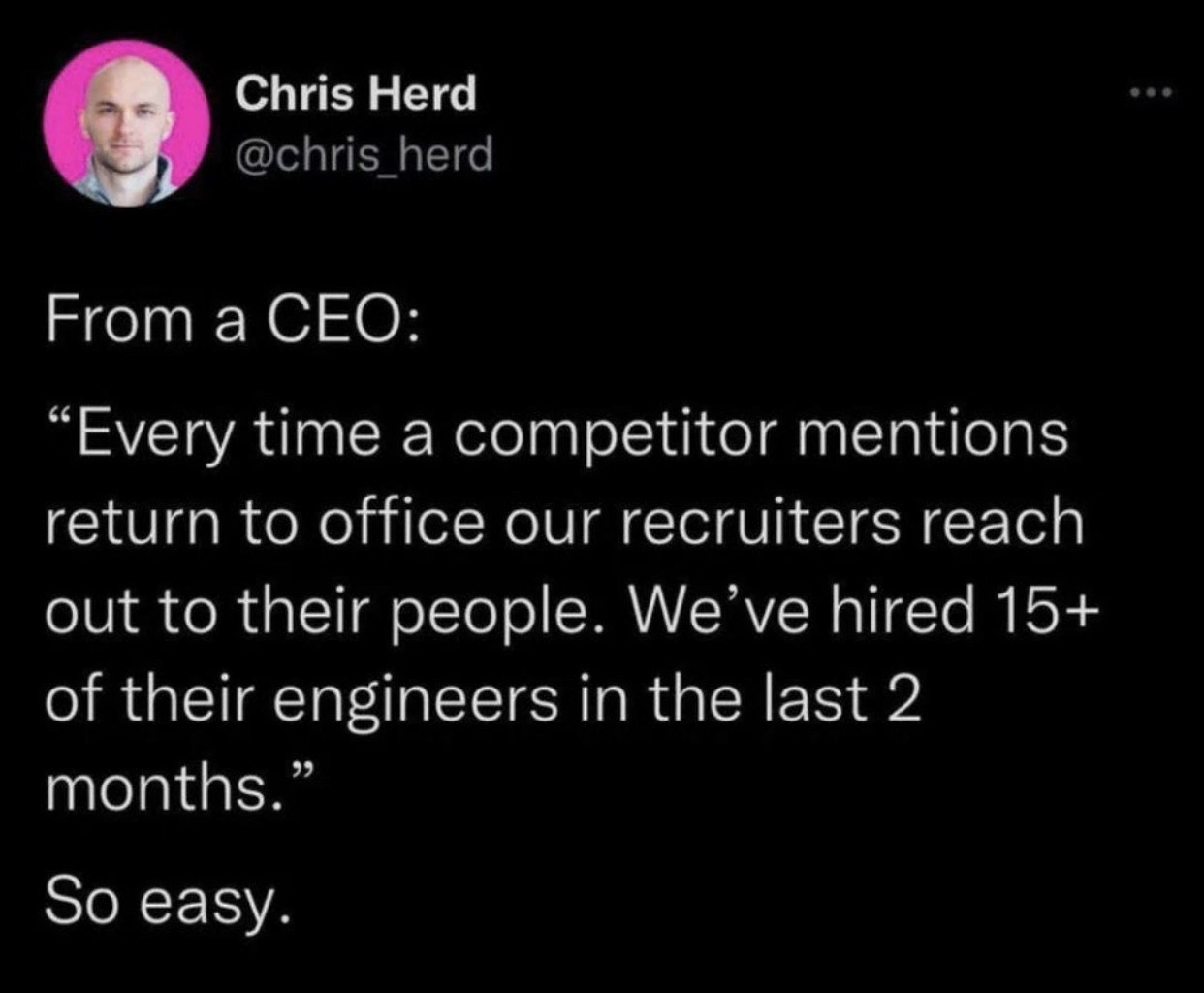
So over a short period (the tweet says “the last 2 months”), Company B managed to hire 15+ engineers from Company A. That’s fifteen skilled people jumping ship from one company to another in about 8 weeks. For a team of engineers, losing 15 people that fast is a big hit – it’s basically a wave of resignations. We call this kind of loss attrition (meaning people leaving). So you could say Company A experienced a spike in engineer attrition right after announcing the RTO policy. Those engineers didn’t all spontaneously decide to leave on their own; they were actively lured away by Company B’s offers. And why did Company B need so little convincing? Because a lot of people really value the option to WorkFromHome. In the post-pandemic JobMarketTrends, flexible work arrangements became one of the top things employees look for.
The punch line of the tweet is “So easy.” It implies that recruiting those engineers was almost effortless. Company B didn’t need an elaborate marketing campaign or expensive hiring agency. All they had to do was wait for Company A to make a move that upset its own staff, and then Recruiter_Playbook 101: swoop in with a better deal. It’s a bit of HiringHumor mixed with reality. The joke here is that Company A basically did itself in. The moment they told everyone to return to office, they inadvertently sent a signal to competitors: “Our people might be looking for an escape.” And Company B simply took advantage of that signal. It was as straightforward as seeing someone unhappy and saying, “Hey, we won’t make you do that thing you hate. Come join us.”
For a junior developer or someone early in their career, the takeaway is how much corporate policies and WorkFromHome culture can affect employees’ choices. Tech companies often compete for talent, and seemingly small things – like whether you can work remotely or have to be in the office – can tip the scales. This meme is pointing out, with a bit of a laugh, that in today’s tech world if a company becomes less flexible or less appealing to its engineers, those engineers might quickly get stolen away by another company that offers what they want (in this case, freedom to work from anywhere). In short, Company B found a recruiting shortcut: wait for Company A to make its people unhappy, then offer those people a happier option. It’s sneaky but apparently very effective!
Level 3: The RTO Backfire
In the grand saga of RemoteWork vs Return-to-Office (RTO), this tweet captures a clever battlefield tactic in the tech talent wars. The quote comes from a CEO who reveals his recruiting hack: whenever a competitor announces a mandatory return to office, his company’s recruiters immediately swoop in to poach that competitor’s engineers. It’s a brilliant example of turning an opponent’s CorporateCulture misstep into your own gain. Why does this work so well? Consider the context: by March 2022, many companies started rolling out "back to office" policies after a long period of pandemic-era Work From Home (WFH). But a lot of software engineers had grown very fond of remote work — think of all the code written in pajamas and all the commuting hours reclaimed for side projects or family time. Forcing these folks to commute again, sit under fluorescent lights, and give up that newfound flexibility was not a popular move. In fact, it often led to engineer attrition: valued developers voting with their feet and leaving for more flexible employers.
Enter the opportunistic competitor. As soon as Company A’s CEO says, “Alright everyone, time to come back to HQ five days a week,” you can bet many engineers at Company A start feeling grumpy or even start dusting off their resumes. Company B’s CEO (the one in the meme) basically says: “Great, that’s our cue!” — and sends in the recruiters. Those recruiters know exactly who to target, often using LinkedIn or their network to discreetly contact the potentially unhappy engineers. The message practically writes itself: “Hey, we heard your company is mandating office time again. Just so happens we have a bunch of remote-friendly positions open. Interested in staying fully remote? Let’s talk. 😎”* Suddenly, Company A’s unpopular RTO policy has become Company B’s recruiting pipeline. It’s almost like Company A did the hard part (making their talent ripe for poaching) and Company B just harvests the result. No wonder the CEO smugly says “So easy.”
This scenario is both hilarious and painfully real to experienced developers and tech managers. It highlights an ongoing post_pandemic_workplace trend: companies that cling to old-school in-office mentality are handing an advantage to competitors willing to embrace modern RemoteWorkCulture. In the fast-paced tech job market, good engineers have options galore. By 2022, many devs would choose a flexible remote role over a higher-paying but office-bound job. Smart companies know this. They’ve added “fully remote” or “work from anywhere” to their list of perks, right alongside free snacks and 401(k)s. The tweet shows that some companies even weaponize this perk as a TechRecruiting strategy. It’s a bit like industrial espionage meets HR: use the competitor’s unpopular policy against them. Historically, we might compare it to Sun Tzu’s old adage from The Art of War: “If your opponent is making a mistake, do not interrupt them.” Here, Company A’s “mistake” (from the employees’ perspective) is demanding a return to office. Company B doesn’t interrupt; they quietly approach each discontented engineer with a solution (a new job offer) before the competitor even realizes what happened.
To put it in dev terms, it’s almost like writing a script to automate recruiting based on trigger events. Pseudocode for this CEO’s strategy might look like:
if competitor.policy == "return_to_office":
for engineer in competitor.engineers:
recruiters.send_message(engineer,
subject="Work from Home Opportunity",
body="Tired of the office? We support remote work. Let's chat!")
It’s humorously efficient. Typically, hiring top engineers is hard – it can take months of sourcing and interviewing to fill a role. But here, a rival company’s RTO announcement is doing half the work: it identifies who’s likely unhappy and nudges them to jump ship. The tweet’s punch line “So easy.” underscores how absurdly effortless this felt for the poaching company.
Beyond the joke, there’s a real commentary on CorporateCulture shifts. Remote work has become a bargaining chip. The meme resonates with developers because many have lived this: perhaps you or colleagues got that LinkedIn message the day your employer announced a strict office mandate. It’s a mix of schadenfreude and validation — schadenfreude because it’s a bit funny to see a stubborn boss lose talent overnight, and validation because it confirms what employees have been saying all along: flexible work is a huge draw. Seasoned engineers nod knowingly because we’ve seen companies underestimate how much folks value autonomy. In an industry already notorious for talent_poaching, this remote-work tug-of-war is the new normal. So the humor has an edge of truth: in 2022’s tech landscape, one of the fastest ways to lose 15 developers is to tell them to come back to the office, and one of the fastest ways to gain 15 developers is to offer them the freedom to stay home. So easy, indeed, as long as you’re on the right side of the remote-work revolution.
Description
A screenshot of a tweet from user Chris Herd (@chris_herd) on a black background with white text. The profile picture shows a man with a shaved head in a pink-to-purple circular frame. The tweet's text starts with 'From a CEO:' followed by a direct quote: 'Every time a competitor mentions return to office our recruiters reach out to their people. We’ve hired 15+ of their engineers in the last 2 months.' Below the quote, Chris Herd adds his own commentary: 'So easy.' The post humorously highlights a major cultural and logistical shift in the tech industry following the rise of remote work. For senior developers, the joke resonates deeply because it frames the controversial 'return to office' (RTO) mandates not just as a preference but as a competitive disadvantage for companies that enforce them, turning them into a predictable source of top-tier talent for more flexible, remote-first organizations
Comments
43Comment deleted
Some companies are spending millions on retention bonuses, others are just monitoring LinkedIn for competitors announcing a three-day-a-week in-office mandate
We just consume the competitors.rto Kafka topic - every “mandatory office” event triggers a Lambda that bulk-sends offer letters to their principal engineers. Zero-downtime talent migration
The best debugging tool for fixing your talent retention problem? Apparently it's your competitor's RTO policy. Nothing quite like watching your carefully cultivated engineering team get git pulled by a company that understands async work isn't just for JavaScript callbacks
The cheapest sourcing tool in tech: a Google Alert on competitors' 'exciting news about our office culture' blog posts
When your competitors implement RTO policies, they're essentially running a distributed talent pipeline directly into your Slack channels - no API integration required. It's like they're doing your sourcing work for you, except they're paying the AWS bills while you collect the engineers. The real MVP here isn't the CEO's strategy; it's the competitors who keep A/B testing 'office mandates' as a retention mechanism and consistently getting statistically significant results... in the wrong direction
RTO mandates are like competitors' git push --force: they overwrite their own team history, and we cherry-pick the commits
Our recruiting is event-driven: when a competitor flips the 'return-to-office' feature flag, a webhook fires and our pipeline migrates their senior engineers
Treat Return-To-Office as an incident: alert fires, recruiters autoscale, and we fail over their senior ICs into our cluster - RTO becomes our Recovery-of-Talent Objective
See I want to work in an office Comment deleted
do you live alone? Comment deleted
Why? Comment deleted
curious to know why you want to work in an office Comment deleted
it's cool to have a social life guys :) to see co-workers, have a drink with them, talk with them :) Better than stay at home 24/7 🤙 Comment deleted
ok extrovert Comment deleted
it's good for health you know to have social relationship 😁😁 Comment deleted
ok, but I can do that without leaving my house, you know. Comment deleted
it's not the same at all ! talking with someone on the phone or behind a screen, will never replace physical interaction. I would even say that it does the opposite, when you use too much digital interaction, you won't konw how to do it ine real life after a while Comment deleted
> will never replace physical interaction for you. The difference for me is that I don't get a panic attack when talking to strangers online. Comment deleted
me too ! i'm not afraid of talking to some strangers online. But i'm pretty sure that the human being was made for real interaction, not digital one !! Anyway i hope you're enjoying your life talking to machine !! Comment deleted
video/voice messages? Comment deleted
the human being wasn't made at all. I do enjoy talking through machines to people; it helps me socialize without triggering my flight or fight response 👍 It's getting better though, so I might start seeing ppl in my free time irl someday soon. Comment deleted
it will be good for you i'm pretty sure 👌 Comment deleted
Work related, i dont mind spend the working hours at home at all. and i have a very active social life. AFTER work, i have time to grab a beer, hang out with friends and coworkers without spending 2 hours daily in traffic Comment deleted
You also can have social life OUTSIDE of your work. Work is not your home, co-workers aren't your family and most of them probably not even your friends. You probably won't even see those people if you or them get fired. Comment deleted
if you don't like your job and over all have no social life with your coworkers... it's kinda pain in the ass Comment deleted
Liking your work have nothing to do with your social life at work. I enjoy my work. And I also enjoy not speaking with my co-workers about some random stuff which is unrelated to work. It might be bad for you, if you are an extroverted person but it's also the opposite if you are an introverted person. Not all people like communication. For me, one of the reason, why I choose to work as a developer is the possibility to have as less interaction with other people as possible. And I'm sure, I'm not the only one. Comment deleted
every one is different ! if you like your life this way, then it's good for you :) but for me it's impossible to go to work and speak with no one, just do my work and go back home. Comment deleted
i live at home with my wife and no friends for 3 years now i go out weekly tho to teach kids and work on stuff at sunday Comment deleted
not really sure what this has to do with working in an office, you can still make friends and meet up with people outside of work Comment deleted
or you can work in office and have zero social life like i had in the past cos fuck people Comment deleted
Work is where you spend the major part of your life... It is better to make it positive in my opinion Comment deleted
i like to spend majority of my life doing useful stuff Comment deleted
If you have enough money to do useful things and things that you love, then you're lucky and i'm happy for you Comment deleted
i dont, but i have time to share my knowledge with kids instead of drinking beer Comment deleted
So for you social life is only drink beer ? Comment deleted
no, just good tea with my wife Comment deleted
(and i'm a developper by the way) Comment deleted
> we’ve hired 15+ engineers you’ve hired 15+ freeloaders, who didn’t want to get back to working more than an hour a day, good luck accopmlishing anything Comment deleted
or who can work at any other company from safety of his home and make products better by spending energy at work and not on transportation Comment deleted
That person is not in discussion group, only in comments Comment deleted
ahaha Comment deleted
i agree ! but for me i'd prefer to have social life and good relationship everywhere i spent time, this means work and outside of work. Comment deleted
All people saying work from home is just as effective might: 1. not be always home and actually spend some good time out with others 2. not have been home for long 3. not used up their grinding energy yet and can still work Comment deleted