A Developer's Accidental Cry for Help
Why is this MentalHealth meme funny?
Level 1: Oops, Wrong Word!
Imagine you’ve been playing your favorite game all day long, and it’s the only thing on your mind. Later, when you’re feeling sick, you want to tell your parents you have a cold…but instead you accidentally say the name of the game! 😄 This meme is just like that, but for a grown-up at work. The person in the picture is a programmer (someone who writes computer programs, which they call “code”). He meant to say he’s sick with a cold (the cough-and-fever kind of sick), but he accidentally wrote “code” because he spends so much time thinking about coding. It’s a bit like his brain mixed up his hobbies or job with real life by mistake.
His friend from work noticed the mix-up and responded with a gentle correction, almost like saying, “Haha, I think you meant cold, not code!” – basically laughing with him. It’s a funny and friendly moment. Why is it so funny? Because it shows even grown-ups typing very serious work emails can have silly slip-ups when their mind is elsewhere. It’s the same kind of chuckle you get when someone calls their teacher “Mom” by accident – it just shows that our brains sometimes auto-pilot to the words we use the most. In this case, the programmer uses the word “code” so much that even when he’s feeling ill, that word popped out instead of “cold.” Whoops!
So the big laugh here comes from seeing a normally serious thing (an email about being out sick) turn a little silly because of one wrong word. It reminds us that even professionals make goofy mistakes, especially when they love what they do so much that it’s stuck in their heads. And the nice reply with a smile shows everyone got the joke and that it’s all in good fun. In short, the picture is funny because it’s a friendly “Gotcha!” moment: the coder’s brain was still in work mode, and his colleague teasingly helped fix the tiny error. Even when you’re sick, sometimes you just can’t get your favorite things out of your head!
Level 2: Developer Brain Autocorrect
So what exactly happened in this meme? We have an email exchange from a normal workday, but with a funny twist. A software developer emailed his team to say he’s out sick. In the message, he meant to write that he’s suffering from a cold (you know, the common illness that gives you a cough and fever). But instead, he wrote he’s suffering from code. That one-letter slip (cold → code) completely changes the meaning – and gives us a good laugh, because “code” is the very thing this developer works with every day. It’s as if his fingers have a mind of their own, replacing the word cold with code out of pure habit. This kind of mistake is commonly called a typo (short for typographical error), where you either hit the wrong key or, in this case, type an unintended word.
Why would someone type “code” instead of “cold”? The humor here comes from the idea of an occupational autocorrect – the notion that because he spends so many hours thinking and talking about code, his brain automatically swaps in that word even in unrelated contexts. It’s like the developer’s brain has its own autocorrect dictionary where “co__” defaults to code because it’s used so frequently. If you’ve ever had your phone texting app correct “omw” to “On my way!” or change a common word into something else you’ve typed a lot, you can imagine a similar effect happening in the person’s brain. Here the term developer_brain_autocorrect or occupational_autocomplete (as tagged) describes this funny phenomenon: your occupation (job) causes a sort of autocorrect in your head. The result? A simple CommunicationBreakdown – a minor mix-up of words that everyone can spot is wrong, but also totally understands how it happened.
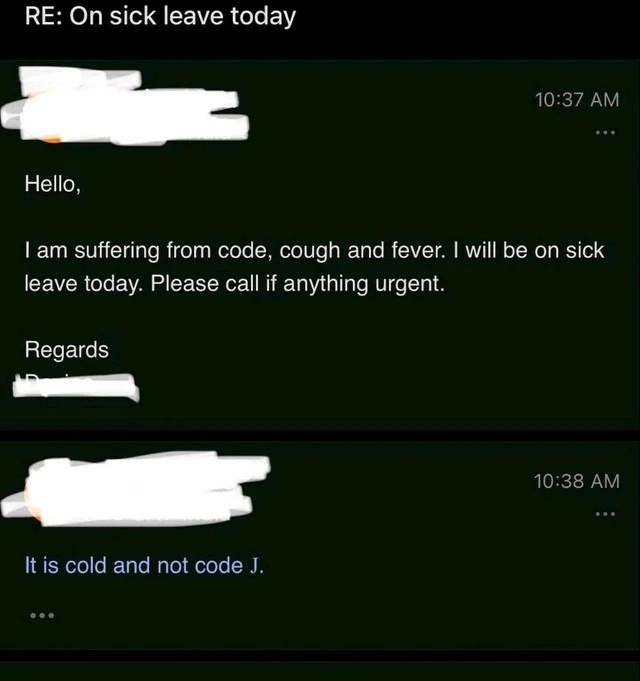
Let’s break down the scene. The email screenshot (with a dark background, because many developers prefer dark mode themes in their editors and even email apps to reduce eye strain) shows two messages. The first, at 10:37 AM, is the developer’s email to colleagues:
“Hello,
I am suffering from code, cough and fever. I will be on sick leave today. Please call if anything urgent.
Regards,
[Name]”
He’s basically informing the team that he’s ill and taking the day off. Except he wrote “suffering from code” at the start, when clearly he meant cold (since he mentions cough and fever, symptoms of a bad cold). This is the classic code_vs_cold_typo mentioned in the tags. It’s a simple slip: code and cold sound almost the same and are just one letter different. Given how much code is on this person’s mind, it sneaked into the sentence. We can almost picture him groggy with fever, yet still subconsciously thinking about that code he was writing yesterday!
Just a minute later, at 10:38 AM, a colleague replies to all (hence the email subject is “RE: On sick leave today”, meaning “Regarding: On sick leave today”). The colleague says:
“It is cold and not code J.”
They’re correcting the typo in a friendly way: basically, “Haha, you meant to say cold, not code.” The letter “J” at the end is likely a smiley or joking indicator. In many corporate email systems (especially older versions of Microsoft Outlook), when someone types a smiley 🙂 it can sometimes appear as the letter "J" to recipients who don't have the same email client. So that "J" is probably the colleague’s way of adding a smile or wink, showing that this correction is meant in good humor, not as a serious reprimand. It’s WorkplaceHumor at play: colleagues sharing a light laugh over a typo. In a healthy corporate culture (here tagged CorporateCulture), little moments like this indicate people feel comfortable joking with each other even in official communications. The colleague likely knows everyone on the thread will chuckle at this obvious mix-up, so they couldn’t resist responding with a teasing one-liner.
From a junior developer’s perspective, there are a few takeaways and terms here:
Code: This is what developers write – the instructions or programs that tell a computer what to do. Developers spend most of their day writing or reading “code” in various programming languages. It’s so central to their job that they even call what they do “coding.” So, it’s no surprise the word code is always on their mind (and apparently, at their fingertips!).
Cold: In this context, it means a common illness (not the temperature). Saying “I have a cold” is a casual way to say you’re sick with cough, sneezing, maybe fever – basically a mild viral infection. It’s something you’d tell your boss or coworkers to explain you’re too unwell to work that day.
Typo: A small mistake in typing. Everyone makes typos, but this one is particularly funny because it accidentally formed a real (but wrong) word that is very relevant to the person’s job. It’s not like he typed “cxld” or something random; he typed another valid word, just not the one he intended. That valid word, code, reveals what’s on his mind.
Autocomplete/Autocorrect: These are features usually in software (like your smartphone’s keyboard or your code editor) that automatically complete a word or correct spelling based on what it thinks you intend to write. For example, your phone might correct “teh” to “the”, or an IDE might finish a variable name once you type the first few letters. In this scenario, there was no actual software doing it, but the joke is that the developer’s brain acted like an autocorrect system due to his habit. He’s typed “code” so often that when he started typing “co-l-d”, somewhere between the brain and the fingers, it morphed into the familiar pattern “co-d-e”. It’s an occupational autocomplete indeed!
Corporate email thread: This is an email conversation at work. One person sends an email (in this case, about being out sick) and then others can reply. “RE:” in the subject stands for “Regarding” and indicates a reply. These threads often include managers, teammates, etc. Here, the fast one-minute reply suggests this might have been a team-wide email and a close colleague chimed in with a joke right away.
Dark mode Outlook: The image is clearly a dark-themed email client, likely Microsoft Outlook given the interface clues. Dark mode is a display setting that shows text on a dark background (instead of the usual black text on white). Developers often prefer dark mode in their coding environments and even email because it’s gentler on the eyes during long hours at the screen. Not a crucial detail for the joke, but it’s a subtle marker that yes, this is a developer’s screenshot (dark mode everything!). The familiarity of that screen just makes tech folks feel at home.
The tags like CommunicationBreakdown and HumorInTech reflect that this is a light communication mishap that produces techie humor. It’s a breakdown only in a trivial sense – nobody is confused about what he actually meant. In fact, it’s so obvious that it became a punchline. The situation is super relatable: many developers have stories of accidentally using programming lingo in normal speech or writing. For instance, a new programmer might write an email ending with a curly brace } as a joke, or say “I’ll ping you later” (a networking term) in casual conversation. These are harmless ways technical language spills over. In this case, it was completely unintentional, which makes it even funnier because it shows just how ingrained coding has become for this person.
And importantly, the whole thing is wrapped in a warm, joking tone. The colleague’s response corrects the mistake but also says “we know what you meant, and we find it funny (not stupid).” The inclusion of a smile (even if it appears as that goofy “J”) tells the sick developer, and everyone else, that it’s all in good fun. It likely brightened the sick person’s day a bit to see that response. This kind of friendly teasing is common in supportive team environments — a little DeveloperHumor to ease the stress. After all, being out sick can make you feel guilty or worried about work, but a colleague making a joke shows they care more about cheering you up than anything else.
In summary, at this level we see clearly what happened and why it’s humorous: a developer made a mistake in an email because his brain was on coding autopilot, leading to a funny word mix-up. Everyone recognizes it was a slip, and a coworker playfully pointed it out. It’s a simple joke about how our work routines can sneak into our everyday communication. If you’re a new developer, it’s also a charming caution: when you live in code 24/7, don’t be surprised if now and then you accidentally speak in code too!
Level 3: Occupational Autocomplete
Every seasoned developer reading this has likely smirked in recognition. This meme hilariously captures a Freudian slip for coders – a code-ian slip, if you will. The email shows a programmer on sick leave accidentally writing “suffering from code” instead of “cold.” Why is this so funny to us? Because it’s a perfect storm of developer muscle memory, context switching failure, and corporate communication all colliding in one innocuous typo.
Think about how often a programmer types the word code in a day – commit messages, Slack chats, documentation, variable names, you name it. The word “code” is practically burned into our fingertips. By contrast, typing “cold” (as in the common cold) is probably not part of our daily keystroke repertoire. So when this poor developer tried to write a sick leave email, their brain’s internal auto-complete kicked in like an IDE suggestion. It’s as if the mind ran developer.brain.autocomplete("col") and, out of habit, it returned "code". Occupational hazard? Absolutely. The result: “I am suffering from code, cough and fever.” Honestly, haven’t we all “suffered from code” at some point? 😉
This resonates with experienced devs because it highlights how deeply work vocabulary seeps into our lives. We joke about writing semi-colons at the end of text messages or saying we “caught a bug” when we’re sick (with a knowing grin that in dev-speak a bug means a software error). Here that dual reality is on full display. The author meant a head cold, but confessed to a coding ailment – something all developers metaphorically understand. Legacy spaghetti code giving you a headache? You literally feel their pain. In an industry where burnout and obsession can loom large, mixing up cold with code is an all-too-real slip. It’s funny, but it also whispers, “hey, maybe you’ve been staring at code for too long, take a breather.”
From a corporate culture perspective, the email’s tone and the quick colleague response speak volumes. In most offices, a sick leave email is a straightforward, almost formulaic piece of Communication. But here, within one minute, a coworker replied with a gentle ribbing: “It is cold and not code J.” The speedy correction (complete with a friendly jab and likely a smiley – that mysterious “J” is the telltale sign of Outlook turning a “:-)” into an inadvertent letter) shows a workplace where humor is alive and well. This is an example of WorkplaceHumor cutting through the formality: colleagues comfortable enough to poke fun at a typo in a team email thread. It’s a little window into a dev team’s culture – camaraderie built on shared understanding that hey, we live and breathe this stuff so much that typing code instead of cold is natural comedy.
Let’s not miss the subtext: the developer wrote, “Please call if anything urgent.” Even on sick leave, they’re on standby, ready to fire-fight if production blows up. That phrase will make the CynicalVeteran chuckle (and wince) – it implies an always-on culture where you can clock out, but you never really clock out. The brain might be feverish, but it’s still parsing if (urgent) { ring_phone(); }. In a healthier world, you’d fully disconnect, but in reality many devs feel guilty or indispensable, hence leaving the door open for a call. So not only is his brain coding by reflex, he’s also half-expecting to jump back in if the build breaks. It’s funny and a tad tragic rolled together – classic tech life humor.
And who could ignore the dark mode aesthetic of the screenshot? The black background with pale text screams developer vibes (we love our dark-themed IDEs and email clients, thank you very much). It’s likely Microsoft Outlook in dark mode, given the greenish tint and that quirky “J” character. Only a true corporate email veteran knows that the letter “J” often appears in emails where someone intended a smiley-face – an artifact of Outlook using the Wingdings font for 😊. So even the email client is adding its own accidental humor: communication breakdown by way of emoji rendering.
In sum, this meme hits senior developers on multiple levels. It satirizes how the DeveloperLifestyle can infiltrate even our sick day communications. It nods to the shared experience of being so deep in code that your brain’s autocorrect favors technical terms over normal words. It highlights a slice of corporate culture where teammates tease each other to keep spirits up. And it even packs in a little tech inside-joke with that “J” rendering glitch. It’s a perfect little snapshot of HumorInTech: absurd, relatable, and layered with the kind of details that make experienced devs both laugh and say “oh man, I feel seen.”
Description
The image displays a screenshot of a professional email exchange in a dark-mode interface. The first email, sent at 10:37 AM with the subject 'RE: On sick leave today,' contains a significant typo. The sender writes, 'I am suffering from code, cough and fever. I will be on sick leave today.' This is clearly intended to say 'cold,' but the typo creates a Freudian slip that is highly relatable to anyone in the software development field. For developers, 'suffering from code' can be a daily reality, representing the mental exhaustion, frustration, and burnout from dealing with complex bugs and difficult projects. A minute later, at 10:38 AM, a reply email provides a blunt correction: 'It is cold and not code J.' The humor lies in the unintentional accuracy of the typo, perfectly capturing the essence of developer struggles, juxtaposed with the dry, corrective tone of a typical workplace interaction
Comments
13Comment deleted
It wasn't a typo. It was a bug report filed via email. Symptoms include a high temperature from the laptop's CPU and a persistent cough every time they look at the legacy codebase
Proof that muscle memory is real: my fingers continue shipping code - straight to HR - even when the rest of the system is down for maintenance
When your muscle memory has been trained on 20 years of code reviews, but your immune system is still running on biological patches from the Pleistocene era
No correction needed - 'suffering from code' with a fever is just an accurate incident report for anyone maintaining the legacy monolith
When you've been debugging production issues for so long that even your immune system starts throwing 'code' exceptions instead of cold symptoms. The real bug here isn't in the codebase - it's the developer's inability to context-switch from work mode even when filing sick leave. Classic case of occupational hazard: your muscle memory is so trained on technical terminology that 'cold' gets compiled to 'code' before it reaches your consciousness. At least the colleague caught the typo before management started wondering if 'suffering from code' is now a valid PTO category
Only developers can call in sick and still get a code review: nit: s/code/cold/g; please attach a repro for the fever
Code cough: the only vulnerability where even zero-days hit your lungs, not your repos
Reply-all nit: s/code/cold/ - code review instincts applied to HR; empathy marked non-blocking
I've been sufferint from Code daily since Jan, 01 till Jan, 25. ( solving Advent of Code 🙂 ) Comment deleted
How did it go? I forgot to participate this year Comment deleted
His year was great! This time, I saw a _real_ AoC. The most fun part is not just solving, it's discussing with friends, comparing solutions, sharing memes 🙂 That turned out to be additional joy. Comment deleted
Dec maybe? Comment deleted
Yup, Jan was mistake! Comment deleted