A Humble Admission of Abstraction Overload
Why is this Languages meme funny?
Level 1: Guessing Game
Imagine your teacher asks you how long it will take to finish your big homework assignment, but you really have no idea because you haven’t even started it. Instead of admitting you don't know, you just shrug and say, “Umm… maybe five or six days, my dude?” in a lazy, unsure voice. It’s a complete guess, and you even call your teacher "my dude" like they’re your friend. Everyone can tell you’re not serious and that you really have no clue. It’s funny (and a bit silly) because you’re treating an important question so casually. The teacher was expecting a real answer, and you just gave a goofy guess. That’s exactly what’s happening in this meme: the developer is basically guessing and sounding super relaxed when he’s supposed to be confident and clear, which makes the whole situation comically awkward.
Level 2: Point of Confusion
In Agile software development, teams often estimate work using story points instead of hours. A story point is a rough unit of measure for the effort or complexity of a task (for example, how hard it is to implement a certain feature). It's deliberately abstract – one team’s "5 points" might be another team’s "8" – because the focus is on relative sizing (comparing tasks against each other) rather than precise time. This helps teams account for uncertainty and differences in how people work. During a sprint planning meeting (a team discussion where everyone plans the next batch of work for the upcoming sprint, which is usually a 1-2 week development cycle), each user story or task is discussed and given a story point value based on how big the team thinks it is.
Now, how do teams usually come up with these story point numbers? Often, they use a method called planning poker. In planning poker, each team member privately picks a number card (commonly from a set like 1, 2, 3, 5, 8, 13, etc.) that they feel represents the task’s size, and then everyone reveals their card at the same time. If there’s a big difference in estimates (say one person chose 3 and another chose 8), the team pauses to discuss why. The goal is to avoid situations where one outspoken person influences everyone else’s estimate. It’s all about reaching a consensus through discussion.
In the meme scenario, though, things go off the rails. Instead of using a structured approach, a single developer just blurts out "maybe 5, or 6". This is a very vague answer (an example of uncertainty in story point estimation) and it shows that the person is not sure at all. The developer’s phrasing makes it sound like even they don’t really know what to pick. To the rest of the team, that answer doesn’t provide much useful info. Are they confident it’s a medium-sized task (around 5 points)? Or are they hinting it might be a bit more (6 points)? The uncertainty can confuse everyone in the room.
Clear communication in a team setting is critical. A casual response like "...my dude, maybe 5 or 6..." can create a communication gap between the person giving the estimate and those hearing it. For example, the project manager might interpret "5 or 6" optimistically as a firm 5 (thinking, "Alright, they said 5, that seems small"). Meanwhile, other developers might think, "Hmm, they aren't sure... maybe this task isn’t fully understood yet." The developer basically mumbled an answer without explaining their reasoning. This can lead to misaligned expectations: the manager expects one thing, but the developer wasn’t actually certain – they were essentially guessing.
It's also worth noting how informal the language is. Saying "my dude" to a colleague, especially to a manager or client, is very informal slang. In a typical workplace, developers wouldn’t address a product owner or boss that way. The meme uses that phrase to emphasize how unprepared and relaxed (perhaps too relaxed) the developer is in that moment. It’s as if he’s treating an important planning meeting like a casual hangout with friends. This mismatch in tone is funny because it’s so out of place in a professional setting.
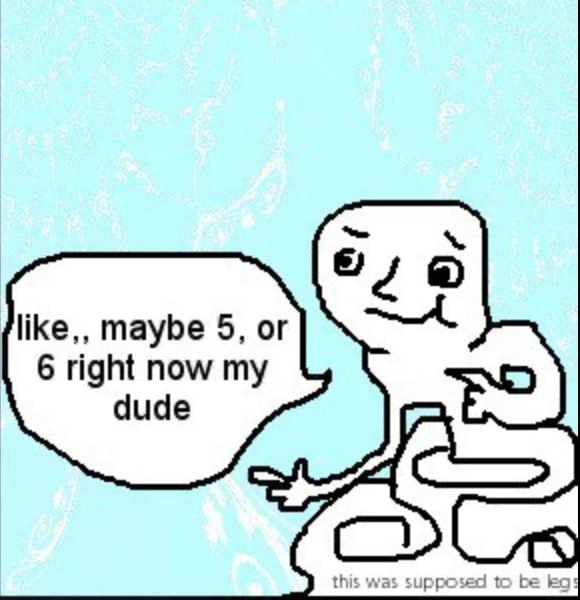
The image itself drives the joke home. The cartoon figure in the meme has a goofy, squiggly body and a simple, sleepy-looking face. This figure represents the developer who’s giving the uncertain estimate. The speech bubble contains the exact quote: "like,, maybe 5, or 6 right now my dude", capturing his unsure answer. The drawing style is intentionally rough and silly (the artist even noted "this was supposed to be leg" next to the poorly drawn limb). It actually resembles a type of comic often seen online known as the stoner troll face meme format. In those memes, the character looks kind of spaced-out or dazed and speaks in a sloppy, uncertain way – exactly like our developer here. All these goofy details make the situation even funnier, because the visuals scream "this person is not exactly on top of things."
Stepping back, you can see why developers share a meme like this. Estimating tasks is hard, and it can be awkward when you don’t have a good answer. It’s a common pain point in Agile teams: you’re expected to give a number, but sometimes you really have no clue yet. Many people in software have experienced that uncomfortable moment, so it becomes a target for developer humor. This meme takes that moment and makes it extreme and silly, so we can laugh about it. It’s basically saying, "Yeah, we’ve all been this guy at least once," in a lighthearted way.
Level 3: Half-Baked Estimate
"like,, maybe 5, or 6 right now my dude"
Picture a software team in their Agile sprint planning meeting. The project manager (or Scrum Master) turns to a developer and asks for a story point estimate on a new feature. Instead of a confident answer, the developer gives a dazed smile and blurts out, "like, maybe 5, or 6 right now my dude." This moment is absurd on multiple levels: the imprecise estimate (is it 5 or 6?), the inappropriate casual language ("my dude" addressing a colleague or boss), and the overall vibe that the developer hasn't properly thought it through. The meme exaggerates a scenario that many experienced devs recognize: when someone is caught off-guard in estimation and just wings it with a random number.
In a proper sprint planning session, teams usually use more structured techniques (like planning poker) to avoid exactly this sort of situation. Planning poker has everyone reveal their point estimate simultaneously to prevent influencing each other, and the team typically sticks to preset values (often a Fibonacci-like scale: 1, 2, 3, 5, 8, 13, ...). In that context, blurting out "5 or 6" on the fly is off-script — teams rarely even use 6 as a value! (They might jump from 5 to 8.) The hesitant range ("5 or 6") immediately tells the room that the developer doesn’t have a clear grasp of the story’s scope. Seasoned engineers nod knowingly (or cringe) at this because they've seen how such off-the-cuff estimates can derail a meeting. One person throwing out an uncertain number like that can break the flow of careful estimation and lead to confusion.
Why is this scene so familiar and funny to veterans? It hits several Agile pain points dead-on:
- Anchoring & Miscommunication: The instant someone blurts out a number, it can anchor the discussion. The team might now subconsciously gravitate around "5 or 6" even if others had very different opinions. Plus, a casual "maybe" introduces a huge communication gap. Is it 5? Is it 6? Do we split the difference? The lack of clarity means everyone could be on a different page. This is a recipe for misaligned expectations.
- Pressure & Guesswork: Estimation meetings often come with a bit of pressure, especially with looming deadlines or managers impatiently waiting. If a developer hasn’t analyzed the task and silence is stretching out, they might blurt out something just to keep things moving. We've all been in that awkward spot where you feel you have to give an estimate even though you’re unsure. The humor here is that the developer isn't even pretending to be sure – the phrase "like, maybe..." basically broadcasts "I'm guessing, folks." It’s an uncomfortable truth of time estimation that sometimes we are just guessing, and the meme lays that bare.
- Managerial Interpretation: When a developer says "maybe 5 or 6", a project manager or product owner might conveniently hear just the lower end. They’ll jot down 5 and start planning the sprint as if that task is a neat, small item. The developer’s uncertainty might be completely lost in translation. Later, when that story inevitably takes longer (who could have guessed?), there's frustration on both sides. It’s the classic scenario of misaligned expectations: the dev was trying to say "I’m not sure, could be moderate effort," but management heard "It’s a small 5-point job." Every experienced team has lived through the fallout of such misunderstanding.
For a bit of dark humor, here's how that vague time estimate tends to translate in practice:
| What Developer Means | What Manager Hears | What Actually Happens |
|---|---|---|
| "I have no clue; I'll just toss out a number." | "5 points – a quick, easy task!" | Ends up more like an 8 or 13-pointer once reality hits. |
The art style of the meme even reinforces the joke. The cartoon figure has a crudely drawn, loopy body and a goofy, vacant expression that’s reminiscent of the old trollface comics or a classic stoner meme character. The character looks oddly relaxed and not all there, which matches the overly chill vibe of saying "my dude" during a serious estimate. In the corner, the artist scribbled "this was supposed to be leg", poking fun at how badly the figure is drawn. Ironically, that scribble is a perfect metaphor: the estimation process in the meme is as sketchy and wobbly as the drawing itself. Taken together, the image and text scream, "This is not how you're supposed to do sprint planning, and yet, here we are."
Ultimately, the meme lands as pure Scrum humor. It’s exaggerating a real developer experience to highlight the silliness. Every developer who has been through rough planning meetings or struggled with story points sees the truth in it. We laugh (maybe a bit ruefully) because we've been in that room, hearing a teammate give an answer so unhelpful that all we can do is chuckle and think, "Oh no, here we go again."
Description
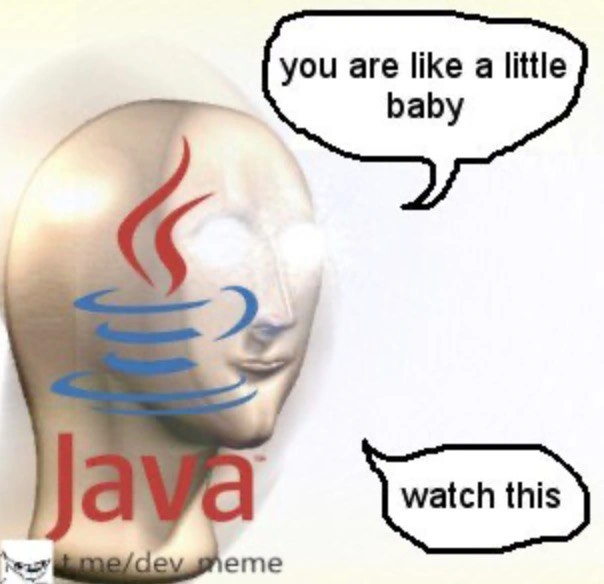
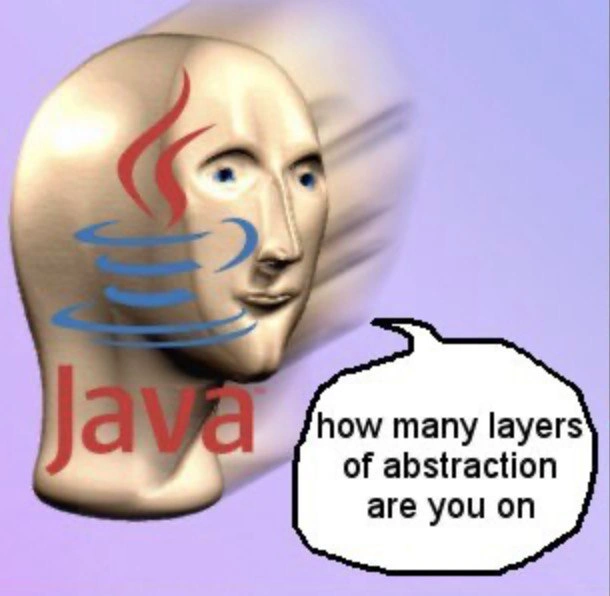
This image is the second panel of a two-part meme, responding to the first panel where a Java-themed 'Meme Man' asks about abstraction layers. This panel features a crudely drawn, white MS Paint-style character against a light blue, subtly patterned background. The character has a smug, knowing expression and is gesturing with its hands. A speech bubble contains the text, 'like,, maybe 5, or 6 right now my dude'. At the bottom right, a small, almost hidden caption reads, 'this was supposed to be legs', humorously pointing out the poor quality of the drawing. This image completes the joke started in the first panel. The response, '5 or 6 layers', is a self-aware jab at the exact kind of over-engineering criticized in the first image. It's funny to senior developers because it represents a moment of realizing one's own code has become the kind of complex, multi-layered system they would typically criticize. The casual, understated answer contrasts with the esoteric absurdity of the situation, making the critique of deep abstraction more potent and relatable
Comments
7Comment deleted
Only 6 layers of abstraction? That's cute. My last project's stack trace looked like a Christopher Nolan movie plot
When I say “5-ish story points” I’m really encoding: 1 for the actual feature, 4 for discovering why the legacy microservice still speaks SOAP, and the remainder for the post-mortem blame-balancing algorithm
When the PM asks how many story points that 'simple' refactor will take after you've discovered it touches seventeen microservices, three legacy monoliths, and a Perl script someone wrote in 2003 that nobody understands but everything depends on
When the architect sold everyone on a microservices platform 'designed to handle thousands of services at web scale,' but three years later you're running exactly six services - and two of them are just health check endpoints. The distributed tracing setup cost more than the actual business logic, and you're paying for a service mesh that routes traffic between containers running on the same node. At least the Kubernetes cluster has room to grow... into the five other services that will never materialize because the monolith actually worked fine
Asked about uptime, the SRE says “like, maybe 5 or 6 right now, my dude” - which would be impressive if those were nines; it’s the number of concurrent Sev‑1s
Stakeholder velocity: infinite. Developer velocity: '5 or 6 points, plus yesterday's carryover.'
Our “simple” GET /users now goes CDN -> WAF -> API gateway -> BFF -> GraphQL -> gRPC -> service -> repository -> ORM - like, maybe 5 or 6 layers, my dude; the only thing flat is the SLO