Skip to content
DevMeme
5643 of 7435
O'Reilly Parody Cover on Revenue-Driven Development and Untested Hotfixes
Deployment Post #6193, on Aug 25, 2024 in TG

O'Reilly Parody Cover on Revenue-Driven Development and Untested Hotfixes

Why is this Deployment meme funny?

Level 1: What Could Go Wrong?

Imagine you’re baking cookies to sell at a school fundraiser. You’re in a huge rush to start selling and making money for the fundraiser (revenue!), so you pull the cookies out of the oven and hand them out without even tasting one or checking if they’re fully baked. You skipped the taste test to save time. Now, maybe most cookies are fine… but a few are still gooey and undercooked in the middle. Oops! Some kids bite in and make a face because the dough is raw. You managed to start selling faster, but serving half-baked cookies might upset people and hurt your sales when they tell others. This is exactly why the meme is funny to developers: it’s like bragging “I serve cookies without tasting them first. Look how quick I am!” Everyone kind of cringes and laughs because we all know that’s risky and bound to cause trouble eventually. It’s humor born from doing something too fast for your own good and hoping nothing goes wrong – a bold move that usually makes us say, “What could possibly go wrong?”

Level 2: Hotfix Hustle

Let’s break down the tech terms and situations referenced in this meme, especially if you’re newer to the developer world. The scenario here is a startup developer deploying a quick fix directly to the live app. We have a few keywords: hotfix, prod, testing, MRR, and tech debt. What does all that mean?

  • Production (Prod): This is the live environment where real users interact with your software or website. Think of prod as the real app on the internet, as opposed to your local computer or a test server. When something is “in prod,” it’s for all the world to see. Changing things in prod is high-stakes because if you mess up, real customers feel it. In the meme, “deploy hotfixes to prod” means pushing code changes straight into the live system.

  • Hotfix: A hotfix is a quick, often urgent change to the code meant to fix a bug or problem right away. It’s called “hot” because it’s applied to a system that’s already running (it’s hot/live), and it’s often done in a rush. For example, if users discover a critical bug in your app (say, nobody can log in), you might issue a hotfix directly on the current version rather than wait for the next big release. Hotfixes are usually small patches aimed at immediate relief. They bypass the usual development process. In the meme, the guy deploys hotfixes without testing — meaning whenever something’s wrong, he’ll patch it now, worries about consequences later.

  • Deploying without Testing: Normally, before new code goes to production, developers run it through testing. Testing can be running automated test scripts (like unit tests, integration tests) or manually trying out the changes in a staging environment (a safe space that mimics prod). To “deploy without testing” means skipping all those checks. It’s like turning in an essay without proofreading or launching a rocket without a pre-flight check. You save time up front, but you’re relying on luck that nothing’s broken. This is definitely not standard best practice! When the meme’s caption admits “I deploy hotfixes to prod without testing,” it underscores the recklessness — and for comedic effect, says it so casually, as if everyone does it.

  • Monthly Recurring Revenue (MRR): This is a business term, not a programming term. If you’re in a Startup or software-as-a-service (SaaS) business, MRR is the consistent income you get every month from subscribers or customers. For example, if you have 100 customers each paying $50 a month, your MRR is $5,000. Startups love growing this number; it’s a key metric of success and stability. Now, “MRR-Driven Development” as a phrase means the development team is driven by the need to increase or protect that monthly revenue. It implies they might prioritize anything that keeps money coming in, possibly at the expense of code quality or proper process. It’s a play on words, since in software we have real methodologies like Test-Driven Development (TDD) (where writing tests guides your design) or Behavior-Driven Development (BDD). Those emphasize quality and correctness. MRR-driven dev, by contrast, jokingly means money first, engineering second.

  • Tech Debt (Technical Debt): This is a metaphor in software engineering. Imagine you have a credit card and you keep borrowing money; you’ll have to pay it back with interest later. Technical debt works similarly: if you take shortcuts now (like skipping tests, using hacky fixes, poor documentation), you’re “borrowing time.” It gets things done faster today, but your codebase “owes” cleanup and fixes in the future. The interest on tech debt is paid in the form of bugs, complicated maintenance, or even outages. In a startup, it’s easy to accumulate tech debt because you’re focused on speed. Deploying untested hotfixes is exactly the kind of shortcut that creates a lot of debt. Later, developers might spend countless hours finding and fixing issues that proper testing would have caught early. The meme’s premise suggests our developer hero has likely accumulated a mountain of tech debt but is still mainly concerned about the next MRR report.

Now, why is this tied to startup life? In a startup, you often have a small team with ambitious goals and tough deadlines. There might not be a dedicated QA (Quality Assurance) engineer or a formal testing process. The motto might be “done is better than perfect” or the infamous “move fast and break things.” In such an environment, a developer might deploy five times in a day, fixing things on the fly to keep users happy. It’s exciting but also nerve-wracking. One minute you’re heroically fixing a bug for an important customer (hurray, they didn’t cancel!), the next minute you realize your fix broke another part of the system (oops, support line blows up). This rollercoaster is exactly what the meme is capturing in a humorous way. The guy holding his cheeks in panic on the cover isn’t a random choice – it’s the face you make when you realize bypassing tests might have backfired.

The O RLY? at the bottom left is a nod to a long-running meme. O’Reilly Media’s actual logo is a little owl and their name, but internet culture turned “O RLY?” (slang for “Oh, really?”) into a joke. There was even a meme with an owl saying "O RLY?" ages ago. Here, the “O RLY?” logo both parodies the publisher’s logo and slyly comments on the statement above: “I deploy without testing.” – “Oh, really?” It’s like the meme itself is teasing, “You seriously do that? Bold move, my friend.” And the handle @levelsio is the creator’s credit (a well-known indie maker). He’s highlighting this absurd-yet-real practice through satire.

For a junior developer (or anyone new), the meme is a cautionary chuckle. It says: yes, some people — especially under tough business pressure — do push code straight to production without proper testing. It’s usually not because they think it’s a great idea, but because they feel they have no time. They’re being driven by metrics like user growth or revenue. But this is a bit like playing with fire. If you’re new in the field, the meme is funny, but it’s also nudging you to understand why testing and good practices exist. Every shortcut has a cost. The experienced folks find it funny because they know how true it can be, and the newer folks can laugh but also take a mental note: maybe don’t let MRR completely drive your development choices. In a real book on career advice, “deploying hotfixes without testing” would be in the “Common Mistakes” chapter, not the recommended techniques!

Level 3: Move Fast, Break Production

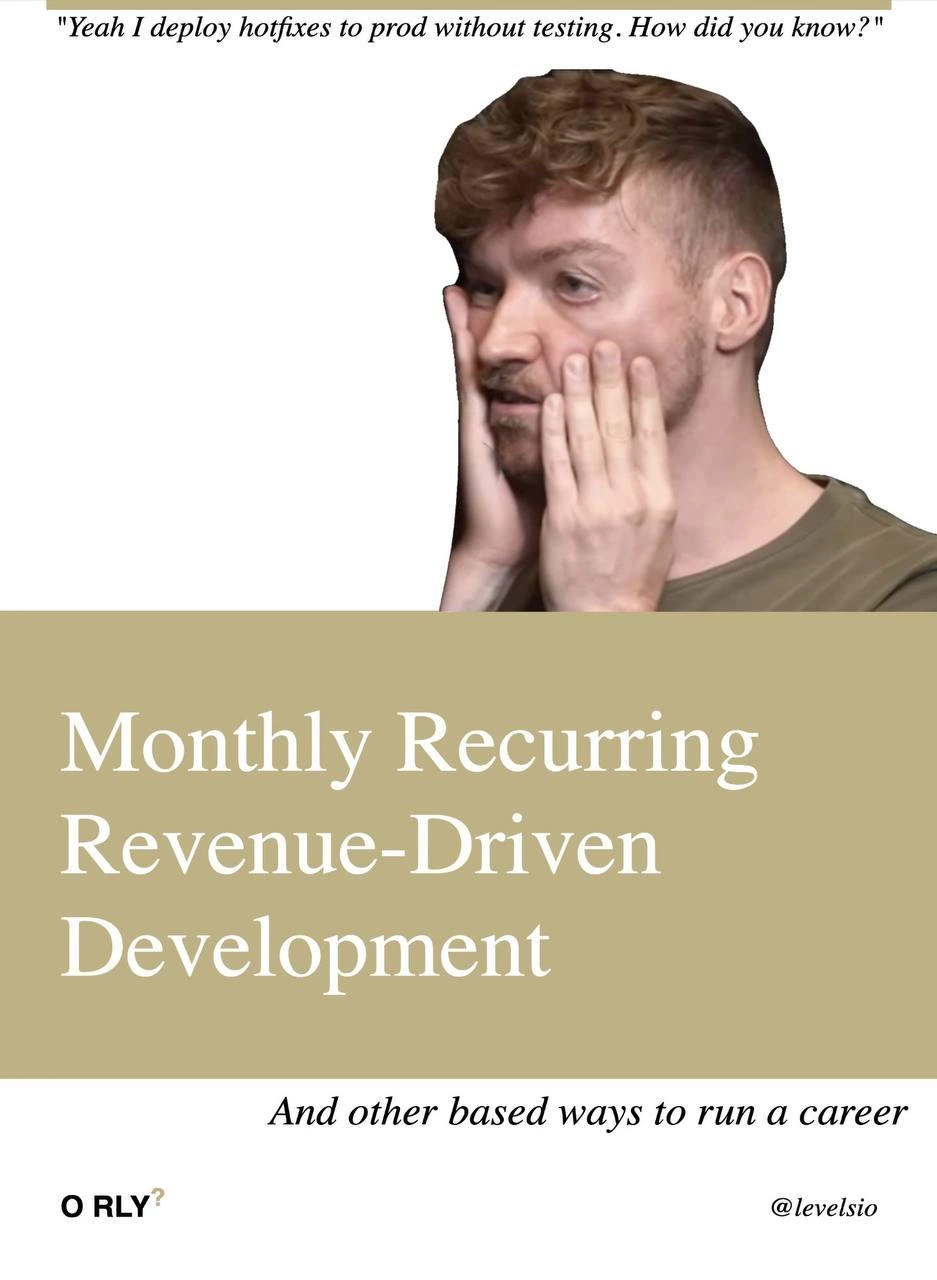
At first glance, this meme looks like an O’Reilly tech book cover, but the title “Monthly Recurring Revenue-Driven Development” is pure parody. It’s poking fun at the idea that money (MRR) is the only metric that matters, even if it means cutting every corner in engineering. The top caption says, “Yeah I deploy hotfixes to prod without testing. How did you know?” — a snarky confession that sets the tone. Seasoned developers instantly recognize this as a tongue-in-cheek jab at startup culture’s “move fast and break things” attitude (a phrase famously used at Facebook). Here, “break things” often means breaking production because you skipped QA. The meme’s humor comes from treating a really reckless practice as if it’s an official methodology worthy of a book deal. It’s like someone wrote a definitive guide on how to speed-run development purely to boost Monthly Recurring Revenue, quality be damned.

The O’Reilly cover parody format is a classic in tech humor – O’Reilly books are known for serious programming topics and their animal covers. By mimicking that style, the meme elevates an outrageous idea (“deploying hotfixes to prod without testing”) to something book-worthy. This contrast is hilarious to anyone who’s suffered the consequences of such cowboy coding. Instead of an elegant tiger or owl illustration, we get a photo of a panicked-looking developer holding his face, as if he’s just realized the bomb he shipped to production. That image is the “cover animal” here – a stressed developer caught in the act of a YOLO deployment. It perfectly visualizes the internal scream of pushing untested code live: “Did I seriously just do that?!”

Why is this funny to a senior engineer? Because it’s painfully real. In a high-pressure startup chasing growth, developers sometimes deploy fixes directly to production to keep customers happy or hit that next monthly revenue target. Maybe a big paying client reported a bug at 4:55 PM on the last day of the month, and the team’s MRR numbers are on the line. The “sensible” thing (in business terms) is to patch it immediately so the client doesn’t churn – even if that means no time for writing unit tests or running the full test suite. From an engineer’s perspective, it’s a classic anti-pattern: you’re solving one problem while silently introducing new bugs or instability due to lack of testing. Seasoned devs have learned (often the hard way) that today’s quick hotfix can become tomorrow’s 3 AM outage. So there’s a dark, war-story humor in seeing it bluntly stated on a fake book: we’ve all seen this disaster recipe before.

This meme also resonates because it satirizes tech startup culture. The subtitle “And other based ways to run a career” drips with irony. In internet slang, calling something “based” nowadays means boldly confident or unorthodox (often without regard for rules). The meme jokingly frames bad practice as edgy career advice. It’s mocking those brag posts where someone might boast about how they “ship daily” and “don’t waste time on tests” as if it’s a virtue. The reality? Ignoring tests and quality assurance might make you look productive in the short term and even bump up those metrics, but it’s a deal with the devil – you incur massive tech debt. Experienced engineers chuckle (or groan) because they know that debt will eventually come due, often at the worst possible time.

Consider the unspoken backstory here: a startup dev under pressure chooses “MRR-driven development.” New customer sign-ups and retention (recurring revenue) guide every decision. Did skipping writing tests this week help close a new deal? Great, do it again. Did pushing a quick patch prevent a refund? Awesome, who needs QA! The meme exaggerates this mindset to the point of absurdity – hence a whole book on it. It’s reflecting a real tension in software teams: business goals vs. engineering best practices. In the short term, business goals often win. The veteran engineers reading this meme have sat through those meetings where a non-technical boss says, “We can’t afford to delay the release – just push it live now!” They know the knot in your stomach when you run git push with fingers crossed because there’s no time for a proper test.

To a battle-scarred dev, the phrase “deploy hotfixes to prod without testing” might trigger flashbacks. It’s basically “testing in production” – a phrase usually said with ironic humor. Sure, in modern DevOps there’s the idea of continuous deployment and rapid iteration, but even the fastest teams set up safety nets (automated tests, canary releases, feature flags, monitoring). Here, the meme implies none of that – just raw, seat-of-your-pants deployment. It’s the kind of thing that leads to legendary outages: maybe you fixed a typo for a big client, but because you didn’t test, you accidentally broke the payment processing for everyone else. Oops, there goes real revenue! The irony is that a strategy meant to maximize revenue (deploying ASAP) can end up costing revenue when things break badly.

The comedic genius is how straight-faced the meme is. The cover looks professional at a glance, and the text reads like a legitimate book title… until you actually digest the words. It’s effectively saying “Embrace recklessness as a service.” Every experienced developer knows that feeling when someone proudly shortcuts a process and you think, “This will end in tears.” This meme captures that with a sly grin. It’s a form of collective catharsis – we laugh because we’ve either done it under pressure or had colleagues do it, and we all survived to joke about it. The @levelsio credit suggests the meme came from an indie hacker known for shipping fast; even he is clearly self-aware about the chaos that entails.

Let’s talk about the “other based ways to run a career” that this fake book might include. They’re basically a list of don’t-try-this-at-home tips that, unfortunately, many of us have witnessed:

  • Deploy on Friday at 5 PM – because who needs a weekend anyway? (Nothing like discovering a production crash during Friday night dinner – oh boy, DeploymentPainPoints.)
  • Skip writing tests – since tests don’t directly add new features or revenue. If the users don’t see it, why do it, right? (This is the essence of lack_of_testing in pursuit of speed.)
  • Debug in Production – literally editing code on the live server to see what works. It’s like doing surgery on a patient who’s wide awake in your only operating room. Risky is an understatement.
  • Chase Every Feature Request from VIP customers – even if it means spaghetti code. When a big client says jump, you jump straight into // TODO: fix this later territory.
  • Ignore Tech Debt Until It Bites – postpone refactoring and documentation indefinitely. After all, if the app hasn’t collapsed yet, it can handle a few more band-aids… until it can’t.

Each of these “tips” is the sort of thing a junior dev might do under pressure or out of ignorance, and a senior dev would facepalm upon hearing. By formatting it as career advice, the meme uses sarcasm to highlight how not to do things. The experienced folks reading this recognise each bullet as a chapter from the chaos playbook they’ve seen in real life. It’s funny because it’s true – and we laugh to keep from crying.

In summary, the meme brilliantly satirizes the conflict between startup hustle and solid engineering. Monthly Recurring Revenue-Driven Development is not a real methodology; it’s a sarcastic label for when business demands force developers into making questionable decisions like deploying untested code. The faux-serious book cover shines a light on this industry reality: too often speed is applauded over caution. Every senior dev who’s performed a desperate 2 AM hotfix (and prayed it doesn’t break anything else) can relate. We chuckle at the meme, all while muttering under our breath, “Please, don’t actually follow this based career guide…”

# Pseudocode motto of MRR-driven development:
if critical_bug and important_customer:
    deploy_hotfix(without_testing=True)  # revenue can't wait for QA
else:
    write_tests_and_fix()  # do the right thing (if time permits)

Description

A parody of a classic O'Reilly programming book cover. The top of the image features a photo of a man with a worried expression, his hands on his cheeks, with the quote above him: 'Yeah I deploy hotfixes to prod without testing. How did you know?'. The main section of the 'book cover', set on a beige background in a serif font, reads 'Monthly Recurring Revenue-Driven Development'. Below this title, a subtitle says, 'And other based ways to run a career'. The bottom left corner has the iconic O'Reilly logo cleverly altered to 'O RLY?', and the bottom right corner credits the creator with the handle '@levelsio'. The meme satirizes the conflict between sound engineering practices and business pressure. 'Monthly Recurring Revenue-Driven Development' is a cynical play on established methodologies like 'Test-Driven Development' (TDD), mocking the mindset where short-term financial goals (MRR) override crucial steps like testing. Deploying untested hotfixes to production is a high-risk, unprofessional practice that resonates with experienced developers who have either witnessed or dealt with the catastrophic fallout. The 'O RLY?' adds a layer of classic internet sarcasm, questioning the validity of such a reckless approach


Comments

8
Anonymous ★ Top Pick Some call it 'Monthly Recurring Revenue-Driven Development,' we call it 'Continuous Incident Generation.' The only thing recurring faster than the revenue is the on-call pager
  1. Anonymous ★ Top Pick

    Some call it 'Monthly Recurring Revenue-Driven Development,' we call it 'Continuous Incident Generation.' The only thing recurring faster than the revenue is the on-call pager

  2. Anonymous

    MRR-driven development: the only green you track in the pipeline is Stripe’s ledger, staging is the first paying customer, and rollbacks are just refund requests

  3. Anonymous

    The real Monthly Recurring Revenue is the AWS bill from all the auto-scaling instances spinning up to handle the memory leaks you introduced with that untested hotfix - but hey, at least the investors see 'rapid iteration velocity' in the quarterly deck

  4. Anonymous

    Ah yes, 'Monthly Recurring Revenue-Driven Development' - the architectural pattern where your monitoring dashboard IS your test suite, and your rollback strategy is 'hope nobody notices until Monday.' It's like TDD, except the first 'D' stands for 'Deploy' and you skip straight to production because staging environments cost money that could be MRR. Senior engineers know this workflow well: write code, git push, kubectl apply, update resume, repeat. The real innovation here is treating your paying customers as unpaid QA - it's basically crowdsourced testing with a subscription model

  5. Anonymous

    If your only SLO is MRR, staging becomes optional and the error budget is called churn

  6. Anonymous

    MRR-driven development: convert the error budget into revenue runway, skip staging, and let customers be the integration environment - if churn stays below MTTR, it’s “tested.”

  7. Anonymous

    MRR-DD: Where test coverage is measured in post-deploy churn rate, not lines of code

  8. dev_meme 1y

    Context: https://www.youtube.com/watch?v=oFtjKbXKqbg

Use J and K for navigation