Skip to content
DevMeme
6315 of 7435
Fighting Global Capital with Ergonomic Office Furniture
CorporateCulture Post #6925, on Jun 25, 2025 in TG

Fighting Global Capital with Ergonomic Office Furniture

Why is this CorporateCulture meme funny?

Level 1: Giant Problem, Tiny Fix

Imagine there’s a huge problem that makes people unhappy at work, kind of like a big, mean bully in a story. Now, instead of really fighting that bully or fixing the big problem, someone says, “Hey, I know what will help – wear these special new shoes!” That sounds silly, right? New shoes might make your feet comfy, but they won’t scare a bully away or solve a huge problem.

This meme is joking about the same idea. The huge problem here is how working in a big money-driven world (like a giant company) can make people feel small or sad. And the tiny fix it jokes about is a standing desk – that’s a desk you stand at instead of sit. Standing up can be healthy for your body, sure, but it won’t magically fix feeling unhappy about work.

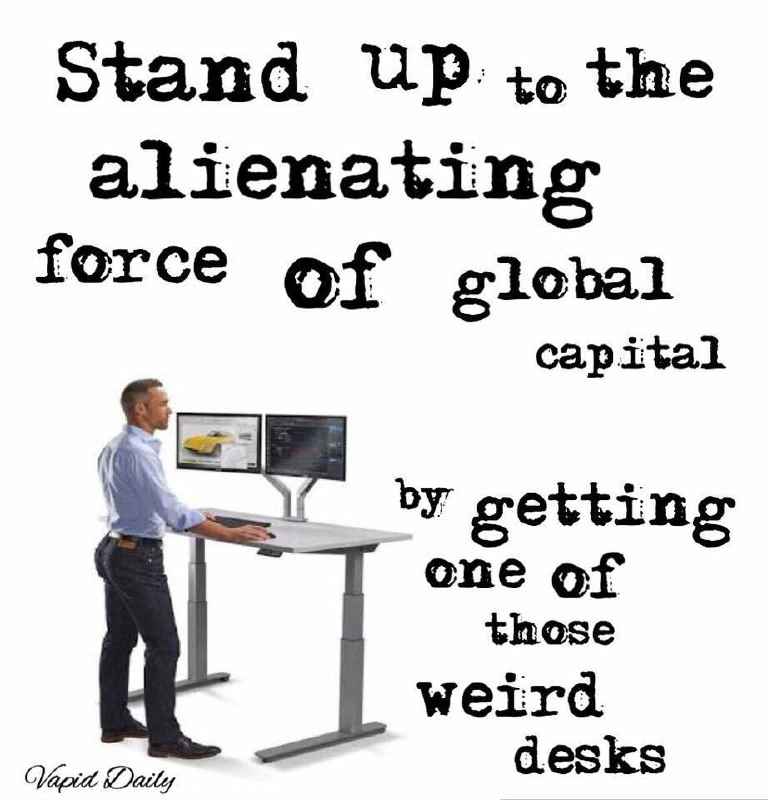
So why is it funny? It’s like if your friend was upset that the school is unfair, and you kidded, “Just stand up from your chair and everything will be okay!” You both know that won’t really solve anything big. We laugh because it’s clearly a goofy answer to a serious problem. The picture even shows a guy standing at a cool robot-like desk with two computer screens, looking determined. It’s as if he believes just standing there is his grand way to “stand up” to the big bad system. That’s as funny as thinking wearing a superhero cape to school will stop the homework from being too much.

In simple terms: a big, complicated problem can’t be solved by a small, simple change, and saying it can is ridiculous. The meme teases that idea so we can smile about our tendency to grab easy fixes, even when we know they won’t fix the big stuff. It’s a gentle way of saying, “Hey, this solution is as wacky as it sounds!”

Level 2: The Ergonomic Fixation

Let’s break down why this meme strikes a chord, especially for developers early in their careers. The key elements here are developer ergonomics and a sarcastic critique of quick-fix workplace solutions. First off, what is a standing desk? It’s a workstation setup that lets you stand up while working instead of sitting in a chair. Many standing desks are adjustable — you can raise or lower the tabletop (often with an electric motor or a manual crank) to switch between sitting and standing positions. They’ve become popular in tech offices as part of a healthy ergonomic_workspace. Ergonomics is all about designing your workspace (desk, chair, monitor position, keyboard, etc.) to fit your body’s needs, so you don’t get aches, pains, or injuries (like carpal tunnel syndrome or lower back pain) from long hours of coding. So, a standing desk is considered an ergonomic improvement because it can reduce the time you spend sitting. Science has told us that sitting all day is unhealthy (you might have heard the slogan “sitting is the new smoking”), leading to issues like back problems or poor circulation. By standing for part of the day, you engage different muscles and can feel more energetic. Many developers rave about how it fights off the post-lunch drowsiness and prevents the “office body” stiffness.

Now, the meme jokes that by getting one of these special desks, you can “stand up to the alienating force of global capital.” That’s some heavy phrasing! “Global capital” refers to big-picture capitalism – think giant corporations, profit-driven global economy, all the stuff that can make an individual worker feel small or alienated. Alienation, in this context, means feeling isolated or estranged, especially from the results of your work. In a tech job, a developer might feel alienated if, say, they’re just pushing tickets and don’t see how it helps people, or if they feel like just a “cog in a machine” making money for a big company without personal satisfaction. It’s a term famously used in socio-economic discussions (originally by Karl Marx to describe workers under capitalism feeling disconnected from their labor).

So the meme is setting up a contrast. Normally, to “stand up to” something means to resist or fight back against it. If someone says “stand up to the bully,” they mean confront the bully, show courage. Here the “bully” is the massive impersonal force of capitalist economy and corporate life – pretty intimidating and abstract! But instead of a serious way to oppose it, the meme suggests: “by getting one of those weird desks.” In plain terms, it’s saying: Buy a standing desk and you’ve magically overcome the depressing parts of working in capitalism. This is clearly a joke. It’s poking fun at the idea that a small lifestyle change or office perk (like using a standing desk) could fix a huge, complex problem (feeling alienated by global capitalism). The humor comes from how mismatched these things are. It’s like saying “end world hunger by upgrading your lunchbox.” It doesn’t fit; one is far too big to be solved by the other.

For a junior developer or someone new to office life, it helps to know that companies often promote these kinds of WorkplaceHumor-tinged “solutions” as part of employee wellness or productivity programs. For example, a tech company might send out an upbeat email: “Hey team! We know work can be stressful, so we got everyone new ergonomic chairs and standing desk options! Stay healthy and keep crushing those sprints!” These measures aren’t bad—having a good chair or the option to stand is genuinely beneficial for your health_and_productivity. In fact, many developers do report improved concentration or less back pain when they alternate between sitting and standing. The dual monitors shown in the meme image are also very real parts of developer life: a dual_monitor_setup means having two screens to spread out your work (perhaps code on one screen and documentation or a web browser on the other, as shown). This often does help with productivity since you can see more at once without switching windows. Developers love to optimize their setup like this; it’s almost a rite of passage to figure out your ideal desk layout, complete with monitors, a good keyboard, maybe a wrist rest, and yes, possibly a standing desk or at least a desk that’s the right height.

The phrase “one of those weird desks” suggests that these standing desks, while popular, are still seen as a quirky trend—maybe your non-tech friends or old-school office workers find them odd. Not long ago, most offices just had standard sitting desks. Now, especially in tech companies focusing on DeveloperExperience_DX, you see motorized desks that whirr up and down, or contraptions where people have treadmill desks (walking slowly while typing), or big yoga balls instead of chairs. These are what we might call tech_office_fads or trends. “Weird desks” is a tongue-in-cheek way to lump all that together. It’s the kind of thing you joke about with teammates: “Oh, the new guy requested one of those robo-desks that go up and down… fancy fancy!” Meanwhile, management might tout these as evidence of a progressive, caring CorporateCulture: “We care about our developers’ well-being; look, we gave them ergonomic workstations!”

The meme is making fun of the gap between real problems and feel-good solutions. In a real scenario, feeling alienated or burned out at work might be addressed by better management, more recognition, less repetitive grunt work, or maybe discussions about the company’s mission. But those are hard (they require structural changes, introspection, maybe even challenging the profit-above-all mindset). It’s much easier to offer tangible perks. A standing desk is a product you can buy – install it, check a box, problem solved, right? Of course, not really. The meme’s joke is basically saying: Sure, you’re alienated by global capitalism… have you tried just standing up? It’s absurd. It highlights a kind of cynicism many developers have: often the company will give you swag, gadgets, or nicer equipment as a substitute for actually giving you a sense of purpose or control.

The DeveloperHumor here is also in the exaggeration. No one literally believes a desk will overthrow capitalism. But developers do joke in similar ways. For instance, we quip that our fancy mechanical keyboards will help us “conquer bugs” (when in reality, it’s our skills, not the keyboard). Or we joke that having a dark theme on our code editor (as seen on the right monitor in the image) is not just easier on the eyes but somehow makes us an “elite hacker.” In reality, these are just personal preferences, not revolutionary changes. In the same vein, a standing desk will make you more comfortable, but it’s not going to make your 4:30 pm deployment meeting suddenly enlightening.

Also, notice the little reference in the description about standing meetings counting as cardio. In agile software teams, there's the daily stand-up meeting – everyone stands in a circle and gives a quick status update. The idea is if everyone’s on their feet, they’ll keep it brief (nobody loves a long meeting on tired legs). Office folks joke, “Haha, my exercise for the day is our 10-minute stand-up!” because sometimes we’re so busy we don’t get to the gym. The meme plays on that kind of humor. It’s like saying: developers sometimes overstate the benefits of minor physical activities at work. Standing for a bit is healthy, sure, but it’s not equal to real exercise or solving stress. Likewise, the meme is winking at us: standing at your desk isn’t equal to truly fixing what might be draining your soul at work.

Let’s clarify why specifically this is labeled a capitalist_critique_meme. The text explicitly mentions “global capital” and “alienating force,” which are critical terms often used to critique how global capitalism can dehumanize workers. The meme is taking that serious critique and merging it with something as trivial as a furniture choice. This mash-up is funny because it’s so out-of-place. It’s like a comic strip where a character says in a dramatic voice, “I will fight for justice and equality… by upgrading my office chair!” The WorkplaceHumor digs at a common situation: many modern workplaces acknowledge employees’ dissatisfaction or fatigue, but the solutions they provide are sometimes off-target. Instead of shorter workweeks or say, sharing profit, they give you cool gadgets or an occasional pizza party. As a fresh developer, once you experience a couple of jobs, you’ll likely see this pattern: external perks vs. internal issues.

So, in simpler terms: the meme is funny because it suggests solving a giant, complex problem (feeling like your work life is soul-crushing or ruled by uncaring big money forces) with a tiny, simple fix (use a standing desk). It’s a classic case of mismatch. We laugh because we know a desk won’t actually change the big thing, and pointing that out is a way to be honest about our frustrations. If you’ve ever felt a bit empty writing code for a project you don’t care about, or working late just to increase some company’s quarterly earnings, you might have had a half-joking thought like, “Well, at least my back doesn’t hurt as much with this new chair.” That’s the vibe here.

One more thing to note: the meme format — black distressed typewriter-style text on a white background — looks deliberately low-tech and almost revolutionary pamphlet-like. It reminds of protest posters or counterculture art. And then it’s signed “Vapid Daily,” which isn’t a real publication, but sounds like it could be a satirical newspaper or an Instagram page that posts sarcastic quotes daily. Vapid means shallow or meaningless. So even the signature is telling you, “Don’t take this at face value; it’s intentionally shallow advice.” It clues you in that this is sarcasm or dark humor, not an actual suggestion.

In conclusion at this level: The meme uses DeveloperLifestyle elements (standing desk, dual monitors, coding in dark mode) that any programmer can recognize, to set up a joke about CorporateCulture. The joke lands because as a developer you often encounter this idea that “better equipment will make you happier/productive,” when sometimes the issues are much bigger. You don’t need deep knowledge of Marx or capitalism to get it — you just need to see the obvious mismatch and know that standing up is being used as a pun (literally standing vs. metaphorically standing up against something). It’s funny in the way inside-jokes about work are funny: a bit of truth, a bit of exaggeration. You smile, maybe a tad ruefully, because on Monday morning, you’ll adjust your fancy desk and realize it doesn’t make your code review comments any less harsh.

Level 3: The Revolution Will Not Be Seated

At first glance, this meme wields dramatic rhetoric—“alienating force of global capital”—and then undercuts it with a mundane solution: buy a standing desk. It’s a sharp jab at tech CorporateCulture and the DeveloperExperience (DX), implying that companies address deep-rooted problems with superficial fixes. The phrase “Stand up to ... global capital” parodies activist language. In serious contexts, standing up means taking meaningful action against an oppressive system (here, global capitalism, which in developer terms includes giant tech companies and venture capital shaping our work lives). But instead of unionizing or rewriting the system, the meme quips that all you need is “one of those weird desks.” It’s a deft use of irony: global capital is enormous and abstract, yet the proposed rebellion is literally standing up at your desk. This contrast is the core humor – as if an ergonomic workspace upgrade is going to topple or even challenge systemic issues like burnout, alienation, or feeling like a cog in a machine. The meme’s anarchic call-to-arms is deliberately deflated by retail therapy: fight back by consuming another office gadget. It’s poking fun at the tech industry’s habit of treating products as panaceas, a nod to how DeveloperLifestyle trends and office perks are often marketed as revolutionary solutions to stress and dissatisfaction.

The image reinforces this satire. In the lower left, we see a well-dressed developer at an electric height-adjustable standing desk, complete with a dual monitor setup. One screen is open to a product webpage – likely the very desk he’s using – and the other displays a dark-themed code editor. This composition suggests a tongue-in-cheek narrative: the developer might be literally browsing for consumer solutions (the product page) while working (the code on the second monitor). It’s a visual metaphor for how we often look to the next shiny DeveloperErgonomics gadget even as we code away at the same grind. The dual_monitor_setup itself is emblematic of modern developer productivity culture: more screens, more code, more efficiency. And yet, no number of monitors or motorized desks can address feeling “alienated”. The face of the man is blurred, making him an EveryDeveloper – it could be any of us in any startup or big tech bullpen. The generic stock-photo vibe (sleeves rolled up, business-casual attire) hints that this scene is as common and cookie-cutter as corporate mission statements. It’s staged perfection, much like how companies showcase their cool offices with standing desks and cable management nirvana to attract talent, even if those externals don’t guarantee a healthy work environment.

The text style – distressed typewriter font – evokes a sort of handmade, counterculture zine aesthetic, as if the message came off a guerrilla poster or a satirical newspaper (“Vapid Daily”). “Vapid Daily” itself is a cheeky faux-source, implying that this advice is shallow (vapid) and yet served up routinely (daily). This magnifies the sarcasm: such a vapid tip might actually appear in a lifestyle blog or in-company newsletter trying to put a positive spin on office life. It’s a stab at motivational corporate emails: “Feeling down about the state of the world economy? Try an ergonomic keyboard!” By crediting the quote to a non-existent outlet, the meme mocks how seriously these trivial solutions are sometimes presented.

For seasoned developers, the humor cuts deep. We’ve seen a parade of tech_office_fads billed as the answer to developer woes. Remember when open-plan offices and collaborative spaces were the rage, promising innovation but delivering distraction? Or when every startup stocked bean bag chairs and ping-pong tables to spark creativity (while you’re pushing 60-hour weeks)? Standing desks are part of that lineage of well-intentioned but half-measure remedies. Sure, an adjustable desk can mitigate back pain and the health risks of sedentary work (after all, “sitting is the new smoking” became a popular saying around tech offices). Many of us requested these desks to relieve our sore necks and lower backs after marathon coding sessions. But the meme wryly suggests that management and developers alike sometimes overestimate what DeveloperErgonomics can solve. It’s easier to approve budget for fancy desks, monitor arms, or the latest 4K curved display than to confront abstract “alienation” or burnout. As a result, office discourse often centers on DeveloperProductivity gear—chairs, keyboards, multiple monitors, noise-cancelling headphones—while talk of reducing crunch time or giving workers more agency gets sidelined. The meme exposes that dissonance: a weird desk won’t fill the void of a demoralizing sprint or meaningless project.

There’s also a sly nod to how capitalism co-opts its critiques. The meme literally turns anti-capitalist phrasing into an advertisement pitch for a commodified solution. It’s almost a parody of how any attempt at counterculture in tech (like the “digital nomad” movement, or "holacracy" flat management structures) can be packaged and sold. Here, the act of rebellion (“stand up to capital”) has been reduced to a market transaction (buy an expensive desk). A cynic might say: under capitalism, even our “revolution” comes with an add-to-cart button. The capitalist_critique_meme aspect shines here; it acknowledges the developer’s feeling of being alienated (a term straight from Marx’s critique of labor under capitalism, where workers feel disconnected from the products of their work and the broader purpose). But instead of proposing collective action or systemic change, the punchline is swapping one consumer choice. It’s dark humor for those of us who’ve read our share of Hacker News comments complaining about feeling like code monkeys despite six-figure salaries and fancy equipment.

Let’s not miss the Agile pun lurking in the background. In software teams, a daily stand-up is a quick status meeting where everyone literally stands (to keep it brief). We joke that these standing meetings are our exercise for the day, the same way this meme jokes a standing desk is our grand act of defiance. Does a stand-up meeting count as cardio? Of course not, and it won’t fix workplace stress either. The meme’s wording “Stand up to…” hints at that double meaning. Developers are used to phrases like “Let’s do a stand-up” (meaning a daily sync, not an uprising). The absurdity is that we’re far more likely to literally stand in a meeting or at a desk than we are to stand up to upper management or systemic issues. It’s a self-aware jab at our routines: we conform (stand in meetings, stand at our desks) under the pretense of improving productivity or health, while true confrontation – like saying no to unreasonable deadlines or questioning profit-driven OfficeLife policies – remains rare.

In essence, this meme resonates with senior devs and industry veterans because it encapsulates a cycle we’ve seen repeatedly:

  • Problem: Developers feeling burnt out, disengaged, or like their labor benefits faceless “global capital” more than themselves (classic alienation).
  • Superficial Solution: Instead of addressing root causes (workload, autonomy, job meaning), the company offers a perk – the latest ergonomic DeveloperLifestyle* upgrade, in this case, a standing desk.*
  • Result: The developer’s posture improves slightly, the company pats itself on the back for investing in DeveloperExperience, but nothing fundamentally changes about how it feels to crank out code for yet another product feature. The force of global capital marches on unthwarted.

It’s funny in a dark way. As a battle-scarred engineer, you chuckle because you’ve been through these motions. Oh, we’re stressed? Let’s get meditation apps and fancy desks. It’s treating symptoms with gadgets. The WorkplaceHumor here is cathartic: we laugh so we don’t cry about the fact that it’s easier to adjust our desk height than our job expectations. You might even recall a late-night deployment where you were literally on your feet at your standing desk, exhausted, thinking, “I’m standing up… why do I still feel beat down?” The truth is, no furniture will compensate for being on call at 3 AM or sprinting toward a crunch deadline. DeveloperProductivity isn’t truly measured by how ergonomic your keyboard is if the real bottleneck is endless meetings or unclear requirements from above.

The meme’s sarcasm lands especially well with developers who are aware of tech industry paradoxes. We pride ourselves on logical problem-solving, yet here we are half-believing that a new chair or desk will solve psychological and economic issues. It’s the same energy as someone saying “My build is broken, better buy a new keyboard.” We know it’s absurd. This joke is a way of venting that frustration. The next time your company’s HR rolls out a wellness initiative like “Mindfulness Monday” or gifts everyone a FitBit to get those step counts up, you might remember this meme and think, “Sure, we’re really sticking it to the man now — with step counting contests.”

In summary, Level 3 reveals that the meme cleverly satirizes the tech_office_fads approach to serious problems. It underscores the disconnect between the grandiose language of resisting systemic issues and the trivial reality of what’s being done (literally standing at a standing_desk). It’s a knowing laugh at the expense of our industry’s habit to throw toys and perks at complex human problems. The revolution in the caption is intentionally hollow, because in real life, standing_desk or not, the forces of workplace capitalism don’t tremble just because we’re on our feet. As one might dryly note, after getting “one of those weird desks,” the code still has to be written, the JIRA tickets still pile up, and global capital is none the worse for it. The only thing elevated is your desk – not your empowerment.

Description

A satirical meme featuring a stock photo of a man in a blue shirt and jeans working at a modern, grey standing desk with a dual-monitor setup. The image is overlaid with text in a distorted, typewriter-style font. The text on the top half reads, 'Stand up to the alienating force of global capital,' and on the bottom right, it continues, 'by getting one of those weird desks.' A small watermark in the bottom left corner says 'Vapid Daily'. The meme humorously juxtaposes a grand, anti-capitalist sentiment with the mundane, consumerist act of buying trendy office furniture. It mocks the corporate wellness trend of using superficial perks to address systemic issues, suggesting that buying an ergonomic desk is a hollow form of rebellion against workplace alienation

Comments

12
Anonymous ★ Top Pick My standing desk helps me fight capitalism by giving me the ergonomic stability to work 12 hours straight optimizing our ad-tech revenue pipeline
  1. Anonymous ★ Top Pick

    My standing desk helps me fight capitalism by giving me the ergonomic stability to work 12 hours straight optimizing our ad-tech revenue pipeline

  2. Anonymous

    Finally - vertical scalability the CFO will approve of: your spine

  3. Anonymous

    Nothing says 'disrupting the system' quite like spending $1500 on a motorized desk to avoid the health impacts of the 60-hour weeks you're pulling to hit those Q4 OKRs before your equity vests

  4. Anonymous

    Ah yes, nothing says 'dismantling systemic oppression' quite like a $1,200 motorized desk from Herman Miller. Next up: revolutionary praxis through mechanical keyboards and ergonomic mice. The real alienation of labor is when your Jira tickets pile up because you spent 45 minutes finding the perfect standing height, only to realize you've been cargo-culting Silicon Valley wellness culture while your actual working conditions remain unchanged. At least your lumbar spine is now complicit in late-stage capitalism with proper posture

  5. Anonymous

    Standing desks are the ergonomic equivalent of adding retries around a failing org‑wide transaction - great for posture, zero impact on SLOs

  6. Anonymous

    Resisting global capital one Bluetooth-synced desk preset at a time - because lumbar support > lumpenproletariat

  7. Anonymous

    Standing desks: an org-level hotfix for alienation - micro‑optimizing the physical runtime while the system stays I/O‑bound on meetings and quarterly OKRs

  8. @RiedleroD 1y

    the ass on that guy tho 👀

    1. @drbogar 1y

      That's what you get if you using standing desk... 😄

      1. @Kryvashek 1y

        Not generally using it, but sitting at first and then actually standing up time after time.

    2. @Insidekitty 1y

      Triple caked up 👀

  9. @FexDaFox 1y

    Way ahead of you

Use J and K for navigation